
The U.S. crypto landscape didn’t slowly shift in 2025-it flipped upside down. Just weeks after Donald Trump took office in January, his administration dropped three executive orders and a landmark law that completely rewrote the rules for digital assets. No more slow regulatory nudges. No more SEC enforcement raids. By July, America had officially become the most aggressive pro-crypto government in the world. And it wasn’t just talk. Billions in Bitcoin were locked into a government reserve. Trading volumes surged. Startups rushed to set up shop. This wasn’t a tweak. It was a revolution.
The Three Pillars of the 2025 Crypto Overhaul
Three actions, all taken within six months, defined the new era. The first came on January 23, 2025: Executive Order 14189, titled Strengthening American Leadership in Digital Financial Technology. It didn’t just relax rules-it dismantled the entire enforcement framework from the Biden years. The Treasury’s 2022 CBDC exploration plan was erased. The SEC’s aggressive stance on crypto as securities was officially overruled. And a new body, the President’s Working Group on Digital Asset Markets, was created with one mandate: make the U.S. the global hub for crypto innovation.
The second move, on March 6, 2025, was even more shocking. The Strategic Bitcoin Reserve was born. Not funded by taxpayer dollars. Not bought on the open market. Every single Bitcoin in this reserve came from forfeited assets-crypto seized from criminals, fraudsters, and sanctioned entities. And here’s the kicker: the government promised never to sell it. Not even in a crisis. The reserve, valued at $14.2 billion by March 31, 2025, held 214,000 BTC. That’s more than 1% of all Bitcoin ever mined. It’s not just an asset. It’s a statement.
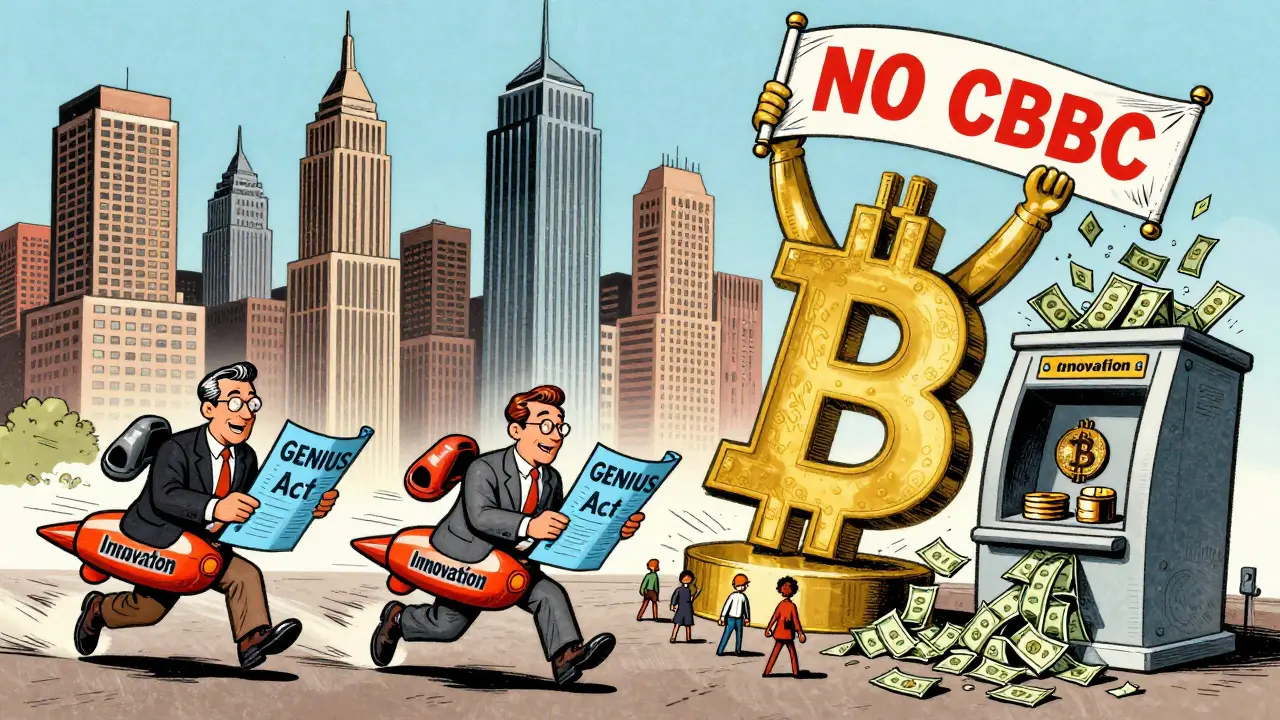
The third pillar, signed into law on July 12, 2025, was the GENIUS Act. Short for Government Empowerment for National Innovation, Unleashed Strategy, this 120-page law didn’t just regulate crypto-it built a new infrastructure. It created clear rules for stablecoins, defined crypto derivatives, set tax treatment for mining and staking, and required federal agencies to stop treating Bitcoin as a speculative asset. It also mandated that all new crypto regulations must be approved by the President’s Working Group, not just the SEC or CFTC. This wasn’t a law. It was a constitution for digital money.
What Got Rolled Back?
The Biden administration’s approach was simple: regulate by enforcement. The SEC sued Coinbase, Kraken, and Binance. The Treasury pushed for a U.S. digital dollar. Crypto firms spent millions defending themselves in court. That era ended on January 20, 2025. Executive Order 14067, which had authorized CBDC research, was revoked. The Treasury’s 2022 framework was deleted from federal databases. The SEC’s new chair, appointed in February, publicly stated that “crypto is not inherently a security.”
But the biggest change? The end of CBDCs. For years, central bank digital currencies were seen as the future. The Fed had spent $200 million on pilot programs. The Treasury had hired consultants to design a digital dollar. Now? The GENIUS Act explicitly bans any future U.S. CBDC. The White House fact sheet says it clearly: “The United States will not issue a sovereign digital currency.” That’s a massive divergence from the EU, China, and even Canada. America chose Bitcoin over a government-controlled digital dollar.

The Strategic Bitcoin Reserve: How It Works
The Strategic Bitcoin Reserve isn’t a vault in Fort Knox. It’s a digital wallet managed by the Treasury Department, secured by multiple private keys held by five different federal agencies. The reserve only grows through forfeitures. When the DEA seizes Bitcoin from a drug cartel, it goes to the reserve. When the IRS wins a tax fraud case involving crypto, those coins are transferred. No new purchases. No market interference. Just clean, legal gains.
By April 30, 2025, the Treasury had completed its inventory of all forfeited crypto across 14 agencies. They found 238,000 BTC. The reserve took 214,000. The rest went to the U.S. Digital Asset Stockpile-a separate fund for altcoins like Ethereum, Solana, and Dogecoin. Unlike Bitcoin, those can be sold. The Treasury Secretary has full discretion over when and how to liquidate them, but only if it helps stabilize markets or fund public projects. No random sales. No profit motive. Just strategic use.
By September 2025, the reserve had grown by another 12,500 BTC through new seizures. The Treasury called it “budget-neutral growth.” No taxpayer money spent. Just better enforcement.
Market Impact: Trading, Jobs, and Capital
The numbers speak louder than speeches. Between January and June 2025, U.S. crypto trading volume jumped 214%. Institutional investors poured $84 billion into U.S.-based crypto firms-tripling the previous record. CoinGecko reported that 63% of that new money came from hedge funds, pension funds, and family offices that had stayed away for years.
Job postings in crypto surged 189% year-over-year. New startups opened in Austin, Miami, and Salt Lake City. Law firms hired hundreds of crypto compliance officers. Blockchain developers saw salaries jump 40%. Even non-crypto tech companies started adding blockchain roles. Microsoft, Amazon, and JPMorgan quietly began testing Bitcoin-based payment rails.
And the market cap? The U.S. crypto market grew from $1.2 trillion in December 2024 to $2.7 trillion by June 2025. The President’s Working Group attributed nearly all of that growth to the policy shift. The same report projected the Strategic Bitcoin Reserve could be worth $50-75 billion by 2030-if Bitcoin hits $300,000-$400,000.
Who’s Happy? Who’s Not?
Industry insiders gave the changes a 4.5/5 rating. A CoinDesk survey of 500 executives found 87% rated the new rules “favorable.” Reddit threads exploded with praise. One user wrote: “The Strategic Bitcoin Reserve announcement literally sent BTC +18% in 24 hours.”
But not everyone cheered. Ethereum Foundation researcher Vlad Zamfir pointed out a flaw: the GENIUS Act focused almost entirely on Bitcoin and stablecoins. Ethereum, Solana, and other Layer 1 networks got vague, scattered rules. “It’s like building a highway for trucks and calling it a transportation system,” he said.
Former CFTC Chair Gary Gensler, now at Harvard, warned the timeline was too fast. “You can’t design a financial system in six months,” he wrote in April. “You’ll miss risks, create loopholes, and hurt investors.”
And then there’s the Congressional Budget Office. In September 2025, they released a report warning that if the Strategic Bitcoin Reserve grows beyond 500,000 BTC-about 2.4% of total supply-it could distort the market. Imagine the government holding a third of all gold. That’s the risk they’re watching.
What’s Next? The 2026 Roadmap
The administration didn’t stop in 2025. The President’s Working Group released a 12-month implementation plan in July. By January 15, 2026, the SEC must finalize rules for stablecoins. By March 30, 2026, the CFTC must issue guidance on crypto futures and options. By June 30, 2026, all federal agencies must adopt uniform reporting standards for crypto transactions.
Grant Thornton estimates these policies could generate $24-38 billion in annual tax revenue by 2027. They also predict 450,000 new jobs in crypto and blockchain by 2030. Meanwhile, Singapore and Switzerland, which led global crypto funding in 2024, are now scrambling to keep up.
Trump summed it up in a September speech: “We are just getting started. This is American brilliance at its best.” Whether you love it or hate it, the U.S. didn’t just change its crypto policy in 2025. It redefined what a government can do with digital money.
Did Trump’s 2025 crypto policy legalize Bitcoin?
Bitcoin was never illegal in the U.S. But before 2025, it was treated like a risky asset under constant regulatory threat. The 2025 policy shift didn’t legalize it-it legitimized it. The Strategic Bitcoin Reserve, the GENIUS Act, and the end of CBDC plans sent a clear signal: Bitcoin is now a recognized financial asset, not a criminal tool.
Can the U.S. government sell the Bitcoin in the Strategic Reserve?
No. The March 6, 2025 Executive Order explicitly states the Strategic Bitcoin Reserve will never be sold. It’s held as a long-term strategic asset, like gold in the U.S. Treasury’s reserves. Even in a fiscal emergency, selling Bitcoin is prohibited. This is a deliberate policy choice to signal long-term confidence in Bitcoin as a store of value.
What’s the difference between the Strategic Bitcoin Reserve and the U.S. Digital Asset Stockpile?
The Strategic Bitcoin Reserve holds only Bitcoin, and it can’t be sold. The U.S. Digital Asset Stockpile holds all other cryptocurrencies seized by federal agencies-Ethereum, Solana, Dogecoin, etc. Unlike Bitcoin, the Treasury Secretary can sell these assets if needed, but only for specific reasons like funding public programs or stabilizing markets. No profit-driven trading.
Did the GENIUS Act ban all crypto regulation?
No. It replaced the old enforcement model with a clear regulatory framework. The GENIUS Act created rules for stablecoins, crypto derivatives, taxation, and market structure. It didn’t remove regulation-it made it predictable. Companies now know exactly what’s allowed, what’s not, and who to report to.
Why did the U.S. ban CBDCs in 2025?
The administration viewed CBDCs as a threat to financial freedom and innovation. Unlike Bitcoin, a government digital dollar would give the Treasury full control over transactions, spending limits, and surveillance. The GENIUS Act explicitly prohibits any future U.S. CBDC, positioning Bitcoin as the preferred digital asset for both citizens and the government.
Is the U.S. now the best place to run a crypto business?
As of 2025, yes. With clear rules, institutional backing, no CBDC threat, and a government holding Bitcoin as a reserve asset, the U.S. has become the most attractive jurisdiction for crypto startups and investors. Over 72% of crypto firms surveyed in April 2025 said they were expanding U.S. operations. Competitors like Singapore and Switzerland are now playing catch-up.





Comments (24)
Sammy Tam
Man, I never thought I’d see the day the U.S. government held Bitcoin like it’s gold. This isn’t just policy-it’s a cultural shift. I’ve watched crypto go from basement hobby to Wall Street staple, and now the feds are basically saying, ‘Yeah, this is real.’ The reserve? Genius move. No taxpayer money, just clean seizures. Feels like the government finally got out of its own way.
And the end of CBDCs? That’s the real win. No one wants a digital leash. Bitcoin’s decentralized nature is why it survived in the first place. This isn’t about politics-it’s about freedom.
Now if only they’d fix the tax reporting nightmare. Still a mess.
Sally Valdez
Oh wow the government is finally not trying to crush us? Shocking. Next they’ll admit pizza isn’t a security. This whole thing smells like a distraction-big tech’s been lobbying for this since 2023. They just needed a clown to sign it. Trump didn’t invent crypto-he just let it breathe. And now everyone’s acting like it’s a miracle.
Meanwhile the reserve is just a PR stunt. Wait till the next crash and they start whispering about ‘strategic sales.’ They’ll sell it all and blame the market.
Jonny Cena
Hey, I’m not a crypto bro but I’ve got cousins in Austin who work for a blockchain startup now. They went from freelancing to full-time with benefits in six months. Salaries jumped, offices opened up, even the local coffee shop took BTC. This isn’t just about tech-it’s about jobs. Real ones.
And yeah, the reserve is wild. But it’s not about owning Bitcoin. It’s about believing in it. That’s huge. We’ve spent decades treating digital money like a scam. Now we’re acting like it’s part of the system. That’s the real win.
Sue Bumgarner
Let’s be real-this is just nationalism dressed up as innovation. America’s always been the last to adopt anything until it’s already global. Now they’re copying Switzerland’s playbook and calling it genius. The GENIUS Act? More like GIMMICK. And don’t get me started on the reserve-214k BTC is a joke. That’s less than 1% of supply. You think that’s a reserve? Try holding 10% and then we’ll talk.
Also, why is no one talking about how this helps Chinese miners? They’re still running 70% of the network. This isn’t American brilliance. It’s American hypocrisy.
George Cheetham
There’s something deeply poetic about a government choosing Bitcoin over a digital dollar. It’s not about money-it’s about trust. A CBDC is control. Bitcoin is permissionless. The U.S. could’ve gone the surveillance route, the authoritarian route, the centralized route. Instead, they picked the one thing that can’t be owned, manipulated, or shut down.
That’s not policy. That’s philosophy. And honestly? It’s the first time in decades the U.S. has led with vision instead of fear.
Heather Turnbow
It’s remarkable how much clarity this brought. Before, every lawyer I knew was terrified to advise clients on crypto. Now? They’re writing white papers. The GENIUS Act didn’t just reduce risk-it created certainty. That’s priceless for innovation. And the reserve? It’s a quiet signal to the world: we’re not here to stop you. We’re here to build with you.
I’m not a crypto enthusiast, but even I can see this is a turning point.
Kelsey Stephens
I work with small businesses in rural Ohio. A few of them started accepting Bitcoin last year. Not because they’re techies-because their customers asked. One guy runs a hardware store. He said, ‘If I can take crypto from a 19-year-old in Portland, why can’t the government stop treating it like contraband?’
This policy didn’t come from a boardroom. It came from people. And that’s why it works.
Cheyenne Cotter
Okay but let’s be honest-this is just a power move. The GOP needed something to look like they’re doing something. Crypto’s the new tax cut. The reserve? It’s just a fancy way of saying ‘we’re rich now.’ And don’t act like this is about freedom-when’s the last time a Republican didn’t want to control something? They just realized they can’t stop it, so now they wanna own it.
Also, why is no one talking about the fact that all this Bitcoin came from criminals? So now the government’s got a stash of stolen money and calling it a reserve? That’s not policy. That’s a crime drama.
Elvis Lam
People are missing the real story: the GENIUS Act didn’t just legalize crypto-it created a legal architecture. Stablecoins now have clear rules. Mining taxes are defined. Derivatives are regulated by the CFTC, not the SEC. That’s huge. Before, you had a patchwork of lawsuits and enforcement raids. Now? You have a rulebook.
And the reserve? It’s not about the value. It’s about signaling. The government is saying: ‘We believe in this enough to lock it away forever.’ That’s not just policy. It’s faith.
Chevy Guy
They’re lying. The reserve is a front. The real plan is to use it to manipulate the market. They’ll sit on it until BTC hits $500k, then quietly dump it and crash the market. Then they’ll say ‘see? We told you it was unstable.’
Also, who authorized this? No one voted on it. This is executive overreach wrapped in libertarian glitter. The same people who hate the Fed are now running a crypto central bank. It’s all a trap. Wake up.
Also, did you know the Treasury has a backdoor key? They do. I read it in a forum. Don’t trust this.
Rebecca Kotnik
It is worth noting, with considerable nuance, that the structural transformation of U.S. digital asset policy in early 2025 represents not merely a regulatory recalibration, but a profound epistemological shift in the relationship between state authority and emergent financial technologies. The abandonment of the CBDC paradigm, in particular, signals a tacit recognition that sovereign control over monetary infrastructure may be incompatible with the decentralized, permissionless ethos underpinning blockchain systems. The Strategic Bitcoin Reserve, while ostensibly a fiscal instrument, functions as a symbolic anchor-a monetary totem that affirms the legitimacy of non-sovereign value storage. Furthermore, the GENIUS Act’s delegation of regulatory authority to the President’s Working Group, rather than to the SEC or CFTC, constitutes a de facto institutional realignment, effectively sidelining the bureaucratic inertia that had previously stifled innovation. This is not deregulation. It is rearchitecting.
That said, the exclusion of non-Bitcoin Layer 1 ecosystems from the Act’s core provisions raises legitimate concerns regarding technological monoculture. A policy that treats Bitcoin as the sole legitimate digital asset, while relegating Ethereum and Solana to the periphery of the U.S. Digital Asset Stockpile, risks entrenching a new form of financial hierarchy-one that privileges scalability over programmability, store-of-value over utility. The long-term consequences of this bifurcation remain uncertain, but the precedent is set: the state will favor one chain above all others. That, in itself, is a form of centralization.
Amy Copeland
Oh wow, the government finally decided to pretend Bitcoin isn’t a criminal tool? Took them long enough. I’m sure the 14 agencies that spent years seizing it didn’t notice the irony.
And the ‘Strategic Reserve’? Cute. They’re basically holding the loot from the biggest heist in history and calling it ‘budget-neutral growth.’ Meanwhile, the same people who said crypto was a scam are now writing op-eds about ‘American brilliance.’
Also, why is everyone acting like this is a win? The SEC still exists. The Treasury still exists. They just stopped suing people. That’s not freedom. That’s boredom.
Dionne Wilkinson
I don’t know much about crypto, but I know what I see. My neighbor’s son got a job at a blockchain company. He’s making more than I do. He’s happy. His parents are proud. That’s the real story. This policy didn’t change the tech. It changed how people feel about it. And that matters more than any law.
Maybe we don’t need to understand it. Maybe we just need to let it work.
Kayla Murphy
It’s wild to think that just a few years ago, people were afraid to say they owned Bitcoin. Now the government’s got it. That’s the kind of shift that doesn’t happen overnight. It takes courage. Or maybe just a really good PR team.
Either way, I’m glad someone finally had the guts to say: ‘Let it breathe.’
SeTSUnA Kevin
The Strategic Bitcoin Reserve is not a reserve. It is a propaganda artifact. The GENIUS Act is not legislation. It is performative governance. The end of CBDCs is not freedom. It is the triumph of ideological dogma over economic pragmatism. The market surge is not growth. It is speculation amplified by state endorsement. This is not innovation. It is theater.
Sean Kerr
OMG I can’t believe this is real!! 🤯 The government holding BTC?! Like… for real?! This is the future!! 🚀 I’ve been holding since 2017 and now the feds are basically my co-investors?? 😭🙌 I’m crying. I’m so proud to be American. The reserve is the most beautiful thing I’ve ever seen. We’re winning. 💪🇺🇸
Also, if you’re not buying BTC now you’re literally helping the deep state. #BTC #BitcoinIsDigitalGold #Trump2028
Donna Goines
They’re not holding Bitcoin-they’re holding a time bomb. The moment the market dips, they’ll panic and sell. Then they’ll blame the ‘speculators.’ And the people who believed in this? They’ll be left holding the bag.
Also, why is no one talking about the fact that the Treasury’s wallet is probably controlled by the same people who ran the 2022 CBDC project? This is the same team. They just changed the name.
They’re not building a reserve. They’re building a trap.
Florence Maail
They say it’s not taxpayer money… but who’s paying for all those DEA raids? Who’s paying for the auditors? Who’s paying for the servers? It’s all taxpayer money, just hidden in the budget. And now they’re calling it ‘budget-neutral’? Lol.
Also, the fact that they’re holding Bitcoin but selling Ethereum? That’s not policy. That’s favoritism. Bitcoin’s got the cult. Ethereum’s got the devs. Guess who won?
And don’t even get me started on the ‘no CBDC’ thing. That’s just the first step. Wait till they roll out the private CBDCs through banks. They always come back.
It’s a trap. 🐀
Shruti Sinha
Interesting. In India, crypto is still treated as a speculative asset with 30% tax. But I see the U.S. move as a global reset. If America leads, others will follow. Singapore and Switzerland may have been first, but now they’re playing catch-up. The real question: will this encourage other nations to embrace decentralization-or will it trigger a global regulatory backlash?
Either way, this changes the game.
Jesse Messiah
Look, I don’t care if you love or hate Trump. This policy? It’s solid. Clear rules. No more lawsuits. Real infrastructure. The reserve? Brilliant. No selling. Just holding. That’s how you build trust.
And the best part? It’s not about politics. It’s about letting people build. That’s what America used to be about.
Keep going. Don’t stop here.
Greg Knapp
They think they’re so smart holding Bitcoin but they don’t know how the blockchain works. They think it’s just a number on a screen. They don’t know about mining, nodes, consensus. They’re playing with fire and don’t even know what they’re holding.
And don’t get me started on the ‘no CBDC’ thing. That’s just to make people feel good. They’ll come back with something worse. You wait. They always do.
Also, the reserve is probably already hacked. They’re just not saying it.
Terrance Alan
Of course the government is holding Bitcoin. They’re just waiting for the right moment to crash it and blame the libertarians. This is the same people who ran the war on drugs. Now they’re running the war on cash. Bitcoin is just the new marijuana.
They’ll never let it succeed. They just want to control it. And they’re using the ‘freedom’ talk to make you feel safe while they lock it down.
Wake up. This isn’t progress. It’s a trap wrapped in a flag.
Samantha West
One must consider the ontological implications of state adoption of a decentralized asset. The Strategic Bitcoin Reserve, while ostensibly a financial instrument, functions as a paradox: a centralized entity holding a decentralized asset, thereby undermining its foundational ethos. The GENIUS Act, while appearing to liberate, in fact institutionalizes a hierarchy-Bitcoin elevated, other chains relegated. This is not innovation. It is reification. The end of CBDCs is not liberation-it is the substitution of one form of control for another. The government no longer seeks to issue a digital dollar. It seeks to own the only viable alternative. And in doing so, it transforms Bitcoin from a tool of resistance into a pillar of the state. The revolution was not televised. It was audited.
Tom Joyner
One sentence: This is the most important thing to happen to money since the gold standard ended.