
The Governance Gap: Who is Actually in Charge?
One of the biggest dangers in unaudited ventures is role confusion. In a healthy project, you know who writes the code, who manages the treasury, and who makes the final calls. In risky projects, these lines blur. You might see multiple people claiming responsibility for the same feature, or worse, critical areas of the project with no clear owner at all. This isn't just a management fluke; it's a massive red flag. According to data from PM-Partners, about 63% of unaudited projects suffer from this kind of ownership chaos. Why does this matter for a blockchain project? Because if no one is officially responsible for the security of the bridge or the minting logic, mistakes go unfixed. When things go south, the team will spend more time pointing fingers at each other than fixing the leak. If the team's documentation is vague about who does what, or if the "founders" are just a group of anonymous accounts with no track record, your risk level spikes.The 'Watermelon' Report and Progress Lies
Have you ever noticed a project that always seems to be "almost finished"? They post weekly updates saying everything is green and on track, but you never actually see any new features live on the mainnet. This is what experts call a "watermelon project": green on the outside, but deep red on the inside. In a study of 200 enterprise initiatives, analyst Henrico Dolfing found that 41% of unaudited projects exhibited this behavior. The tell-tale sign is identical progress notes for three or four reporting periods in a row. If the team says "optimizing smart contracts" for two months without releasing a single line of code to GitHub, they are likely stalling or stuck. In the crypto space, this often masks a project that has hit a technical wall or a team that is simply coasting while waiting for the token price to pump so they can exit.Financial Smoke and Mirrors
Money is where the most dangerous red flags hide. In an audited environment, every cent is tracked. In unaudited projects, expenses are often "miscategorized." For example, professional services might be lumped into operational costs to hide the fact that the team is spending more on marketing hype than on actual engineering. TrueProject found that these misclassifications happen in nearly 28% of unaudited projects. Keep an eye out for these specific financial warnings:- Missing Approval Timestamps: If payments are processed without a clear trail of who approved them and when, the door is wide open for fraud. There have been cases where vendors submitted duplicate invoices for hundreds of thousands of dollars because no one was checking the timestamps.
- Vague Treasury Spending: If the project treasury is spending massive amounts on "miscellaneous" or "community growth" without a detailed breakdown, it's a sign of poor oversight.
- Billed Hours vs. Actual Output: When a project bills for thousands of developer hours but the GitHub commit history shows only a few minor tweaks, the money is leaking.

Timeline Slips and the 'Missing Milestone' Trap
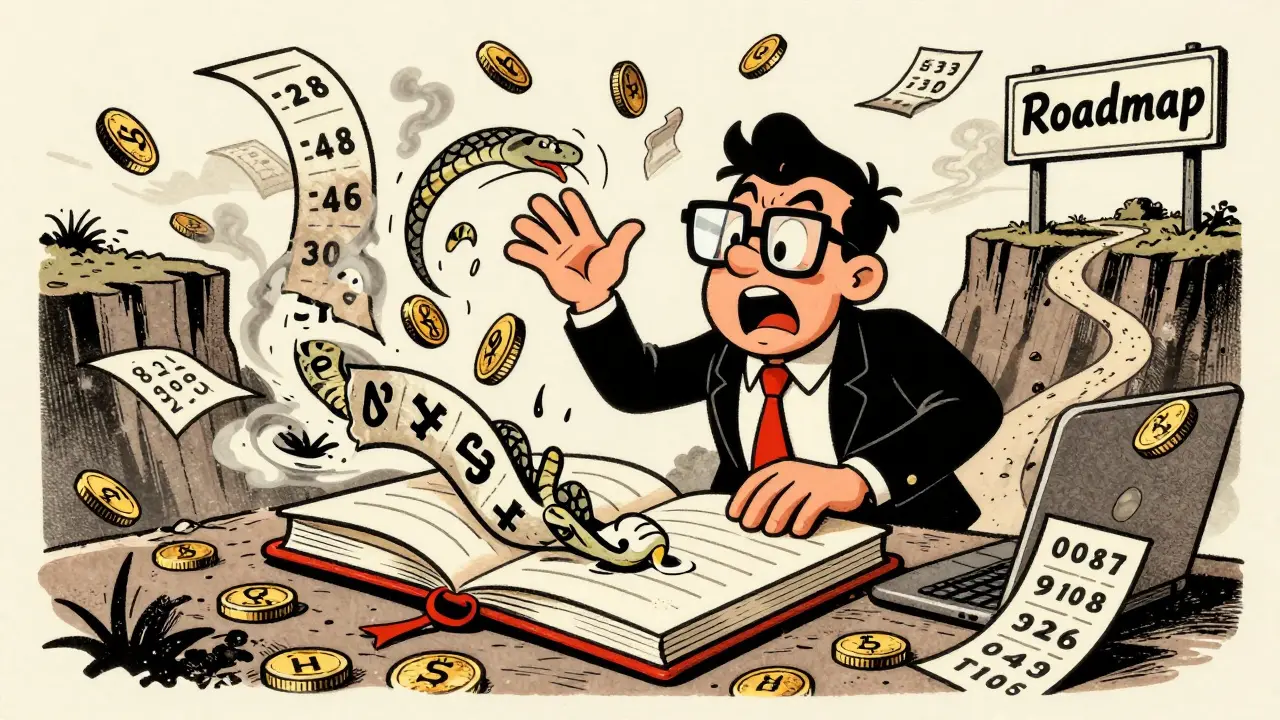
Every project has a roadmap. It's the promise they make to the community to get you to buy in. But when a project starts missing three or more consecutive milestones without a formal explanation or a revised timeline, you're looking at a project in crisis. Grant Thornton's forensic analysis showed that 34% of failed unaudited projects had this specific pattern. In blockchain, a missed milestone isn't just a delay; it's often a sign of technical incompetence. If they promised a testnet by January and it's now April with no update, the "unforeseen technical challenges" they mention are usually just a cover for the fact that the code doesn't work. Be wary of teams that move the goalposts constantly without admitting they failed the previous target.The Danger of Rubber-Stamp Approvals
In many unaudited projects, the approval process is a joke. Instead of a rigorous review where engineers challenge each other's logic, you get "rubber-stamp approvals." This means a lead dev or a founder just says "looks good to me" and pushes the code to production without any documented review. SAFEbooks.ai found this in 22% of unaudited projects. This is how catastrophic bugs enter the system. When there is no independent verification, a small 5% variance in a budget or a tiny logic error in a smart contract can grow into a 35% loss or a total drain of funds within months. If the project doesn't have a public record of peer reviews or a clear change-control process, they are gambling with your money.| Feature | Audited Project | Unaudited Project (Red Flags) |
|---|---|---|
| Code Verification | Independent 3rd party review | Internal "looks good" / No review |
| Reporting | Evidence-based milestones | "Watermelon" reports (Green outside/Red inside) |
| Governance | Clear roles and accountability | Role confusion and overlapping duties |
| Financials | Verified audit trails | Miscategorized expenses / No timestamps |
| Failure Rate | Lower (standardized) | 2.3x higher failure rate (PMI data) |
How to Protect Yourself: A Practical Checklist
If you're looking at a project that hasn't been audited yet, you can't just walk away-some of the best projects start unaaudited. Instead, implement your own "minimum viable audit trail." Spend a few hours doing the following:- Check the GitHub: Look at the commit history. Are there regular updates from multiple developers, or just one person pushing huge blocks of code once a month?
- Question the Roadmap: Ask the team specifically why the last milestone was missed. If the answer is vague, mark it as a red flag.
- Analyze the Team: Use LinkedIn or Twitter to see if the team members have worked together before or if they have a history of failed projects.
- Watch the Communication: Are the founders selectively unreachable? If they disappear for weeks at a time or only answer "moon" related questions while ignoring technical ones, be careful.
The Psychology of Red Flag Fatigue
One final warning: watch out for "red flag fatigue." This happens when you see so many warnings that you start to normalize them. You tell yourself, "Well, every crypto project is a bit messy," and you ignore the signs. Gartner notes that this affects about 19% of organizations and individual investors. Normalization is how people lose millions. The fact that other projects are also messy doesn't make the one you're investing in safe. As the Association for Project Management points out, awareness without action is actually worse than having no awareness at all. If you see the red flags, you must have a plan to exit or a threshold of how many warnings you'll tolerate before you pull your funds.Why are unaudited projects more likely to fail?
Unaudited projects lack the independent checkpoints that catch critical errors. According to PMI, they have a 2.3 times higher failure rate because small issues in code or finances compound unchecked, leading to catastrophic crashes or fraud.
What is a 'watermelon project' in the context of blockchain?
A watermelon project is one that appears healthy (green) in official reports and social media updates, but is actually failing (red) internally. Signs include identical progress updates for weeks and a lack of actual code deployment despite claims of being "almost done."
Can a project be successful without an audit?
Yes, but the risk is significantly higher. Some early-stage startups use lightweight verification instead of full audits to move faster. However, Harvard Business School research shows that even lightweight verification reduces failure rates compared to completely unaudited processes.
What is the most dangerous financial red flag?
The absence of approval timestamps and the miscategorization of expenses are critical. When there is no trail of who authorized a payment, it becomes easy for teams to embezzle funds or pay duplicate invoices without detection.
How can I tell if a team has 'role confusion'?
Look for a lack of clear ownership in their documentation. If multiple people claim to lead the same feature, or if you can't find who is responsible for the security of the smart contracts, the project likely suffers from governance issues that lead to delays and errors.





Comments (16)
Nishant Goyal
Good breakdown. Staying cautious while staying hopeful is the way to go here.
Ian Chait
Absolute joke if u think thrd party audits actually mean anything. Most of these 'reputable' firms are just paid shills for the VCs to pump and dump the retail sheep. The whole ecosystem is a rigged game of shadow governance and hidden backdoors anyway. Just look at the liquidity pools, it's all a facade for the big players to exit. Proper dYOR means ignoring the rubber stamp and following the on-chain flow of funds, not some PDF report written by a junior analyst in a suit.
Prachi Bhadarge
Oh look, another guide telling people to read the GitHub. Sure, because everyone loves spending their weekend reading 5,000 lines of poorly documented Solidity just to realize the 'lead dev' copy-pasted the entire project from a 2021 tutorial. Absolute joy.
Sandeep Bhoir
Actually, the watermelon project phenomenon is a classic symptom of poor agile implementation in decentralized teams. It's almost poetic how they manage to report 100% progress while the actual codebase is a dumpster fire. If you see 'optimizing' in a status report for a month, just assume the dev is actually on a beach in Bali with your money.
Abhinav Chaubey
You guys are missing the point. Indian devs are literally carrying the global blockchain infrastructure on their backs while the West just provides the venture capital and the hype. The technical competence is there, but the lack of audits is a systemic failure of the global standard, not the individual projects. I've seen local projects with zero audits outperform audited US-based trash because the actual engineering was superior.
Sean Mitchell
This is simply an absolute tragedy of the modern era. The sheer audacity of these developers to lure innocent investors into a black box of financial ruin is nothing short of Shakespearean. I am practically breathless at the thought of how many millions have vanished into the void of 'miscellaneous expenses'. Truly, we are living in an age of digital anarchy where a single missing timestamp can erase a family's entire life savings.
siddharth narula
It is a matter of profound moral failure that we allow such anarchy to persist in our financial systems. One must contemplate the spiritual emptiness of a developer who knowingly leaves a backdoor in their code for personal gain. We have traded the sanctity of trust for the cold, indifferent logic of a smart contract, and yet we still succumb to the oldest sin: greed. 😔
Gaurav Undirwade
The lack of professional ethics displayed by these unaudited ventures is utterly reprehensible. It is my firm belief that any individual who invests in a project without a certified audit possesses a fundamental lack of discipline. You cannot claim to be a victim when you have ignored the most basic tenets of financial due diligence. It is a failure of character to prioritize 'moon' potential over verifiable security.
Kaitlyn Wu
Let's be clear: the responsibility for security lies with the founders, but the responsibility for risk management lies with the investor. We need to stop normalizing 'messy' launches as a badge of honor in the startup world. Asserting that a project is 'too early' for an audit is just a convenient excuse for incompetence or malice.
Trudy Morse
Truth is, audits are just a snapshot in time. A project can be audited on Monday and a dev can push a malicious update on Tuesday. Everything is relative in this space. Just keep a cool head and don't bet the house.
Karen Mogollon Gutierrez
I find it absolutely abhorrent that we are expected to navigate these treacherous waters without more stringent regulation. The sheer level of negligence described in the 'rubber-stamp approval' section is an affront to professional engineering standards. It is a travesty that a 5% budget variance can spiral into a total financial collapse simply because a founder felt the need to bypass a peer review. The audacity of these teams to call themselves 'innovators' while practicing such primitive risk management is genuinely insulting to anyone with a shred of professional integrity.
Keri Pommerenk
totally agree with the checklist part just keeping it simple helps the most avoid the stress
nikki krinkin
It's a lot to process, but the part about red flag fatigue really resonates. It's easy to just stop caring when everything feels like a scam.
Kim Smith
i feel like the whole concept of an audit is just another layer of the simulacrum we've created to feel safe in an inherently unsafe digital wilderness... like we're just puting a band-aid on a volcano and calling it a safety measure lol. i once spent three hours reading a whitepaper for a project that claimed to revolutionize cross-chain bridging but it turn out they just had a google sheet and a dream, which kinda proves that the human element is always the weakest link regardless of whether some firm in london says the code is 'safe' or not, it's all just a game of musical chairs with our money and the music never actually stops it just gets louder until the crash happens.
Kevin Lư
Haha, the 'watermelon project' is such a mood. I've been in so many groups where the admin is just like 'trust the process' while the token is bleeding 90%. It's kind of funny how we all just play along until the rug is actually pulled. Just stay friendly and keep your exit strategy ready, man.
nathan jones
Keeping it simple is best. Check the GitHub, check the team, and get out if it smells weird.