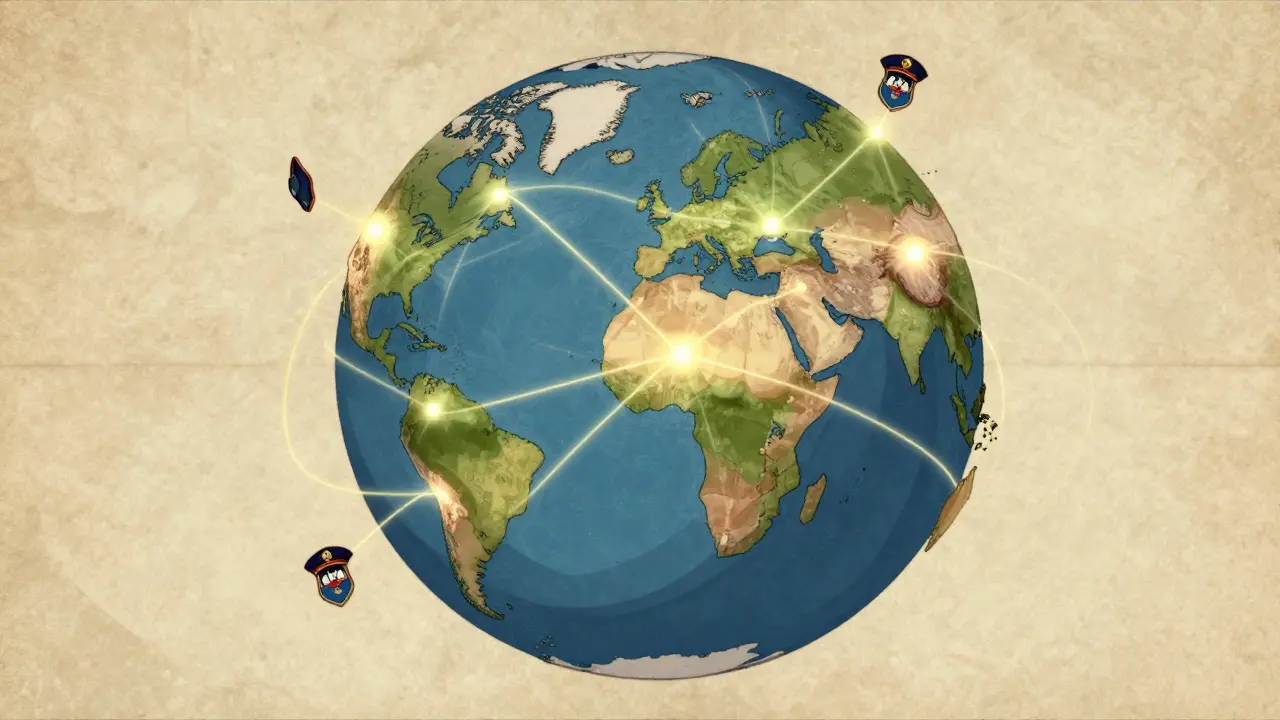
In August 2025, authorities recovered over $439 million stolen through digital financial scams. That single operation, known as Operation HAECHI VI, proves that catching crypto criminals is no longer just a local police matter. By March 2026, the landscape has shifted dramatically. Criminals move fast across borders, but so do law enforcement agencies. They are using shared intelligence and specialized tools to freeze assets before they vanish into thin air. If you think lost cryptocurrency is gone forever, look again.
Cybercrime ignores national boundaries. A scam started in one country often sends money to an exchange in another while the operators sit in a third. This complexity broke traditional policing models. To fix this, major powers turned to INTERPOL
a global network connecting 195 member countries to coordinate cross-border criminal investigations. Established in 2014, their Global Financial Crime Programme acts as the central hub. It connects national police forces directly to financial intelligence units worldwide. This connectivity allows for real-time action rather than waiting weeks for formal treaties.
The Mechanics of Global Coordination
Success relies on speed. In the past, freezing funds took months of paperwork. Today, mechanisms like the Global Rapid Intervention of Payments (I-GRIP) change the timeline. Launched in 2022, I-GRIP enables stop-payment requests between different nations instantly. When a victim in South Korea gets scammed out of KRW 6.6 billion, investigators can contact Emirati authorities immediately to halt transfers to illegitimate bank accounts in Dubai. Without this bridge, those funds would likely disappear into private wallets forever.
Technology drives these successes. Law enforcement cannot trace transactions manually anymore. They rely on blockchain analytics
software platforms used to trace illicit cryptocurrency transactions and identify threat actors. Firms like Chainalysis and TRM Labs provide the eyes on the chain. Their 2025 reports show illicit entities hold nearly $15 billion in assets. While large amounts seem unmovable, these tools allow police to see the movement patterns. They identify where money pools before exiting the ecosystem. This visibility forces criminals to launder money further downstream, complicating their ability to cash out.
Major Operations Changing the Game
The most significant example occurred recently. Operation Serengeti 2025 targeted mining centers and investment scams. Authorities dismantled 25 cryptocurrency mining centers in Angola alone. But the impact went beyond Africa. During the same period, cybercriminals were arrested in Côte d'Ivoire for activities originating in Germany. This demonstrates the power of synchronized arrests. Officers did not work in silos. One takedown triggered actions in five other continents simultaneously. This coordination prevented suspects from fleeing to safe havens when they learned an investigation was underway.
Victims play a crucial role in reporting, yet many feel hopeless after losing funds. The success rates vary by region and method. In Operation HAECHI VI, partners recovered funds sent through legitimate banking channels mixed with crypto flows. The recovery rate was significantly higher than standalone national efforts. For context, the Korean National Police Agency worked closely with regional partners to trace forged shipping documents. They followed the money trail until it hit a frozen account. These cases serve as proof that unified action works better than isolated attempts.
| Operation Name | Timeframe | Funds Recovered | Participating Nations |
|---|---|---|---|
| Operation HAECHI VI | April - Aug 2025 | $439 Million | 40+ |
| Operation Serengeti 2025 | August 2025 | $300 Million (Zambia Scam) | Africa + Europe + Asia |
| Korea-UAE Recovery | 2025 | $3.91 Million | 2 |
Tools Behind the Tracking
Detectives now treat crypto like traditional finance. You need forensic software. TRM Labs
a company providing blockchain intelligence tools for law enforcement and regulated industries. provides reports showing how sanctioned entities and ransomware groups shift tactics. They found that threats have evolved to use more cashout addresses for shorter durations. This makes manual tracking impossible. Automated systems flag suspicious behavior. For example, if a wallet receives funds from a known darknet market and immediately moves them through a decentralized exchange, the system alerts investigators.
Training is essential for adoption. INTERPOL reported that officers participating in Operation Serengeti underwent 120 hours of specialized training. They learned to read blockchain ledgers, understand smart contracts, and navigate legal frameworks for asset forfeiture. Before 2022, many units lacked even basic crypto knowledge. Now, 87% of member countries report dedicated cryptocurrency investigation units. This represents a massive cultural shift within law enforcement agencies globally.

The Ongoing Technical Battle
Criminals adapt quickly. As enforcement tightens, they use more sophisticated methods. Elliptic's 2025 research highlights a major hurdle: cross-chain crime. More than $21.8 billion in illicit crypto has been laundered using bridges and decentralized exchanges without Know Your Customer checks. These gaps exist because blockchain protocols operate differently. Tracing funds from Bitcoin to Ethereum to privacy coins involves switching tools constantly. Analysts note that automatic cross-chain tracing reduces investigation time from hours to minutes. This efficiency gap is closing, but criminals still exploit the fragmentation of the ecosystem.
Jurisdiction remains a sticky point. Law enforcement agencies are constrained by national laws. Cybercriminals target victims across borders specifically to confuse legal authority. If a scammer lives in Country A, hacks someone in Country B, and holds funds on a server in Country C, who investigates? International cooperation solves this via trusted hubs. INTERPOL acts as the facilitator, sharing assessments between police, the private sector, and non-governmental groups. This removes the diplomatic hurdles that usually stall investigations.
Regional Approaches and Differences
Not every nation plays the same game. The United States Department of Justice focuses heavily on criminal prosecutions. They filed charges in October 2024 against individuals using bots to manipulate meme coin volumes. Meanwhile, the Securities and Exchange Commission pursues civil suits. The European Union, through Europol, emphasizes the link between money laundering and crimes like online recruitment of minors. African nations have increased participation significantly through AFRIPOL. They joined Operation Serengeti to combat local fraud rings that siphon money to the rest of the world. Each region prioritizes different aspects of the problem, but the data sharing binds them together.
Recovery statistics tell part of the story. Chainalysis notes that direct transfers from illicit entities to exchanges have collapsed from 40% in 2021 to around 15% in Q2 2025. Criminals now hide funds in personal wallets for longer periods or use mixers. This doesn't mean money is safe. It just means it stays hidden longer. The pressure keeps growing. With regulators demanding stricter compliance from crypto exchanges, more illicit funds get tagged when users try to convert to fiat currency. The exit points are shrinking.

Challenges Facing the System
The biggest barrier remains the speed of asset recovery. While millions are seized, getting them back to victims takes time. There were instances where funds moved to banks in Dubai were recovered, but others slip through. Criminals utilize complex networks of intermediaries. Sometimes, the cost of litigation outweighs the amount recovered. Despite this, the trend is positive. The number of arrests rose to 3,000 in Operation HAECHI VI alone. The net effect is a hostile environment for large-scale organized crime.
Privacy coins present a specific challenge. Monero and Zcash offer strong encryption that hides transaction details. However, investigators have developed heuristics to track usage patterns even on these chains. They monitor exchange deposits and withdrawals. If a user cashes out on a regulated platform, the anonymity breaks down. Agencies prioritize targeting these on-ramps and off-ramps. Private developers argue this hampers innovation, but regulators view it as necessary protection for the broader economy.
Looking Ahead to Late 2026
As we move further into 2026, cooperation will deepen. The World Economic Forum predicts that shared expertise will lead to larger scale operations. We expect more joint task forces focusing on DeFi protocols. Decentralized Finance offers new hiding spots for laundered money. New regulations will likely require protocol builders to cooperate more with intelligence gathering. The question shifts from "can we find the money" to "can we recover it faster." Technology will automate much of the tracing work. Human investigators will focus on prosecution and strategy.
Victims must act fast. Time is the enemy in crypto theft. Reporting to a local authority triggers a chain reaction if the international framework catches wind of it. Delay increases the chance of funds being layered beyond reach. Understanding that global help exists empowers people to come forward sooner. The narrative is shifting from inevitable loss to potential recovery. This psychological shift matters as much as the technical improvements.
Can I get my stolen crypto back?
It depends on the timing. Recent operations like HAECHI VI have recovered hundreds of millions, but you must report immediately. International cooperation speeds up asset freezing, but once funds enter private wallets or pass through multiple layers, retrieval becomes harder.
What is INTERPOL doing about crypto crime?
INTERPOL coordinates global operations involving up to 40 countries at once. They share intelligence through the Global Financial Crime Programme. They also train officers in blockchain analysis to standardize skills across different national borders.
Does cryptocurrency remain anonymous?
It is pseudo-anonymous. Blockchain analytics companies can trace flows to public addresses. When funds eventually move to an exchange requiring ID, the link to a real person becomes clear to investigators.
What is the biggest challenge for enforcement?
Jurisdictional conflicts are the main issue. Crimes happen across borders, but laws are local. International bodies like INTERPOL help bridge this gap by acting as a hub for information sharing between agencies.
How do cross-chain transfers affect tracing?
Moving assets between different blockchains obscures the trail. Billions of dollars are laundered this way using decentralized bridges. Investigators need advanced tools to track these jumps automatically instead of manually checking each ledger.




Comments (21)
Tiffany Selchow
Global cooperation sounds nice until my tax money funds their tech upgrades.
Justin Garcia
Stop crying about taxes and think about actual crime prevention instead of your wallet
Ashley Stump
INTERPOL is basically just another layer of control disguised as safety measures for the masses
Beverly Menezes
Maybe it helps stop real theft instead of conspiracy theories though
Callis MacEwan
The implementation of I-GRIP mechanisms suggests a shift towards automated compliance standards across jurisdictions
We are seeing regulatory harmonization that benefits cross-border enforcement efficiency significantly
Sean Carr
Exactly and those protocols are finally catching up to the speed of the chain
Addy Stearns
It is interesting how the narrative shifts from individual responsibility to global governance structures
We often forget that the underlying technology remains neutral throughout these proceedings
Human intent dictates the utility of blockchain ledgers in any jurisdiction
The concept of sovereignty gets diluted when digital assets move instantly
Traditional borders no longer hold the same weight as they did ten years ago
Enforcement agencies realize they must collaborate or risk obsolescence entirely
Yet the question remains regarding the balance of privacy rights versus security
We see increased surveillance capabilities emerging under the guise of financial protection
Every tool designed to catch criminals is eventually repurposed to monitor citizens
History provides us with ample examples of such technological dual-use scenarios unfolding
We should welcome transparency but remain vigilant against overreach in execution
The speed of asset freezing is impressive but raises concerns about due process delays
Innocent parties sometimes suffer collateral damage during these broad sweeps of accounts
It takes significant resources to reverse mistakes once funds have been frozen preemptively
Ideally we need independent oversight committees to audit these global operations regularly
Until then trust remains fragile between governments and the public sector alike
Matt Bridger
Operational efficacy relies on strict adherence to established protocol guidelines Implementation details remain opaque to lay observers Strategic alignment across nations proves essential
Lisa Miller
It is really amazing to see how much progress has been made this year so far
Joy Crawford
feel like people forget victims are still waiting
Disha Patil
I guess its hard to care when you never lost anything yourself
Jay Starr
Some people just want to watch the world burn
joshua kutcher
We all go through tough times but support makes a big difference here
Shubham Maurya
🚨🚨 criminals are everywhere and gov fails us 🤡
Jamie Riddell
Lets try to focus on the solutions presented rather than fear mongering
Elizabeth Akers
i read this and thought it was actually good news for once
Alex Lo
teh tools rly help but ther eare still glitches n the system
athalia georgina
yeah i thnk u might rite bout som things being missed
Alex Kuzmenko
its cool dat they got more power now to track stuff
Liam Robertson
Agree completely with the need for better training for officers globally
Katrina Tate
Training programs cost millions while victims get pennies back annually