Airdrop Value Calculator
Calculate the potential value of tokens you received from an airdrop. Note: Most airdrops lose value over time, as seen with the SPIN airdrop example.
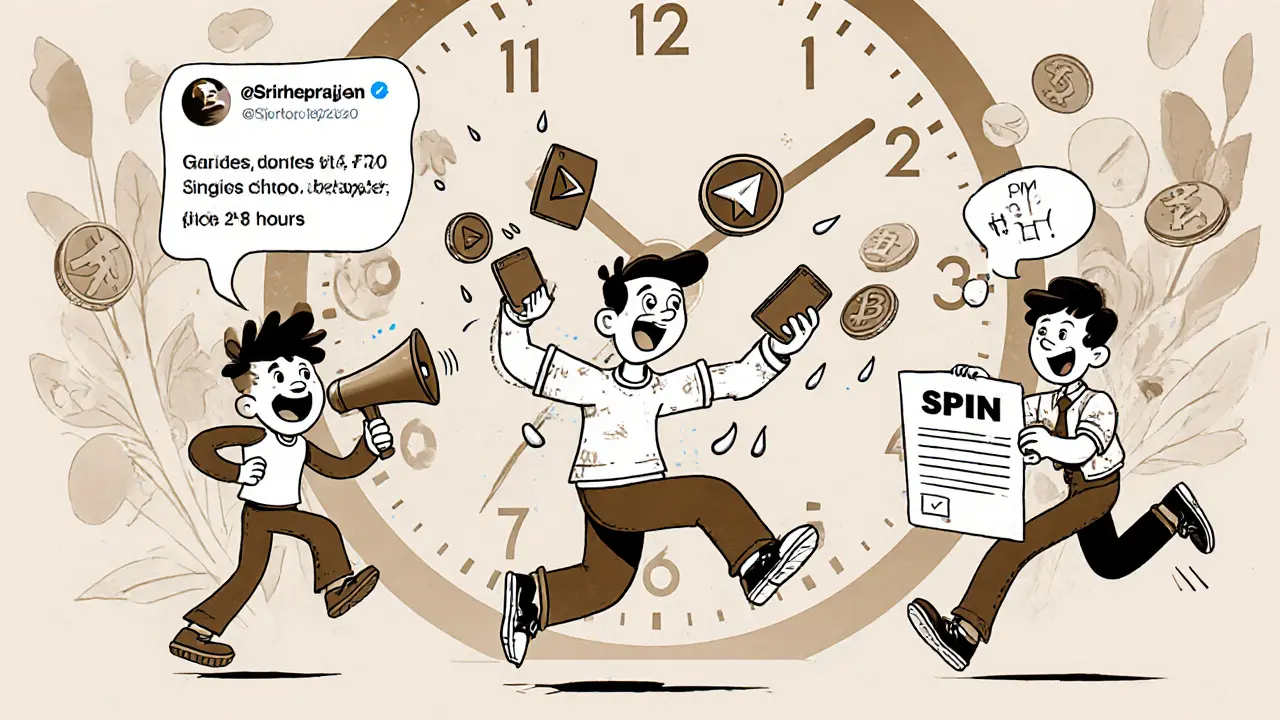
Back in late 2021, if you were active in crypto Twitter or Telegram, you probably saw ads for the SPIN airdrop. It promised free tokens just for following a few social media accounts and filling out a form. For many, it felt like easy money. But here’s the truth: most people who joined never saw the value they expected. And by 2025, Spintop Network barely registered on the radar.
How the SPIN Airdrop Actually Worked
The Spintop Network airdrop wasn’t some random giveaway. It was a carefully planned launch tactic for their blockchain gaming hub. The goal? Build a community fast. They distributed 2.5 million SPIN tokens to the first 5,000 people who completed the tasks. That’s exactly 500 SPIN tokens per person. To qualify, you had to do three things:- Join the official Spintop Telegram group and channel
- Follow Spintop on Twitter and retweet their airdrop post (you needed at least 10 followers)
- Complete a human verification quiz on their airdrop form
What the Tokens Were Worth (And What They’re Worth Now)
At the time of distribution, each SPIN token was valued at around $0.01. That meant 500 tokens = $5. Not life-changing money, but decent for a few minutes of work. Compared to other airdrops in late 2021 - like those from Axie Infinity or The Sandbox - this was average. Not the biggest payout, but not the worst either. The tokens were distributed on Binance Smart Chain (BSC). That meant low gas fees to claim and transfer. Smart move. Ethereum airdrops often cost more in gas than the tokens themselves. Spintop avoided that trap. But here’s the kicker: the token’s value never grew. After the initial hype died down, SPIN traded sideways. By early 2022, the market cap hovered around $97,000. That’s tiny. For context, even small DeFi projects were hitting $10 million by then. Spintop never broke out of the basement tier. By 2025, SPIN is essentially worthless. Trading volume is near zero. Most exchanges delisted it. The official website still exists, but the community channels are quiet. The tokens you earned? They’re just digital dust now.The Hidden Airdrops: CoinMarketCap and Guild Rewards
Spintop didn’t stop at one airdrop. They ran two more. First, they partnered with CoinMarketCap. That campaign gave out 900,000 SPIN tokens to 5,000 winners - but this time, the amounts varied. Winners got between 50 and 180 SPIN tokens. No one knew in advance how much they’d get. It felt like a lottery. Many people who didn’t qualify for the first airdrop tried this one. Most still didn’t win. Then came the guild system. Spintop encouraged players to form teams - guilds - to play their games and earn rewards. The top three guilds got a slice of the airdrop pie:- 1st place: 2.5% of total airdrop pool
- 2nd place: 1.5%
- 3rd place: 1%
Why the SPIN Airdrop Failed to Last
Spintop had a solid idea: become a hub for play-to-earn games. Think of it like Steam, but for blockchain games. You’d browse, review, join guilds, stake tokens, and farm rewards. Sounds great on paper. But execution? Flawed. They spent all their energy on marketing - airdrops, social media, partnerships - and almost nothing on building the actual product. No playable game. No working staking. No NFT marketplace. Just a website and a token. The GameFi boom of 2021 was a frenzy. Everyone was launching a token. Investors chased the next big thing. But by 2022, the market crashed. Projects without real utility died fast. Spintop had no utility. Just tokens. Also, the Twitter follower requirement - 10 minimum - blocked a lot of new users. Crypto newcomers often had zero followers. They couldn’t even enter. That’s not inclusive. It’s gatekeeping. And the human verification quiz? It was basic. But it added friction. People gave up. Many who did complete it later said it felt like a scam. Why should you prove you’re human for a free token? That’s not trust-building. It’s suspicion.What Happened to the Team?
Spintop’s team disappeared quietly. No major updates after 2022. No roadmap revisions. No new hires. No press releases. The last official blog post was in January 2022. The team’s LinkedIn profiles went cold. One founder posted a vague update in 2023: “Focusing on new opportunities.” That was it. No one officially shut down the project. It just faded. No bankruptcy filing. No announcement. Just silence. That’s common in crypto. Projects launch with big promises. They raise money. They do an airdrop. They vanish. Spintop followed the script perfectly.
What You Can Learn from the SPIN Airdrop
If you’re thinking about joining an airdrop today - and there are dozens every week - here’s what the SPIN case teaches you:- Don’t chase free tokens for the sake of free tokens. If the project doesn’t have a working product, the token won’t mean anything.
- Check the team. Are their LinkedIn profiles active? Do they have past experience in gaming or blockchain?
- Look for real utility. Is there a game? A staking system? A marketplace? Or just a whitepaper and a Twitter account?
- Be wary of social media requirements. If they demand you follow 5 platforms and retweet 3 times, they’re prioritizing marketing over product.
- Assume the token will go to zero. Most airdrops do. Treat any tokens you earn as a bonus - not an investment.
Is There Any Way to Claim SPIN Tokens Today?
No. The airdrop window closed in November 2021. The CoinMarketCap campaign ended in early 2022. The guild rewards were distributed and locked - and since the game never launched, those tokens are unusable. You can still check your wallet for any SPIN tokens you might have claimed back then. But if you didn’t claim them, you’re out of luck. The smart contract no longer accepts new claims. There are no active airdrops for Spintop in 2025. The project is dead.What’s the Legacy of SPIN?
Spintop’s legacy is a case study in how not to build a blockchain project. It had potential. It had funding. It had community. But it lacked execution. It’s a reminder that airdrops aren’t rewards. They’re marketing tools. And if the product behind them doesn’t deliver, the tokens become worthless. Today, airdrops are smarter. Projects use gamified tasks, staking requirements, and on-chain activity to qualify users. They don’t just ask you to follow Twitter. They ask you to use the product. Spintop didn’t evolve. It got left behind.Did anyone make money from the SPIN airdrop?
Very few. The 500 SPIN tokens given out were worth about $5 at the time. Some early buyers traded them for a small profit when the price briefly rose after the Token Generation Event. But by 2022, the price dropped below $0.001. Today, SPIN has no trading volume. No one is buying or selling it. So while you technically "got" tokens, you didn’t make money.
Was the SPIN airdrop a scam?
No, it wasn’t a scam. The tokens were distributed as promised. The smart contract worked. The team didn’t steal funds. But it was a classic case of a project with no real product. They raised money, ran a marketing campaign, and vanished. That’s not fraud - it’s failure.
Can I still join a Spintop airdrop in 2025?
No. All airdrop campaigns ended by early 2022. The official website and social channels are inactive. There are no new airdrops, no new token distributions, and no plans to restart. Any site claiming to offer SPIN tokens today is a phishing scam.
Why did Spintop choose Binance Smart Chain?
Binance Smart Chain had lower transaction fees and faster confirmations than Ethereum - ideal for a gaming project expecting lots of small transactions. It also had a large user base already familiar with DeFi and NFTs. Spintop wanted to reach gamers, not just crypto traders, so BSC made sense.
What was the total supply of SPIN tokens?
The total supply was 13.5 million SPIN tokens. The airdrop distributed 2.5 million (18.5%), the CoinMarketCap campaign gave out 900,000 (6.7%), and the rest went to private sales, team allocations, and ecosystem development. Only a small portion was ever made publicly available.
Comments (21)
ty ty
500 tokens for following Twitter? Bro, I did that for a free NFT that turned out to be a JPEG of a monkey. At least this one didn’t charge me gas fees to claim nothing.
Ashley Mona
I still have my SPIN tokens in a wallet I forgot about. Found them last week while cleaning up my MetaMask. Funny thing? I didn’t even remember signing up. But hey, free digital confetti!
tom west
Let’s be real: this was a textbook example of vaporware dressed up as a Web3 project. They didn’t build a game. They built a marketing funnel. The team knew the token would crash. They cashed out early. The airdrop wasn’t for users-it was for the insiders to inflate hype before dumping. The only people who lost money were the ones who believed the hype.
Kylie Stavinoha
I remember seeing the SPIN airdrop pop up while I was researching Play-to-Earn models in Thailand. Back then, it felt like the future-until I realized none of the games existed. It’s a cultural artifact now: a snapshot of 2021’s delusion that crypto = community = value. The real tragedy isn’t the lost tokens-it’s how many new users got burned and walked away from Web3 forever.
Arthur Coddington
It’s not that Spintop failed. It’s that we failed them. We showed up for free tokens, not for a vision. We didn’t ask for roadmaps. We didn’t demand demos. We just wanted to click, claim, and cash out. So when the tokens didn’t moon? We blamed the team. But we were the ones who treated it like a lottery ticket, not a startup.
Johanna Lesmayoux lamare
I did the airdrop because I thought it might help a small team. Turns out, the team vanished. Still, I’m glad I tried. It taught me to look deeper than the tweet.
Phil Bradley
I joined the top guild. We had 47 members, a Discord bot, weekly meetings, even a meme contest. We were so proud. Then the game never dropped. We kept chatting for months, just because we liked each other. That’s the real legacy of SPIN-friendships formed over nothing. And that’s kinda beautiful.
dhirendra pratap singh
LMAO the ‘human verification quiz’? I had to pick which face was real out of 5 AI-generated ones. I swear, if I had to do that again, I’d just give them my social security number. At least then I’d get paid. This was a scam disguised as a test. And now? The devs are probably sipping margaritas in Bali with our data.
Suhail Kashmiri
If you’re still chasing airdrops without checking the team’s LinkedIn, you’re not a crypto user-you’re a tourist. And tourists get robbed. SPIN was just the first stop on the way to the airport.
Michelle Elizabeth
I thought SPIN was going to be the next Axie. I even bought a second phone just to run the demo they promised. When it never came, I cried. Not because I lost money-I lost hope. That’s what these projects steal: your belief in something better.
Edward Phuakwatana
The real innovation here was the BSC deployment. Most airdrops were stuck on Ethereum’s gas hell, but Spintop understood user friction. That’s why it scaled so fast. The failure wasn’t technical-it was existential. They created a token without a use case. And in DeFi, that’s like building a car with no engine. You can polish the paint all you want, but it won’t move.
Atheeth Akash
I didn’t get any tokens. But I still follow their Twitter. Just in case. You never know. Maybe one day they’ll come back. I believe in second chances.
Joy Whitenburg
i did the airdrop and forgot about it… then saw it on a coin tracker last month and was like… wait did i do that?? lol. still have the tokens. might as well keep em as a meme. kinda like a crypto fossil.
Raymond Day
Let’s not sugarcoat this: SPIN was a Ponzi dressed as a community. They knew the token would crash. They didn’t care. The ‘guild system’? A psychological trap. People spent months grinding for nothing because they were told they were ‘building the future.’ The real crime? They exploited the hope of people who thought crypto was about empowerment-not extraction.
Stephanie Platis
The fact that the website is still live-with no disclaimer-is unethical. It’s digital ghosting. They didn’t shut it down. They just abandoned it. That’s not failure. That’s negligence. And the CoinMarketCap partnership? A blatant manipulation of trust. They used a reputable platform to lend legitimacy to a hollow project.
Diana Dodu
If you're American and you still believe in these airdrops, you're part of the problem. We’re the ones who keep giving these offshore teams our attention, our data, our time. We don’t demand accountability. We just want free stuff. And that’s why crypto keeps failing here.
James Ragin
You think this was just a failed project? Think again. The real airdrop wasn’t for users-it was for the team to launder their private sale tokens. The 2.5 million distributed? That was the bait. The real 11 million? Locked for 5 years, then dumped on retail after the hype died. The ‘community’ was a front. The ‘game’ was a distraction. The whole thing was a coordinated exit scam disguised as Web3.
Noriko Yashiro
I joined the airdrop because I was new to crypto and thought this was how innovation worked. I was wrong. But I’m not mad. I learned more from this failure than from any 10 successful projects. That’s the real value of SPIN: it taught me to ask harder questions.
BRYAN CHAGUA
I appreciate the transparency in this breakdown. Too many people just scream 'scam!' without understanding the mechanics. Spintop didn’t steal-it just didn’t deliver. And in crypto, that’s often worse. At least a scam gives you closure. This? This is just a quiet funeral.
Debraj Dutta
In India, we call this 'jugaad'-a clever workaround that looks like a solution. SPIN was jugaad in Web3 form. It worked for a few months. Then the wheels fell off. But hey, at least they got people talking. Maybe next time, they’ll build something that lasts.
Kristin LeGard
This is why America needs to stop letting foreign dev teams run Web3 projects. They don’t care about us. They take our data, our attention, our hope-and then vanish. This isn’t innovation. It’s exploitation dressed in blockchain buzzwords.