Bitcoin Mining Distribution Explorer
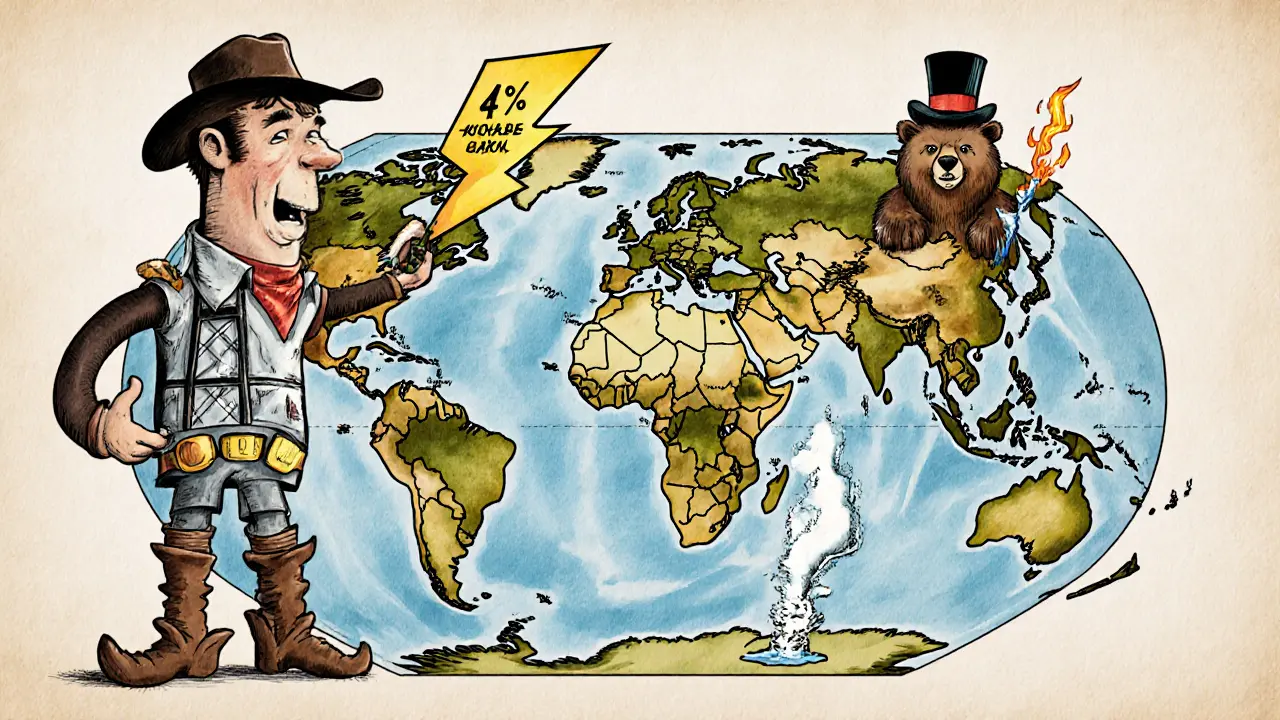
Explore where the world's Bitcoin mining power is located. As of 2025, the global hash rate is approximately 1,020.71 EH/s, with the U.S. controlling 44% of the network's computing power.
Click on any country slice to see detailed information about their mining operations.
Mining Country Distribution
Texas controls nearly half of US mining due to deregulated energy markets, abundant renewable power, and miner-friendly policies. The U.S. leads the global hash rate distribution with 44% of the network's computing power.
When you think of Bitcoin, you might picture digital coins being sent between wallets. But behind every transaction, there’s a massive, invisible machine working nonstop - a global network of computers solving complex math problems to keep the blockchain secure. That’s the Bitcoin hash rate. And where that computing power is physically located matters more than you think.
What Is the Bitcoin Hash Rate?
The Bitcoin hash rate measures how much computational power the entire network is using to mine new blocks and verify transactions. Think of it like the engine of Bitcoin - the higher the hash rate, the harder it is for anyone to attack or manipulate the network. As of October 2025, the global hash rate sits at around 1,020.71 exahashes per second (EH/s). That’s over a quintillion calculations every second.
This number isn’t static. It jumps up and down based on electricity prices, new mining hardware, and how hard the network makes the puzzles. In September 2025, it hit a record high of 1,441.84 EH/s. That’s more than double what it was just five years ago. The reason? Better machines. New ASIC miners in 2025 are 35% more efficient than last year’s models, meaning they can do more work using less electricity.
Why Geography Matters
Bitcoin mining isn’t run from a single server farm in Silicon Valley. It’s scattered across the planet, wherever electricity is cheap, reliable, and legal. The location of mining operations affects everything: network security, environmental impact, and even political risk.
Back in 2021, China controlled over 60% of the global hash rate. Then the government shut it all down. Overnight, miners packed up their rigs and moved - to Texas, Kazakhstan, Russia, Canada. That event reshaped Bitcoin’s entire geography. Today, the map looks completely different.
The Top Mining Countries in 2025
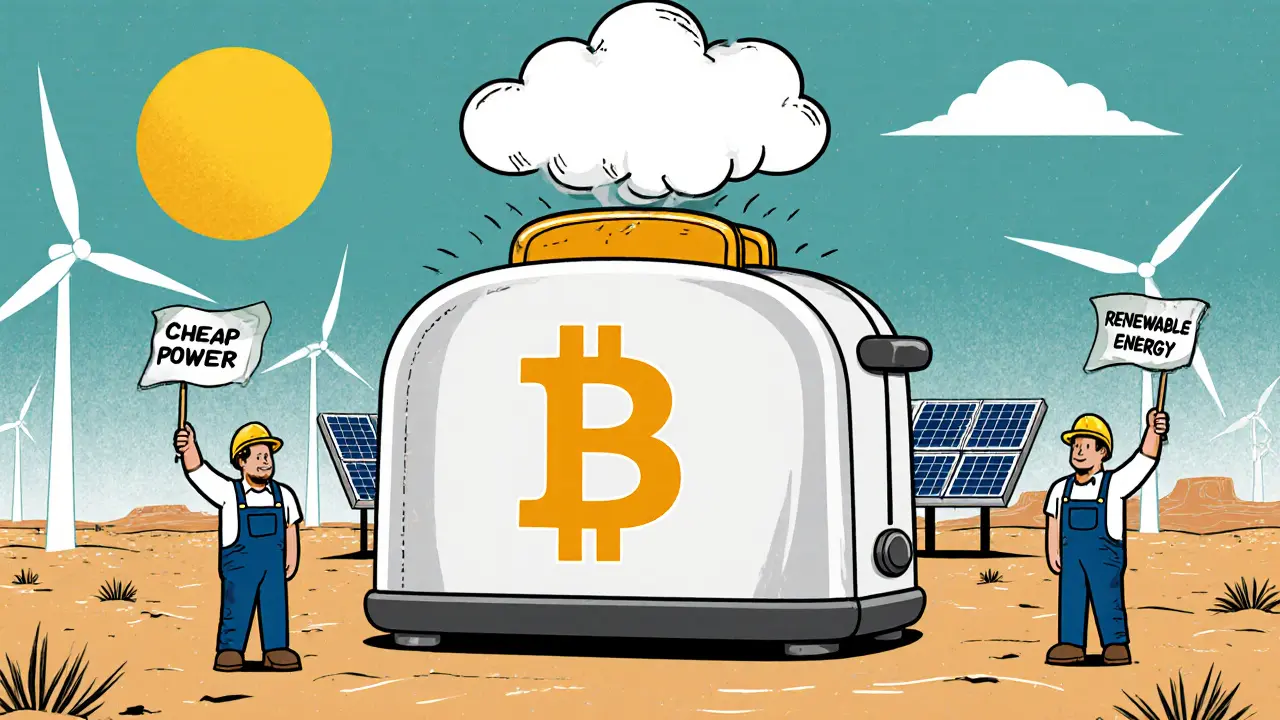
Right now, the U.S. is the undisputed leader. It controls about 44% of the global Bitcoin hash rate. Texas alone accounts for nearly half of that, thanks to deregulated energy markets and surplus wind and solar power. When the grid has extra electricity, miners turn on their machines. When prices spike, they shut down. It’s a flexible, market-driven system that’s hard to beat.
Kazakhstan comes in second at 12%. It’s not glamorous, but it’s practical. The country has cheap coal and natural gas, plus tax breaks for mining companies. But recent regulatory changes have made some operators nervous. If the government decides to raise taxes or ban mining, the hash rate could drop fast.
Russia holds 10.5%. Its mining boom isn’t about clean energy - it’s about waste. In remote oil fields, companies flare off excess natural gas - burning it into the air as useless byproduct. Now, some miners are setting up rigs right next to those flares, turning pollution into profit. It’s dirty, but efficient. And with cold winters, cooling costs are low.
Canada is steady at 9%. Alberta and Quebec lead the pack, both using mostly hydroelectric power. That makes Canadian mining one of the greener options globally. Investors who care about ESG (Environmental, Social, Governance) standards are pouring money into Canadian operations.
The Nordic countries are quietly dominating sustainability. Iceland runs over 92% of its mining on geothermal energy - heat from the earth. Norway uses 96% hydropower. These countries don’t have the biggest hash rates, but they’re the most sustainable. And that’s becoming a big selling point.
Iran, despite sanctions and power shortages, still contributes 4.2%. Miners there use subsidized electricity, but blackouts are common. Many rigs shut down during peak demand hours. It’s risky, but the low cost keeps some operators going.
How Do We Know Where Miners Are?
You might wonder: how do we track this? The answer isn’t perfect. Researchers use data from mining pools - groups of miners who combine their power to earn rewards more consistently. Pools like BTC.com, Poolin, and Foundry report where their miners connect from, usually by IP address.
But here’s the problem: miners use VPNs. A miner in Germany might connect through a server in Ireland to hide their location. That makes countries like Ireland and Germany look bigger on the map than they really are. The Cambridge Centre for Alternative Finance tries to clean up this data with partnerships and manual checks, but there’s always a lag. Their latest maps are often three months behind.
So the numbers you see? They’re estimates. Close, but not exact.
Energy Use and Sustainability
Bitcoin mining uses a lot of electricity. In 2022, it consumed more than Finland’s entire national grid. Today, it’s closer to Australia’s usage - still huge, but stable. Why? Because miners are smarter now.
Old miners burned coal. New ones hunt for stranded energy - excess wind, solar, hydro, even flared gas. Many modern mining farms are built right next to renewable energy plants, so they use power that would otherwise go to waste.
That’s why places like Iceland and Norway are so attractive. Their grids are 90%+ renewable. Miners there don’t just pay less for power - they get better reputations. Institutional investors, pension funds, even ETFs now screen for carbon footprints. A miner in Texas using solar is more valuable than one in China using coal - even if they both have the same hash rate.
What About Mining Pools?
Most miners don’t work alone. They join pools - groups that share rewards based on how much computing power each one contributes. The biggest pools control a lot of the network’s total hash rate. If one pool ever got over 51%, it could theoretically halt transactions or double-spend coins.
That hasn’t happened. And it’s unlikely. The top pools - BTC.com, Foundry, Poolin, Antpool - are spread across different countries. Even if one pool grows too big, miners can easily switch to another. The system is designed to self-correct.
But it’s still a risk. That’s why decentralization matters. The more spread out the hash rate, the safer Bitcoin is.
The Future of Mining Geography
Where will mining go next?
Right now, the winners are countries with:
- Clear, stable laws
- Cheap, reliable electricity
- Good internet and cooling infrastructure
- Access to renewable energy
That’s why the U.S., Canada, and Nordic countries are winning. Places like Saudi Arabia, UAE, and even Paraguay are starting to build mining hubs. They have solar, low taxes, and political stability. If they keep investing in grid upgrades, they could grab 5-10% of the market in the next few years.
China is out. Russia and Kazakhstan are vulnerable to political shifts. Iran is too unstable for long-term investment. The future belongs to the countries that treat mining like a serious industry - not a loophole.
And the hardware? It’s getting better every year. New ASICs are 35% more efficient. That means even countries with expensive electricity - like Germany or Japan - can still mine profitably. Efficiency is leveling the playing field.
What This Means for Bitcoin
A concentrated hash rate doesn’t mean Bitcoin is broken. But it does mean it’s more vulnerable to regional risks. If Texas has a blackout. If Kazakhstan bans mining. If Russia gets cut off from global tech supplies - the network could slow down.
But here’s the good news: Bitcoin’s design rewards decentralization. The more places miners are spread out, the harder it is to shut it down. That’s why the U.S. dominance is a double-edged sword. It’s powerful, but risky.
The ideal future? A network where mining is spread across continents - powered by clean energy, regulated fairly, and run by honest operators. That’s not just good for Bitcoin. It’s good for the planet.
For now, the hash rate map tells us one thing clearly: Bitcoin mining isn’t a digital fantasy. It’s a real, physical industry - built on power lines, cooling towers, and wind turbines. And where you find cheap, clean energy, you’ll find Bitcoin miners.
What is the current global Bitcoin hash rate?
As of October 2025, the global Bitcoin hash rate is approximately 1,020.71 exahashes per second (EH/s). It reached a record high of 1,441.84 EH/s in September 2025, driven by new, more efficient ASIC miners and increased mining activity in the U.S. and other stable jurisdictions.
Which country has the highest Bitcoin hash rate?
The United States leads with 44% of the global hash rate as of 2025. Texas is the top state, thanks to deregulated energy markets, abundant renewable power, and miner-friendly policies. Other major contributors include Kazakhstan (12%), Russia (10.5%), and Canada (9%).
Why did China stop being a major Bitcoin miner?
In June 2021, the Chinese government banned cryptocurrency mining, citing energy consumption and financial stability concerns. Overnight, miners shut down operations in provinces like Xinjiang and Sichuan, where coal and hydropower had powered over 60% of the global network. This triggered a massive relocation of mining equipment to the U.S., Kazakhstan, Russia, and Canada.
How do researchers track where Bitcoin miners are located?
Researchers use data from mining pools - groups like BTC.com and Foundry - that report the IP addresses of connected miners. They map these IPs to countries. But this method isn’t perfect. Many miners use VPNs to hide their location, which can inflate numbers for countries like Ireland or Germany. The Cambridge Centre for Alternative Finance tries to correct this with manual verification, but data is typically 1-3 months behind.
Is Bitcoin mining bad for the environment?
It depends on where and how it’s done. In 2025, over 60% of Bitcoin mining runs on renewable or stranded energy - like excess wind in Texas, hydropower in Canada, or flared gas in Russia. That’s a big improvement from 2021, when coal-powered mining dominated. While Bitcoin still uses a lot of electricity, its footprint is now comparable to Australia’s national grid, and many operations are becoming carbon-neutral.
Can one mining pool take over the Bitcoin network?
Technically, yes - if a single pool controls more than 51% of the hash rate, it could disrupt the network. But that’s extremely unlikely. The top five pools together control less than 60%, and miners can easily switch pools. The system is designed to prevent centralization. If one pool grows too big, miners leave, and the network self-corrects.
What’s next for Bitcoin mining geography?
The future belongs to countries with stable laws, cheap renewable energy, and solid infrastructure. The U.S., Canada, and Nordic nations are leading. Emerging markets like Saudi Arabia, UAE, and Paraguay are investing in mining hubs. China is out. Russia and Kazakhstan are at risk due to political uncertainty. Efficiency gains in ASICs mean even high-cost countries can compete - but only if they have reliable power and clear regulations.


Comments (15)
SHASHI SHEKHAR
Bro, Bitcoin mining is basically the ultimate hack of capitalism 🤯 Turning waste gas into digital gold? That’s next-level resourcefulness. Russia’s flaring gas and mining rigs side-by-side? Pure chaos genius. And Texas? Where the grid’s got extra juice, miners just flip a switch like it’s a light bulb. This ain’t just tech-it’s survival art.
stephen bullard
It’s wild to think how much of Bitcoin’s security hinges on geography and electricity prices. Not some secret algorithm or government decree-just people chasing cheap power and stable laws. Kinda beautiful, really. The network doesn’t care about borders, but it *does* care about whether the lights stay on. That’s the real decentralization.
Vijay Kumar
U.S. dominates? Of course. They’ve got the money, the lawlessness, and the solar panels. But let’s be real-this isn’t progress, it’s just moving the pollution elsewhere. Iceland’s green? Sure. But they’re still burning through energy like it’s free. Bitcoin doesn’t solve anything. It just redistributes greed.
Puspendu Roy Karmakar
Love how miners are now like energy farmers-waiting for wind to blow or sun to shine before turning on their rigs. It’s not just mining anymore, it’s energy timing. Smart. And honestly? If we can use wasted power to secure a global currency, why not? This feels like the future.
Brian Bernfeld
Let me tell you something-this whole thing is a quiet revolution. Miners aren’t just tech bros in basements. They’re engineers, energy traders, environmental strategists. You think Canada’s hydro is just ‘green mining’? Nah. It’s a quiet economic lifeline for rural towns. These aren’t just rigs-they’re community anchors. And the Nordics? They’re running Bitcoin on Earth’s natural battery. That’s poetry.
Michael Fitzgibbon
It’s funny how people panic about Bitcoin’s energy use but ignore that coal plants run 24/7 no matter what. Miners? They’re the only ones who turn off when demand spikes. They’re the grid’s shock absorber. And honestly? If you’re mad about energy waste, go yell at the data centers streaming cat videos. At least Bitcoin’s doing something useful.
Evelyn Gu
Okay, but can we talk about how insane it is that a single country like the U.S. controls nearly half the hash rate? I mean, what if Texas has a heatwave and the grid goes down? Or California shuts down all mining because of ‘carbon footprint’? It’s like putting all your eggs in one basket… and that basket is on fire. The network’s supposed to be decentralized, but right now it’s just… concentrated. And that scares me.
Michael Labelle
IP tracking? Pfft. I’ve seen miners route through five different VPNs just to make it look like they’re in Sweden. The data’s garbage. And the Cambridge maps? They’re basically using a 1998 GPS. We need real-time blockchain geolocation-like, actual GPS chips on ASICs. Otherwise, we’re just guessing.
jeff aza
Let’s not romanticize this. ‘Stranded energy’ is just a euphemism for ‘we’re using what nobody else wants.’ And ‘renewable’ mining? Most of it’s still grid-tied to fossil fuels during peak hours. The 60% renewable claim? That’s cherry-picked quarterly data. The real footprint? Still massive. And don’t even get me started on ASIC efficiency gains-those chips still use more power than your entire apartment. It’s greenwashing with hardware.
Vaibhav Jaiswal
Imagine this: a kid in Kerala, India, learns about Bitcoin mining and builds a tiny rig from scrap parts. He powers it with a solar panel and a car battery. He doesn’t care about hash rate percentages or ESG reports. He just wants to be part of something bigger. That’s the real story. Not countries. Not corporations. Just people. That’s what keeps Bitcoin alive.
SHIVA SHANKAR PAMUNDALAR
They say decentralization is the goal. But look at the map. It’s a monopoly with a few satellites. The U.S. runs the show. Russia’s a wildcard. Kazakhstan’s one tax hike away from collapse. This isn’t freedom. It’s a new kind of colonialism-mining colonies tied to the whims of Texas deregulation and Norwegian hydropower.
SARE Homes
So… you’re telling me we’re all okay with this? Miners in Iran using subsidized electricity while people there can’t even turn on their lights? And you call this ‘innovation’? This isn’t progress-it’s exploitation wrapped in blockchain buzzwords. Wake up.
Shelley Fischer
While the narrative around Bitcoin mining often emphasizes decentralization, the empirical data reveals a troubling concentration of hash rate within jurisdictions possessing favorable regulatory and infrastructural conditions. The U.S. dominance, while economically rational, introduces systemic risk. The reliance on volatile energy markets undermines network resilience. A more distributed, legally codified global framework is imperative.
Komal Choudhary
Can we talk about how weird it is that the guy who wrote this is probably sitting in a cozy house with AC, sipping coffee, while miners in Kazakhstan are sweating in a warehouse with no windows? This whole thing feels like a rich person’s fantasy. ‘Oh, they’re using waste gas!’ Cool. But what about the people who live next to those flares? No one talks about them.
Joel Christian
ok so like… if the u.s. has 44% and texas has half of that… then like… if texas goes dark… does bitcoin just… die? like… what if a hurricane hits? or the grid gets hacked? i mean… this is literally the most important financial network in the world and it’s running on… what? wind turbines and solar panels? i feel like we’re all just pretending this is safe