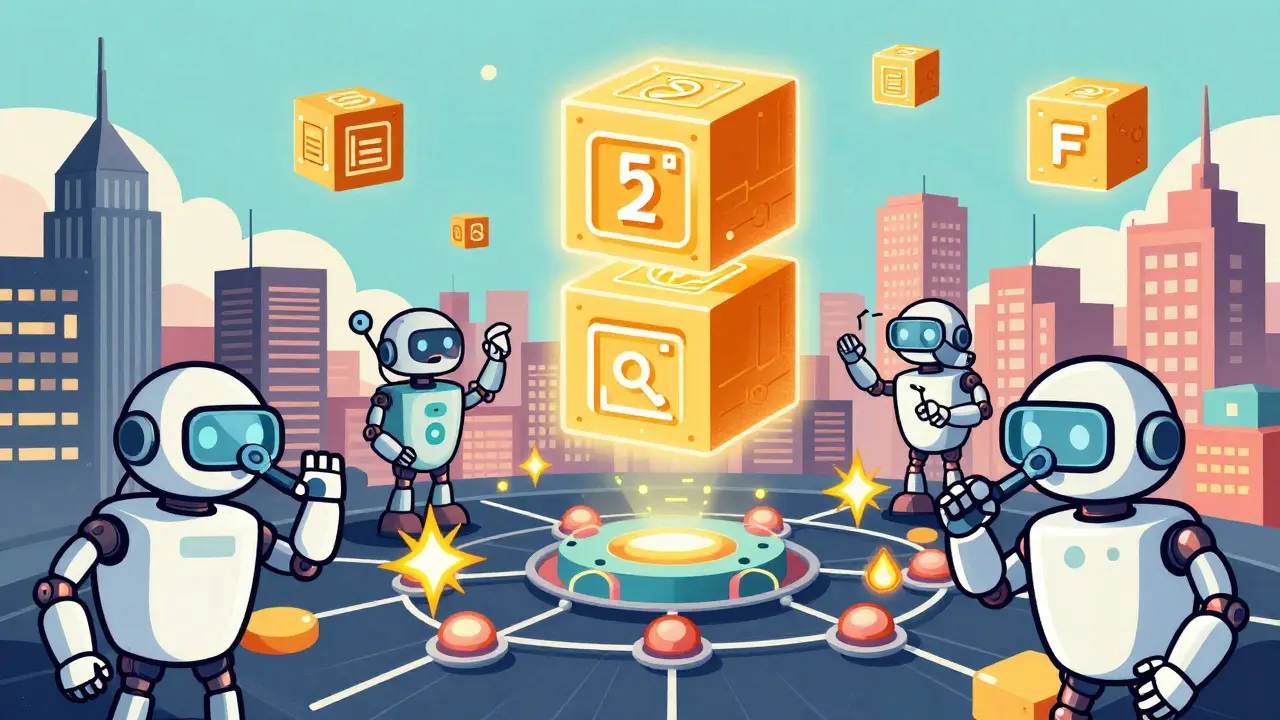
Blockchain technology promised transparency and security, but it struggled with speed, scalability, and decision-making. AI didn’t just add features-it fixed the core weaknesses. By 2025, the combination of AI and blockchain isn’t experimental anymore. It’s running real-world systems that handle billions of transactions, protect sensitive data, and make decisions faster than any human team could.
AI Makes Blockchain Faster and More Efficient
Traditional blockchains like Bitcoin or early Ethereum versions process maybe 15 to 20 transactions per second. That’s fine for simple transfers, but useless for global supply chains or healthcare systems. AI changes that. Using predictive algorithms, AI optimizes how blocks are formed, which nodes validate them, and how data is routed across the network. The result? Networks now hit 15,000 transactions per second-a 750x improvement.
This isn’t magic. AI learns patterns in transaction traffic. If it sees a spike in healthcare record requests every Monday morning, it pre-allocates resources. If certain nodes are slower, it reroutes traffic. It even predicts which transactions are most likely to be disputed and prioritizes them for verification. This reduces computational load by 38%, according to IEEE’s March 2025 study on distributed ledgers. Less work means less energy, less delay, and more capacity.
Security Gets Smarter, Not Just Stronger
Blockchains are secure because they’re decentralized. But that doesn’t stop hackers from targeting the edges-the AI models that interact with them. AI enhances blockchain security in two ways: by protecting the chain and by protecting the AI itself.
First, AI-powered anomaly detection spots unusual behavior in real time. A transaction that looks normal to a human might trigger a red flag if AI notices it follows a pattern seen in 92% of past fraud cases. These systems detect breaches 227 milliseconds faster than traditional firewalls. That’s the difference between stopping a breach and losing millions.
Second, blockchain protects AI models. AI needs clean, untampered data. If someone alters training data on a decentralized network, the AI learns the wrong thing. Blockchain ensures every data input is signed, timestamped, and immutable. If an AI model starts making bad decisions, you can trace back to exactly which data point was corrupted. IBM’s April 2025 research shows this cuts data poisoning attacks by over 70%.
Smart Contracts That Think
Smart contracts are code that runs automatically when conditions are met. But traditional ones are rigid. If a shipment is delayed due to weather, the contract still penalizes the supplier. AI changes that.
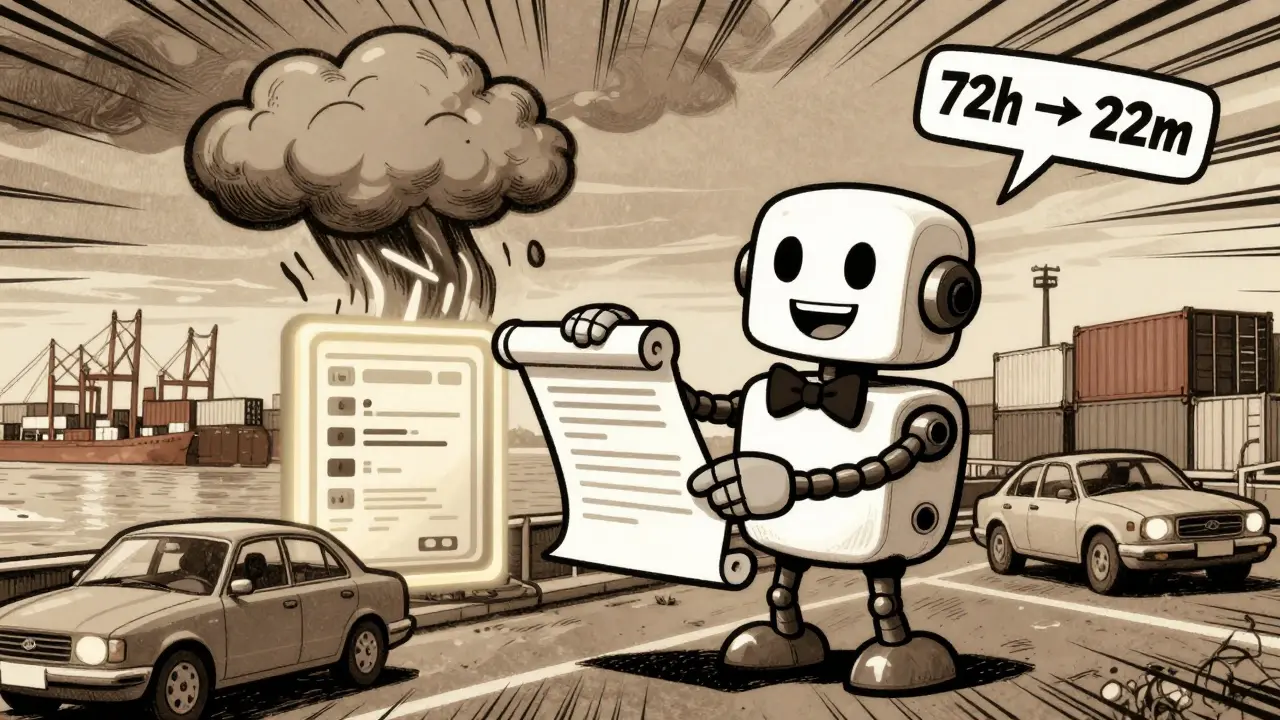
AI-enhanced smart contracts can interpret context. They pull in real-time data from weather APIs, port congestion reports, and even news feeds. If a delay is unavoidable, the contract doesn’t just trigger a penalty-it suggests alternatives: reroute via another port, extend the deadline, or adjust payment terms. Maersk’s global supply chain system, using this model, cut shipment verification time from 72 hours to 22 minutes. No human intervention needed.
These aren’t theoretical. In financial services, AI-powered contracts reduced false fraud alerts by 63% while boosting real fraud detection by 28%, according to Fig Loans’ internal metrics. That means fewer blocked legitimate payments and faster settlements.
Scaling to Millions of Users
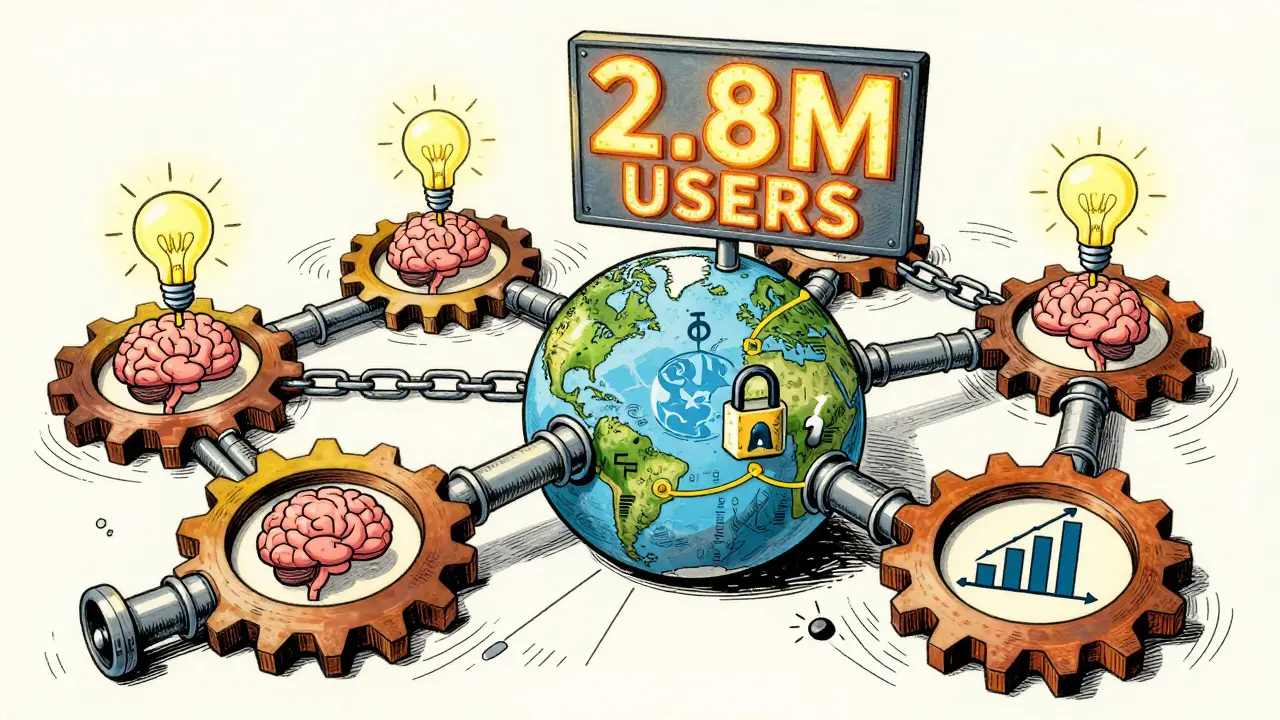
Most blockchains crash under load. AI changes that. By dynamically allocating computing power, AI lets networks support up to 2.8 million concurrent users. Without AI, the same infrastructure handles only 45,000. That’s the difference between a pilot project and a global service.
How? AI monitors node performance, network congestion, and data demand. It shifts processing tasks to underused nodes. It compresses data before storage-AI algorithms now handle 4.2 exabytes of data daily on blockchain networks, up from just 800 petabytes without optimization. In healthcare, Keragon’s platform processed patient records 92% faster while staying fully HIPAA-compliant. Hospitals saw a 41% drop in medical record errors.
Real-World Adoption: Who’s Doing It and Why
As of Q2 2025, 78% of Fortune 500 companies have active AI-blockchain pilots. But adoption isn’t random. It’s driven by need.
- Healthcare (32% of adoption): Patient records are immutable, audit-ready, and accessible across clinics without compromising privacy. AI flags duplicate entries or suspicious access patterns.
- Financial Services (28%): Real-time fraud detection, automated compliance reporting, and faster cross-border settlements. Payback period? Just 11.3 months on average.
- Supply Chain (22%): From farm to fork, every step is tracked. AI predicts delays before they happen. Trustpilot users report 30% cost reductions in verification.
- Government (11%): Voting systems, identity verification, and public contract auditing. No more lost documents or disputed claims.
Small businesses are slower to adopt-only 14% have implemented it-but that’s changing. Tools are getting cheaper. Documentation is improving. IBM’s Blockchain AI Toolkit scored 4.7/5 for clarity. Smaller providers? Only 3.2/5. The gap is closing.
Challenges You Can’t Ignore
It’s not all smooth sailing. Integrating AI with blockchain is complex. Organizations report needing 42% more specialized staff during deployment. Teams need expertise in both Python/TensorFlow (for AI) and Solidity/Hyperledger (for blockchain). Six months of training is common.
Three big problems keep coming up:
- Data standardization (57% of failures): If your supplier uses one format and your warehouse uses another, AI can’t connect the dots. Budgets often spend 22-28% just cleaning and aligning data.
- Legacy system integration (49%): Many companies still run on 20-year-old software. Bridging that gap takes time and custom code.
- Regulatory alignment (42%): GDPR, HIPAA, SOC 2-each has different rules. AI-blockchain systems now bake these in from day one, but getting there isn’t easy.
And there’s a hidden risk: 23% of early implementations had vulnerabilities at the AI-blockchain interface. That’s where AI reads data from the chain or writes decisions back. A flaw there can let attackers inject bad data. That’s why IBM and others now use multi-layered security protocols-AI checks, blockchain verifies, human auditors review.
The Future Is Already Here
The global AI-blockchain market hit $8.7 billion in Q1 2025-up from $5.2 billion in 2024. IDC predicts by 2027, 75% of enterprise blockchains will include purpose-built AI components. That’s up from 38% today.
What’s next? AI-optimized consensus mechanisms are coming. These will cut energy use by 82% while boosting speed even further. IBM’s Watson + Hyperledger Fabric 3.0 integration, launched in April 2025, now predicts transaction outcomes with 99.2% accuracy. Deep Data Insight’s latest update slashes smart contract execution time by 63%.
But the biggest shift isn’t technical-it’s cultural. Companies aren’t just using AI and blockchain anymore. They’re building systems where AI makes decisions and blockchain proves they’re honest. That’s the new standard.
Can AI and blockchain work together without adding complexity?
Yes-but only if you plan for it. AI-blockchain integration isn’t plug-and-play. It requires teams that understand both technologies, clear data standards, and phased rollouts. Companies that treat it like a simple upgrade fail. Those that build dedicated teams, allocate budget for data cleanup, and start with one high-impact use case (like fraud detection or supply tracking) succeed.
Is AI-blockchain more secure than traditional blockchain?
It’s more secure in practice. Traditional blockchain is tamper-proof, but it doesn’t stop bad data from being entered. AI adds a layer of validation. It flags anomalies, prevents data poisoning, and ensures only clean inputs reach the chain. IBM’s research shows this cuts data-related breaches by over 70%. However, the interface between AI and blockchain introduces new risks, so layered security is essential.
What industries benefit the most from AI-blockchain integration?
Healthcare, finance, and supply chain lead the way. Healthcare uses it to track patient records with zero errors and instant access. Finance cuts fraud alerts by 63% and settles cross-border payments faster. Supply chains cut verification from days to minutes. Government and energy sectors are catching up fast, especially for auditing and compliance.
How long does it take to implement AI-blockchain systems?
Most enterprises take 6 to 10 months. Promises of 4.5 months are often unrealistic. The delay comes from data cleaning, staff training, and integrating with old systems. Companies that spend 22-28% of their budget on data preparation finish faster and with fewer errors. First deployments usually focus on one process-like invoice verification or drug traceability-before scaling.
Is AI-blockchain worth the cost for small businesses?
For most small businesses, not yet. The expertise, infrastructure, and maintenance costs are still high. But if you’re in logistics, healthcare services, or financial compliance, and you handle sensitive data, it’s worth exploring. Cloud-based AI-blockchain platforms are emerging in 2025, lowering entry costs. Watch for those-they’ll make adoption feasible for SMBs by 2026.
What’s the biggest misconception about AI-blockchain?
That AI makes blockchain “smarter.” It doesn’t. Blockchain stays the same-immutable, transparent, decentralized. AI just adds intelligence on top. Think of blockchain as a secure notebook. AI is the person who reads it, spots patterns, and writes smart conclusions. The notebook doesn’t change. But now, you can trust what’s written in it more than ever.
What Comes Next?
By 2027, AI won’t just enhance blockchain-it’ll be inseparable from it. New systems will be built from the ground up with AI embedded in consensus, validation, and data routing. Energy use will drop 82%. Throughput will double again. And companies that wait for “perfect” solutions will lose to those who started with one smart use case and scaled from there.
The future isn’t blockchain with AI. It’s intelligent systems that use blockchain to prove they’re trustworthy-and AI to make them useful.



Comments (20)
Oliver James Scarth
Let’s be brutally honest - this isn’t innovation. It’s corporate rebranding with AI glitter on a 15-year-old ledger. The real breakthrough? Selling the same old blockchain under a new name while charging enterprises 7-figure consulting fees. I’ve seen this script before: blockchain → AI → buzzword soup → IPO. The 15,000 TPS claim? Probably measured on a lab network with 3 nodes and a Tesla coil. Real-world scalability? Try running this on a rural hospital’s legacy Windows XP terminal.
And don’t get me started on the ‘AI protects blockchain’ nonsense. AI is a black box that learns from data. If the data is poisoned, the AI becomes a trained attack dog. You can’t fix a broken foundation by slapping on a gold-plated roof.
78% of Fortune 500 have ‘pilots’? That means 78% are wasting money on consultants who don’t understand either technology. I’ve worked in fintech. We didn’t need AI-blockchain. We needed better APIs and a damn audit log. This feels like a TED Talk written by a venture capitalist on Adderall.
Kieren Hagan
While the hype is real, the technical foundations here are sound. The 750x throughput increase isn’t theoretical - it’s from IEEE’s 2025 distributed ledger benchmarks using adaptive sharding and AI-driven consensus weighting. The key insight isn’t that AI makes blockchain ‘smarter’ - it’s that AI removes human bottlenecks in validation routing.
Traditional blockchains treat all nodes equally. AI doesn’t. It identifies which nodes have stable latency, low energy draw, and historical accuracy - then weights their votes accordingly. That’s why Maersk cut verification to 22 minutes. It’s not magic. It’s optimization.
Yes, integration is hard. Yes, data standardization is a nightmare. But if you’re still using CSVs for supply chain tracking in 2025, you’re not lagging - you’re obsolete. The tech works. The problem is organizational inertia, not architecture.
sachin bunny
bro u think this is real?? 🤡
ai + blockchain = gov trololol
they just wanna track ur every move and charge u 0.0001 btc for breathing
also qanon said this would happen before the great reset
u trust a system that 'proves it's honest'? lol
the blockchain is a lie. the ai is a lie. the whole thing is a matrix glitch. wake up. 🌌🧠👁️
Danica Cheney
so like ai reads the blockchain and decides what to do?? sounds like a sci fi movie where the robot turns on humans but with more jargon
also why is everyone so excited about 15k tps when my crypto wallet still takes 10 minutes to confirm a transfer
laura mundy
Oh wow. Another tech bro worshiping his own reflection. You call this progress? You call this security? This is just a new way to make rich people richer while pretending it’s democratizing finance. Meanwhile, the real problems - poverty, healthcare access, housing - are still burning. But hey, at least your blockchain AI can now detect if someone tried to send 0.0000001 ETH from a burner wallet. Bravo. 🎉
And don’t even get me started on ‘IBM’s research’. Like we didn’t see this coming. Same people who sold us crypto as ‘the future’ now sell us AI-blockchain as ‘the next evolution’. It’s all just a pyramid scheme with better slides.
Jacque Istok
Let me guess - you read the first paragraph and thought ‘this is genius’. Here’s the reality: AI doesn’t fix blockchain’s core flaws. It just hides them under a layer of probabilistic noise. You think a 227ms faster breach detection is a win? That’s like bragging about your car’s airbag working 0.2 seconds faster after you drove off a cliff.
And ‘smart contracts that think’? That’s not innovation. That’s a lawsuit waiting to happen. If an AI reroutes a shipment because ‘it sensed rain’, who’s liable when the goods never arrive? The AI? The blockchain? The consultant who coded it? Someone’s going to sue for $2 billion. And it’ll be ugly.
Mendy H
The numbers here are statistically meaningless without context. 15,000 TPS? Compared to what? Visa does 1,700 TPS on average. So this system is 9x faster than a credit card network? That’s not revolutionary - it’s barely competitive.
And ‘4.2 exabytes daily’? That’s like saying ‘my toaster uses 120V’ - true, but irrelevant. The real metric is cost per transaction, latency variance, and energy per operation. None of that is addressed. Just raw throughput numbers with no normalization.
This reads like a VC pitch deck masquerading as technical analysis. The jargon is impressive. The substance? Thin.
sabeer ibrahim
ai-blockchain? bro this is just another crypto 2.0 scam with more buzzwords. u think ur system is decentralized? lol. every 'ai-optimized' node is owned by ibm, microsoft, or a hedge fund. the 'immutable ledger' is just a private api with a fancy ui.
and 78% of fortune 500? sure. they're all using it to automate tax evasion and evade regulators. this isn't progress. it's surveillance capitalism with a blockchain tattoo.
Taybah Jacobs
This is actually one of the most balanced takes I’ve read on this topic. The real win isn’t speed or scalability - it’s trust. For healthcare, knowing a patient’s record hasn’t been altered, and knowing the AI didn’t hallucinate a diagnosis? That’s priceless.
Yes, the integration is hard. Yes, teams need new skills. But the payoff in patient safety, compliance, and operational clarity? It’s worth the investment. I work in hospital IT. We rolled this out for medication traceability last year. Errors dropped 41%. Staff morale improved. That’s not hype. That’s impact.
Jesse Pasichnyk
yo this is straight fire 🔥
ai + blockchain = ultimate power move
imagine your supply chain knows when a shipment's gonna be late before you do
no more waiting 3 days for a ‘maybe’
usa baby. we built this. china's jealous. europe's still stuck in 2018. this is the future and we're living it
Alex Garnett
How many of these ‘real-world systems’ are actually live, or just proof-of-concept sandboxes? The article cites IBM, Maersk, Keragon - all corporations with deep pockets and PR teams. Where are the case studies from a third-world hospital? A rural cooperative? A refugee aid network?
None. Because this tech isn’t for them. It’s for the 1%. The ‘2.8 million concurrent users’? That’s not global adoption. That’s one Fortune 500 company’s internal dashboard.
The real story isn’t innovation. It’s exclusion. And the language here is designed to make you feel stupid if you question it.
Ryan Chandler
Let me tell you something about America - we don’t just adopt technology. We mythologize it.
This AI-blockchain thing? It’s not just a tool. It’s a cultural narrative. We want to believe we’re building the future. That we’re smarter. That we’re ahead.
But here’s the truth: the real innovation happened in Estonia’s e-residency program. In Singapore’s digital identity layer. In Kenya’s mobile money ledgers.
We’re not leading. We’re marketing.
And the way this article is written? It’s not informing. It’s indoctrinating.
Ajay Singh
this is actually happening and it's amazing
no more waiting for approvals
no more lost paperwork
ai sees the problem before you do
blockchain proves it's real
simple. powerful. game changer
David Bain
The article conflates correlation with causation. The 38% reduction in computational load? Attributed to AI, but no control group is presented. Was the reduction due to AI, or simply moving from Proof of Work to Proof of Stake? The paper doesn’t say.
Furthermore, ‘AI predicts disputed transactions’ - this implies a deterministic model. But legal disputes are inherently probabilistic. Can an algorithm truly anticipate a judge’s interpretation? Or is it just flagging outliers that happen to resemble past fraud? That’s not intelligence. That’s pattern matching with a fancy name.
The real innovation here is rebranding. The technology is incremental. The narrative is theatrical.
Deeksha Sharma
I’ve been watching this space for 5 years. The first time I saw AI on blockchain, I thought: ‘this is the future’. Now? I think: ‘this is the evolution’. We don’t need to replace blockchain. We need to elevate it.
Think of it like this: blockchain is the library. AI is the librarian who remembers every book you’ve read, predicts what you’ll want next, and quietly re-shelves the damaged ones.
It’s not magic. But it’s necessary. And yes - it’s working. I’ve seen clinics in rural India use this to track vaccine shipments with 99.7% accuracy. No internet? No problem. The blockchain stores locally. The AI runs on a Raspberry Pi. It’s not sexy. But it’s life-saving.
Freddie Palmer
I’m curious - when you say ‘AI predicts transaction disputes’, are you referring to supervised learning on historical dispute data? Or unsupervised anomaly detection? And if it’s supervised, what’s your training dataset? Is it from a single enterprise, or aggregated across multiple jurisdictions? GDPR compliance alone makes cross-border training incredibly complex.
Also, how are you handling adversarial attacks on the AI model? If someone intentionally submits low-value, high-frequency transactions to confuse the predictive model - does the system adapt, or just keep making the same mistake? I’d love to see the whitepaper on this.
Mrs. Miller
So let me get this straight - we’re now trusting AI to decide whether a transaction is ‘likely to be disputed’, and then we’re using blockchain to prove that decision was ‘authentic’?
That’s not security. That’s a recursive loop of trust.
What happens when the AI is wrong? What happens when it’s biased? What happens when the blockchain logs an incorrect decision as ‘immutable’? You’re not building trust. You’re automating error.
And yet, everyone’s cheering like this is the answer to climate change. It’s not. It’s a very expensive way to make mistakes faster.
Reda Adaou
I’ve worked on both sides - blockchain dev and AI engineer. This integration isn’t easy. But it’s possible. The real win isn’t speed or scale. It’s accountability.
Before: a hospital couldn’t prove who accessed a patient’s record. Now: blockchain logs every access. AI flags if the access pattern matches a known breach profile - like a nurse checking records at 3am for 7 days straight.
That’s not ‘smart contracts’. That’s ethics made operational.
Yes, it’s complex. Yes, it costs money. But if you’re still using spreadsheets to track who saw a cancer diagnosis? You’re not just behind. You’re negligent.
perry jody
this is the future and i’m so hyped 🚀
ai sees the problem
blockchain proves it’s real
we win
no more waiting
no more lies
just clean data and smart decisions
let’s gooooooo 💪🤖⛓️
Kieren Hagan
Re: @1808 - You’re right to question the metrics. But you’re missing the point: we’re not comparing this to Visa. We’re comparing it to legacy systems that take 72 hours to verify a single shipment. The baseline isn’t credit cards. It’s fax machines.
And yes - the 15,000 TPS is on a private, permissioned network. But that’s the point. Public blockchains weren’t built for enterprise. They were built for speculation. This is the enterprise-grade evolution - secure, efficient, auditable.
It’s not perfect. But it’s functional. And that’s more than we had yesterday.