Toko Token (TKO) isn’t just another altcoin. It’s a digital asset built for one specific purpose: to power Indonesia’s growing crypto economy. Launched on April 1, 2021, through Binance Launchpad, TKO is the first cryptocurrency from Indonesia to combine centralized and decentralized finance into a single system called CeDeFi. If you’re trying to understand whether TKO has real value or is just another speculative token, this guide breaks down exactly what it does, how it works, and who it’s actually for.
What Is Toko Token (TKO) and Who Created It?
Toko Token (TKO) is the native token of Tokocrypto, an Indonesian cryptocurrency exchange founded in 2017 and officially launched in 2018. Tokocrypto became the first crypto platform in Indonesia to be officially registered by BAPPEBTI - the government’s Futures Exchange Supervisory Board - in November 2019. That registration matters. It means Tokocrypto operates under Indonesia’s financial regulations, not in the wild west of unregulated crypto.
TKO was designed to be more than just a trading asset. It’s a utility token meant to tie together everything Tokocrypto offers: spot trading, staking, NFTs, and even fiat on-ramps. Unlike tokens like Ethereum or Solana that aim to be global blockchains, TKO’s entire reason for existing is to serve Indonesian users. It’s built on the Binance Smart Chain (BSC) as a BEP-20 token, which keeps transaction fees low and speeds high - critical for a market where millions access crypto via mobile phones.
How Does TKO Work? The CeDeFi Model Explained
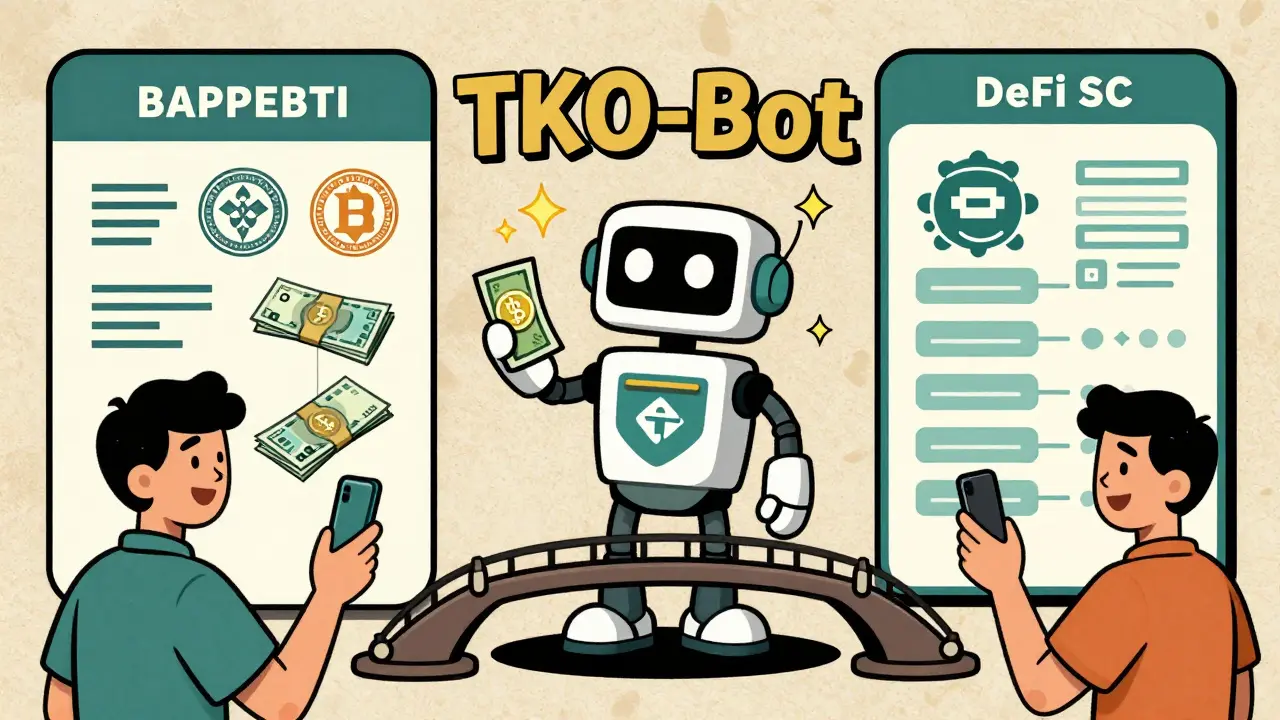
The term CeDeFi (Centralized + Decentralized Finance) sounds like buzzword bingo, but with TKO, it’s real. Here’s how it works:
- Centralized side: You buy TKO on Tokocrypto’s exchange using Indonesian rupiah (BIDR), trade it for other coins, or stake it through their app. All of this is handled like a traditional crypto exchange - fast, simple, and regulated.
- Decentralized side: TKO can be used in DeFi protocols built on BSC, like staking pools and yield farms. You earn rewards by locking up your TKO, and you can vote on platform upgrades - something you can’t do on most centralized exchanges.
This hybrid approach solves a big problem in Indonesia: most people don’t understand how to use wallets or private keys. Tokocrypto handles the complexity behind the scenes, so users get DeFi rewards without needing to navigate Metamask or understand gas fees.
What Can You Do With TKO?
TKO isn’t just a speculative asset. It has five clear, usable functions inside the Tokocrypto ecosystem:
- Trading fee discounts: Pay your trading fees in TKO and get 20-25% off. That’s a real, immediate saving every time you buy or sell crypto.
- Staking rewards: Through the TKO Savings program, you can earn between 5% and 15% annual yield. Longer lock-up periods (like 90 or 180 days) give higher returns. You earn daily, and payouts are in TKO.
- Governance voting: TKO holders can vote on key decisions like new token listings, fee structures, or platform features. Each TKO equals one vote.
- NFT marketplace access: Tokocrypto launched its NFT Arcade in Q2 2023. You need TKO to buy, sell, or list NFTs on the platform.
- Fiat gateway: TKO pairs directly with BIDR (Binance’s Indonesian rupiah stablecoin). This lets users deposit rupiah, buy TKO, then swap into other cryptocurrencies - all within one app.
These aren’t theoretical benefits. They’re features people in Indonesia use every day. In 2022, Tokocrypto captured 22% of Indonesia’s total crypto spot trading volume - largely because TKO made using the platform cheaper and more rewarding.
TKO Supply and Market Data (As of January 2026)
TKO has a fixed maximum supply of 500 million tokens. As of early 2026, around 108.5 million TKO are in circulation, with another 387 million still locked or reserved for future releases. That means only about 22% of the total supply is actively trading.
Price data varies by platform, but as of January 2026, TKO trades around $0.088 USD on Binance and Tokocrypto. That’s down from its all-time high of $0.32 in late 2021, but consistent with the broader crypto market correction. Daily trading volume on Tokocrypto averages $600,000, mostly from Indonesian users.
Market cap sits at roughly $95 million, making TKO a small-cap token by global standards - but it’s the largest Indonesian-native crypto by market value. For comparison, UNI (Uniswap) trades at over $5 billion, and CAKE (PancakeSwap) at $1.2 billion. TKO’s value isn’t based on global adoption - it’s based on its role in one country’s financial ecosystem.
Why TKO Is Different From Other DeFi Tokens
Most DeFi tokens - like UNI, SUSHI, or CAKE - are designed to be used globally. TKO is the opposite. It’s built for one market: Indonesia.
Here’s what sets TKO apart:
- BIDR pairing: No other DeFi token offers direct rupiah on-ramps. This lets users convert cash to crypto without needing a bank account - critical in a country where 68% of adults are unbanked.
- Mobile-first design: Tokocrypto’s app has over 500,000 downloads on Google Play and a 4.3/5 rating. It’s simple enough for a 65-year-old grandmother in Jakarta to use.
- Regulatory compliance: Tokocrypto is licensed by BAPPEBTI. That means TKO operates under legal oversight - a rarity in crypto.
- Local focus: TKO’s roadmap includes merchant payments, school payment systems, and small business adoption - things global tokens ignore.
But there’s a flip side: TKO’s value is tied to Indonesia’s crypto adoption rate. If the government cracks down, or if Tokocrypto loses its license, TKO’s utility drops fast. That’s the trade-off.
Who Should Buy TKO?
TKO isn’t for everyone. Here’s who it’s actually good for:
- Indonesian crypto users: If you live in Indonesia and trade on Tokocrypto, TKO saves you money on fees and earns you passive income.
- Investors in Southeast Asia: If you believe Indonesia’s crypto market will grow (it’s projected to hit $18 billion by 2026), TKO is a direct bet on that growth.
- DeFi beginners: If you want to try staking and yield farming but don’t want to manage wallets or private keys, TKO’s app does it for you.
Who should avoid it?
- International traders: TKO is only listed on Binance and Tokocrypto. You won’t find it on Coinbase, Kraken, or KuCoin.
- Those seeking global exposure: TKO doesn’t compete with Ethereum or Solana. It’s a regional tool, not a global asset.
- People who don’t speak Indonesian: The app’s English support is limited. Customer service is mostly in Bahasa Indonesia.
Risks and Challenges
TKO has potential, but it’s not risk-free.
- Regulatory uncertainty: Indonesia still doesn’t have full crypto laws. BAPPEBTI regulates exchanges, but there’s no clear legal status for tokens like TKO. A sudden ban could crash its value.
- Limited liquidity: With only $600k daily volume, TKO is easy to manipulate. Large sell-offs can cause sharp price drops.
- Dependence on one platform: TKO’s utility is almost entirely tied to Tokocrypto. If the exchange fails, TKO becomes nearly worthless.
- Language barrier: Non-Indonesian speakers struggle with the app and support. This limits its global appeal.
Analysts at VanEck noted in their August 2025 report: “TKO’s success remains tightly coupled to Tokocrypto’s exchange performance and Indonesian regulatory clarity.” That’s the bottom line.
The Future of TKO: What’s Next?
Tokocrypto’s 2024 roadmap includes:
- Expanding BIDR liquidity pools to reduce slippage
- Allowing TKO payments at local merchants (grocery stores, online services)
- Launching a TKO-based loan system using crypto as collateral
- Integrating with Indonesia’s digital ID system for KYC
If these features roll out successfully, TKO could become more than a token - it could become a financial tool for millions of unbanked Indonesians. Bank Indonesia projects that if crypto adoption hits 15% of the population (about 40 million people) by 2026, TKO’s value could triple.
But that’s a big if. It depends on regulation, user trust, and whether Tokocrypto can keep its platform secure and reliable.
Final Thoughts: Is TKO Worth It?
Toko Token isn’t a get-rich-quick crypto. It’s not going to make you a millionaire overnight. But if you’re in Indonesia - or you believe in the country’s crypto future - TKO has real, usable value. It saves you money on fees, earns you interest, and gives you a stake in a platform that’s actually solving real problems: financial access, mobile simplicity, and regulatory safety.
Outside Indonesia? It’s mostly a speculative play. The token’s utility doesn’t extend far beyond Tokocrypto’s app. But inside Indonesia? It’s one of the few crypto assets that’s actually being used - not just traded.
Think of TKO like a loyalty card for crypto. You don’t need it to use crypto. But if you’re already using Tokocrypto, it makes everything cheaper and more rewarding.
Is TKO a good investment?
TKO isn’t a traditional investment like Bitcoin or Ethereum. It’s a utility token with value tied to usage on Tokocrypto. If you trade on Tokocrypto, holding TKO saves you money on fees and earns staking rewards - that’s real value. But if you’re looking for price appreciation based on global adoption, TKO is risky. Its future depends entirely on Indonesia’s crypto regulations and Tokocrypto’s ability to grow its user base.
Where can I buy TKO?
You can buy TKO on two platforms: Binance and Tokocrypto’s own exchange. It’s not listed on Coinbase, Kraken, or most other global exchanges. To buy TKO, you’ll need to create an account on either platform, deposit funds (in crypto or BIDR), and trade for TKO. The easiest way for Indonesian users is to deposit rupiah directly via bank transfer and buy TKO instantly.
Can I stake TKO?
Yes. Tokocrypto offers a TKO Savings program where you can stake your tokens and earn between 5% and 15% annual yield. The longer you lock your TKO (30, 90, or 180 days), the higher the reward. Rewards are paid daily in TKO and can be withdrawn anytime, even if your lock-up period isn’t over. This is one of the most popular features among Indonesian users.
Is TKO safe?
TKO is built on Binance Smart Chain, which is secure and widely used. Tokocrypto is regulated by Indonesia’s BAPPEBTI, meaning it follows anti-money laundering and security standards. However, no crypto is 100% safe. The biggest risk isn’t the token itself - it’s the platform. If Tokocrypto gets hacked or loses its license, TKO’s value could collapse. Always use strong passwords, enable 2FA, and never store large amounts of TKO in your exchange wallet long-term.
Why is TKO’s price so low compared to other tokens?
TKO’s price is low because its total supply is capped at 500 million tokens, and only about 108 million are in circulation. That means each token is worth less than tokens with smaller supplies like Bitcoin. But price doesn’t equal value. TKO’s value comes from utility - not speculation. A $0.08 token that saves you 25% on trading fees and pays 10% annual interest is more valuable than a $10 token with no use case. Think of it like a discount coupon, not a stock.


Comments (22)
Liza Tait-Bailey
TKO feels like a loyalty card for crypto, not an investment. If you're in Indonesia and use Tokocrypto, it makes sense. Otherwise, it's just another token with a cute story.
Still, I'm impressed they made something actually useful for regular people instead of just pumping hype.
Bharat Kunduri
bro tk0 is just a bnb clone with a indonesian flag slapped on it. why would i care? i dont even speak bahasa and i dont trust any exchange that needs govt approval. if its regulated, its already dead.
Chris O'Carroll
Okay but let’s be real - if this thing crashes because Indonesia suddenly bans crypto, who’s gonna be left holding the bag? The 65-year-old grandma in Jakarta? Nah. It’s the guys who bought it at $0.30 thinking it was the next ETH. This isn’t finance, it’s a cultural experiment with a 22% circulating supply and zero global liquidity.
Also, why is the price $0.088? Because no one outside Jakarta gives a damn.
Kelly Post
This is actually one of the most thoughtful crypto write-ups I’ve read in a long time. Most projects pretend to be global, but TKO is honest - it’s for Indonesia. That’s rare.
And the CeDeFi model? Brilliant. People don’t need to understand private keys to earn 10% APY. That’s accessibility, not hype.
It’s not going to make you rich, but if you live there, it makes your life easier. That’s worth something.
Andre Suico
While the utility of TKO within the Tokocrypto ecosystem is clearly articulated, one must remain cautious about the structural risks. The token’s value is entirely dependent on the operational integrity and regulatory standing of a single entity in a jurisdiction with evolving crypto legislation.
Historically, such centralized dependencies have led to catastrophic value collapse when trust is compromised. Investors should treat TKO as a utility instrument, not a store of value.
Chidimma Okafor
What a breath of fresh air! Finally, a crypto project that understands its people instead of chasing global dominance like a thirsty tourist. TKO is not trying to be Bitcoin - it’s trying to be the bridge between cash and digital freedom for millions who’ve been left behind by traditional finance.
Imagine a grandmother in Surabaya staking TKO to pay for groceries. That’s not speculation - that’s revolution. And it’s happening quietly, without fanfare.
Let’s celebrate the quiet builders.
Bill Sloan
TKO is the only crypto I’ve seen that actually solves a real problem - access. No bank? No problem. Just use your phone, buy BIDR, swap to TKO, earn interest, pay fees cheaper. Done.
And the fact that it’s regulated? That’s not a bug, it’s a feature. Most people don’t want to be anarchists - they just want to buy crypto without getting scammed.
Also, 15% APY? Sign me up. I’m not here to be a degenerate, I’m here to make my money work.
ASHISH SINGH
They say it’s regulated but that’s just a trap. BAPPEBTI is controlled by the same people who own the banks. This is how they lure the unbanked into a digital trap so they can track every transaction, freeze accounts, and tax you into oblivion. TKO isn’t freedom - it’s financial surveillance with a cute logo.
Also, why is the supply 500M but only 108M circulating? That’s a rug pull waiting to happen. They’ll dump the rest when the price hits $0.20 again.
Vinod Dalavai
Been holding TKO since late 2022. Used it for trading fees, staked it for 90 days, got 12% APY. No drama. No panic. Just steady use.
It’s not sexy, but it works. If you’re in Indonesia, why not? It’s like having a discount card that pays you back.
Also, the app is actually good. My mom uses it. That says something.
Tony Loneman
Oh wow, another ‘regional crypto’ that’s just a centralized exchange token with a fancy name. Let me guess - the devs are in Singapore, the marketing team is in Dubai, and the real users are just Indonesian peasants being sold a dream.
They say it’s for the people? Nah. It’s for VCs who want to cash out before the next election. This isn’t innovation - it’s rebranding rent-seeking as financial inclusion.
Callan Burdett
TKO is the crypto equivalent of a good local coffee shop - not the biggest, not the trendiest, but the one you keep coming back to because it just works.
And hey, if you’re in Indonesia, why not support your own? Global crypto is drowning in noise. This? This is quiet utility.
Respect.
Anthony Ventresque
I’m curious - how many of the 500M TKO tokens are actually locked in staking vs. just sitting in exchange wallets? The whitepaper says 387M are reserved, but is that just a placeholder or are they truly locked with smart contracts?
Also, is there any data on how many users are actually using TKO for governance? Or is voting just a checkbox nobody clicks?
Nishakar Rath
TKO is a scam wrapped in regulation. BAPPEBTI is a puppet of the central bank. They let this happen so they can monitor every transaction and eventually ban it when they need to control the narrative. The 15% APY? That’s a Ponzi trick to get suckers in before they pull the plug. I’ve seen this movie before - it ends with everyone screaming into the void
Jason Zhang
So TKO’s market cap is $95M? That’s cute. But let’s be honest - if you took away the Indonesian user base, this token would be worth $0.002. It’s not a crypto asset. It’s a regional loyalty program with a blockchain sticker.
Still, I’ll give them credit - they didn’t try to be something they’re not. That’s rare.
Katherine Melgarejo
Oh look, another ‘financial inclusion’ token. Next they’ll be selling TKO-branded rice cookers and calling it DeFi.
At least it’s not another memecoin. I’ll give them that. But honestly? If I had to use an app in Bahasa to earn 10% on my crypto… I’d just stick with Binance.
Patricia Chakeres
Let’s not pretend this is innovation. TKO is a regulatory arbitrage play. Binance partnered with a government-approved exchange to create a token that looks decentralized but is really just a controlled environment for retail investors to be harvested.
The ‘CeDeFi’ label? Marketing jargon. The real story? They’re using crypto to bypass traditional banking oversight - and that’s dangerous. This isn’t finance. It’s financial colonialism disguised as empowerment.
Alexis Dummar
TKO reminds me of early Bitcoin in a small town - not flashy, not famous, but actually being used by real people for real reasons.
Most crypto projects are trying to change the world. TKO just wants to make paying for coffee in Jakarta a little less annoying.
And honestly? That’s more valuable than another NFT collection.
kristina tina
I’m so proud of what Tokocrypto’s done. Imagine being a mom in Bandung who’s never had a bank account, but now she can earn interest on her crypto just by tapping her phone. No paperwork. No fees. No confusion.
This isn’t about price charts - it’s about dignity. TKO gives people control. That’s worth more than any million-dollar pump.
Anna Gringhuis
Let’s cut through the fluff. TKO is a utility token with zero global relevance. It’s not going to moon. It’s not going to disrupt finance. It’s just a fee discount with a side of staking.
But you know what? That’s fine. Not every project needs to be Ethereum. Sometimes, being useful is enough.
And if you’re in Indonesia? Cool. Use it. If not? Move on.
Michael Jones
Excellent breakdown. The CeDeFi model is genuinely innovative in its simplicity. Most DeFi projects overcomplicate things. TKO removes the friction for non-technical users without sacrificing core functionality.
It’s rare to see a crypto project prioritize usability over speculation. Hats off to the team.
Lauren Bontje
Indonesia doesn’t need crypto. They need better infrastructure, not digital loyalty cards. TKO is a distraction - a shiny object to keep people from demanding real economic reform. This is what happens when you let tech bros think they’re helping the poor.
Also, why is Binance involved? Because they want to lock in a monopoly in Southeast Asia. This isn’t empowerment - it’s corporate capture.
Stephanie BASILIEN
While the operational framework of TKO demonstrates a commendable alignment with local regulatory environments, one must consider the long-term implications of institutional dependency.
The token’s utility is contingent upon the continued existence of a single exchange, which, by nature, introduces systemic fragility. Moreover, the regulatory landscape in Indonesia remains in flux - a single legislative shift could invalidate the entire value proposition.
One must approach this not as an investment, but as a transient utility instrument - with all the caution such a designation warrants.