
Providing liquidity in decentralized finance (DeFi) isn’t just a technical term-it’s a way to earn passive income just by holding crypto. You don’t need to trade, speculate, or time the market. You simply deposit two tokens into a smart contract, and in return, you get a share of every trade that happens in that pool. It sounds simple, but there are real risks and smart strategies behind it. If you’ve heard about earning 20%, 40%, or even 70% APY from liquidity pools, this is how it actually works-and what you’re really signing up for.
What Is a Liquidity Pool?
A liquidity pool is a smart contract that holds pairs of cryptocurrencies, like ETH and USDC, or SOL and USDT. These pools replace traditional order books used by exchanges like Binance or Coinbase. Instead of matching buyers and sellers directly, trades happen against the pool. If you want to swap 1 ETH for USDC, the pool gives you USDC from its reserves and takes your ETH. The price is set automatically by a mathematical formula, not by a human trader.
This system is called an Automated Market Maker (AMM). Uniswap, launched in 2018, made it popular. Today, pools on Uniswap, SushiSwap, Curve, and Raydium handle billions in daily trades. When you add your tokens to one of these pools, you become a liquidity provider (LP). In return, you get LP tokens-digital receipts that prove you own a slice of that pool.
How Do You Earn Fees?
Every time someone swaps tokens in a pool, they pay a small fee-usually 0.3% on Uniswap, 0.04% on Curve for stablecoins, or 0.2% on Solana-based Raydium. That fee doesn’t go to the platform. It gets split among all the liquidity providers in that pool. So if you own 1% of the ETH/USDC pool, you earn 1% of every fee generated by trades in that pool.
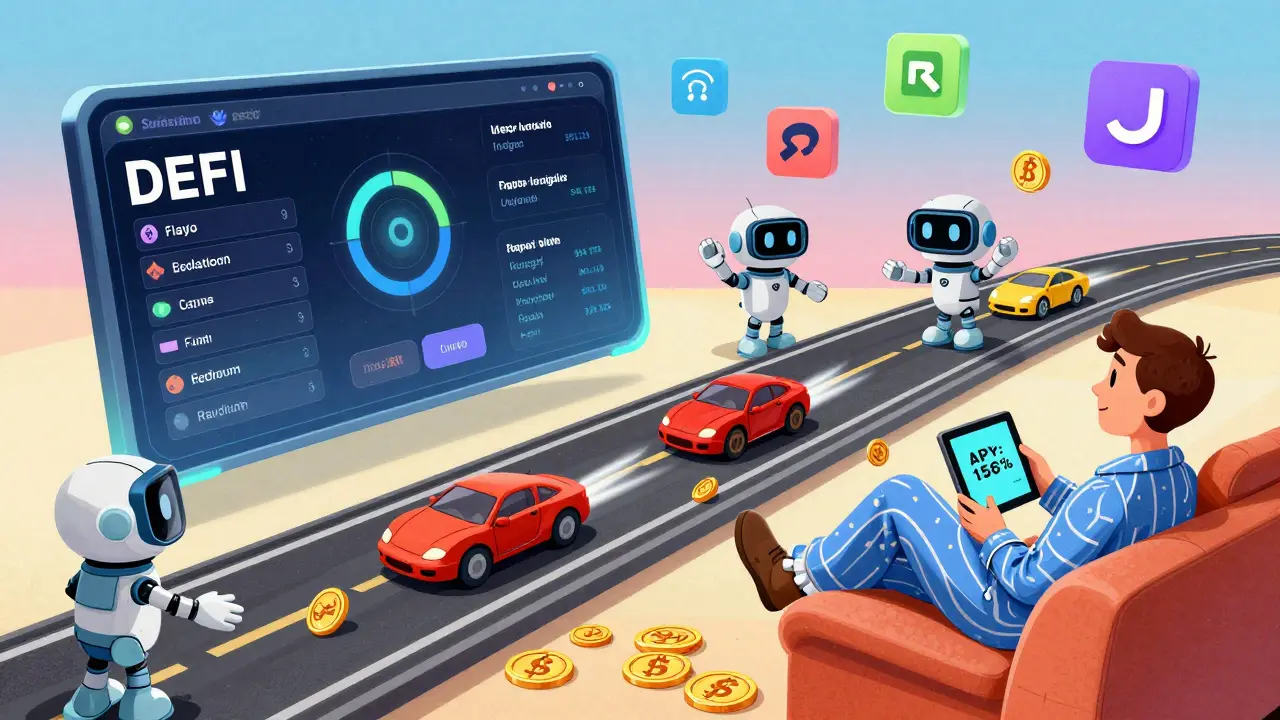
Let’s say the ETH/USDC pool has $10 million in total value and trades $100 million in a week. At 0.3% fees, that’s $300,000 in fees. If you’ve put in $10,000 worth of ETH and USDC, you own 0.1% of the pool. That means you earn $300 in fees that week. That’s $15,600 a year, or 156% APY-before any extra rewards.
But here’s the catch: not all pools are equal. Pools with high trading volume, like ETH/USDT or BTC/USDC, earn more fees. Pools with low volume, like some obscure altcoin pairs, might earn pennies. And some platforms give you extra tokens on top-UNI from Uniswap, CRV from Curve, or SUSHI from SushiSwap. These can add 10-30% more to your yield.
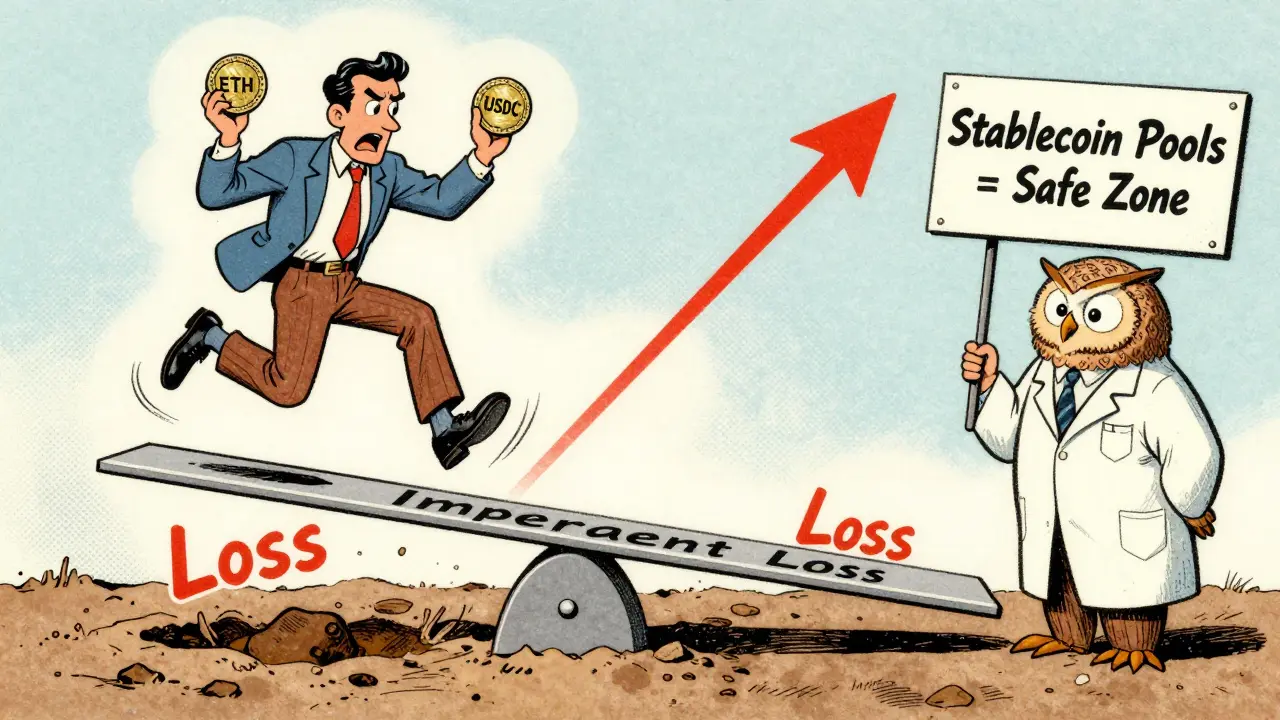
Impermanent Loss: The Hidden Risk
Here’s where most people get burned. Let’s say you deposit $1,000 worth of ETH and $1,000 worth of USDC into a pool. The price of ETH is $3,000 per coin. A week later, ETH jumps to $6,000. The pool automatically rebalances to keep the ratio of ETH to USDC stable, so it sells some ETH and buys USDC to match the new market price.
When you withdraw, you get back less ETH than you put in-and more USDC. Even though ETH doubled, your total value might only be $1,800 instead of $2,000 (what you’d have if you just held the tokens). That $200 gap? That’s impermanent loss.
It’s called "impermanent" because if ETH drops back to $3,000, the loss disappears. But if you withdraw while the price is off, it becomes real. The math is brutal: if one token doubles, you lose about 5.7% compared to just holding. If it triples, you lose over 13%.
That’s why experienced providers stick to:
- Stablecoin pairs (USDC/USDT, DAI/USDC)-low volatility means near-zero impermanent loss.
- Correlated assets (ETH/wstETH, BTC/renBTC)-they move together, so price ratios stay close.
- High-fee pools with strong volume-fees often cover the loss over time.
Never provide liquidity to a token pair with wild swings unless you’re ready to absorb losses. A 200% APY pool with a 30% impermanent loss isn’t a win.
Where to Provide Liquidity
Not all platforms are created equal. Here’s what’s actually working in early 2026:
- Uniswap V3 (Ethereum, Arbitrum, Polygon): The largest pool provider. V3 lets you choose a price range for your liquidity-concentrating it where trades happen. This boosts fee earnings but needs active monitoring. Great if you know the price range.
- Curve Finance (Ethereum, Polygon): Best for stablecoins. Fees are low (0.04%), but impermanent loss is almost zero. They also pay CRV rewards, pushing yields to 5-15% APY.
- Raydium (Solana): Low fees, near-zero gas costs. Perfect for small deposits. Solana’s speed makes rebalancing easy. Yields hover around 8-12% from fees alone, plus SOL rewards.
- Balancer (Ethereum): Lets you create pools with up to 8 tokens and custom weights. Good for advanced users who want fine control.
Most users start on Uniswap or Raydium. Ethereum is still the most liquid, but Solana is catching up fast-especially for deposits under $1,000.
How to Get Started
Here’s the step-by-step process, no tech background needed:
- Connect your wallet (MetaMask for Ethereum, Phantom for Solana).
- Choose a pool based on your risk: stablecoin pairs for safety, ETH/USDC for balance, or volatile pairs only if you understand the risk.
- Deposit equal value of both tokens. The platform calculates this for you. If you have $500 in ETH, you need $500 in USDC.
- Approve the transaction in your wallet. This costs a few dollars on Ethereum, less than $0.50 on Solana or Polygon.
- Confirm the deposit. You’ll get LP tokens in your wallet.
- Track your position on the platform’s dashboard. Watch fees accumulate and check for impermanent loss.
Most platforms require a minimum of $100-$500 to make sense. Smaller deposits get eaten up by gas fees. On Ethereum, a $50 deposit might cost $10 in gas to enter and exit. On Solana? You can do it for $0.20.
Advanced Tips: Boosting Your Returns
If you’re serious about earning more, here’s what pros do:
- Yield farming LP tokens: Stake your LP tokens on another protocol. For example, deposit your UNI-V3 LP tokens into a staking pool that pays extra UNI. This can double your yield-but adds more risk. If the token price drops, you lose twice.
- Use automated tools: Platforms like Yearn Finance or Beefy Finance auto-compound rewards and shift your liquidity to the best-paying pools. You don’t need to monitor it daily.
- Rebalance manually: If one asset grows too much, withdraw, sell the excess, and re-deposit equal values. This reduces impermanent loss but costs gas.
- Track APY dashboards: Use DeFiLlama or APY.vision to compare pools in real time. Fees change daily. A pool at 15% today might be at 5% next week.
One user on Reddit posted a 3-month log: they started with $2,000 in ETH/USDC on Uniswap V3. Fees earned: $410. Impermanent loss: $180. Net gain: $230 (11.5% over 3 months). Not flashy, but steady. They didn’t touch it.
What’s New in 2026
DeFi is evolving fast. In early 2026:
- Layer 2 dominance: Over 70% of new liquidity now flows to Arbitrum, Polygon, or Base. Ethereum mainnet is too expensive for small providers.
- Regulatory pressure: The EU’s MiCA regulation now requires KYC for DeFi users who lock over €10,000 in liquidity. This is slowing institutional entry-but not stopping it.
- Cross-chain pools: Protocols like Synapse and Stargate let you provide liquidity across chains. You deposit on Solana, earn fees on Ethereum. Riskier, but higher rewards.
- AI-powered LP tools: New bots now predict price trends and auto-adjust concentrated liquidity ranges. They’re still experimental, but some users report 30% higher fee earnings.
The big takeaway? Liquidity provision isn’t "set and forget." It’s more like a part-time job. You need to watch your pools, understand the risks, and adjust. But if you do it right, it’s one of the few ways to earn real returns from crypto without selling your assets.
Can you lose money providing liquidity?
Yes. You can lose money from impermanent loss if the price of one token moves sharply compared to the other. You can also lose if the platform gets hacked, or if the token you’re earning as a reward crashes. Always start small, stick to well-known pools, and never put in more than you can afford to lose.
Is liquidity provision better than staking?
It depends. Staking gives you fixed, predictable returns-like 5-8% on Ethereum. Liquidity provision can earn 10-50% or more, but comes with risk. If you want safety, stake. If you want higher returns and can handle price swings, provide liquidity. Many users do both: stake some, provide liquidity with the rest.
Do I need to pay taxes on liquidity pool earnings?
In most countries, yes. The fees you earn are treated as income. When you withdraw, the value of your LP tokens at that moment is taxable. Some places tax the swap when you deposit tokens, others tax when you withdraw. Keep records of every deposit, withdrawal, and token price. Tax software like Koinly or TokenTax can help track it.
Why do some pools pay more than others?
High fees come from high trading volume. Pools like ETH/USDT have millions in daily trades, so fees add up. Low-volume pools earn little. Also, platforms offer extra rewards (like UNI or CRV tokens) to attract liquidity. These are temporary incentives-once they end, yields often drop. Always check if rewards are still active.
Can I withdraw my liquidity anytime?
Yes, you can withdraw anytime. But if you do it when one token has moved a lot in price, you’ll likely experience impermanent loss. Waiting until prices stabilize reduces the loss. Some users wait 30-60 days before withdrawing to let fees offset the loss.


Comments (20)
Lauren Brookes
Been doing this for two years now. Started with $500 in ETH/USDC on Uniswap V3. Didn’t touch it. Fees piled up, impermanent loss was maybe $40 total. Ended up with $780 in value just from fees. No stress, no monitoring. This is the closest thing to passive income I’ve ever found in crypto.
Don’t chase 100% APY pools. Those are traps. Stick to stable pairs or ETH/USDC. Let time do the work.
Chris Thomas
Anyone who thinks LPing is "simple" hasn’t actually run the math on concentrated liquidity ranges or fee tier optimization. You’re not just depositing tokens-you’re essentially running a micro-market-making algorithm. If you don’t understand gamma exposure or vega risk, you’re just gambling with your principal.
And don’t even get me started on those Solana yield farmers. They’re not earning yield-they’re subsidizing exchange liquidity with their own capital. It’s a zero-sum game with gas fees as the rake.
Andrew Edmark
Hey, I just started last month with $200 in USDC/DAI on Curve. Got my first CRV reward this week-$0.87 😅
It’s not life-changing, but it feels good. No impermanent loss. No panic. Just watching the numbers tick up slowly. I’m learning, and that’s enough for now.
Thanks for the clear breakdown. Took me weeks to find this level of detail. You’re helping people like me.
Dominica Anderson
Stablecoin pools are for peasants. If you’re not leveraging concentrated liquidity on Uniswap V3 with a 5% price range and compounding via Beefy, you’re already losing.
Nova Meristiana
Y’all act like this isn’t just DeFi’s version of a Ponzi. The fees? Paid by retail traders getting rekt on slippage. The rewards? Floated by VC-backed token emissions that crash in 3 months. You’re not earning-you’re being used.
JJ White
THIS IS A TRAP. I LOST $12,000 LAST YEAR BECAUSE I DIDN’T KNOW ABOUT IMPERMANENT LOSS.
I put ETH and USDC in a pool. ETH went up 3x. I thought I was rich. I withdrew. Got back 1.2 ETH and 800 USDC. My ETH alone was worth $18k. I had $10k in. I walked away with $11k. I lost $7k because I trusted a "simple" system.
Don’t do this. Just HODL. Or better yet-sell everything and buy gold.
Nicole Stewart
Most people don't understand LP. They think it's free money. It's not. It's risk disguised as yield.
Alan Enfield
Been on both sides. Did LP on Ethereum for a year-gas fees ate my profits. Switched to Raydium with $300. Gas was $0.12 to deposit. Earned $18 in fees in 3 weeks. No drama.
Don’t overcomplicate it. If you’re not on a Layer 2 or Solana, you’re paying for the privilege.
kieron reid
Let’s be real. The only people making consistent money here are the devs who created the protocols. The LPs? They’re the ones absorbing the slippage, the volatility, the rug pulls. You think you’re earning yield? You’re the liquidity buffer.
I track every pool. The APYs are all fake. They’re inflated by token emissions that expire. You’re not getting paid-you’re being baited.
Avantika Mann
Hi! I’m from India and started with just $100 in USDT/DAI on Polygon. Took me 3 days to figure out how to connect MetaMask. Got my first fee payout-$0.42. I screamed 😭
It’s tiny, but it’s mine. No middleman. No bank. Just code. I’m learning every day. Thank you for writing this so clearly. It made me feel like I belong here.
jennifer jean
Just deposited my first $500 into ETH/USDC on Arbitrum. Took 45 minutes to understand the interface. But now I’m watching my LP tokens grow like a plant. 🌱
Feels like planting seeds. You don’t dig them up every day. You water them. Wait. And one day… you’re surprised by the harvest.
Thank you for the calm, clear guide. Needed this today.
Paul David Rillorta
Y’all think this is safe? LMAO. The smart contracts are written by 19-year-olds in their parents’ basement. One bug. One hack. Poof. Your $10k is gone.
And don’t tell me about audits. I’ve seen the code. It’s spaghetti with a fancy logo.
They’re not building finance. They’re building a casino with a whitepaper.
andy donnachie
My favorite part? The way people act like impermanent loss is some mysterious curse. It’s just math. If you deposit two assets and one goes up 100%, your portfolio gets rebalanced-you end up with less of the winner.
It’s not a flaw. It’s a feature. You’re not holding. You’re market-making. Adjust your expectations. Or stick to staking.
Lisa Parker
I tried it. Lost money. Cried. Then I did it again. Lost more. Now I just stare at my wallet like it’s a ghost. Why do I keep doing this? I hate myself.
But… I still check the dashboard every day. I’m addicted. Help.
Tarun Krishnakumar
Let me tell you what they don’t say. The real reason you earn fees is because retail traders are constantly swapping their shitcoins. Every trade you earn from? Someone else got fleeced.
They’re buying a token that’s 90% down from its peak. They’re selling into a 2% dip. They’re the ones paying your yield.
So yes, you’re earning. But you’re profiting off of desperation. That’s not passive income. That’s predatory arbitrage.
And the platforms? They know. That’s why they incentivize it. They want the volume. They don’t care if you lose. They just want your LP tokens to lock up so the traders keep coming.
I’m not saying don’t do it. I’m saying know what you’re really doing. You’re not a banker. You’re a debt collector for degens.
Charrie VanVleet
Started with $100 on Raydium. Got my first SOL reward. Was $0.03. I saved it. Now I have $1.10. Still not rich. But I feel like I’m part of something.
Don’t compare yourself to the guys with $50k in pools. Start small. Learn. Celebrate the $0.10 wins.
You got this. 💪
Sarah Shergold
Liquidity provision? More like liquidity sacrifice. I lost 20% on a SOL/USDC pair. Now I just hold SOL. Less stress. More sleep.
Nikki Howard
Given the regulatory landscape post-MiCA, it’s prudent to consider the tax implications of LP token withdrawals as realized income events, particularly in jurisdictions with strict capital gains frameworks. Furthermore, the operational risk associated with smart contract vulnerabilities remains non-trivial, especially for non-custodial protocols without formal insurance mechanisms.
One must also account for the time-decay of incentive emissions, which renders many APY figures statistically transient rather than structural.
Thus, while theoretically sound, liquidity provision as a yield strategy demands rigorous risk modeling and continuous monitoring-not a passive approach.
Sasha Wynnters
Providing liquidity is like being the bartender at a wild party. You’re not drinking. You’re not dancing. You’re just standing there, refilling glasses, cleaning up spills, and hoping no one throws a bottle at your head.
But hey-you get a cut of every tip. And sometimes, someone leaves you a $100 bill on the counter.
It’s messy. It’s unpredictable. But if you’re cool with chaos? You’ll make more than the DJ.
Anandaraj Br
I put 100 ETH in a pool. Got back 89. I thought I was smart. Turned out the pool got hacked. My LP tokens were worthless. Now I just buy Bitcoin and shut up. No more math. No more drama. Just HODL.