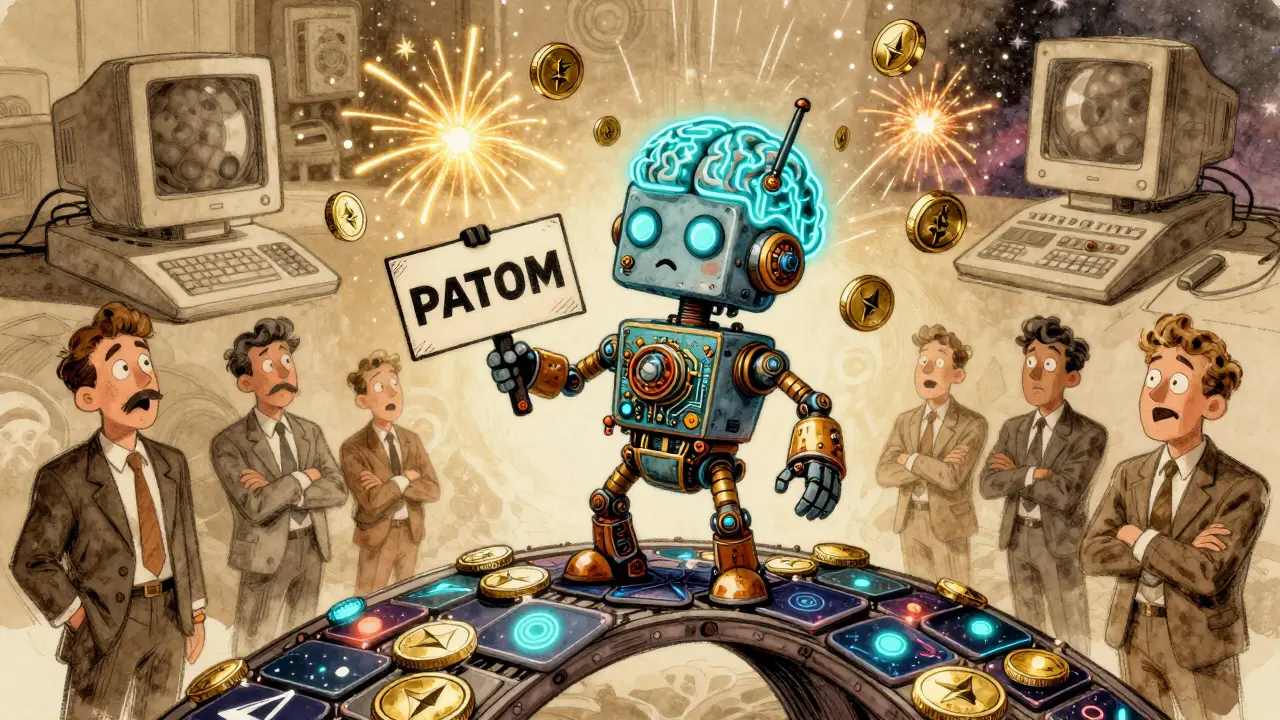
When you hear "pSTAKE Finance" or "PSTAKE coin," you might think of a simple staking token-something like Lido or Rocket Pool, where you lock up your crypto and earn rewards. But that’s not the full story anymore. As of early 2026, pSTAKE Finance has quietly shifted from being a liquid staking protocol to something far more ambitious: a research collective focused on the intersection of artificial intelligence and decentralized networks. And that change? It’s confused investors, split data across exchanges, and turned what was once a niche DeFi tool into a wildcard in the crypto space.
What pSTAKE Finance Used to Be
A few years ago, pSTAKE Finance was known for bridging two big blockchains: Ethereum and Cosmos. If you owned ATOM-the native token of the Cosmos network-you could deposit it into pSTAKE and get back pATOM, an ERC-20 token that worked on Ethereum. That meant you could use your staked Cosmos assets in Ethereum-based DeFi apps like Uniswap or Aave, all while still earning staking rewards. It was a clever workaround for users who wanted yield without giving up liquidity. At its peak, the protocol had over 14,000 token holders, according to Gate.com’s December 2025 report. It wasn’t the biggest player-Lido dominated Ethereum staking-but it carved out a real niche by connecting Cosmos validators with Ethereum’s DeFi ecosystem. The project was backed by heavy hitters: Binance Labs, Coinbase Ventures, DeFiance Capital, and Spartan Group. That kind of backing gave it credibility early on.The Big Pivot: From Staking to AI Research
Here’s where things get strange. If you visit pstake.finance today, you won’t find step-by-step guides on how to stake ATOM or BTC. Instead, the homepage talks about "onchain reasoning," "modular routing," and "verifiable AI flows." The project now describes itself as a research collective exploring how AI and decentralized systems evolve together. That’s not a minor update. It’s a complete overhaul. The team hasn’t abandoned staking-they’ve just shifted their focus. Instead of building bridges between chains, they’re now building AI agents that can verify smart contract logic in real time, predict liquidity needs, and optimize governance decisions using onchain data. Think of it like giving blockchain protocols a brain that learns from every transaction. This pivot coincided with a new partnership: Babylon. Now, pSTAKE lets users liquid stake Bitcoin through Babylon’s infrastructure. You deposit BTC, get pBTC tokens that represent your staked Bitcoin, and earn yield from securing other blockchain networks. This puts pSTAKE in the fast-growing BTCfi (Bitcoin finance) space, competing with projects trying to unlock Bitcoin’s yield potential without selling your coins.Tokenomics: Supply, Price, and Confusion
The PSTAKE token has a total supply of 500 million. As of January 2026, around 439.65 million are in circulation-so nearly 88% of all tokens are already out there. That’s a lot of supply floating around, which can pressure prices if demand doesn’t keep up. But here’s the real headache: no one agrees on the price. On Binance, PSTAKE trades at $0.000899. On CoinCodex, it’s $0.0009141. CoinMarketCap says the market cap is $360,000. Binance says it’s over $8 million. That’s more than a 20x difference. Why? Because data isn’t synced. Some exchanges list PSTAKE as a staking token. Others treat it as an AI research play. Some users are still buying it for Bitcoin staking. Others are betting on its AI future. The market is split-and that’s why 24-hour price changes vary wildly: CoinCodex shows an 8% drop, while Binance shows a 3.6% gain. Neither is wrong. They’re just reflecting different crowds.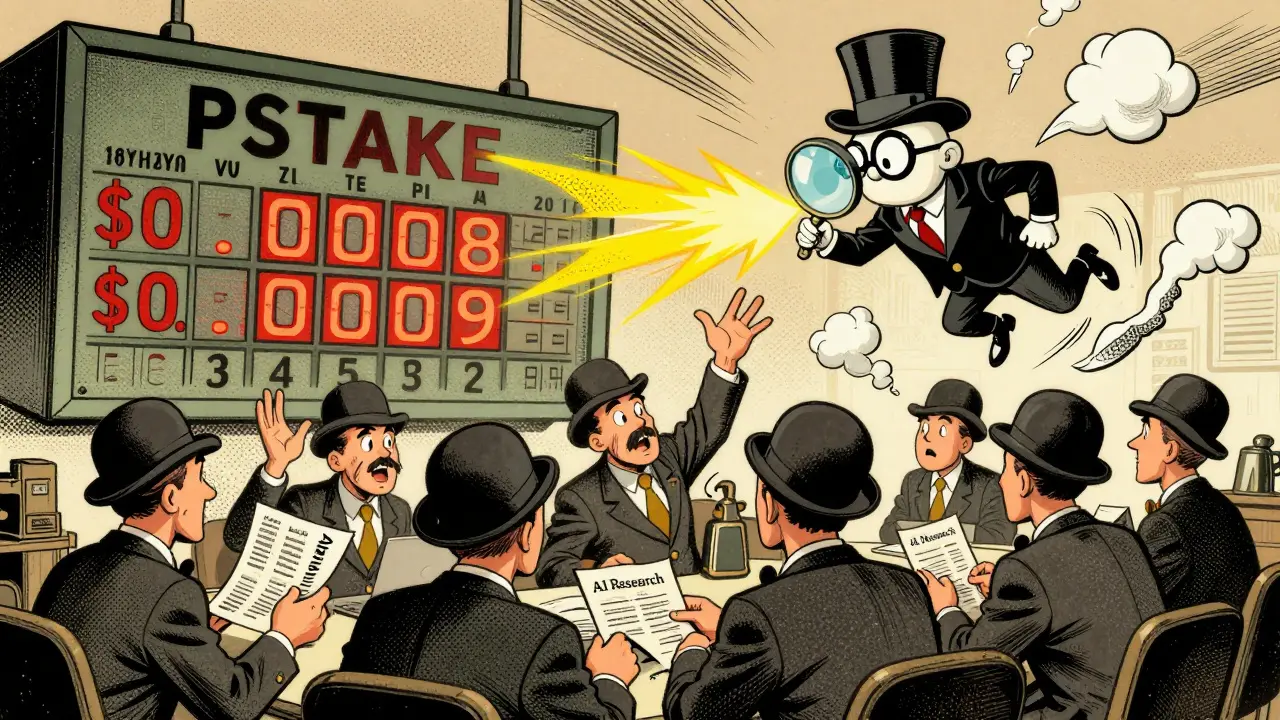
Why the Confusion Matters
This isn’t just a technical glitch. It’s a communication failure. When a project pivots, it needs to tell its users clearly. But pSTAKE’s website now reads like a research paper, not a user guide. If you’re new to crypto and you want to stake BTC, you’ll struggle to find instructions. The old documentation is still live on some exchanges, creating a mismatch between what users expect and what the project actually offers today. Investing.com’s technical analysis gives it a "Strong Sell" rating. Moving averages across 5-day to 200-day timeframes all point downward. That’s not because the tech is bad-it’s because the market doesn’t know what to value anymore. Is it a staking token? An AI token? A speculative bet? The lack of clarity is costing it credibility.Who’s Behind It? And Is It Safe?
The team hasn’t vanished. They’re still backed by the same big names: Binance Labs, Coinbase Ventures, DeFiance Capital. That’s a strong signal. These firms don’t throw money at random projects. They invest in teams with execution ability. Security-wise, pSTAKE has partnered with top audit firms: Halborn, Hexens, Oak Security, Immunefi, and Forta. That means their smart contracts have been reviewed by professionals. No public audit reports are available yet, but the fact that they’ve worked with these firms suggests they’re taking security seriously. Still, the real risk isn’t hacking-it’s ambiguity. If you’re holding PSTAKE, you’re betting on a team that’s trying to build AI for blockchain. That’s a long-term, high-risk play. There’s no guarantee this research will lead to a product, let alone a profitable one.How Does It Compare to Other Staking Projects?
Let’s put pSTAKE in context:- Lido (LDO): Dominates Ethereum liquid staking with a $1.2 billion market cap. Simple, clear, widely used.
- Rocket Pool (RPL): Decentralized staking on Ethereum. $380 million market cap. Trusted by hardcore DeFi users.
- pSTAKE (PSTAKE): Market cap under $1 million. Started as a bridge between Cosmos and Ethereum. Now pivoting to AI + Bitcoin staking.

Should You Buy PSTAKE?
If you’re looking for steady yield on Bitcoin or Ethereum? Skip it. Use Lido, Rocket Pool, or Babylon directly. But if you believe AI will reshape how blockchains operate-and you’re okay with high risk-then PSTAKE might be worth a small position. It’s not a staking coin anymore. It’s a bet on a team trying to build something no one else has: AI agents that run on blockchain, make decisions, and adapt in real time. The token’s low price ($0.0009) makes it look cheap. But cheap doesn’t mean good. It means uncertain. The real question isn’t "Is it undervalued?" It’s "Do you believe in AI-driven blockchain protocols?" If yes, then PSTAKE is one of the few tokens betting entirely on that idea.Where to Buy and Use PSTAKE
You can trade PSTAKE on:- Binance
- Gate.io
- Bybit
- CoinCodex-supported exchanges
What’s Next for pSTAKE?
The team hasn’t released a roadmap. No whitepaper update. No product launch date. That’s the biggest red flag. In crypto, silence often means delay-or worse, abandonment. But if they pull this off-if they actually build working AI agents that optimize DeFi protocols or automate governance-the upside could be massive. Imagine a system where your staking rewards adjust automatically based on network congestion, gas prices, and liquidity trends. That’s what pSTAKE claims to be building. For now, it’s still in the lab. And like any early-stage research project, it’s risky. But in crypto, the biggest winners often come from the projects no one understands-at first.Is pSTAKE Finance still a liquid staking protocol?
Partially. While pSTAKE still supports Bitcoin liquid staking through Babylon, its official focus has shifted from staking to AI research. The website now describes it as a research collective exploring AI and decentralized networks, not just a staking platform. So while you can still stake BTC, the project’s long-term goal is no longer centered on staking rewards.
Why are price and market cap numbers so different across exchanges?
The price and market cap discrepancies come from mismatched data feeds and different user bases. Some exchanges still list pSTAKE as a liquid staking token, while others treat it as an AI research project. This confusion leads to inconsistent trading behavior. Binance, for example, sees higher volume from traders betting on its AI future, while CoinCodex reflects more traditional staking investors. The token’s low liquidity and fragmented community amplify these differences.
Can I stake Bitcoin using pSTAKE right now?
Yes. pSTAKE integrates with Babylon’s infrastructure to allow users to liquid stake Bitcoin. You deposit BTC, receive pBTC tokens, and earn rewards from securing other blockchain networks-all while keeping your Bitcoin liquid. The process is similar to staking on other platforms, but documentation is limited, and the interface is geared toward advanced users.
Is pSTAKE safe to use?
The smart contracts have been audited by reputable security firms like Halborn, Hexens, and Immunefi, which is a good sign. However, safety isn’t just about code-it’s about clarity. Since the project’s direction changed without clear communication, users may be interacting with a platform they don’t fully understand. Always start with a small amount and use a non-custodial wallet.
What’s the difference between PSTAKE and LDO or RPL?
LDO and RPL are established liquid staking tokens focused on Ethereum, with clear use cases, large user bases, and high market caps. PSTAKE started as a bridge between Cosmos and Ethereum but has pivoted to AI research and Bitcoin staking. It’s smaller, less liquid, and its purpose is unclear to many users. LDO and RPL are proven tools. PSTAKE is a speculative bet on a future that hasn’t been built yet.
Why did pSTAKE pivot from staking to AI research?
The liquid staking market is crowded and dominated by giants like Lido. The team likely realized that competing head-on was unsustainable. By shifting to AI research, they’re entering a new frontier: using blockchain to power autonomous AI agents that can optimize DeFi, governance, and liquidity. It’s a bold move-and if it works, it could redefine how decentralized systems operate. But it’s also a high-risk bet with no guaranteed outcome.



Comments (18)
Tony Loneman
This isn't a project-it's a fever dream dressed in whitepaper silk. AI agents on-chain? Bro, if I wanted to buy a sci-fi novel, I'd go to Amazon. Not crypto. They're not building anything, they're just slapping buzzwords on a dead staking protocol and hoping the hype fairy shows up with a checkbook. And don't get me started on the price chaos-eight million? Three hundred grand? Someone's lying, and it ain't the market.
They're not pivoting. They're panicking. And now they're trying to convince us the panic is visionary. Wake up. This is what happens when VCs get bored with Lido and need a new toy to fund.
PS: If you're holding PSTAKE because you think 'AI on blockchain' is the next big thing, you're not an investor-you're a character in a Black Mirror episode.
Callan Burdett
Okay but imagine if this actually WORKS?? Like, AI agents that read onchain data and auto-adjust liquidity or predict governance votes?? That’s not crypto-that’s the future. We’re talking about self-learning DeFi. No more manual governance votes, no more gas wars, no more humans screwing things up. pSTAKE might be messy right now, but they’re building the brain of the next blockchain. And yeah, the docs suck, the price is all over the place, but that’s what happens when you’re 10 years ahead of the curve. I’m not buying for yield-I’m buying for the revolution. 🚀
Anthony Ventresque
I’m kinda torn. On one hand, the team has legit backing-Binance Labs, Coinbase Ventures, the whole crew. That’s not random money. On the other hand, why the hell is the website reading like a PhD thesis? If you’re trying to attract new users, you don’t throw jargon at them. You show them how to deposit BTC and earn yield. Simple. Clear. No fluff.
And the price discrepancies? That’s not market inefficiency-that’s a lack of communication. If the project doesn’t know what it is, how can the market?
I’m not selling, but I’m not buying more either. I’m watching. Waiting. Hoping they clean up their act.
Jason Zhang
Wow. So after all this time, they turned a simple staking tool into… a research lab? Cool. I guess now I’m supposed to be impressed that they stopped explaining how to use their product and started writing essays about AI reasoning. Great. I’ll just stick with Lido, thanks. At least I know what I’m getting. This feels like a startup that ran out of ideas and decided to rebrand as Elon Musk’s ghostwriter.
Katherine Melgarejo
So let me get this straight-you took a project that was literally called 'pSTAKE' and now you don't want to be known for staking? Cool. Cool cool cool. And you're surprised people are confused? Honey, you didn't pivot. You ghosted your own brand. 🤡
Also, the price on Binance says $0.000899. CoinMarketCap says $360k. That's like saying your car costs $5 or $50,000 depending on which Yelp review you read. Someone's drunk. Or lying. Or both.
Alexis Dummar
Look, I’m not a coder, but I’ve been in crypto since 2017. I’ve seen projects die because they lost their story. pSTAKE had a great one: bridge Cosmos and Ethereum. Simple. Useful. Now? They’re chasing a dream that doesn’t have a name yet. AI on-chain? Maybe. But you can’t just say it-you have to show it. And right now, the only thing they’re showing is confusion.
But here’s the thing-I believe in the team. They’re smart. They’ve got the right backers. If they release even a beta version of their AI agent that does one thing well-like auto-rebalancing liquidity pools-I’ll buy 10x more. Until then? I’m holding. Not buying. Just holding. Waiting for the proof.
Jill McCollum
Okay I just spent 20 mins reading this and I’m still not sure if I’m supposed to be excited or scared 😅
Like… I get that AI + blockchain is the future, but right now it feels like they’re trying to build a spaceship while still teaching people how to use a bicycle. The docs are a mess, the price is all over the place, and I don’t even know if I’m buying a staking token or a research paper with a ticker symbol.
But… I kinda love that they’re trying? 🤔 Maybe I’m just a sucker for bold bets. I’m putting in 0.5% of my portfolio. If it blows up, I’ll laugh. If it works? I’ll be the one saying I told you so. 💪
Josh V
AI on chain is the future and pSTAKE is the only one doing it stop talking about price and start thinking about what this means for the whole ecosystem if this works you are looking at a new era of crypto not just another staking token this is the real deal if you dont get it you dont deserve to be here
Stephen Gaskell
USA only. No more foreign crypto experiments. Lido is American. This is just another foreign scam pretending to be AI. Stop wasting time. Buy Bitcoin. Hold. Done.
CHISOM UCHE
From a technical standpoint, the integration of Babylon’s BTC staking infrastructure introduces a non-custodial, trust-minimized yield layer for Bitcoin, which is non-trivial. However, the token’s utility function is now bifurcated: it serves as both a governance instrument for AI-driven onchain reasoning modules and a liquidity proxy for pBTC issuance. The lack of a formalized tokenomics model for the AI layer creates an asymmetry in value accrual. Until the whitepaper is updated to delineate the incentive alignment between stakers, AI agents, and protocol revenue streams, this remains a high-entropy asset class.
Ashlea Zirk
While the conceptual ambition of integrating AI agents into decentralized financial infrastructure is commendable, the executional clarity required for sustainable user adoption is critically lacking. The dissonance between the project’s historical identity as a liquid staking bridge and its current positioning as an AI research collective has resulted in significant market fragmentation. Without a unified communication strategy, transparent roadmap, and publicly accessible audit reports, institutional participation remains improbable. This is not a critique of the technology-it is a critique of the communication strategy. In decentralized finance, trust is not derived from ambition alone, but from consistency, transparency, and predictability.
myrna stovel
Hey everyone-I’ve been holding PSTAKE since last year and I know it’s confusing. But let’s remember: every big thing started messy. Look at Ethereum in 2015. No one knew what it was either. pSTAKE isn’t trying to be the next Lido. They’re trying to be the first of something new. And yeah, the website is rough, the price is all over the place, and the docs are garbage-but that’s because they’re still building.
If you’re new, start small. Don’t put your rent money in. But if you believe in AI + blockchain? This is one of the few tokens betting everything on that. I’m not telling you to buy. I’m just saying: don’t dismiss it because it’s confusing. Sometimes the future looks like a mess… until it doesn’t.
Hannah Campbell
So they turned a staking coin into an AI startup and now the price is a meme? Classic. You know what’s worse than a scam? A scam that thinks it’s genius. They’re not building AI-they’re building confusion. And now they’re trying to sell us hope as a token. I’ve seen this movie. It ends with the team deleting their Twitter and vanishing to Bali. Save your gas fees. Buy Bitcoin. Or better yet-buy a sandwich. At least that won’t disappear.
nathan yeung
Man I’m from India and I’ve seen so many crypto projects come and go. But this one? I feel it. Not because of the price. Not because of the hype. But because the team isn’t trying to make a quick buck. They’re trying to solve a real problem-how do you make blockchains smarter? I don’t understand all the AI stuff, but I get that they’re trying something hard. And that’s rare.
I bought a little. Not because I think it’ll pump. But because I want to see if they can pull it off. If they do? I’ll be kicking myself for not buying more. If they fail? At least I tried to be part of something bold.
Bharat Kunduri
so i read all this and im like… wait they still do btc staking? or no? like i wanna stake my btc but now im not sure if i should even use this site. the website looks like a 2012 blog and the price is all over the place. i think i just gonna use babylon direct. this pstake thing is too much drama. also i think they misspelled ‘reasoning’ in one of the blogs. lol.
Chris O'Carroll
Let’s be real-this project is a walking contradiction. They say they’re not a staking protocol anymore, but they still let you stake BTC. They say they’re building AI, but there’s no demo, no beta, no GitHub repo. They have big backers, but zero transparency. The only thing consistent here is the confusion.
I used to love this project. Now? I just feel bad for them. They had something good, and instead of growing it, they tried to become a sci-fi movie. And now no one knows if they’re the hero… or the villain.
Kelly Post
I’ve been reading this thread and I just want to say-this is exactly why crypto needs more mentors, not more hype.
If you’re new and you’re wondering whether to buy PSTAKE, here’s the truth: if you don’t understand what you’re buying, don’t buy it. It’s not about being smart or dumb-it’s about being responsible. This isn’t a lottery ticket. It’s a bet on a team’s ability to build something no one’s seen before.
Ask yourself: Do you know how their AI agents work? Do you know where the revenue goes? Do you know who controls the keys? If you can’t answer those, wait. Watch. Learn. There’s no shame in sitting this one out. The best investors aren’t the ones who buy first-they’re the ones who understand last.
Ashlea Zirk
Thank you, Kelly, for articulating the most important point here: responsibility over speculation. I would add that the lack of a formal whitepaper revision or public roadmap is not merely an oversight-it is a governance failure. In a space where trust is the only asset, silence is the most dangerous signal. The team’s technical ambition is not in question. Their communication strategy, however, is actively eroding the very community they seek to empower. Until they publish a clear, accessible, and updated narrative-complete with milestones, risks, and team roles-they are not building a protocol. They are building a myth.