NFT Airdrop 2025: What’s Real, What’s Fake, and Where to Find Legit Drops
When you hear NFT airdrop, a free distribution of non-fungible tokens to wallet holders as a reward or promotion. Also known as NFT giveaway, it’s a way projects build early communities without selling tokens upfront. But in 2025, most NFT airdrops you see online are fake. Scammers copy real project names, fake websites, and even clone Twitter accounts to steal your private keys. The real ones? They don’t ask for your seed phrase. They don’t ask you to send crypto first. And they rarely pop up on random Telegram groups.
Real NFT airdrops in 2025 usually tie back to active platforms—like OpenSea, the largest NFT marketplace that once gave out SOS tokens to active traders—or to projects with actual usage, not just hype. Take the Mars Ecosystem Token (XMS), a DeFi token that ran a real airdrop in 2024 before fading. It had a working protocol, a clear distribution plan, and public records. Compare that to fake airdrops like SecretSky.finance, a site claiming to give away SSF tokens with no app, no team, and zero trading volume. The difference? One had history. The other is a trap.
What makes an NFT airdrop worth your time? Three things: proof of activity, public records, and no upfront cost. If a project has traded volume on a chain like Ethereum or Solana, if their token contract is verified on Etherscan or Solana Explorer, and if they’re announcing drops through their official website—not a Discord DM—you’re looking at something real. Projects like Spintop Network, which gave out SPIN tokens to early users of its gaming platform did it right. They tracked participation. They didn’t promise riches. They just rewarded users who actually used their product.
Meanwhile, the market is flooded with fake NFT airdrops tied to non-existent tokens like BSC AMP, SCIX, or xSuter—all labeled as "2025 drops" with zero proof. These aren’t opportunities. They’re phishing lures. The same people who pushed fake E2P airdrops on CoinMarketCap are now using the same scripts, just changing the token name. If you’re seeing a "NFT airdrop 2025" that looks too easy, it’s designed to look easy. That’s the whole point.
Real NFT airdrops in 2025 are rare. They’re quiet. They don’t need hype. They’re tied to projects that already have users, not just posters. You’ll find them in the footnotes of active NFT collections, in official blog posts, or in verified wallet history—not in a viral TikTok ad. The ones worth chasing are the ones you can verify, not the ones that scream "FREE TOKENS!"
Below, you’ll find real breakdowns of past NFT airdrops that worked, those that vanished, and the scams that are still active in 2025. No fluff. No promises. Just what happened, who got paid, and who got robbed.
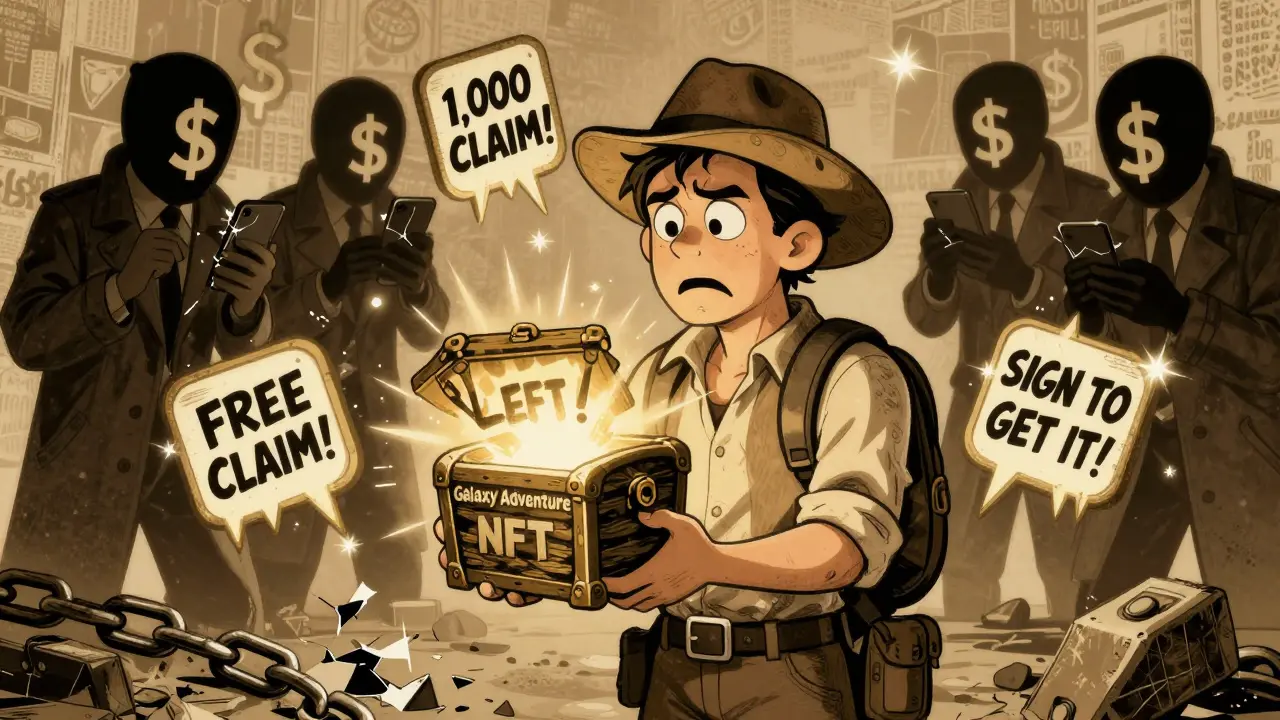
No Galaxy Adventure Chest NFT airdrop exists in 2025. This article exposes the scam behind fake NFT claims, shows how real airdrops work, and gives you steps to protect your wallet from crypto thieves.
Continue reading