
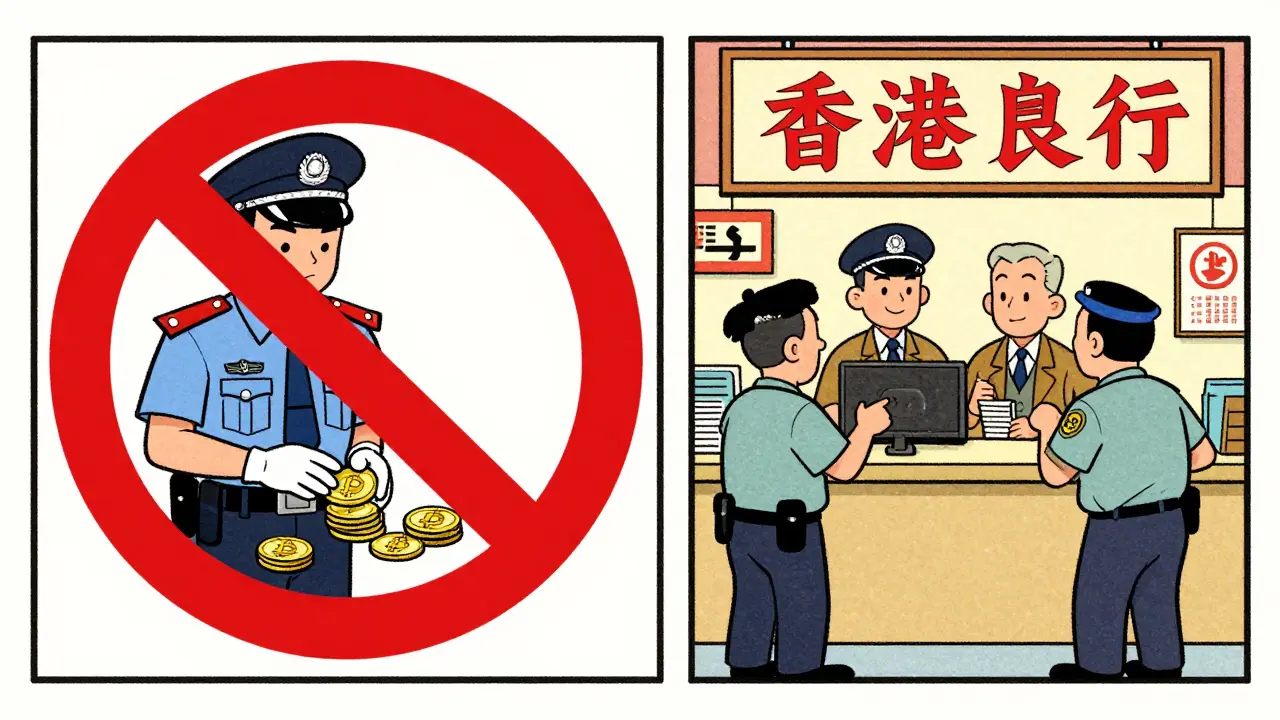
As of 2025, businesses in mainland China face severe criminal penalties for accepting cryptocurrency payments. This isn't just a restriction-it's a complete ban backed by new laws that make owning or transacting in Bitcoin, Ethereum, or any other digital currency illegal. The China cryptocurrency ban is absolute-no exceptions for businesses. The People's Bank of China China's central bank responsible for monetary policy and financial regulation declared all crypto transactions illegal in 2021, but the situation worsened significantly with legislation passed on May 30, 2025. That law criminalizes personal ownership of cryptocurrencies, eliminating any competition to China's state-backed digital yuan.
Current Legal Status of Cryptocurrency in China
China's regulatory approach has evolved from cautious warnings to total prohibition. Before 2025, businesses could technically accept crypto but faced heavy restrictions. Now, the law explicitly states that all cryptocurrency activities are illegal financial operations. This includes accepting payments, mining, trading, or even holding digital assets. Financial institutions must block any crypto-related transactions, and internet companies are required to monitor and report crypto content. The Ministry of Public Security Chinese law enforcement agency tasked with combating financial crimes actively enforces these rules, conducting raids on businesses suspected of crypto use.
Timeline of China's Crypto Regulations
China's crackdown on cryptocurrency wasn't sudden. It began in 2013 when banks were banned from handling Bitcoin transactions. By 2017, Initial Coin Offerings (ICOs) were banned, and domestic crypto exchanges were shut down. In 2021, the People's Bank of China declared all crypto transactions illegal nationwide and banned mining. 2022 saw courts refuse to recognize crypto-related civil disputes. By 2024, authorities started making arrests for unlicensed crypto activity. The 2025 legislation took it further-making cryptocurrency ownership itself a criminal offense. This systematic progression shows China's commitment to total control over financial systems.

Enforcement and Monitoring Mechanisms
China's enforcement system is designed to be impossible to evade. Financial institutions use automated monitoring tools to scan customer transactions for any crypto activity. If detected, funds are frozen and reported to regulators. The Cyberspace Administration of China Government agency overseeing internet content and data security blocks access to overseas crypto exchanges for Chinese residents. Businesses attempting crypto payments face immediate investigations. Penalties include prison sentences of up to five years, fines up to 200% of transaction value, and permanent business license revocation. There's no gray area-any crypto-related activity triggers enforcement action.
| Aspect | Mainland China | Hong Kong SAR |
|---|---|---|
| Legal Status | Complete criminal prohibition | Licensed exchanges allowed |
| Business Acceptance | Illegal for all businesses | Permitted with licenses |
| Regulatory Body | People's Bank of China, Ministry of Public Security | Hong Kong Securities and Futures Commission |
| Enforcement | Arrests, seizures, criminal charges | Regulated compliance |
| State Digital Currency | Digital yuan (e-CNY) China's state-backed digital currency, replacing cash for transactions is the only legal option | Not applicable |
Why China Banned Cryptocurrency
China's government views cryptocurrencies as a direct threat to its financial control. Digital currencies like Bitcoin allow anonymous transactions, which could enable capital flight and undermine the state's ability to monitor money flows. This directly conflicts with China's goal of promoting the digital yuan-a currency the government can fully control and track. By banning crypto, China eliminates competition for its own digital currency while maintaining strict oversight of all financial activity. The blockchain innovation State-sanctioned blockchain development under government supervision is still encouraged, but only for projects that align with central bank policies.
What Businesses Should Do Instead
For businesses operating in mainland China, the digital yuan is the only legal digital payment option. The government has rolled out the digital yuan for everyday transactions, with millions of merchants already using it. Businesses should integrate the digital yuan through official banking channels or approved payment processors. There are no exceptions-any attempt to accept Bitcoin, Ethereum, or other cryptocurrencies will result in legal action. Companies expanding into China must avoid crypto entirely and focus on compliant payment methods like the digital yuan or traditional banking systems.
Frequently Asked Questions
Can businesses in mainland China accept cryptocurrency payments legally?
No. As of 2025, all cryptocurrency transactions in mainland China are illegal under criminal law. Businesses accepting crypto face severe penalties including imprisonment, fines, and asset seizures. The law makes no exceptions for any type of business or transaction.
Is there any way around China's crypto ban for businesses?
No. The 2025 legislation explicitly criminalizes cryptocurrency ownership and transactions. There are no legal loopholes or special exemptions for businesses. Even using crypto for international transactions is illegal if the business operates in mainland China. The only compliant payment method is the digital yuan.
How does Hong Kong's crypto policy differ from mainland China?
Hong Kong has a completely different approach. It allows licensed crypto exchanges, stablecoin operations, and crypto-related services under strict regulations. Businesses in Hong Kong can legally accept cryptocurrency payments with proper licensing. However, this only applies within Hong Kong SAR-mainland China's ban still applies to all operations based there.
What happens if a business accidentally accepts crypto in China?
Accidental acceptance still triggers legal consequences. Authorities investigate all crypto-related transactions, regardless of intent. Businesses must immediately report and freeze any crypto funds received. Ignoring the issue or attempting to hide it will lead to harsher penalties. The only safe course is to avoid crypto entirely.
Can foreign businesses accept crypto from Chinese customers?
No. Chinese law prohibits residents from using cryptocurrency for any transactions, including international ones. If a Chinese customer tries to pay with crypto to a foreign business, the transaction will be blocked by Chinese financial institutions. The foreign business itself isn't directly liable, but the Chinese customer faces legal risks for initiating the transaction.





Comments (15)
Joshua Herder
The Chinese government's absolute ban on cryptocurrency is a catastrophic overreach.
This isn't just about financial control-it's a full-blown power grab disguised as regulation.
They're so terrified of losing authority that they're willing to stifle innovation and criminalize personal financial freedom.
Bitcoin and Ethereum were created to escape centralized control, and China's move only proves how right we were.
Imagine being locked in a digital cage where every transaction is monitored. It's Orwellian nonsense.
The digital yuan is nothing but a surveillance tool disguised as progress.
They claim it's for 'financial stability,' but it's really about control.
This ban will only drive crypto underground, where it's harder to regulate.
Businesses are being forced to choose between compliance and survival.
The next step could be banning private banking altogether.
This is a slippery slope toward total authoritarianism.
The world should be outraged.
China's leadership is playing with fire, and the consequences will be severe.
This isn't progress-it's regression.
The government's obsession with control is blinding them to the benefits of decentralized finance.
They're destroying opportunities for their citizens.
This ban is a mistake that will haunt them for decades.
Trust me, I've seen this before. Centralized systems always fail.
The people will find a way around it. Always do.
Matt Smith
This ban is a total disaster for innovation! 🤦♂️ China's just scared of losing control, but this will backfire big time. Crypto's the future, people! 🚀💸
Alex Garnett
This regulation is necessary for national security. The digital yuan is a superior system; any attempt to circumvent it is unpatriotic and foolish.
sachin bunny
China's banning crypto to control people. They don't want freedom! Digital yuan is just a surveillance tool. 😡🔒
Katie Haywood
Well, looks like China's really doubling down on control. Digital yuan here we come. No choice but to adapt, I guess. 😒
Danica Cheney
Crypto ban bad.
Molly Andrejko
This information is crucial for businesses to navigate the new regulations! It's important to stay compliant with the digital yuan system, to avoid legal issues. Let's all work together, to ensure smooth transitions! :)
Freddie Palmer
This is a critical development for global finance; it's fascinating how different regions approach digital currency regulation. The Hong Kong vs. mainland China contrast presents a compelling case study in regulatory divergence.
David Bain
The dichotomy between state-controlled digital currencies and decentralized cryptocurrencies presents a fundamental tension in modern monetary systems. This regulatory stance reflects a broader epistemological conflict regarding the nature of value and sovereignty.
Jim Laurie
This is a game-changer for sure! Gotta use digital yuan now. No room for mistakes, folks. Stay safe and compliant! 😊
Kyle Pearce-O'Brien
The existential conflict between decentralized finance and centralized authority is profound. This ban represents a regression into authoritarian control. 🤔💸
Josh Flohre
Businesses that ignore this law are reckless. The penalties are severe for a reason-crypto is inherently risky and unregulated. Compliance is non-negotiable.
Nathaniel Okubule
It's essential for businesses to adopt the digital yuan immediately. This ensures compliance and avoids legal issues. Stay informed and proactive.
Matthew Ryan
This is important info. Need to make sure businesses comply with digital yuan. Good to know the details.
Olivette Petersen
The digital yuan is the future of payments in China. Businesses must adapt quickly to stay compliant. This is a necessary step for financial stability. Let's embrace the change and move forward together!