
Think you can just hold onto your Bitcoin and forget about the taxman? Think again. In Australia, the Australian Taxation Office (ATO) doesn't see your digital coins as currency; they see them as property. This distinction is everything. Because your crypto is treated like a house or a share, every time you swap, sell, or even spend it, you're potentially triggering a taxable event. If you don't get the math right, you're not just risking a fine-you're leaving money on the table, especially when it comes to the massive 50% discount available for patient investors.
The Basics of CGT Treatment for Crypto
To get a handle on Capital Gains Tax (CGT) in Australia, you first need to understand that it isn't a separate tax. It's part of your income tax. When you dispose of an asset for more than it cost you to acquire, that profit is a "capital gain." This gain is added to your other income for the year and taxed at your marginal rate.
What counts as a "disposal"? It's more than just cashing out to AUD. You trigger a CGT event when you:
- Sell crypto for Australian Dollars.
- Trade one cryptocurrency for another (e.g., swapping BTC for ETH).
- Use crypto to buy a coffee or a car.
- Gift crypto to someone else.
For the 2024-2025 financial year, those gains are taxed based on your total income. For someone earning between $18,201 and $45,000, the rate is 19%. If you're a high flyer earning over $180,000, you're looking at 45%, plus a 2% Medicare levy. The good news? Your standard tax-free threshold of $18,200 still applies to these gains.
The Magic of the 50% CGT Discount
If there's one rule you must memorize, it's the 12-month mark. This is where Crypto taxation in Australia becomes much friendlier for "HODLers." If you hold your crypto asset for at least 12 months before selling, you qualify for a 50% CGT discount. This means you only pay tax on half of your profit.
Let's look at a real-world scenario. Imagine you bought some Solana (SOL) for $1,100 and paid a $100 transaction fee, making your total cost base $1,200. You later sell it for $2,000. Your total gain is $800.
- Held for 6 months: You add the full $800 to your taxable income.
- Held for 14 months: You apply the discount, and only $400 is added to your taxable income.
As tax experts like John Morgan from Deloitte have noted, this is the single biggest tax planning opportunity for investors. For a high-income earner with a $100,000 gain, waiting until the 12-month mark could literally save them $18,000 in taxes.
Investor vs. Trader: The Dangerous Line
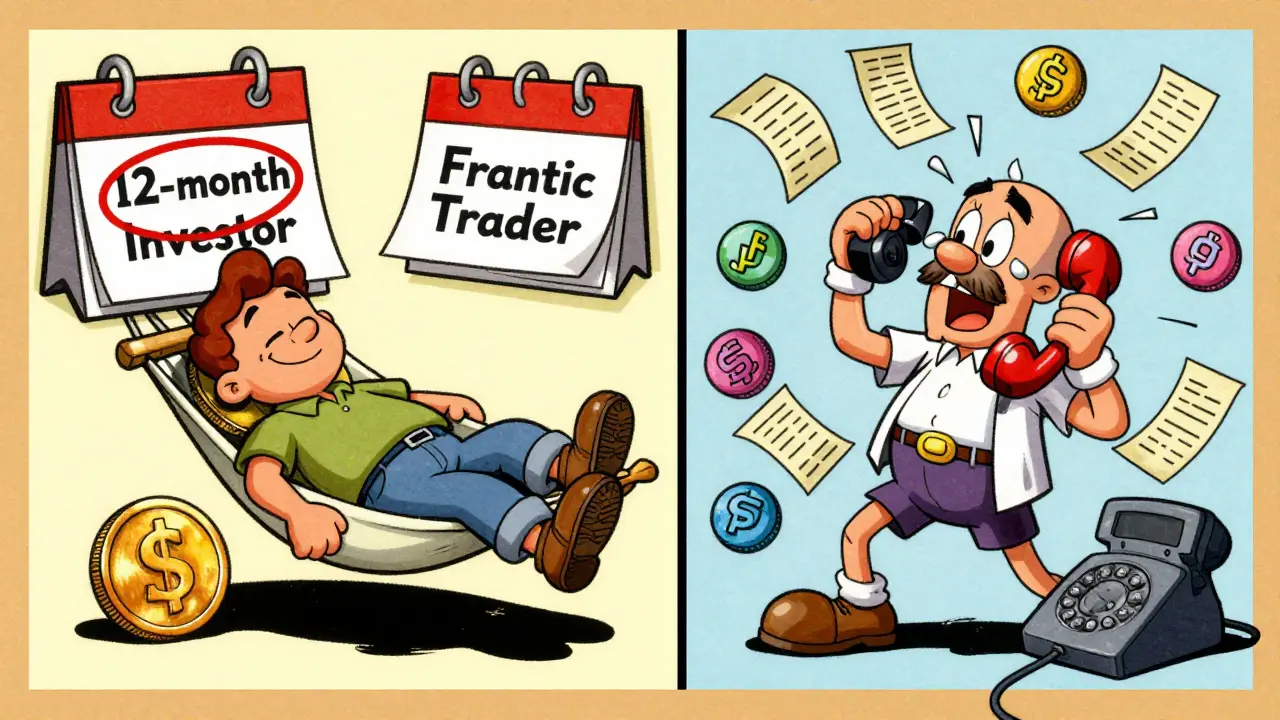
Not everyone gets to enjoy the CGT discount. There is a sharp divide between being a "passive investor" and "carrying on a business" as a trader. If the ATO decides you are a professional trader-perhaps because you make 100+ transactions a year or use complex high-frequency strategies-they may classify your gains as ordinary income.
If you're labeled a trader, the 50% CGT discount vanishes. Every cent of profit is taxed at your marginal rate, regardless of how long you held the asset. Dr. Michael G Gardner from the University of Melbourne has pointed out that this creates a lot of uncertainty. Many people think they are just "investing," only to have the ATO challenge that status during an audit.
| Feature | Passive Investor | Active Trader (Business) |
|---|---|---|
| Tax Treatment | Capital Gains Tax (CGT) | Ordinary Income Tax |
| 12-Month Discount | Eligible for 50% discount | Generally Not Eligible |
| Tax Rates | Marginal Rate (on discounted gain) | Full Marginal Rate |
| Record Keeping | Per-asset cost base tracking | Business accounting standards |
The Hidden Traps: Network Fees and Airdrops
The ATO's view of crypto as property creates some "invisible" tax events that catch people off guard. One of the biggest is the "transfer fee trap." When you pay a network fee (gas) in crypto to move funds, you are technically disposing of that crypto. You must calculate the capital gain or loss on the specific amount of crypto used to pay that fee.
Then there are Airdrops and staking rewards. These aren't CGT events at the start. Instead, they are treated as ordinary income at the market value on the day you receive them. This becomes your "cost base." When you eventually sell those rewards, you then trigger a CGT event based on the difference between the value when received and the value when sold.
For those venturing into NFTs (Non-Fungible Tokens), the same CGT rules generally apply. However, many users try to claim the "personal use asset" exemption (which can exempt assets under $10,000). Be careful here-the ATO is strict. If you bought the NFT intending to flip it for profit, it's not a personal use asset, and you owe the tax.
Practical Implementation and Record Keeping
Calculating your tax manually is a nightmare. Since the ATO requires you to track each asset separately, a year of active trading can take 15 to 20 hours of manual spreadsheet work. You need to track the acquisition date, the cost in AUD, and the disposal date for every single transaction.
While the ATO provides some tools, most people turn to Crypto Tax Software like Koinly or CoinTracker. These tools sync with your exchanges via API to automate the process. This is especially critical now that the ATO has direct data-sharing agreements with major Australian exchanges like CoinSpot and Swyftx. They know what you're doing; the goal now is to ensure your reporting matches their data.
One professional tip: always use the "specific identification" method for your cost base. This allows you to choose which specific unit of crypto you are selling, which can help you strategically manage your capital gains and losses to lower your tax bill.

Dealing with Losses
The silver lining in a bear market is the ability to offset losses. If you have a project that crashed to zero, you can use that capital loss to reduce your total taxable capital gains. For example, if you made $10,000 on Bitcoin but lost $4,000 on a failed NFT project, your net taxable gain is only $6,000. If your losses exceed your gains, you can carry those losses forward to future financial years, effectively creating a tax shield for your future profits.
Does the 50% CGT discount apply to all cryptocurrencies?
Yes, as long as the asset is held for at least 12 months and you are acting as an investor rather than a professional trader. This applies to Bitcoin, Ethereum, and other tokens recognized as property by the ATO.
What happens if I trade BTC for ETH?
This is a taxable event. You must calculate the AUD value of the BTC at the moment of the trade. If that value is higher than what you originally paid for the BTC, you have a capital gain that must be reported.
Are staking rewards taxed differently than holdings?
Yes. Staking rewards are treated as ordinary income at the time of receipt. Only when you later sell those rewards do they enter the CGT framework.
Can I claim a tax deduction for my crypto losses?
You cannot deduct crypto losses from your regular salary, but you can use them to offset other capital gains. If you have no gains this year, you can carry the loss forward to future years.
Will the ATO find out about my offshore exchange accounts?
Increasingly, yes. Through international data-sharing agreements and the Digital Asset Data Exchange, the ATO is gaining visibility into global accounts. It is always safer to disclose and pay than to face penalties and interest.
Next Steps for Different Investors
For the Long-Term Holder: Focus on your hold dates. If you are close to the 12-month mark, waiting a few extra weeks can literally cut your tax bill in half. Keep a clean log of your initial purchase dates.
For the Frequent Trader: Start treating your trading like a business. Keep a detailed ledger and consult a tax professional to determine if you should be filing as a business or an investor. You may need to shift from simple CGT tracking to a full profit-and-loss statement.
For the DeFi User: Be extra cautious with liquidity pools and yield farming. These often involve frequent swaps and reward distributions that trigger multiple tax events. Using specialized software is almost mandatory here to avoid missing taxable events.





Comments (22)
Jagdish Sutar
This is a really helpful breakdown for anyone starting out in Australia. It's great to see the distinction between investing and trading explained so clearly for the community!
Kathleen Bergin
Koinly is the only way to go. Doing this by hand is just a waste of time.
Greg Reynolds
The distinction between a passive investor and a trader is intentionally vague. The ATO keeps it that way so they can arbitrarily decide who to hammer during an audit based on transaction volume regardless of intent.
Alex Hunter
That's a fair point about the ambiguity. I think the best way to handle it is to keep a very detailed log of why you made certain trades to prove your intent if things ever go south.
Mike Krasner
imagine actually paying taxes lol just keep it in cold storage and pretend it doesnt exist
Guy Bianco
I would strongly advise against that approach. The ATO's data-sharing agreements are quite comprehensive these days. :)
Robert Mosolygo
The data sharing is just the beginning. They want a full ledger of every single digital movement to implement a social credit system tied to your wallet. If you think the API sync is for your convenience, you're delusional. They are mapping the entire network to freeze assets once the CBDCs are fully rolled out to ensure total state control over individual wealth.
Charlie Queen
Whoa there! Let's keep it positive! 🌈 I think it's just about making sure everyone pays their fair share for the roads and hospitals! 🇦🇺✨
Ali Tate
absolute madness that the state thinks it owns a slice of my digital gold just cause i moved it from one chain to another total robbery
Keith Garcia
The sheer audacity of the plebeian class to complain about a standard capital gains framework is truly breathtaking. 🙄 It is a simple matter of civic duty, though I suppose the nuance of fiscal responsibility is lost on those who trade 'meme coins' in their bedrooms. 💅
Miranda Jamieson
Stop whining and just use the software. If you're too lazy to track your cost base, you deserve the audit.
Lisa Camp
JUST GET YOUR RECORDS DONE NOW! DO NOT WAIT UNTIL JUNE! GET IT DONE!
Larry Yang
The specific identification method is a total lifesaver if you've got a mix of bags. Most people just use FIFO and leave money on the table because they're too lazy to optimize.
Sarah Fisher
It's interesting how we view currency as property now. It shifts the entire philosophy of money from a medium of exchange to a speculative asset.
Tony Gurley-Ward
Property, currency, magic beans... it's all just numbers on a screen until the government decides they want a cut of the feast!
Jennifer L
I feel so overwhelmed reading this!! The idea of a transfer fee being a taxible event is just... truly heartbraking for the litle guy. I hope evryone finds a way to stay calm and organized throuogh this process. 🌸
Alex Wan
I must concur with the sentiment that meticulous record keeping is paramout! One might find themselves in a quite precarious position should the authorities request a full audit of one's digital holdings. I have personally found that a cloud-based ledger is most effectve for such endeavors, though one must remain vigilant regarding security! 😅
jill huyo-a
I wonder if the personal use asset exemption is ever actually granted for NFTs that aren't just art, like utility tokens. It seems like a very gray area.
Paige Raulerson
The utility argument is a joke. If it's on a blockchain, it's an asset. Period.
Sara Ellis
who cares about the rules anyway just vibe with it
praveen subbiah
INDIA WILL SOON HAVE THE BEST CRYPTO LAWS IN THE WORLD! Our digital infrastructure is becoming legendary! 🇮🇳
Findlay Duncan Lyon
Cheers for the info. Super useful for the expats.