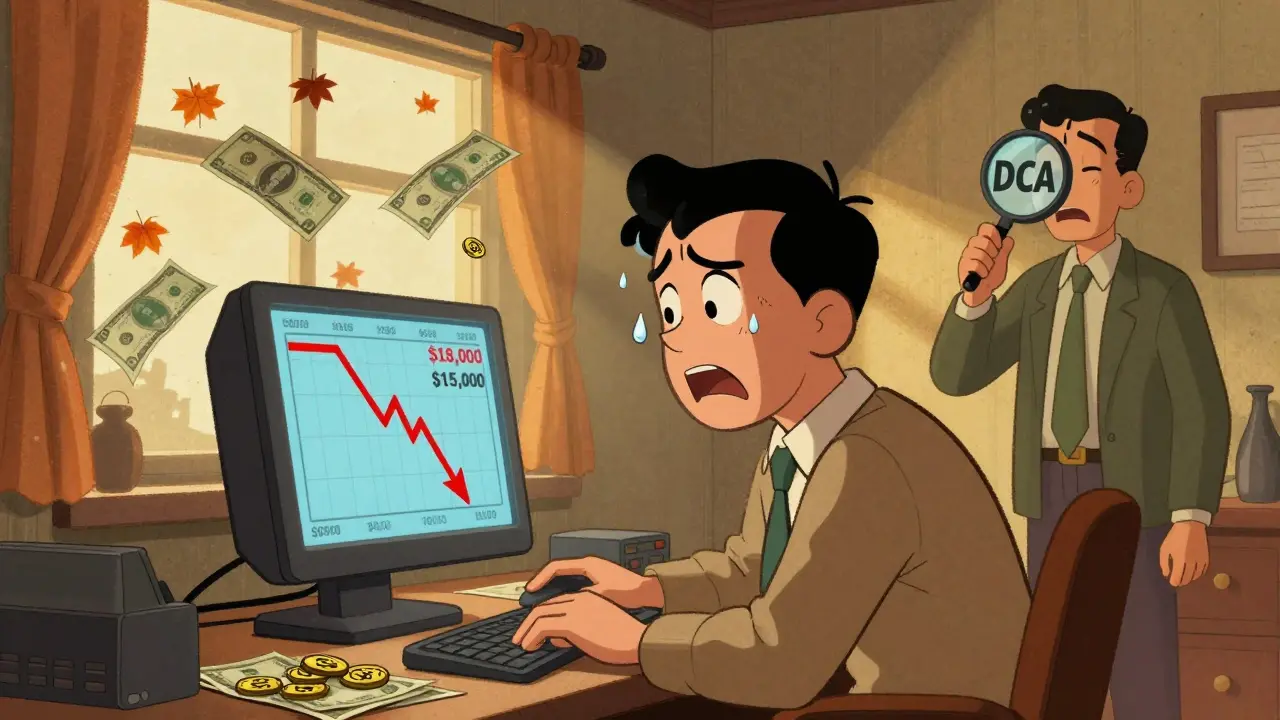
When Bitcoin drops 70% in a year and your portfolio feels like it’s evaporating, it’s not just a market correction-it’s a bear market. And for crypto investors, these aren’t rare events. Since 2010, Bitcoin has gone through four major bear markets, each wiping out 80% or more of its peak value. The last one, from November 2021 to December 2022, saw Bitcoin crash from $68,789 to $15,590. That’s not a glitch. That’s the pattern.
Most people panic. They sell. They quit. But the ones who survive-and even thrive-are the ones who understand how bear markets work and what to do when fear takes over.
What a Crypto Bear Market Really Looks Like
A crypto bear market isn’t just a price drop. It’s a prolonged collapse, usually lasting 10 months or more, with losses often exceeding 80%. Unlike stock markets, where a 35% drop is considered severe, crypto’s smaller size and high leverage make it far more volatile. In 2018, Bitcoin fell 84%. In 2022, it dropped 77%. And those aren’t outliers-they’re the norm.
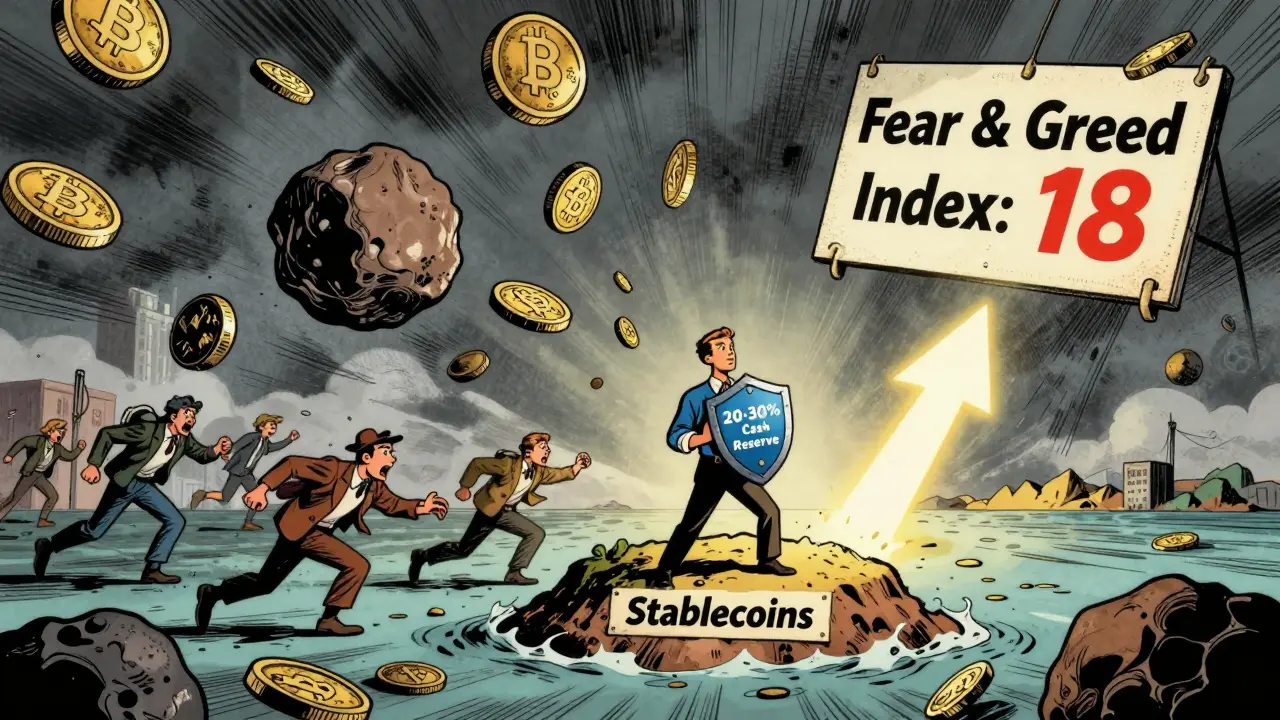
During these periods, liquidations spike. In October 2024 alone, over $870 million in crypto positions were wiped out in a single day. The Fear and Greed Index, which measures market sentiment, routinely plunges below 30-sometimes even below 20. That’s deep fear. And when it hits, most retail investors do the wrong thing: they sell low.
But here’s the truth: bear markets aren’t designed to destroy you. They’re designed to separate the weak from the strong. The smart ones don’t run. They prepare.
Strategy 1: Dollar-Cost Averaging (DCA) Is Your Best Friend
DCA isn’t sexy. It doesn’t make headlines. But it’s the most reliable way to survive a crypto bear market.
Here’s how it works: instead of trying to time the bottom, you buy a fixed amount of Bitcoin or Ethereum every week-no matter if the price is $20,000 or $10,000. In the 2018-2019 bear market, investors who bought $100 of Bitcoin every week ended up with a 223% return by 2021.
Why does this work? Because you buy more when prices are low. When Bitcoin crashed to $16,000 in late 2022, those who kept buying accumulated coins at rock-bottom prices. One Reddit user, u/CryptoHodler42, allocated 10% of their portfolio monthly during that range and ended up with 185% unrealized gains by mid-2024.
Don’t wait for the “perfect” price. That price doesn’t exist. The market doesn’t announce bottoms. It just drops-and keeps dropping. DCA removes emotion. It turns panic into discipline.
Strategy 2: Keep Cash Ready-But Not in Your Wallet
Having cash during a bear market isn’t about sitting idle. It’s about being ready to act when others are running.
Experts like Michael van de Poppe and Gemini’s Chief Economist Motohiro Okubo say the best buying opportunities happen when the Fear and Greed Index falls below 20. That’s the point of maximum fear. And historically, every major Bitcoin bottom has occurred there.
So keep 20-30% of your portfolio in stablecoins like USDC or USDT. Not because you think crypto is dead, but because you know it will recover. When FTX collapsed in November 2022, Bitcoin dropped to $16,000. Investors who had 25% in USDC were able to buy more Bitcoin at $15,500-then watched it climb back to $40,000 within months.
Stablecoins aren’t an exit. They’re ammunition.
Strategy 3: Diversify Beyond Crypto
Putting 100% of your money into crypto during a bear market is like betting everything on one horse in a storm.
During the 2022 bear market, investors who split their portfolio into 30% Bitcoin, 20% Ethereum, 20% altcoins, 20% stablecoins, and 10% traditional assets (like gold or S&P 500 ETFs) saw 42% smaller losses than those who stayed 100% in crypto.
Why? Because crypto is no longer isolated. Bitcoin’s 90-day correlation to the S&P 500 hit 0.72 in 2022-meaning it moves with stocks. When interest rates rose, both markets fell together.
So if you’re holding crypto, don’t ignore the rest of your financial life. Bonds, gold, even dividend stocks can act as shock absorbers. You don’t need to abandon crypto. Just don’t put all your eggs in one basket.
Strategy 4: Use Technical Indicators, Not Gut Feelings
When prices are falling, your gut says: “Sell now!” But your gut is wrong.
Instead, use tools that have proven themselves over multiple cycles:
- The Mayer Multiple: Divide Bitcoin’s price by its 200-day moving average. When it falls below 0.85, it’s historically been a strong buy signal. This happened in 2015, 2019, and 2023-and each time, Bitcoin rebounded within months.
- The 200-week moving average: This longer-term indicator has correctly signaled major bottoms in 2015, 2019, and 2023. If Bitcoin holds above this line during a dip, it’s a sign the long-term trend isn’t broken.
- Fear and Greed Index below 30: This isn’t just a number. It’s a signal. When it drops below 30, historical data shows 68% of DCA investors made money within 18 months.
These aren’t magic formulas. They’re patterns. And they’ve held up through four bear markets.
Strategy 5: Never Risk More Than 2% Per Trade
One of the biggest mistakes investors make is over-leveraging.
During the Luna collapse in 2022, one trader on BitcoinTalk lost $28,500 in 72 hours because he used 10x leverage on a short position. He thought he was smart. He was just lucky until he wasn’t.
According to Twitter analyst TheTrendOracle, 63% of traders who stuck to the “2% rule”-risking no more than 2% of their total portfolio on any single trade-made it through the 2022-2023 bear market without major losses. Only 29% of those risking 5% or more survived.
Don’t try to double your money in a week. Don’t short just because the price is falling. Don’t chase memecoins. Stick to the plan. If you’re not sure, don’t trade. Just hold. Or DCA.
Strategy 6: Learn-Don’t Just Watch
The most successful investors during bear markets aren’t the ones who made the most money. They’re the ones who learned the most.
Fidelity found that investors who completed structured education programs-like Binance Academy’s Bear Market Survival Course-were 3.2 times less likely to panic-sell during a crash.
Learn how blockchain works. Understand how mining adjusts after a halving. Study how institutional adoption is changing the market. Read reports from Kraken, Coinbase, and Binance Research. Don’t just scroll TikTok for “crypto guru” hot takes.
Knowledge isn’t just power. It’s emotional armor.

What’s Different This Time?
Yes, bear markets have happened before. But the crypto landscape is changing.
Since 2021, institutional holdings of Bitcoin have jumped from 12% to 28% of total supply. The SEC’s approval of spot Bitcoin ETFs in early 2024 reduced the severity of the next bear market to a 52% drop-far less than the 80%+ crashes of the past.
Derivatives markets have grown too. CME Bitcoin futures open interest hit $7.2 billion in October 2024-up from $1.8 billion in 2020. That means big players can hedge risk without crashing the market.
And adoption? It’s still growing. Chainalysis reported in September 2024 that active blockchain addresses rose 18% year-over-year-even during the bear market.
This isn’t 2018 anymore. The market is bigger. More stable. More resilient.
What to Avoid
Here’s what kills people in bear markets:
- Leverage: 87% of retail traders lose money shorting crypto. Don’t be one of them.
- Chasing pumps: If a coin doubles in 3 days, it’s probably a trap. Wait for the dust to settle.
- Ignoring fundamentals: Don’t buy a coin just because it’s cheap. Ask: Does it have real users? Real development? Real utility?
- Listening to hype: “This time it’s different” is the oldest lie in finance.
Remember: the goal isn’t to make a quick profit. The goal is to survive until the next bull market.
Final Thought: Bear Markets Build Fortunes
Every billionaire in crypto made their money during a bear market. Not by timing the bottom. But by staying calm, buying consistently, and holding through the pain.
Bitcoin didn’t go from $15,000 to $60,000 because people were excited. It went there because smart investors bought when everyone else was scared.
If you’re reading this right now, and your portfolio is down, don’t despair. You’re not behind. You’re exactly where you need to be.
The next bull market isn’t coming because the price bounced. It’s coming because people kept buying when no one else would.
Be one of them.
How long do crypto bear markets usually last?
Historically, crypto bear markets last around 10 months on average, based on data from 2013 to 2023. Some, like the 2018 downturn, lasted a full year. The 2022-2023 bear market lasted about 13 months. While there’s no fixed timeline, most recoveries begin after 8-12 months, especially after Bitcoin’s halving events.
Should I sell my crypto during a bear market?
Only if you need the cash for living expenses. Otherwise, selling locks in your losses. The best performers during bear markets are those who hold or buy more. Selling in panic means you miss the recovery. Bitcoin has recovered from every single bear market in its history.
Is dollar-cost averaging really effective in bear markets?
Yes. Investors who consistently bought Bitcoin weekly during the 2018-2019 bear market saw a 223% return by 2021. DCA works because it lets you buy more coins when prices are low. It removes emotion and turns market crashes into opportunities.
What’s the best indicator to know when to buy in a bear market?
The Mayer Multiple (Bitcoin price divided by its 200-day moving average) below 0.85 has signaled major buying opportunities in every past cycle. The Fear and Greed Index below 20 is another strong signal. Both are backed by historical data, not guesswork.
Can I make money shorting crypto in a bear market?
A few skilled traders can, but 87% of retail traders lose money shorting crypto due to funding rates, liquidations, and sudden rallies. It’s high-risk and requires constant monitoring. For most people, buying the dip with DCA is far safer and more profitable over time.
How much of my portfolio should I keep in stablecoins?
Keep 20-30% in stablecoins like USDC or USDT. This gives you dry powder to buy during extreme fear events. Investors who held 25% in stablecoins during the FTX collapse in 2022 achieved 37% higher returns during the recovery.
Is crypto still a good investment during a bear market?
Yes-if you’re thinking long-term. Blockchain adoption keeps growing, even during price drops. Active addresses rose 18% in 2024 despite the bear market. Institutional interest is increasing. The market is maturing. Bear markets are where fortunes are built-not where they’re lost.




Comments (23)
Alexandra Wright
Oh wow, another ‘buy the dip’ sermon. Let me guess-you also think ‘HODL’ is a religion and your crypto portfolio is your spiritual backup plan? Sweet. Meanwhile, my rent is due and your ‘DCA strategy’ didn’t pay my electric bill. 🤡
Jack and Christine Smith
lol i just bought 0.002 btc on sale n my cat is now richer than me 🐱💸 i mean… she dont even know what crypto is but shes got more chill vibes than my ex. keep it real fam
Jackson Storm
Man, I used to panic-sell every time BTC dipped below $30k. Then I started DCAing $50 a week like it was coffee money. Two years later? I own more than I thought possible. No magic. Just consistency. And yes, I still check the price too often. 🙃
Raja Oleholeh
USA always preach DCA. India know real pain. 2022 crash? We lost everything. Now we buy only when below $15k. No emotion. Only math. 🇮🇳
Alison Hall
You got this. Bear markets are just nature’s way of filtering out the noise. Stay calm. Buy small. Sleep well. The rebound is coming. 💪
Amy Garrett
im still holding my 2021 btc like its my first love 😭 i cried when it hit 16k but now im just… waiting. like a plant. a very anxious plant.
Brandon Woodard
While I appreciate the didactic structure of this exposition, I must respectfully dissent from the implicit assumption that market cycles are deterministic. Human psychology, regulatory arbitrage, and macroeconomic dislocations render historical patterns unreliable as predictive tools. One must exercise epistemic humility.
Johnny Delirious
It is imperative to underscore that the notion of ‘bear market survival’ presupposes an unjustified faith in the intrinsic value of non-sovereign digital assets. One might argue that such instruments are speculative constructs devoid of underlying productive capacity. I remain skeptical.
Bianca Martins
My buddy bought 0.5 BTC at $16k during the FTX crash. Now he’s got a new car. I bought 0.05 and still drink instant coffee. 🤷♀️ DCA works, but only if you have the stomach for it. And the cash. And the patience. And the therapy bills.
Monty Burn
What is survival if not the act of continuing to believe in something that doesn't believe in you? The market doesn't care if you're strong. It only cares if you're liquid. And yet we call it a game of skill. How strange.
Kenneth Mclaren
They’re all lying. The ETFs are a trap. The Fed is printing money to buy Bitcoin. They want you to think it’s decentralized. It’s not. The real bottom? When the NSA stops mining. Then we’ll know. 🕵️♂️
Michelle Slayden
The Mayer Multiple remains one of the most statistically robust indicators in crypto history. Its recurrence across four distinct bear cycles-2015, 2019, 2022, and 2023-demonstrates empirical validity. One must not confuse pattern recognition with superstition.
christopher charles
Bro, I literally just bought 0.1 ETH after it dropped to $2,800… and I’m not even gonna check my wallet for 6 months. My wife says I’m obsessed. I say I’m wise. 😎
Vernon Hughes
DCA is good. Stablecoins are smart. Leverage is suicide. That’s it. No need for 2000 words. Just do it.
Haritha Kusal
Don't worry too much. Everything will be okay. I bought when it was $12k and now I sleep better. Slow and steady wins the race. 🌱
Ian Koerich Maciel
I’ve been in crypto since 2017. Seen three crashes. Lost 80% twice. Came back stronger. The real win? Not the coins. It’s the discipline. The peace. The quiet confidence. That’s the real ROI.
Andy Reynolds
Let’s be real-bear markets are the only time crypto feels like a real community. No influencers. No shilling. Just people holding, learning, and quietly buying when the lights go out. That’s the magic. That’s the soul.
alvin mislang
Anyone who DCA’s during a bear market is just feeding the machine. The rich get richer. You get more Bitcoin. They get your future tax dollars. Wake up. 🚨
Prateek Chitransh
India’s retail investors didn’t panic in 2022. We just kept buying. Why? Because we know the dollar won’t save us. Bitcoin might. DCA isn’t strategy-it’s survival. 🇮🇳
Mike Reynolds
I sold half my BTC in 2021 and regret it every day. But I didn’t sell the rest. That’s the difference. You don’t need to be right. Just not dumb.
dayna prest
Everyone’s acting like bear markets are some rite of passage. Nah. It’s just capitalism eating its own. The only thing ‘strong’ here is the people who made the rules. The rest of us? Just paying rent with our dreams.
Brooklyn Servin
Okay but let’s talk about the real elephant: 90% of people who ‘DCA’ are just emotionally attached to their wallet. They’re not investing-they’re clinging. And when the market finally rebounds? They’ll brag about ‘timing’ like they’re geniuses. Spoiler: they just got lucky. 🤫
Alexandra Wright
Exactly. And the worst part? The ones who made money during the crash? They’re the same people who sold at $68k. They didn’t DCA-they cashed out. Then bought the dip like it was Black Friday. Meanwhile, you’re still buying $50 a week hoping the moon comes to you.