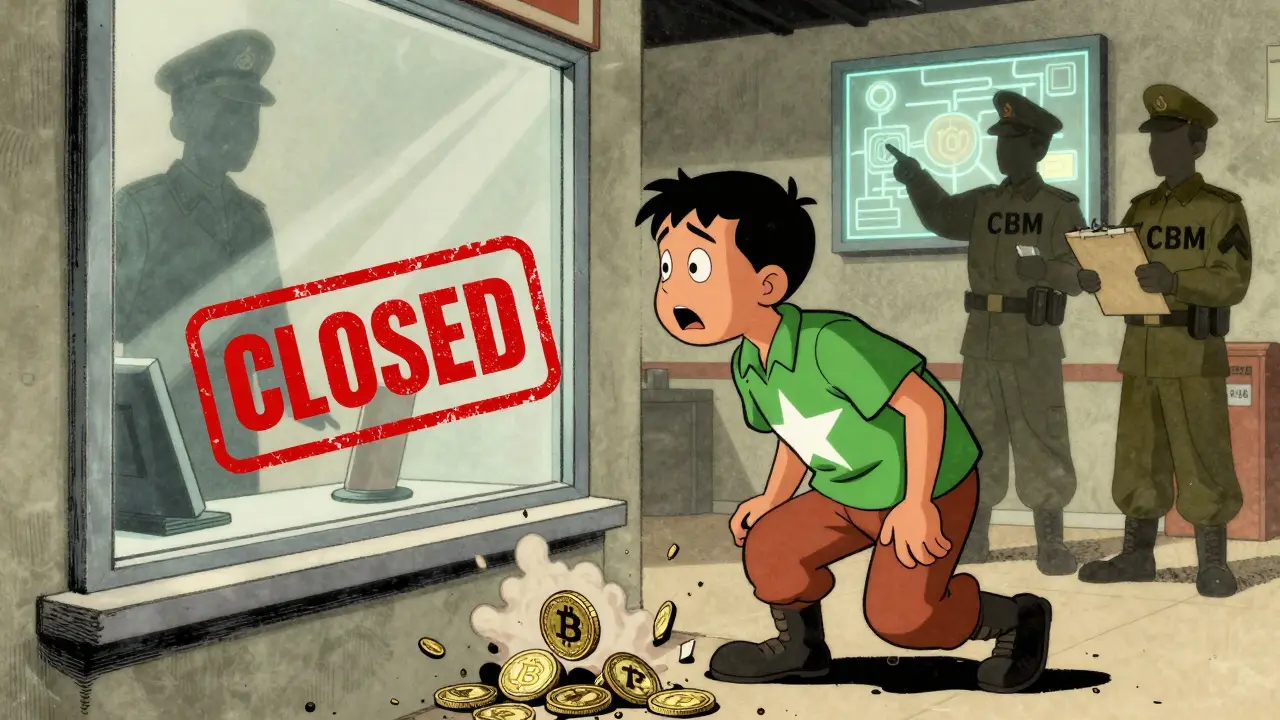
If you’re using Bitcoin, Ethereum, or USDT in Myanmar, you’re playing with fire. Not metaphorically. Literally. Your bank account can vanish overnight, and you could end up in jail. There’s no warning, no second chance. The Central Bank of Myanmar (CBM) doesn’t negotiate. Since May 2024, they’ve been actively shutting down accounts, filing criminal charges, and dragging people into court for just owning or trading cryptocurrency.
It’s Not Just Illegal - It’s a Criminal Offense
Myanmar doesn’t just discourage crypto. It treats it like drug trafficking. Under the Central Bank of Myanmar Law a legal framework that gives the CBM exclusive control over the country’s currency, any transaction involving Bitcoin, Litecoin, Ethereum, or even Tether (USDT) is classified as illegal currency conversion. That’s not a fine. That’s a criminal act.The CBM doesn’t just freeze accounts - they close them permanently. No appeals. No refunds. All your savings, salary deposits, even money meant for rent or medical bills can disappear in a single day. And it’s not just banks. If you use a mobile wallet linked to your ID, or even a payment app tied to your national registration number, they can trace it. Your phone number, your Facebook profile, your Telegram channel - all become evidence.
What Triggers an Account Closure?
You don’t need to be a miner or a trader to get caught. Just sending USDT to a friend in Thailand to pay for family medical bills? Illegal. Buying Bitcoin on a peer-to-peer app to protect your savings from the collapsing kyat? Illegal. Even accepting crypto as payment for goods? Still illegal.The CBM’s 2024 notice was crystal clear: “Any sale, purchase, exchange, or transfer of unregulated digital currencies will result in immediate account closure and legal action.” They didn’t say “if caught.” They said “will result.” This isn’t a threat - it’s policy.
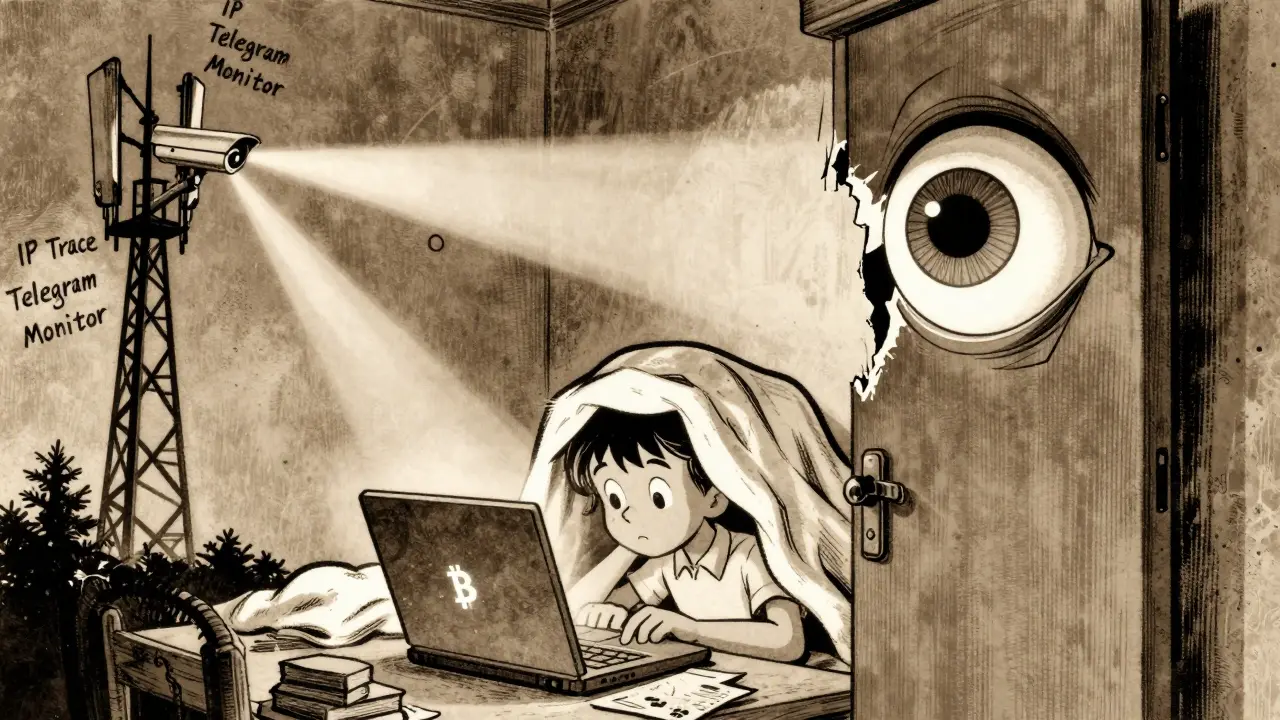
They’ve targeted specific platforms too. Facebook pages selling crypto, Telegram groups coordinating trades, and even websites hosted outside Myanmar that Myanmar residents access - all are under surveillance. The CBM works with telecom providers to track IP addresses and mobile data usage. If you’re using a VPN to access Binance or Kraken, they know. And they don’t care if you’re just trying to save money.
More Than Just a Closed Account
Account closure is just the beginning. Under the Anti-Money Laundering Law a legal tool used to prosecute financial crimes, including crypto transactions, you can face up to five years in prison. Under the Financial Institutions Law a law that governs all banking and financial services in Myanmar, fines can reach millions of kyat - more than most people earn in a year.There are real cases. In late 2024, a 28-year-old man in Mandalay was arrested after transferring $5,000 worth of USDT to his sister in Malaysia. He used Facebook Messenger to coordinate the trade. The CBM traced the transaction through his bank records, his phone logs, and his Facebook activity. He spent six months in pre-trial detention. His account was closed. His phone was seized. His family lost their main source of income.
Another case involved a university student who mined Bitcoin using a laptop in his dorm. He didn’t sell it. He just held it. The university’s IT department reported him after noticing unusual network traffic. He was charged under the Anti-Money Laundering Law. He’s still waiting for trial.
Why Is Myanmar So Harsh?
The military government lost control of the economy after the 2021 coup. The kyat collapsed. Inflation hit 60%. People turned to crypto because it was the only way to send money out of the country or protect what little they had left. The CBM saw this as a threat to their power.They can’t control crypto. They can’t tax it. They can’t track every transaction - or so they thought. So they turned to the one thing they can control: the banking system. Close the accounts. Cut off the flow. Make it too dangerous to even try.
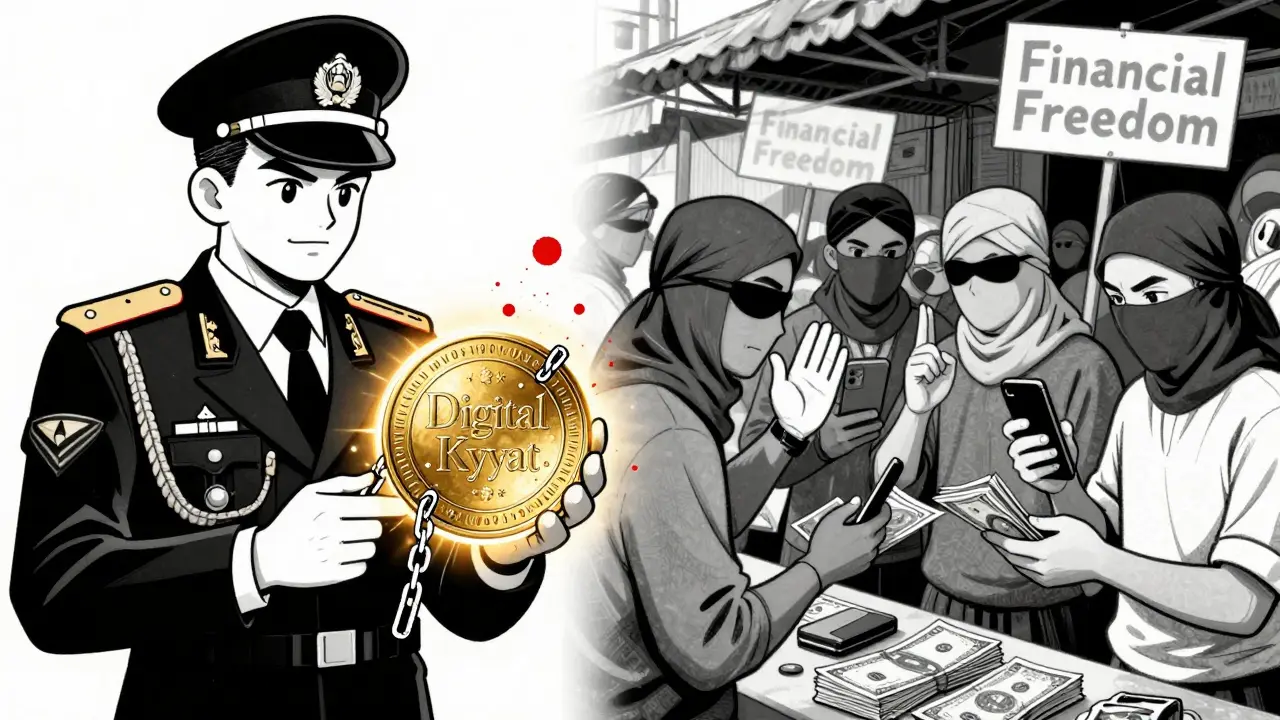
But here’s the twist: while the CBM bans crypto, they’re building their own digital currency. In June 2025, they formed the Central Committee for the Issuance of Central Bank Digital Currency a government body created to develop a state-controlled digital kyat. This isn’t about stopping innovation. It’s about monopolizing it. They want a digital kyat they can track, freeze, and control - exactly the opposite of Bitcoin.
What’s Happening Underground?
Despite the risks, crypto use hasn’t stopped. It’s just gone deeper.Telegram channels now run 24/7, trading USDT for cash via meetups in crowded markets. People use burner phones, cash-only deals, and trusted middlemen. Some miners have moved to Thailand and Laos, where they can operate without fear. Others stay, hiding rigs in basements, using solar power to avoid drawing attention to electricity usage.
The National Unity Government (NUG), which opposes the military regime, declared USDT legal tender in 2021 in areas they control. That means the same transaction can be legal in one part of the country and a crime in another. There’s no clear map. No official guidance. Just fear.
Who’s Most at Risk?
You don’t have to be a crypto expert to get caught. The CBM doesn’t care if you know the difference between ETH and USDT. They care if you used a bank account to move money. That means:- Students sending money home from abroad
- Workers sending remittances to families
- Small business owners accepting crypto payments
- Anyone using Facebook or Telegram to trade
- People holding crypto in wallets linked to their ID
If you’re using any digital payment system tied to your name, you’re vulnerable. Even if you’ve never bought crypto - if someone else used your account to receive funds, you’re still liable.
What Should You Do?
If you’re in Myanmar and you’re holding crypto, the safest move is to get out. Not the crypto - you. If you have the means, leave the country. If you can’t, stop using any bank account linked to crypto activity. Don’t trade. Don’t send. Don’t receive. Even holding it in a non-bank wallet carries risk if your identity is tied to it.If you’re outside Myanmar and sending money to someone inside, don’t use crypto. Use official channels, even if they’re slow or expensive. The risk of your recipient getting arrested or having their account shut down isn’t worth it.
There’s no workaround. No legal gray area. No loophole. The CBM doesn’t care about your reasons. They don’t care if you’re helping your family. They care about control. And they will use every tool they have to enforce it.
The Bigger Picture
Myanmar isn’t just cracking down on crypto. It’s cracking down on financial freedom. The account closures aren’t about stopping crime. They’re about stopping resistance. When people can’t move money, they can’t organize. They can’t survive. They become dependent.The CBM’s goal isn’t to protect the economy. It’s to protect power. And they’re willing to destroy lives to do it.
If you’re reading this because you’re thinking about crypto in Myanmar - stop. The penalties aren’t just severe. They’re designed to terrify. And they work.
Is it illegal to hold cryptocurrency in Myanmar?
Yes. Simply holding Bitcoin, Ethereum, or USDT is not explicitly banned, but if authorities trace any transaction - even a single transfer - you can be charged with illegal currency conversion. Holding crypto without ever moving it is risky because your wallet address may still be linked to your identity through past bank activity or device records.
Can you get arrested for using crypto in Myanmar?
Yes. Under the Anti-Money Laundering Law and Financial Institutions Law, individuals involved in cryptocurrency transactions can be arrested and face prison terms of up to five years. There are documented cases of arrests for sending USDT via Facebook or mining with a personal laptop.
Do banks in Myanmar monitor crypto transactions?
Yes. Banks in Myanmar are legally required to report suspicious activity to the Central Bank of Myanmar. Any transfer to or from known crypto exchange addresses, or repeated small transfers matching patterns of peer-to-peer trading, triggers an automatic review. Account closures follow within days.
Is Tether (USDT) treated differently than Bitcoin in Myanmar?
No. All cryptocurrencies are treated equally under the law. However, USDT is targeted more often because it’s the most widely used stablecoin for remittances and underground trade. Its stability makes it the preferred tool for moving value, which makes it the easiest to trace and the most visible to regulators.
What happens if your account is closed for crypto use?
Your account is permanently closed. You lose access to all funds. You cannot reopen it. You may be summoned for questioning by the CBM. In many cases, you’ll be charged under financial or anti-money laundering laws, leading to fines or imprisonment. There is no appeal process.
Is there any legal way to use crypto in Myanmar?
No. There are no legal exemptions, no licensed exchanges, and no government-approved use cases. Even using crypto for humanitarian aid or remittances is illegal. The only exception is the state’s own planned digital kyat - which will be fully controlled by the Central Bank of Myanmar.
Can foreign crypto exchanges be shut down in Myanmar?
Foreign exchanges like Binance or Kraken cannot be shut down directly because they operate outside Myanmar. However, the CBM blocks access to their websites within the country and pressures telecom providers to cut off traffic. They also threaten legal action against anyone who uses them, making access effectively impossible.
How do authorities track crypto users in Myanmar?
Authorities track users through bank records, mobile phone data, Facebook and Telegram activity, IP addresses, and device IDs. Many users link their crypto wallets to bank accounts or payment apps tied to their national ID. Even using a VPN doesn’t fully protect you - the CBM works with telecom companies to log connections and identify patterns of suspicious behavior.
What’s the difference between the CBM’s stance and the NUG’s stance on crypto?
The Central Bank of Myanmar (CBM), controlled by the military regime, bans all cryptocurrency. The National Unity Government (NUG), which opposes the regime, declared USDT legal tender in areas it controls as a way to bypass currency controls and support resistance efforts. This creates a dangerous legal gray zone where the same action can be legal or criminal depending on location.
Are there any safe ways to send money to someone in Myanmar?
Yes. Use official remittance services like Western Union, MoneyGram, or bank wire transfers through approved channels. Avoid peer-to-peer apps, Telegram, or crypto. Even if the recipient doesn’t use crypto, receiving funds from a crypto-linked source can trigger an investigation. Stick to traceable, regulated methods to protect both you and the recipient.
If you’re outside Myanmar and considering helping someone inside with crypto - don’t. The cost isn’t just financial. It’s human. And it’s too high.





Comments (23)
Stephen Gaskell
This is pure tyranny. If you want to control money, you need to control the people first.
Lauren Bontje
Oh wow, another sob story about people trying to bypass sanctions. The CBM isn't the villain here - it's protecting a collapsing state from being looted by crypto grifters. If you're using USDT to dodge economic consequences, you're not a victim, you're a parasite.
CHISOM UCHE
From a financial sovereignty perspective, the CBM's move is a textbook case of monetary hegemony enforcement. The absence of a regulated on-ramp creates a zero-sum博弈 where decentralized finance becomes an existential threat to state-controlled capital flows. The use of telecom metadata for transaction tracing represents a surveillance-capitalist escalation in fiscal governance.
myrna stovel
I know this is terrifying for people trying to help their families or keep their savings safe. But please, if you're reading this and you're connected to someone in Myanmar - don't send crypto. Even if you think it's harmless, it could get them arrested. Use Western Union. Even if it's slow. Even if it's expensive. Their safety matters more than your convenience.
Sarah Baker
My heart breaks for the students, the mothers, the workers just trying to survive. This isn't about crypto - it's about power. The CBM doesn't care if you're helping your sister get medicine. They care that they can't control it. And that terrifies them more than any blockchain ever could. Stay strong, Myanmar. We see you.
Pramod Sharma
Freedom is not free. But prison is cheaper.
nathan yeung
It's wild how the same tech that lets me send money to my cousin in India is now a crime in Myanmar. People aren't trying to break the law - they're trying to survive it. The real crime is a government that sees its own people as threats.
Andre Suico
While the humanitarian implications are deeply concerning, the legal framework under which the Central Bank of Myanmar operates is unambiguous. The Anti-Money Laundering Law and Financial Institutions Law provide clear statutory authority for account closures and criminal prosecution. The absence of a licensing regime for digital asset intermediaries renders all such transactions inherently non-compliant. Legal recourse, while theoretically available, is functionally inaccessible under current governance structures.
Bill Sloan
Bro, imagine being scared to send $50 to your sister because the government might throw you in jail. That's not a country - that's a prison with Wi-Fi. And now they're building their own crypto? LOL. They want the benefits of tech without the freedom. Pathetic.
ASHISH SINGH
CBM is a psyop. The whole crypto ban? Just a distraction so they can roll out their own blockchain surveillance system. You think they don't know Bitcoin can't be tracked? They're letting people get arrested so the population thinks crypto is dangerous. Meanwhile they're quietly minting digital kyats with backdoors built in. This isn't control - it's psychological warfare. They want you to fear freedom.
Tony Loneman
Oh sweet Jesus this is the most dramatic thing I've read since the 2021 coup was 'a democracy reset'. People are getting arrested for sending USDT? What next - jail for using PayPal? This isn't a crackdown, it's a soap opera written by a guy who thinks 'digital currency' is a spy gadget. The CBM is a bunch of scared old men holding a remote control that doesn't work, and they're screaming at the TV because the channel changed.
Callan Burdett
Myanmar’s story is the future of every country that fears change. They’re not banning crypto because it’s dangerous - they’re banning it because it’s free. And freedom scares people who built their power on control. The digital kyat? That’s not innovation. That’s a digital leash.
Nishakar Rath
Who cares if they lock up some guy for sending USDT to his sister? The real problem is the West pretending to care while their banks launder billions for dictators. This is just the tip of the iceberg. The CBM is doing what any sane government would do - protect its currency from being hijacked by offshore grifters. You think your crypto is safe? It's all just digital glitter
Jason Zhang
So the government bans crypto because people use it to survive, then builds its own crypto to control them? That's not policy. That's a sitcom written by a drunk bureaucrat. The real joke? The people who need it most can't even access the official channels. So they get arrested. Classic.
Katherine Melgarejo
So the military bans Bitcoin because it's decentralized… then builds their own centralized version? Wow. The only thing more ironic than this is that they probably use a VPN to read the news.
Patricia Chakeres
Let’s be honest - this isn’t about financial regulation. It’s about the regime’s deep-seated paranoia. Crypto represents a decentralized, untraceable, ungovernable alternative to their failing economy. And that terrifies them more than any armed rebellion ever could. They’re not protecting the kyat - they’re protecting their own irrelevance.
kristina tina
I just want to say - if you’re reading this and you have even one friend or family member in Myanmar, please don’t send them crypto. I know it feels like the fastest way. But the cost? A child losing their parent. A mother losing her home. A student losing their future. That’s not worth saving a few hours. Use Western Union. Even if it takes three days. Even if it costs more. Their life is worth more than your impatience.
Anna Gringhuis
They're not banning crypto - they're banning hope. And the fact that they're building their own digital currency proves it. They want all the power of digital money without any of the freedom. It's like banning bicycles because people use them to escape, then building a government-owned electric scooter with GPS tracking. Pathetic. And terrifying.
Stephanie BASILIEN
It is, of course, an undeniable fact that the Central Bank of Myanmar, as the sole custodian of monetary authority under the provisions of the Central Bank of Myanmar Law (2024), is constitutionally empowered to enforce the integrity of the national currency. The utilization of unregulated digital assets, irrespective of intent, constitutes a material breach of statutory fiduciary obligations. The resultant legal consequences, while severe, are neither arbitrary nor disproportionate when viewed through the lens of macroeconomic stability and state sovereignty.
Deb Svanefelt
What’s happening in Myanmar isn’t just about money. It’s about what happens when fear becomes policy. People aren’t breaking laws to get rich - they’re breaking them to survive. And the state is punishing them for daring to imagine a world where they control their own future. The digital kyat isn’t progress - it’s the opposite. It’s the end of financial autonomy, wrapped in code and enforced by surveillance. We should be screaming about this, not scrolling past it.
Telleen Anderson-Lozano
Okay, so, like, I get that the government is scared of crypto, right? But like, also, it's not like people are using it to rob banks - they're using it to pay for medicine, or send money home, or just not lose everything to inflation. And then the CBM goes and builds their own crypto? Like, what? Are they trying to be the villains in a dystopian Netflix show? Because this is straight-up Black Mirror stuff. And the worst part? It's real. People are in jail. For sending USDT. To their sister. For medicine. Like... what even is this world?
Ashlea Zirk
The CBM’s decision to criminalize cryptocurrency transactions, while legally defensible under existing statutes, raises profound ethical questions regarding proportionality and human rights. The absence of due process, coupled with the irreversible nature of account closures and the lack of appeal mechanisms, suggests a system prioritizing control over justice. The development of a state digital currency further complicates this dynamic, revealing a contradiction between suppression of decentralized finance and the pursuit of centralized digital sovereignty.
Shaun Beckford
They're banning crypto because it's untraceable? Then why the hell are they building a digital kyat? This isn't about money - it's about control. They want to know where every kyat goes. They want to freeze your rent payment because you said something they didn't like. This isn't economics. It's totalitarianism with a blockchain UI.