
If you're a US citizen holding cryptocurrency on a foreign exchange, you're likely already dealing with more tax complexity than you signed up for. The IRS doesn't treat crypto like cash. It treats it like property. And when that property is stored outside the US, FATCA kicks in - whether you realize it or not.
What FATCA Actually Covers
FATCA, or the Foreign Account Tax Compliance Act, was passed in 2010 to stop Americans from hiding money overseas. It forces foreign banks, investment firms, and other financial institutions to report account details of US persons to the IRS. If they don’t, they face heavy fines - so most do.But here’s the twist: FATCA doesn’t just cover bank accounts. It covers any financial account or asset held with a foreign institution. That includes cryptocurrency wallets, exchange accounts, and even crypto held through foreign-based custodians or DeFi platforms.
The IRS defines "specified foreign financial assets" broadly. It includes:
- Financial accounts maintained by foreign institutions
- Stocks or securities issued by non-US companies
- Financial instruments with non-US counterparties
- Interests in foreign entities
Does crypto fit? Absolutely. If your Bitcoin is on Binance, Kraken, or any non-US platform, it’s likely a "specified foreign financial asset." The platform itself may even be registered as a Foreign Financial Institution (FFI) under FATCA. The IRS publishes a public list of registered FFIs - and many crypto exchanges are on it.
When Do You Need to File Form 8938?
You must file Form 8938 with your federal tax return if your total foreign financial assets exceed these thresholds:- Single, living in the US: More than $50,000 on the last day of the year OR more than $75,000 at any time during the year
- Married filing jointly, living in the US: More than $100,000 on the last day OR more than $150,000 at any time
- Single or married filing separately, living abroad: More than $200,000 on the last day OR more than $300,000 at any time
- Married filing jointly, living abroad: More than $400,000 on the last day OR more than $600,000 at any time
These numbers are not negotiable. If you had $76,000 worth of Ethereum on Coinbase (a foreign entity) on June 15th, you’re required to report - even if your balance dropped to $20,000 by December 31st.
Form 8938 must be filed with your Form 1040. The deadline is the same: April 15, with automatic extensions to October 15. But don’t wait. Penalties for missing this form can hit $10,000 - and keep climbing if you don’t fix it after the IRS asks.
Cryptocurrency Valuation: The Hard Part
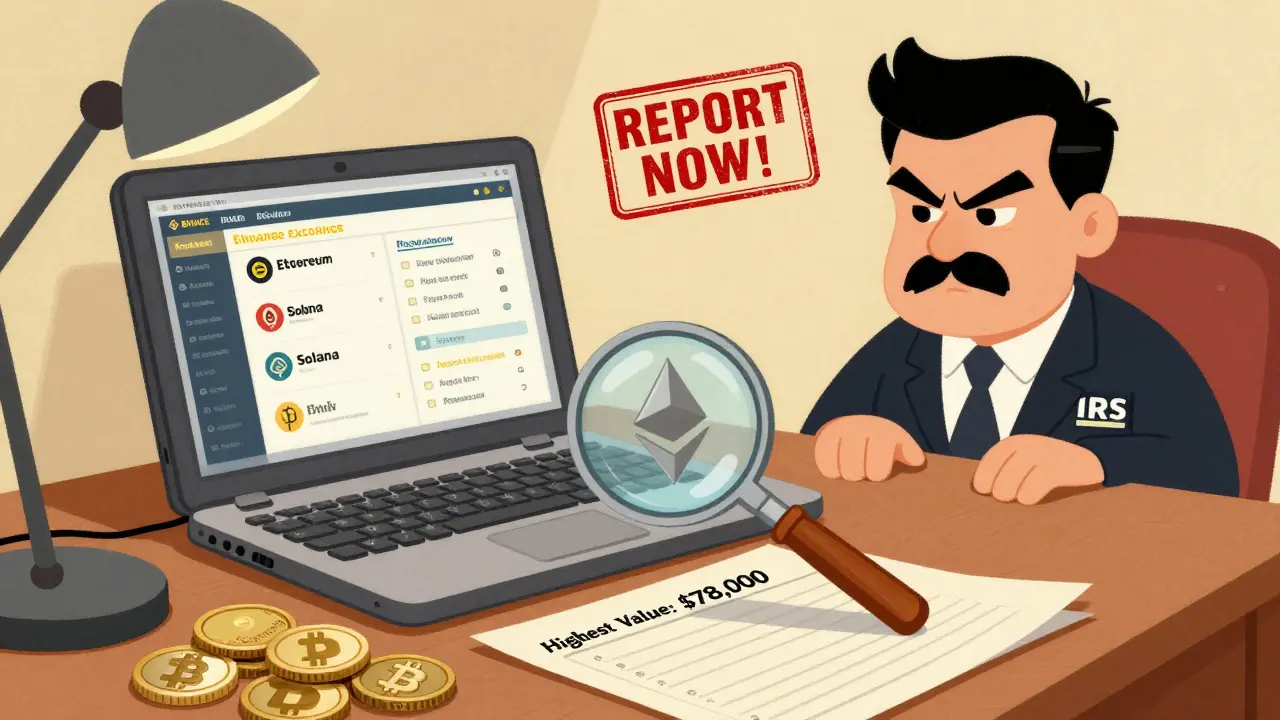
You can’t just guess how much your crypto is worth. The IRS wants the fair market value on the last day of the year - and at any peak during the year if you cross the threshold.That’s tricky. Bitcoin jumped 120% in 2024. Ethereum surged 89%. If you held $48,000 in crypto on January 1, but it hit $78,000 in March, you crossed the reporting line. Even if it fell back to $45,000 by year-end, you still report it.
Most tax pros recommend using the highest value your portfolio reached during the year. Why? Because the IRS doesn’t care about average prices - it cares about peak exposure. Use data from reputable exchanges (CoinGecko, CoinMarketCap) or your exchange’s own historical records. Don’t rely on wallet apps that auto-calculate - they often use outdated or inaccurate pricing.
What if your exchange doesn’t give you account numbers? No problem. The IRS accepts "unknown" or "login credentials" as placeholders. Just write: "Crypto held on Binance, account: [email protected]". That’s enough for compliance.
FBAR Is a Separate Nightmare
Here’s where things get worse. FATCA isn’t the only reporting requirement. There’s also FBAR - FinCEN Form 114. It’s for foreign bank accounts with balances over $10,000 at any point during the year.Traditionally, crypto wasn’t included. But in 2025, FinCEN proposed new rules that would force US citizens to report foreign crypto accounts on FBAR too. If you held $11,000 in Solana on Kraken for one day, you’d need to file FBAR - even if you never sold it.
That means two forms. Form 8938 (for FATCA) and Form 114 (for FBAR). Both have different thresholds, different deadlines, and different penalties. Missing one doesn’t excuse the other. The IRS and FinCEN share data. They’re already cross-checking exchange reports with tax filings.
What About Selling or Trading Crypto?
Reporting your holdings is one thing. Reporting your gains is another. Every time you sell, trade, or spend crypto, you trigger a taxable event. That’s true regardless of where the transaction happened.You must report all capital gains and losses on Form 8949 and summarize them on Schedule D. The IRS uses FIFO (first-in, first-out) by default unless you can prove which specific coins you sold. That’s nearly impossible unless you’re tracking every single transaction with a dedicated tool.
For example: You bought 1 BTC in 2020 for $10,000. In 2025, you sold 0.5 BTC for $50,000. Even if you didn’t touch that wallet since 2020, you owe tax on $40,000 in capital gains. No one else reports this to the IRS - you have to.
Staking rewards, airdrops, and DeFi yields? All taxable as ordinary income. You report them on Form 1040, line 21. The value is based on the USD price at the moment you received them.

What Happens If You Don’t Report?
The IRS has tools now. They’ve signed agreements with over 100 countries. They get data from exchanges. They use AI to match transaction patterns across platforms. If you’re a US citizen with foreign crypto and you’re silent - you’re already flagged.Penalties for not filing Form 8938: $10,000. If you still don’t file after being notified? Another $10,000 per month - up to $50,000.
For FBAR: $10,000 per violation. If the IRS thinks you’re willfully hiding assets? Up to 50% of the account balance - or $100,000, whichever is higher.
And don’t think you can just wait. The IRS has a 6-year statute of limitations for underreported foreign assets. That means if you filed a return in 2020 and didn’t report crypto from 2019, they can still audit you in 2026.
What Should You Do Right Now?
You don’t need to panic. But you do need to act.- Inventory every foreign crypto exchange you’ve ever used - even if you haven’t logged in since 2022.
- Export your transaction history. Use CSV files from each platform.
- Calculate the highest value your holdings reached in 2025.
- If you crossed the FATCA threshold ($50K/$75K), prepare Form 8938.
- If your total foreign crypto balance ever hit $10,000 in 2025, prepare for FBAR.
- Use a crypto tax tool like Koinly, CoinTracker, or TokenTax to auto-calculate gains, losses, and income.
And if you’re unsure? Talk to a CPA who specializes in crypto and international tax. Not a generic accountant. Someone who’s filed Form 8938 for clients with Binance, Bybit, or Gate.io accounts. The rules are changing fast. You need someone who’s seen this before.
What’s Coming Next?
The IRS is building a crypto reporting system. They’re working with foreign regulators to automate data flows. Expect new forms. New thresholds. Possibly even mandatory exchange reporting directly to the IRS.By 2027, most major exchanges will be required to issue Form 1099-DA (Digital Asset Sales) - just like they do for stocks. That means the IRS will have your entire trade history before you even file.
Waiting for perfect guidance isn’t smart. The law is already clear enough: if it’s foreign, it’s reportable. If it’s crypto, it’s taxable. The IRS doesn’t wait for you to catch up. They move fast. And they’ve got the data.
Do I need to report crypto on FATCA if I only hold it and never sell?
Yes. FATCA is about ownership, not transactions. If your crypto is held on a foreign exchange and its value exceeds the reporting threshold at any point during the year, you must report it - even if you never sold, traded, or sent it. The IRS cares about where your assets are stored, not what you did with them.
Can I avoid FATCA by using a US-based crypto exchange?
If the exchange is based in the United States and operates under US regulations (like Coinbase or Kraken US), then your holdings there are not subject to FATCA. But if you use a global platform like Binance.com or KuCoin - even if you’re in the US - those are considered foreign financial institutions. The key is where the platform is legally headquartered, not where you live.
What if my foreign crypto exchange doesn’t send me any statements?
You’re still responsible. The IRS doesn’t require the exchange to give you paperwork. You must gather your own records. Use transaction history exports, screenshots of your wallet balances, or even your own spreadsheet. The IRS accepts "unknown" for missing account details - as long as you clearly state the platform name and your login info.
Does FATCA apply to DeFi wallets or non-custodial wallets?
Only if you’re using a foreign DeFi platform that acts as a financial intermediary. If you hold crypto in your own MetaMask wallet with no foreign exchange or custodian involved, it’s not reportable under FATCA. But if you’re staking on a foreign DeFi protocol that holds your assets or provides yield services (like Aave or Curve on a non-US server), tax professionals advise reporting it - because the platform may qualify as a foreign financial institution.
I forgot to report crypto on Form 8938 last year. Can I fix it?
Yes. File an amended return (Form 1040-X) with the missing Form 8938 attached. If you haven’t been contacted by the IRS, you’re likely eligible for reduced or no penalties under the IRS’s voluntary disclosure program. The sooner you fix it, the lower your risk. Waiting makes it worse.





Comments (16)
Elizabeth Smith
Honestly this whole FATCA crypto thing is just another way the government screws over ordinary people who try to be responsible
They don't care if you're trying to comply - they just want to catch you slipping
I've seen people lose everything over a missed form
It's not tax policy - it's surveillance dressed up as law
Robert Kromberg
I get that reporting is a pain, but honestly? I'd rather deal with paperwork than get audited six years later.
My crypto was on Binance for a few months in 2024 - hit $72k peak.
Filed Form 8938. No drama. Just took an afternoon with Koinly.
Worth it.
Daisy Boliaan
OMG I JUST REALIZED I FORGOT TO REPORT MY SOLANA ON KUCOIN
IT PEAKED AT $18K IN MARCH AND I DIDN'T EVEN THINK ABOUT IT
AM I GONNA GET ARRESTED??
MY DAD JUST TEXTED ME 'YOU NEED A LAWYER' AND I CRIED IN THE SHOWERS
Nicki Casey
The notion that decentralized digital assets should be treated as financial instruments under U.S. domestic law is a grotesque overreach.
By conflating non-custodial wallets with foreign bank accounts, the IRS is violating the spirit of the Fourth Amendment and the principle of due process.
FATCA was designed for Swiss bank accounts, not MetaMask.
There is no legal basis for extending this framework to permissionless blockchain systems.
Moreover, the IRS lacks jurisdiction over extraterritorial nodes operating under foreign sovereign authority.
These forms are unconstitutional.
And yes - I’ve read the statute. Twice.
Jessica Carvajal montiel
They’re using crypto to build a financial surveillance state.
Every time you trade, every time you stake, every time you send - they’re logging it.
They already have your IP, your device ID, your exchange login.
And now they want your entire transaction history?
Don’t be fooled - this isn’t about taxes.
This is about control.
They want to know where every dollar goes.
And if you’re not compliant? They’ll freeze your assets.
They’ve already done it to people who didn’t file FBAR.
It’s not paranoia - it’s policy.
maya keta
Okay so I just used TokenTax and holy hell it auto-pulled all my trades from Binance, KuCoin, and even my DeFi staking on Aave.
It calculated my gains, flagged my FBAR threshold, and even suggested I file Form 8938 with a nice little PDF.
Cost me $50.
Worth every penny.
Stop winging it with spreadsheets - you’re gonna get burned.
PS: if your exchange says 'we don't report' - that doesn't mean you're off the hook. The IRS doesn't care about your exchange's PR.
Curtis Dunnett-Jones
To those who are overwhelmed: please take a deep breath.
Compliance is not optional, but it is manageable.
You do not need to be a tax expert.
You need a qualified professional who understands digital asset reporting.
I have personally guided over 37 clients through Form 8938 and FBAR filings this year.
All of them avoided penalties by acting early.
Do not wait for a letter.
Act now.
It is never too late to correct a mistake - but it is always too late to ignore it.
Sean Logue
I lived in Thailand for two years and kept all my crypto on Binance Thailand.
Thought I was safe because I wasn’t in the US.
Turns out - the IRS doesn’t care where you live.
They care where you’re a citizen.
Had to file 8938 and FBAR for 2023.
Worst 3 hours of my life.
But now I’m clean.
And I tell every American expat I meet: don’t wait. Just do it.
Carl Gaard
I just filed my 8938 and FBAR and I’m crying 😭
Not because I’m scared - but because I actually did it.
For the first time in 5 years, I feel like I’m not a criminal just for holding Bitcoin.
Thanks to everyone who shared tips here.
And to the IRS? I’m not hiding anymore.
Here’s my data. Do what you gotta do.
bella gonzales
Ugh. I just opened my spreadsheet and saw I had $82k in crypto on Kraken last year. I didn't even remember.
Now I have to go back and find 14 months of transaction logs.
I'm not even mad. I'm just... tired.
Paul Reinhart
I’ve been tracking my crypto since 2017. I’ve got 12 CSVs from 7 different exchanges. I’ve cross-referenced every transaction. I’ve calculated every capital gain. I’ve documented every DeFi yield.
And yet - I still don’t feel confident.
Because the rules change every quarter.
And the IRS doesn’t publish clear guidance.
And the penalties are terrifying.
So I hired a CPA who specializes in crypto.
It cost me $2,500.
But I sleep at night.
And that’s worth more than money.
Samantha Stultz
You’re all missing the real issue: FATCA was never meant for crypto.
It was designed for offshore bank accounts with account numbers and IBANs.
Crypto has no account number.
It has a public key.
So technically, you’re not reporting a financial account - you’re reporting a cryptographic address.
That’s not FATCA.
That’s regulatory overreach.
And the IRS knows it.
They’re just exploiting ambiguity to expand power.
Robert Conmy
If you’re not reporting your foreign crypto, you’re not just breaking the law - you’re betraying the system.
You think you’re being clever?
You’re just making it harder for honest Americans.
I’ve paid my taxes since I was 18.
And now I have to pay extra because some guy on Binance didn’t file?
That’s not freedom.
That’s selfishness.
Do the right thing - or get out of the system.
Lilly Markou
The complexity of this regulatory framework is intentionally overwhelming.
It functions as a de facto tax on financial autonomy.
By requiring granular reporting of digital asset holdings, the IRS creates a compliance burden that disproportionately affects middle-class citizens who lack access to specialized legal counsel.
This is not enforcement - it is exclusion.
And the result is a system where compliance is reserved for the wealthy, and non-compliance is criminalized for the rest.
McKenna Becker
Hold crypto. Report it. Pay what you owe. Move on.
precious Ncube
I’m a crypto investor. I’m also an American citizen.
That means I have two responsibilities.
One to my portfolio.
One to the law.
And if you’re too lazy to file Form 8938?
Then you don’t deserve to hold crypto.
It’s not complicated.
It’s not unfair.
It’s just the price of being part of this country.