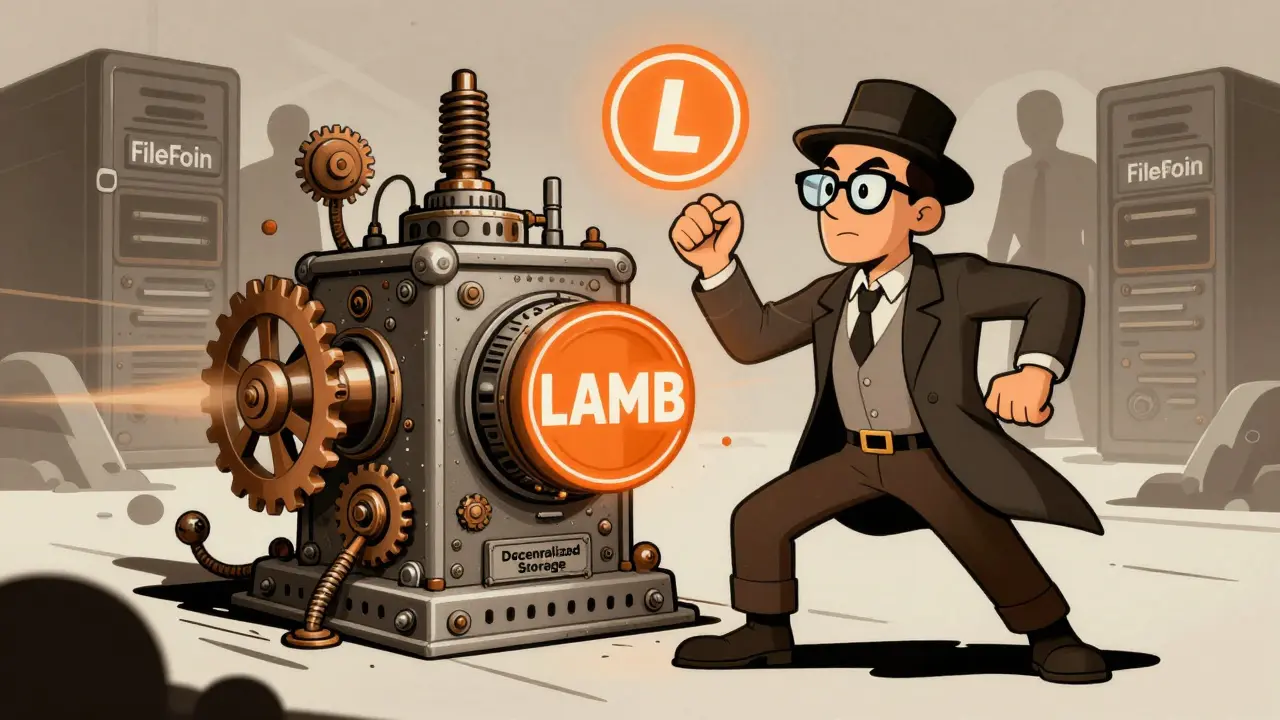
Imagine finding a digital coin that promised to revolutionize how we store data on the blockchain. That was the pitch for Lambda (LAMB), a cryptocurrency originally designed as a decentralized data storage infrastructure. Launched with big ambitions back in 2018, it aimed to compete with giants like Filecoin by offering fast, secure, and scalable storage for decentralized applications (dApps). But if you are looking at LAMB today, June 2026, the picture looks very different from those early hype cycles.
You might be asking: is LAMB still a viable investment? Is the project dead? Or is it just sleeping? The short answer is complicated. While the token still trades on some exchanges, major indicators suggest the original project has largely stalled. This guide breaks down what Lambda actually is, where it stands now, and why you need to be extremely careful before interacting with this asset.
The Original Vision: Decentralized Storage on Ethereum
To understand where LAMB is today, you first have to look at where it started. Lambda launched as an Ethereum-based token intended to power a decentralized storage network. In simple terms, instead of storing your files on a single company's server (like Amazon or Google), you would store them across a network of independent computers.
The core technology behind this promise was a consensus mechanism called Proof-of-Space-Time (PoST). Unlike Proof-of-Work, which burns electricity to secure Bitcoin, PoST requires participants to commit hard drive space and time to verify that they are actually storing data. In late 2018, Lambda claimed to be the first to open-source this algorithm, boldly stating it had "surpassed" competitors like Filecoin in terms of developer accessibility.
The goal was clear: provide dApps with unlimited, trustless data storage. Developers would pay in LAMB tokens to store data, and node operators would earn LAMB for keeping that data safe and available. It sounded like a perfect fit for the growing Web3 ecosystem.
Current Status: A Discontinued Token?
Here is where things get tricky. If you check major data aggregators in 2026, you will see conflicting signals. On one hand, educational platforms like OKX and Gate Learn still describe Lambda as part of the Web3 AI infrastructure landscape. They talk about its modular storage network and high-speed capabilities as if it is an active, cutting-edge project.
On the other hand, reality checks are harsh. As of March 2025, Blockspot, a prominent crypto data provider, explicitly labeled LAMB as a "discontinued Ethereum token." More importantly, the official website, lambdastorage.com, has been offline since August 2024. When a project’s primary communication channel goes dark for over a year, it is rarely a good sign.
This discrepancy creates a dangerous fog for investors. You have marketing narratives that sound alive, but operational evidence that suggests dormancy. There are no recent roadmap updates, no active GitHub commits from the core team, and no new partnerships announced. The project appears to exist more as a legacy footprint than an active development effort.
Tokenomics and Market Reality
Let’s look at the numbers, because they tell a stark story. The total supply of LAMB is fixed at 6,000,000,000 tokens. However, the circulating supply is murky. Some trackers report around 1.86 billion tokens in circulation, while others, like Coinbase, show zero circulating supply despite listing a price. This inconsistency makes calculating true market capitalization nearly impossible.
| Metric | Value | Note |
|---|---|---|
| Total Supply | 6,000,000,000 | Fixed cap |
| Circulating Supply | ~1.86 Billion | Varies by exchange; often disputed |
| Price Range | $0.000009 - $0.0001 | Extremely low value |
| Market Cap | ~$15,000 - $56,000 | Tiny compared to peers |
| Daily Volume | < $1,000 | Very low liquidity |
With a market capitalization hovering between $15,000 and $56,000 depending on the source, LAMB is economically negligible. For context, leading decentralized storage projects like Filecoin (FIL) or Arweave (AR) have market caps in the hundreds of millions or billions. LAMB’s daily trading volume is often under $1,000. This means if you tried to sell a large amount of LAMB, you would likely crash the price instantly due to lack of buyers.
Where Can You Buy LAMB?
If you are determined to acquire LAMB, your options are limited. Major U.S.-friendly exchanges like Coinbase do not support trading LAMB. Their pages explicitly state it is not tradable.
Your best bet is mid-tier global exchanges. KuCoin and CEX.IO have listed the token in the past. KuCoin currently provides price feeds and allows swaps, meaning you can trade other cryptocurrencies for LAMB there. However, be aware of the slippage. With such low volume, the difference between the buy and sell price can be massive, eating into any potential gains.
Always double-check the contract address. Since LAMB is an ERC-20 token on Ethereum, ensure you are sending funds to the correct wallet address associated with the original Lambda project, not a scam copycat.
The Ticker Trap: Beware of LAMB276
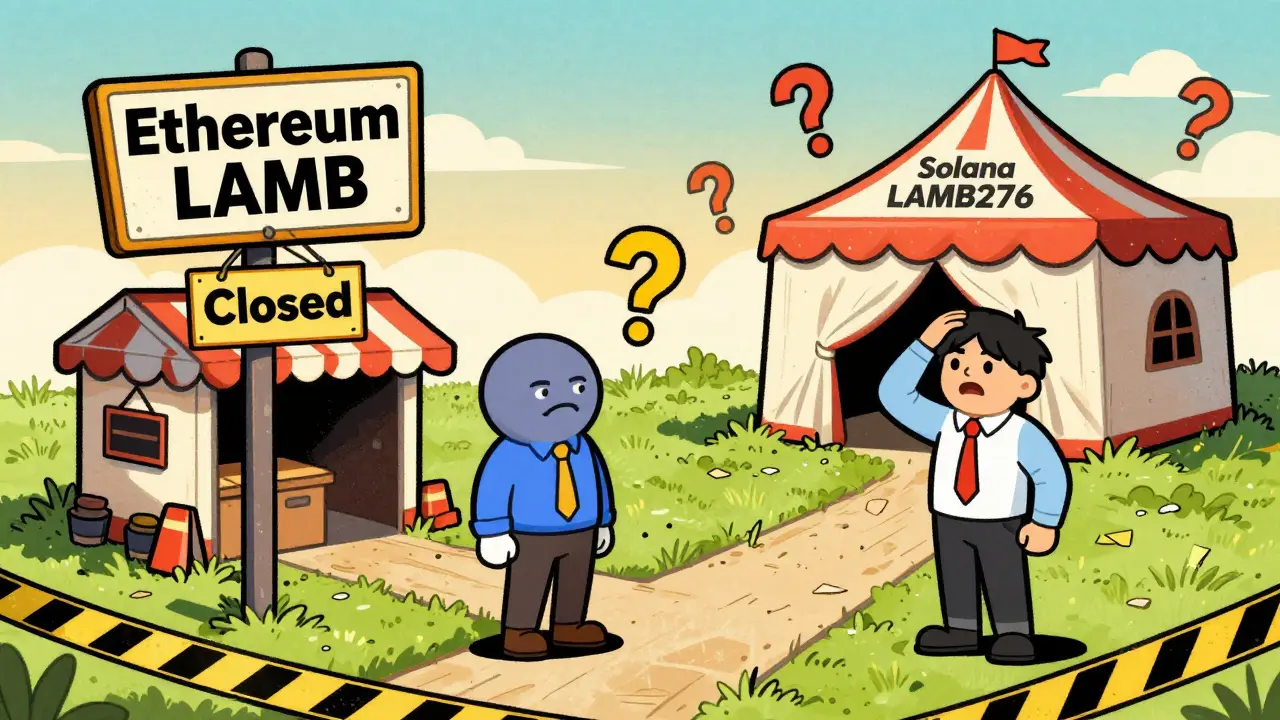
One of the biggest risks with older, less popular coins is ticker collision. You might search for "LAMB" and find a completely different project. Enter LAMB276.
LAMB276 is a hybrid DeFi ecosystem built on Solana, not Ethereum. It uses the same ticker symbol (LAMB) but has nothing to do with the original decentralized storage network. As of mid-2026, LAMB276 also has a tiny market cap (around $8,000) and distinct tokenomics.
If you are reading news or checking prices, make sure you know which chain you are looking at. Buying Solana-based LAMB thinking you are getting Ethereum-based Lambda storage credits is a costly mistake. Always verify the blockchain network and contract address before executing any trade.
Why Did Lambda Fade?
It is natural to wonder why a project with such technical ambition faded into obscurity. Several factors likely contributed:
- Fierce Competition: The decentralized storage space is crowded. Filecoin established itself early with significant venture capital backing and real-world usage. Arweave carved out a niche in permanent storage. Lambda struggled to gain mindshare against these well-funded rivals.
- Technical Complexity: Building a reliable decentralized storage network is incredibly hard. It requires robust incentive mechanisms, data redundancy checks, and seamless integration with dApps. Many projects fail to bridge the gap between whitepaper promises and working software.
- Market Cycles: Lambda launched during the 2017-2018 ICO boom. When the market cooled, many projects ran out of funding or failed to deliver on their roadmaps. Without continuous development and community engagement, momentum dies quickly.
- Lack of Adoption: Despite claims of being used by dApps, there is little public evidence of major applications relying on Lambda for storage. Without users, there is no demand for the token, leading to a death spiral of low liquidity and declining interest.
Is LAMB Worth Investing In?
I will be direct: investing in LAMB right now carries extreme risk. It fits the profile of a "zombie coin"-a token that still exists on-chain and trades on minor exchanges but lacks active development, community support, or utility.
There is no clear catalyst for growth. No new partnerships, no technological breakthroughs, and no return of the founding team. While some speculative traders might hope for a random pump, relying on that is gambling, not investing. If you are interested in decentralized storage, look at projects with active development, transparent teams, and substantial market capitalization like Filecoin, Arweave, or Storj.
If you already hold LAMB, consider whether the opportunity cost of keeping those funds tied up in a stagnant asset outweighs the potential returns elsewhere. Liquidity is so low that exiting a position might be difficult without significant loss.
Is Lambda (LAMB) still an active project?
Evidence suggests no. The official website has been offline since August 2024, and data providers like Blockspot label it as a discontinued token. While some educational sites still mention it, there are no signs of active development or team communication in 2026.
Can I buy LAMB on Coinbase?
No. Coinbase explicitly states that Lambda is not tradable on their platform. You would need to use other exchanges like KuCoin or CEX.IO, where liquidity is very low.
What is the difference between LAMB and LAMB276?
They are completely different projects. Original Lambda (LAMB) is an Ethereum-based decentralized storage token. LAMB276 is a Solana-based DeFi ecosystem. Do not confuse the two, as they have different values and purposes.
How much is 1 LAMB worth in 2026?
The price fluctuates between $0.000009 and $0.0001 USD. Due to extremely low trading volume, the price is highly volatile and may not reflect true market demand.
Is LAMB a good investment?
Generally, no. It is considered a high-risk, low-liquidity asset with no active development. Most financial experts would advise avoiding discontinued tokens unless you are engaging in high-speculation trading with money you can afford to lose entirely.

Comments (13)
Andrea Burd
ugh another dead coin post
Narendra Kulkarni
hey thanks for sharing this info i was actually lookin at lamb last week and got confused by all the different tickers out there it is kinda scary how easy it is to get scammed with these old tokens that still show up on charts but have no real activity behind them i think people need to be more careful before they put any money into something like this especially when the website has been down for so long it just feels wrong to ignore those red flags
verna kennedy
It is frankly embarrassing that anyone still holds this garbage. The project died years ago and yet here we are in 2026 pretending it has value. You do not invest in zombie coins you invest in projects with active development teams and clear roadmaps. This is financial illiteracy at its finest.
Kelly Tenney
I can understand why someone might hold onto it hoping for a comeback, but we have to face reality. The team left, the site is down, and the volume is non-existent. It is important to protect our portfolios from assets that offer no utility or growth potential. Let us focus on projects that are actually building things instead of holding onto past hype.
Greg Lewis
you see the pattern here? same old story every cycle launch with big promises steal the liquidity vanish into the ether leaving retail holders holding the bag while the devs buy yachts in dubai it is not an accident it is a design feature of this broken system where code is law but morality is optional
Sonya O'Brien
I completely agree with the sentiment that we need to be more discerning about where we place our trust in this ecosystem, because when you look at the sheer number of projects that have failed since the initial coin offering boom, it becomes incredibly apparent that most of them were never going to survive the bear market, let alone thrive in the current landscape, and so it is crucial for investors to conduct thorough due diligence rather than relying on marketing materials that often paint a rosy picture that does not reflect the harsh operational realities of maintaining a decentralized network.
Nick Rice
Listen up folks if you want real storage solutions look at Filecoin or Arweave they have actual usage and developers working on them daily Lambda is a ghost town stop wasting your time checking prices on a token that has less liquidity than a desert spring you want gains? go build something dont buy trash
Charles Pawlikowski
typical crypto scam lol :D always the same story rich guys take the money run away poor people lose everything should have stayed in stocks boys and girls
Jessica Lane
The distinction between LAMB and LAMB276 is absolutely critical for anyone navigating this space. I have seen too many traders accidentally buy the Solana variant thinking it is the Ethereum storage token. Always verify the contract address. It is a simple step that can save you from significant financial loss and unnecessary frustration.
Akeem Whittaker
Let me be clear about this situation. If you are holding LAMB right now you are essentially donating to whoever decides to sell their stack. There is no community support no dev updates and zero utility. Cut your losses and move on to projects that respect your capital. Do not let sunk cost fallacy dictate your future decisions.
John Doe
This article hits the nail on the head regarding the danger of ticker collisions. It is genuinely alarming how easily one can confuse two entirely different assets with similar names. The lack of regulation in this sector means mistakes like this are entirely on the investor. We need better educational resources to prevent these costly errors from happening repeatedly across the industry.
Mekz Wheoki
Oh wonderful another eulogy for a corpse. Did you really need a whole article to tell us it is dead? The website has been offline for a year. The github is silent. It is not rocket science. Next time check the date on the last commit before writing a blog post.
Caralee Robertson
i feel bad for the ppl who bought in early they probably thought they were part of some revolution but yeah it looks like it is just dust now hope everyone learns from this so they dont make the same mistaks again it is hard to keep up with all the new coins though