Most people pick a cryptocurrency because they saw it on Twitter or heard a friend talk about it. That is a recipe for losing money. The real edge in the crypto market comes from knowing how to look under the hood. You need to compare projects fundamentally, not just by their price charts.
Fundamental analysis in crypto isn't about predicting tomorrow's price. It is about understanding if a project has a real reason to exist. Does it solve a problem? Is the team competent? Is the token actually useful? When you strip away the hype, you are left with facts. This guide shows you exactly how to build that fact-based comparison framework.
The Core Pillars of Fundamental Analysis
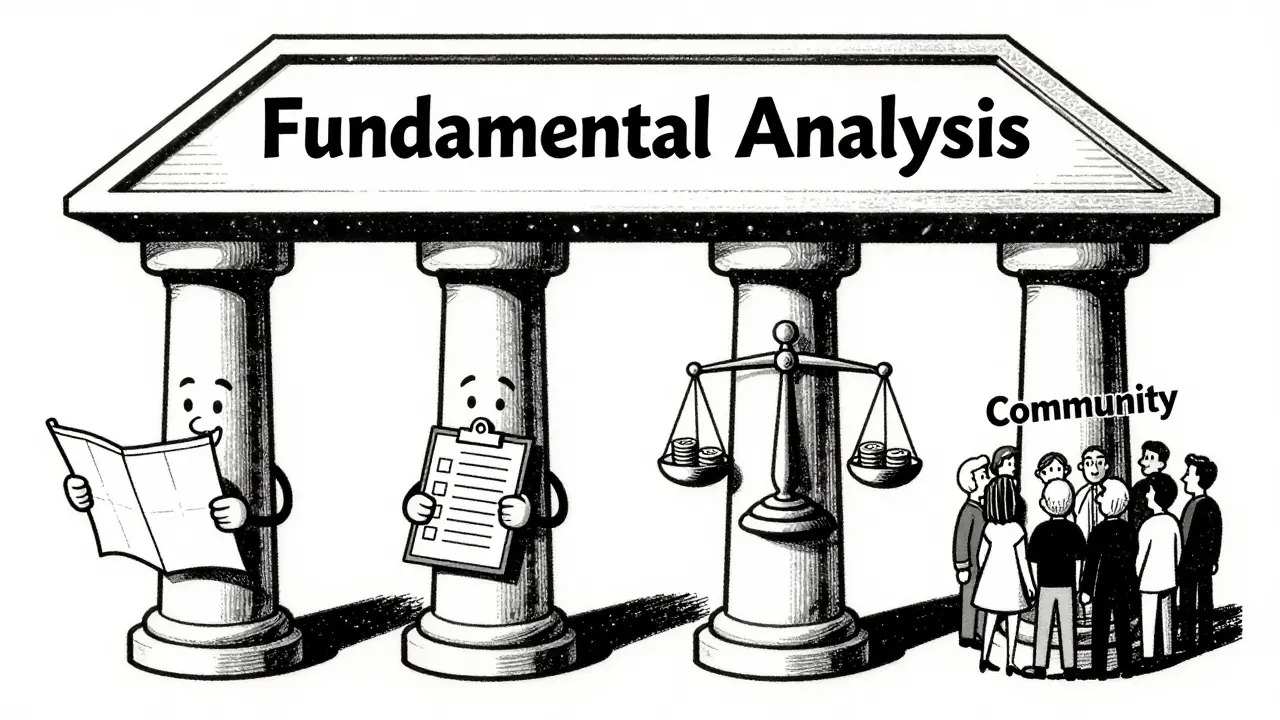
To compare any two crypto projects, you need a consistent set of criteria. If you judge one project by its technology and another by its marketing budget, your comparison is useless. You must use the same ruler for everyone. There are four main pillars you should evaluate:
- The Team: Who is building this? Do they have experience?
- The Technology: Does the code work? Is it secure?
- The Tokenomics: How does the token create value?
- The Community & Traction: Are real people using it?
Let’s break down each pillar so you know what questions to ask.
Evaluating the Team and Vision
A great idea means nothing if the people behind it cannot execute it. Start by looking at the founders and developers. Are their identities public? In the early days of crypto, anonymity was common, but today, transparency builds trust. Check LinkedIn profiles. Have these people built successful software before? Have they launched previous blockchain projects?
Look for "doxxed" teams-those who reveal their identities. This reduces the risk of a rug pull, where developers abandon the project and take the funds. Also, read their whitepaper or documentation. Does it clearly explain the problem they are solving? Or is it filled with buzzwords like "synergy" and "metaverse" without substance? A clear, concise vision is a sign of a focused team.
Analyzing the Technology and Security
You don't need to be a coder to understand the tech stack, but you do need to know where to look. First, identify the blockchain the project is built on. Is it Ethereum, Solana, or a new Layer-1 chain? Each has different trade-offs in speed, cost, and security.
Next, check for audits. Smart contract audits are critical. Reputable firms like CertiK or OpenZeppelin review code for vulnerabilities. If a project claims to be secure but has no audit report, treat it as high-risk. Look for the audit date too; an audit from three years ago might not cover recent code changes.
Also, consider the scalability. Can the network handle thousands of transactions per second? If the project promises low fees but runs on a congested network, users will leave when gas prices spike. Tools like Etherscan or Solscan let you see transaction history and contract interactions directly.
Decoding Tokenomics: The Economic Engine
This is often the most misunderstood part of crypto investing. Tokenomics refers to the economic model of the token. You need to answer three key questions: What is the total supply? How are tokens distributed? And what is the utility?
Total Supply and Circulating Supply: A project with a trillion-token supply isn't necessarily bad, but you need to know how many are currently in circulation. If only 1% of tokens are circulating, the remaining 99% could flood the market later, crashing the price. This is called inflationary pressure. Look for projects with capped supplies or deflationary mechanisms, like burning tokens upon transaction.
Distribution: Who holds the tokens? If the top 10 wallets hold 50% of the supply, the project is centralized and risky. Use tools like Etherscan's token holder tab to check distribution. Ideally, you want a wide distribution among many small holders.
Utility: Why does someone need this token? Is it used for governance (voting on changes), paying for fees, or staking to earn rewards? A token with no utility is just a speculative asset. For example, Ethereum's ETH is needed to pay for computation on the network. That demand creates intrinsic value.
| Metric | What to Look For | Red Flags |
|---|---|---|
| Total Supply | Capped or deflationary | Unlimited minting rights |
| Circulating Supply | High percentage of total | Very low initial circulation |
| Team Allocation | Vested over time (e.g., 4 years) | Immediate unlock for team |
| Utility | Essential for platform function | No clear use case |
Measuring Real Traction and Community
Hype fades, but usage sticks. To compare projects, look at on-chain metrics rather than social media followers. Social media can be bought; blockchain data cannot be faked easily.
Active Addresses: How many unique addresses interact with the smart contracts daily? A growing number of active users indicates organic adoption. Platforms like Dune Analytics provide dashboards for many major protocols.
Total Value Locked (TVL): For DeFi projects, TVL shows how much capital users trust in the protocol. A rising TVL suggests confidence in the system's security and yield potential. However, watch out for incentives-driven TVL, where users deposit funds only to earn rewards and leave immediately after.
Community Engagement: Join the Discord or Telegram. Are people discussing technical updates and product features? Or are they only asking "When moon?" A healthy community debates improvements and reports bugs. A toxic community focuses solely on price speculation.

Comparative Framework: A Practical Example
Let’s apply this framework to two hypothetical Decentralized Exchange (DEX) projects: Project A and Project B.
Project A: Built on Ethereum. Audited by CertiK. Team is public with prior Web3 experience. Token has a fixed supply of 10 million, with 20% vested for the team over 3 years. Utility includes governance and fee discounts. TVL is $500 million. Active users are growing 5% monthly.
Project B: Built on a new, untested chain. No audit. Anonymous team. Token has 1 billion supply, with 40% held by the team wallet. Utility is vague. TVL is $10 million, mostly from a few large wallets. Social media is full of bot accounts.
Even if Project B’s token is cheaper, Project A is fundamentally stronger. It has lower risk, better utility, and real traction. Price is irrelevant if the foundation is weak.
Common Pitfalls to Avoid
When comparing projects, avoid these common mistakes:
- Focusing only on price: A cheap token doesn't mean good value. Market cap matters more than unit price.
- Ignoring vesting schedules: If the team unlocks millions of tokens next month, expect selling pressure.
- Trusting influencers: Many paid promotions are disguised as organic endorsements. Always do your own research (DYOR).
- Neglecting competition: Is there already a better solution? If Project C offers the same service with lower fees, why would users switch?
Fundamental analysis takes time, but it protects your capital. By systematically evaluating team, tech, tokenomics, and traction, you can separate viable projects from scams. Start with one sector, like DeFi or NFTs, and practice comparing two projects at a time. Over time, you’ll develop an intuition for what makes a crypto project truly valuable.
What is the most important metric in crypto fundamental analysis?
There is no single metric, but token utility and team transparency are foundational. Without a clear use case for the token and a trustworthy team, other metrics like TVL or user count become less reliable indicators of long-term success.
How do I find reliable data for comparing crypto projects?
Use specialized platforms like CoinMarketCap or CoinGecko for basic stats, Dune Analytics for on-chain activity, and Etherscan or Solscan for smart contract details. For audits, check the project’s official website or GitHub repository for links to reports from firms like CertiK or OpenZeppelin.
Is it safe to invest in projects with anonymous teams?
It carries higher risk. While some legitimate projects started anonymously, the lack of accountability increases the chance of fraud or abandonment. If you choose to invest, limit your exposure and verify the code’s open-source nature and audit status thoroughly.
What does a "vesting schedule" mean for investors?
A vesting schedule determines when team members and early investors can sell their tokens. Long vesting periods (e.g., 2-4 years) align team incentives with long-term project success. Short or immediate unlocks can lead to sudden sell-offs, crashing the price.
How often should I re-evaluate my crypto holdings?
Regularly, especially after major upgrades, funding rounds, or changes in leadership. Quarterly reviews are a good baseline. Monitor on-chain metrics monthly to detect shifts in user activity or liquidity trends early.