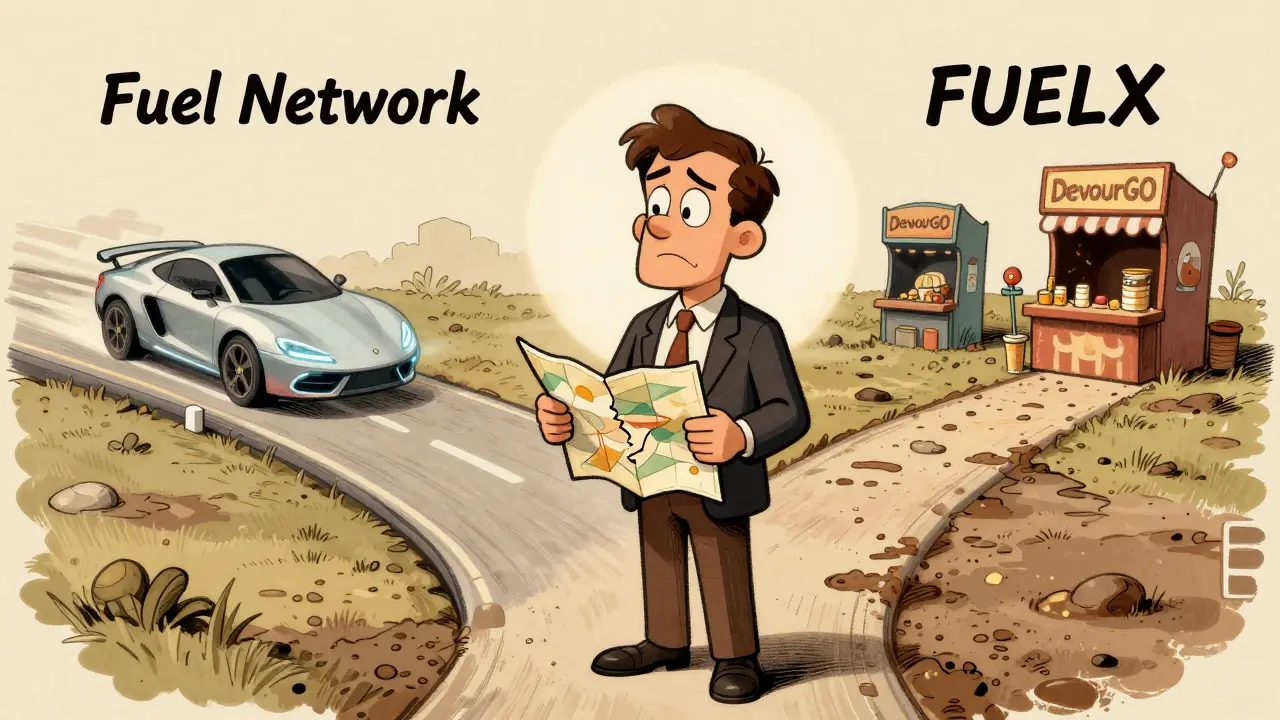
You’ve probably seen the ticker FUELX pop up on a chart or heard it mentioned in passing. But here’s the thing: there is a massive confusion surrounding this name in the crypto world right now. When you search for "Fuel," you might find references to a high-performance Layer 2 blockchain scaling solution for Ethereum. However, the specific token symbol **FUELX** belongs to a completely different project: DevourGO, which describes itself as a gaming and rewards ecosystem.
If you are looking at the FUELX token specifically, you need to understand exactly what it does, why its price has dropped so dramatically, and the serious security red flags attached to its smart contract. This isn't just about buying low; it's about understanding if the asset even holds real value. Let’s cut through the noise and look at the facts behind the FUELX token as of mid-2026.
The Identity Crisis: FUEL vs. FUELX
Before we dive into the numbers, we have to clear up the biggest misconception. The crypto space loves acronyms, and that leads to mix-ups. There is a project called Fuel Network (a modular execution layer for Ethereum built on the Sway programming language). That project aims to speed up Ethereum transactions. It is a major infrastructure play with significant venture capital backing.
Then there is FUELX (the native utility token of the DevourGO platform). This is an ERC-20 token living on the Ethereum mainnet. It is not a blockchain itself. It is a payment and reward mechanism for a specific app ecosystem focused on gaming and food delivery via DevourPlay. If you are holding FUELX, you are not investing in Ethereum scaling technology. You are betting on the success of a niche gaming and lifestyle reward platform. Confusing the two can lead to catastrophic financial errors, as their market caps, use cases, and risk profiles are worlds apart.
What Does FUELX Actually Do?
So, if you buy FUELX, what are you actually getting? According to the project’s whitepaper and tracking data, FUELX functions as the operational currency within the DevourGO ecosystem. Here is how the utility breaks down:
- Gaming Rewards: Users earn FUELX by playing games on the DevourPlay platform. The model follows a "play, earn, repeat" loop, where in-game achievements translate to token payouts.
- In-App Purchases: You can spend FUELX to buy gaming gift cards, in-game loot, and digital assets directly through the platform.
- Food Delivery Payments: A unique feature is the ability to pay for food delivery services using the token, attempting to bridge crypto with everyday consumer spending.
- Yield Generation: Holders can lend their FUELX tokens within the ecosystem to generate yield, though liquidity pools for such low-cap tokens are often thin and risky.
The idea is sound on paper-creating a closed-loop economy where tokens have immediate, tangible use. However, utility only matters if people are actually using the platform. Current trading volumes suggest that adoption is extremely limited.
Supply Mechanics and Market Data
Let’s look at the hard numbers. Understanding supply is crucial because it dictates scarcity and potential inflation.
| Attribute | Value |
|---|---|
| Blockchain | Ethereum (ERC-20) |
| Max Supply | 5,000,000,000 (5 Billion) |
| Circulating Supply | ~3.87 Billion (Data inconsistent across trackers) |
| All-Time High (ATH) | $0.019419 (April 1, 2024) |
| All-Time Low (ATL) | $0.00001775 (August 21, 2024) |
| Current Price Range | $0.000083 - $0.000124 |
The discrepancy in circulating supply reports is a red flag. Some platforms show near-zero circulation, while others show nearly 4 billion tokens in play. This lack of transparency makes calculating the true market cap difficult. Most aggregators list the market cap as $0 or negligible because they cannot verify the active float. The fully diluted valuation (FDV), however, sits around $425,000 to $438,000. This means if every single one of the 5 billion tokens were traded today, the entire project would be worth less than half a million dollars. For context, many small local businesses are worth more than the total theoretical value of this token.
The Security Red Flag: Proxy Contracts
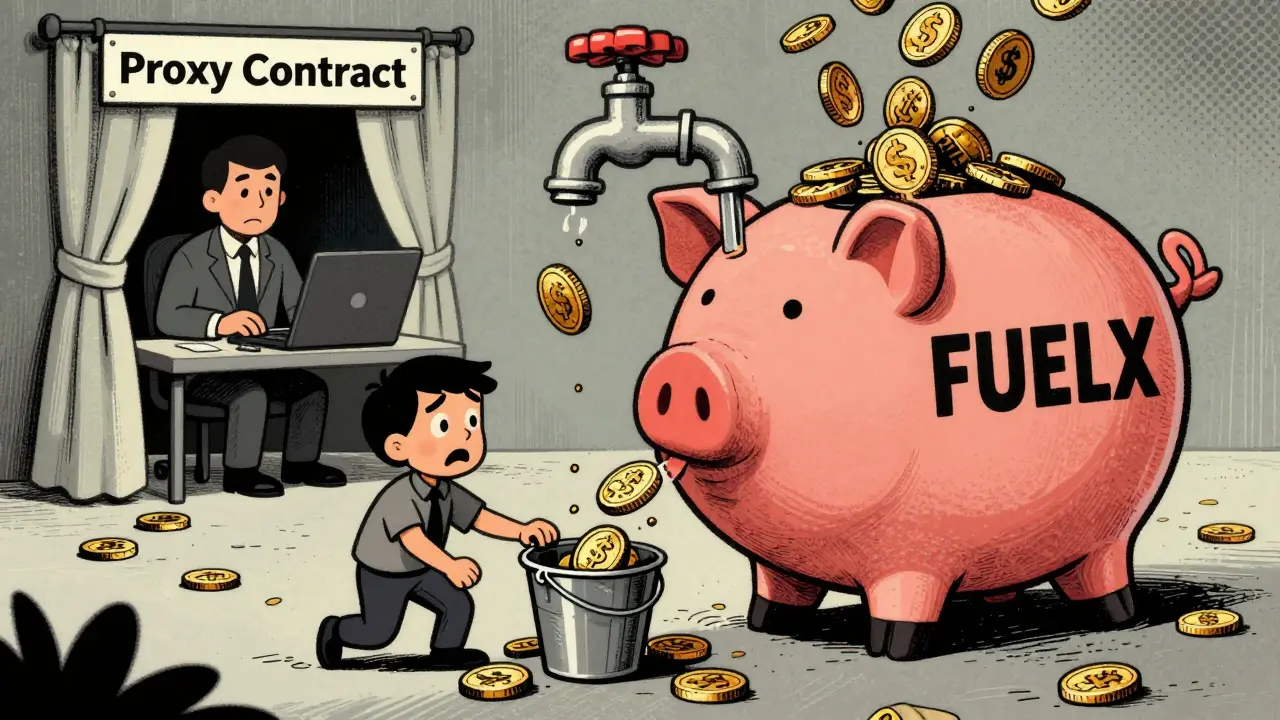
This is the most critical section for any investor. You need to know that the FUELX token operates on a Proxy Contract (a smart contract structure that allows the code to be upgraded by the owner). In simple terms, this means the developers retain control over the token's underlying code.
Why does this matter? Because a proxy contract gives the owner the power to:
- Mint new tokens: They can create infinite amounts of FUELX, diluting your holdings instantly.
- Disable selling: They can pause transfers, trapping your funds inside your wallet.
- Change fees: They can alter transaction taxes without community vote.
- Transfer tokens: They can move tokens from user wallets to their own.
Security auditors like GoPlus and CoinGecko explicitly warn users to "exercise caution" due to these centralization risks. In decentralized finance (DeFi), trustless systems are the gold standard. FUELX relies heavily on trusting the team not to abuse their admin privileges. Given the token’s performance history, that trust is hard to justify.
Price Performance and Volatility
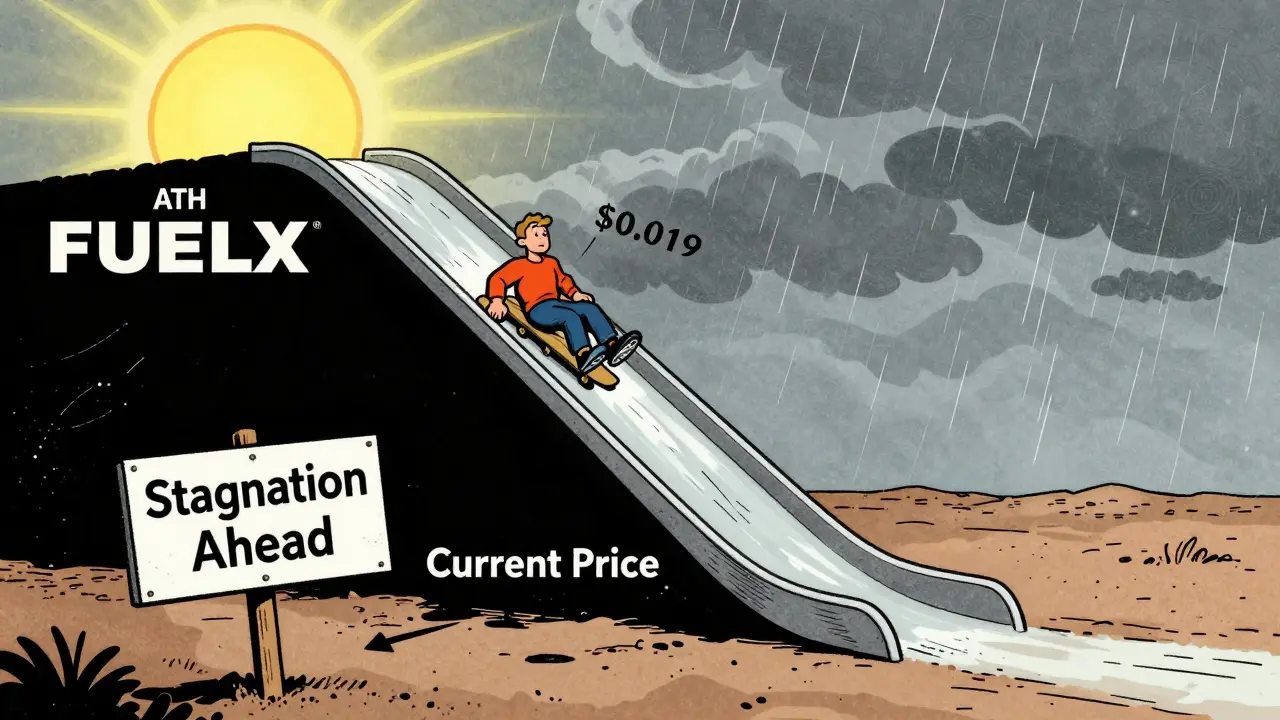
The price action of FUELX tells a story of severe depreciation. Since hitting its all-time high of roughly $0.019 in April 2024, the token has lost approximately 99.5% of its value. By August 2024, it had bottomed out at $0.00001775. As of late June 2026, it hovers around the $0.00008 mark.
Compare this to the broader market. While Bitcoin and Ethereum have seen cycles of growth and consolidation, FUELX has consistently underperformed. In the last year alone, it is down over 94% against the general crypto market index. Trading volume is also abysmal, often dipping below $2,000 in 24-hour turnover on major exchanges. Low volume means low liquidity. If you try to sell a large amount of FUELX, you could crash the price yourself simply because there aren’t enough buyers waiting in the order book.
Future Outlook and Predictions
Is there hope for a rebound? Predictive models from platforms like LBank forecast FUELX reaching between $0.000081 and $0.000089 by 2027. Essentially, the models predict stagnation or slight decline, not recovery. For FUELX to regain relevance, several things must happen:
- Real-World Adoption: DevourGO needs to prove that people actually want to buy food and game loot with FUELX instead of fiat or stablecoins.
- Developer Empowerment: The project needs to attract third-party developers to build on its ecosystem, similar to how Monero or other privacy coins fostered communities.
- Strategic Partnerships: Without partnerships with major gaming studios or food delivery giants, the utility remains theoretical.
Until then, FUELX remains a speculative asset with high risk and unclear utility. It ranks outside the top 14,000 cryptocurrencies by market cap, placing it in the "micro-cap" or "dust" category where projects frequently go to zero.
How to Manage FUELX Safely
If you already hold FUELX or decide to experiment with it, you need to handle it carefully. The token lives on the Ethereum network. You can import it into wallets like MetaMask using the contract address: 0xcc54ac31164b5b3c39db4eef26d89275c468ec9d.
However, be aware of the gas fees. Transacting with such a low-value token on Ethereum mainnet can cost more in ETH gas fees than the token is worth. Always check the current gas prices before attempting a transfer. Furthermore, never connect your primary wallet containing significant assets to unknown dApps associated with low-tier tokens. Use a separate "burner" wallet for interactions with high-risk contracts like FUELX.
Is FUELX the same as the Fuel Network blockchain?
No. Fuel Network is a Layer 2 scaling solution for Ethereum. FUELX is a utility token for the DevourGO gaming and rewards platform. They are unrelated projects, and confusing them is a common mistake.
Why is the market cap of FUELX listed as $0?
Many tracking platforms report the market cap as $0 because the circulating supply data is inconsistent or unverified. The Fully Diluted Valuation (FDV) is estimated around $425,000, but the actual tradable float is unclear, leading to calculation errors on aggregators.
What are the risks of holding a proxy contract token?
Proxy contracts allow the developer to change the code after launch. This means they can mint unlimited new tokens, disable selling, or steal funds. It creates a centralized point of failure and significant trust risk for holders.
Can I use FUELX to buy food?
Theoretically, yes. The DevourGO ecosystem promotes using FUELX for food delivery payments via DevourPlay. However, practical adoption appears very low, and merchant acceptance is likely limited to specific partners within their app.
Is FUELX a good investment for 2026?
Based on current data, FUELX is considered high-risk. It has lost 99.5% of its value since its peak, has low liquidity, and carries significant smart contract risks. Most analysts predict stagnation rather than growth.

Comments (17)
Jay Sharma
They want you to think it's a gaming token but it's actually just a honeypot designed to drain your wallet. The proxy contract is the smoking gun right there, classic rug pull setup where they mint infinite tokens and dump on you while you're busy playing their little games. I've seen this pattern a hundred times in these micro-cap dumps.
Rebecca Shoniker
The technical analysis here is utterly pathetic if you don't understand the fundamental mechanics of ERC-20 governance vulnerabilities!! You are essentially holding a digital IOU that can be rewritten at any second by the dev team!!! It is not an investment, it is a donation to someone else's Lamborghini fund!!!
ross harris
FUELX is basically financial radioactive waste wrapped in a shiny wrapper of 'gaming utility' nonsense. The whole ecosystem is a house of cards built on thin air and desperate hope. When the music stops, which it always does for these proxy-contract scams, everyone left holding the bag realizes they bought a ticket to nowhere. It’s a masterclass in how to lose money slowly rather than all at once.
Scott Miller
Stop crying about the losses and look at the potential! Every great crypto had a bottom like this before it mooned. If you have conviction, you buy the dip. Fear is for losers who sell at the bottom. Hold tight and watch them eat their words when it pumps 100x next cycle!
Carl Hanzel
You are delusional if you think this will recover. The market doesn't care about your feelings or your 'conviction'. It cares about liquidity and utility, neither of which FUELX has. This isn't a dip, it's a cliff. Keep your hands off garbage assets.
Scott Miller
Tough love is needed sometimes. Most people lack the stomach for real gains. While you sit on the sidelines watching others get rich, you can keep complaining. That's why you're broke.
Carl Hanzel
I'm not broke because I avoid scam coins. I'm wealthy because I don't gamble my savings on projects with admin keys that allow developers to steal funds. Your aggression is just a mask for your ignorance.
Fiona Ellis
Oh my goodness, reading this thread is exhausting 😩. Can we please focus on the actual security risks instead of fighting? The fact that the circulating supply data is inconsistent across trackers is so worrying 🚩. It feels like walking into a dark room without a flashlight. Just be careful out there, everyone! 💖
Mélanie Boulay
I find myself quite concerned about the transparency issues mentioned in the article, particularly regarding the discrepancy between different data aggregators reporting vastly different circulating supply figures, which naturally leads to significant confusion among retail investors who may not possess the technical expertise to verify the on-chain data themselves, thereby creating an environment ripe for exploitation by those with malicious intent.
Maurice Flynn
It's funny how these projects promise the world with 'food delivery' and 'gaming rewards' but never show any real traction. I just watch from the sidelines. Let the degens fight over scraps. I'll stick to BTC and ETH where the tech actually works and the contracts are immutable. Peace is underrated.
Ryan Peters
This is exactly what happens when you let unregulated offshore entities create fake economies. American taxpayers shouldn't have to bail out idiots who lose their life savings on worthless meme-adjacent tokens. The SEC needs to shut these proxy-contract casinos down immediately before more victims fall for the hype.
Carl Belgrave
Get off my lawn with this foreign scam nonsense! We need strong domestic regulation and protection for our citizens. These crypto grifters are bleeding our economy dry. Burn the code, ban the exchanges, and protect American wealth from globalist thieves.
Routh Middaugh
Look, everyone is entitled to their opinion, but let's try to stay civil here; the technology behind blockchain is fascinating even if this specific implementation is flawed, and perhaps we can learn from these mistakes to build better systems in the future, rather than just tearing each other apart over lost money.
Rob Morton
The philosophical implication of trustless systems being compromised by centralised admin keys is profound. It challenges the very core tenet of decentralisation. If you must trust the developer, why use blockchain at all? Use a bank. At least banks have legal recourse. Here, you have nothing but code that can change against you.
Jon Milton
Listen up folks. The difference between Fuel Network and FUELX is massive and confusing people daily. One is serious infrastructure, the other is a dust cap trap. Stop mixing them up. If you hold FUELX, you're betting on a niche app that nobody uses. Cut your losses and move to real assets. No hard feelings but wake up.
Sajjad Ghorbani Moghaddam
Hey guys, just wanted to drop some knowledge here. A lot of newbies get stuck because they don't check the contract type. Always use tools like GoPlus to scan for proxy contracts before buying. It takes two seconds and saves you thousands. Stay safe and keep learning, the community is here to help if you ask the right questions.
Abby Martin
Honestly, I feel bad for anyone still holding this. It's not just bad luck, it's bad decisions. You ignored every red flag because you wanted to get rich quick. Now you're sitting on digital toilet paper. Maybe take a break from crypto and go touch grass?