Imagine sending money to someone on the other side of the world without a bank, without waiting days, and without paying huge fees. That’s the promise of cryptocurrency. It’s not magic. It’s not just a fad. It’s a real, working system that’s changing how money moves - and you don’t need to be a tech expert to understand it.
What Exactly Is Cryptocurrency?
Cryptocurrency is digital money. Not like the dollars in your wallet, but like a file on your phone that can’t be copied, forged, or erased. It runs on something called a blockchain - a public, digital ledger that records every transaction ever made. Unlike banks, which keep track of your money behind closed doors, this ledger is visible to everyone and maintained by thousands of computers around the world.
The first cryptocurrency, Bitcoin, was created in 2009 by someone using the name Satoshi Nakamoto. No one knows who they really are. But their idea stuck: a money system that doesn’t need banks, governments, or middlemen. Today, there are over 10,000 different cryptocurrencies, but only a handful matter to beginners. Bitcoin and Ethereum together make up about 60% of the entire market.
How Does It Work?
Every time someone sends Bitcoin or Ethereum to someone else, that transaction gets checked by a network of computers (called nodes). These computers solve complex math puzzles to confirm the transaction is real. Once confirmed, it’s locked into a "block" and added to the chain of previous transactions - hence the name blockchain.
That’s why it’s so secure. If you try to cheat - say, spend the same Bitcoin twice - the network rejects it. And because the ledger is copied across millions of devices, no single person or company can control it. That’s decentralization. No central bank. No government. Just code and consensus.
Transactions settle fast. Bitcoin usually takes 10 to 60 minutes. Ethereum can be even quicker. Fees? They vary. During busy times, Bitcoin might cost $5 to $50 to send. But newer networks like Solana or Polygon charge less than a penny. And unlike banks that close at 5 p.m., cryptocurrency runs 24/7. You can send money at 3 a.m. on a Sunday. No delays.
Why Do People Use It?
People use cryptocurrency for different reasons. Some see Bitcoin as digital gold - a store of value that won’t get ruined by inflation. Others use Ethereum to run apps that don’t rely on companies like Google or Facebook. These apps, called decentralized applications or dApps, let you lend money, trade assets, or even play games without a central server.
For people in countries with unstable currencies - like Nigeria or Argentina - cryptocurrency is often the only reliable way to save money. In 2025, about 320 million people worldwide owned some kind of cryptocurrency. That’s 4% of the global population. In Nigeria, nearly one in three adults owns crypto. In Japan, it’s just 4%. Adoption isn’t even.
Big companies are jumping in too. Tesla, MicroStrategy, and Square hold billions in Bitcoin. JPMorgan and Goldman Sachs now let clients trade crypto. Even governments are testing digital currencies - though most are trying to control them, not let them be free.
How Is It Different From Regular Money?
Here’s the big difference: traditional money (like dollars or euros) is controlled by central banks. They decide how much to print, set interest rates, and can freeze your account if they want. Cryptocurrency? No one controls it. You own it outright - if you know how to protect it.
Another difference? Volatility. Bitcoin can swing up or down 10% in a single day. Stock markets rarely move more than 2%. That’s scary - but also exciting. Since Bitcoin started, its average yearly return has been over 100%. But it’s also crashed 80% several times. If you invest, you need to be ready for rollercoaster rides.
And then there’s speed and cost. Sending $1,000 internationally through a bank? Could take 3 days and cost $50. Sending it via Bitcoin? Maybe 30 minutes and $2. That’s why people in developing countries rely on crypto for remittances.
How Do You Get Started?
You don’t need to buy a whole Bitcoin. You can buy as little as $10 worth. Most beginners start on Coinbase or Binance.
Here’s the simple step-by-step:
- Sign up on an exchange like Coinbase. You’ll need your ID and a photo - this takes 1 to 3 days.
- Link your bank account or debit card.
- Buy $50 or $100 of Bitcoin or Ethereum. Don’t go all in.
- Once you have it, move it out of the exchange and into your own wallet. More on that soon.
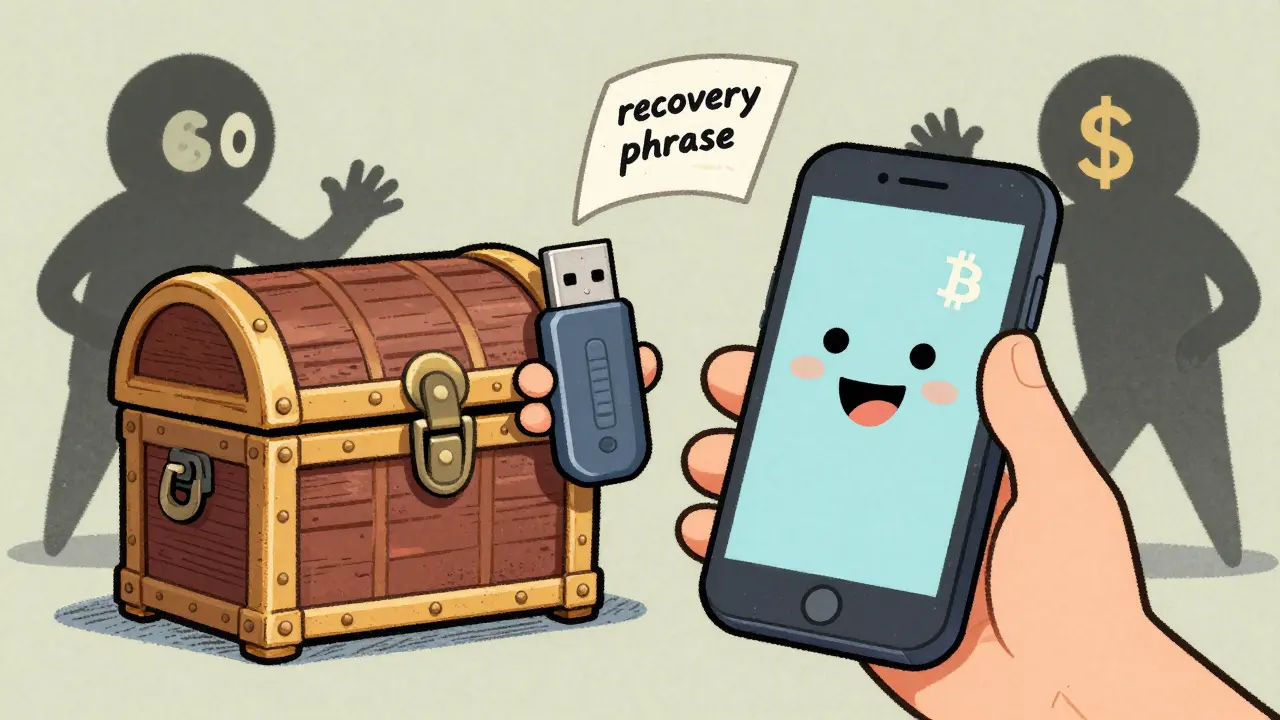
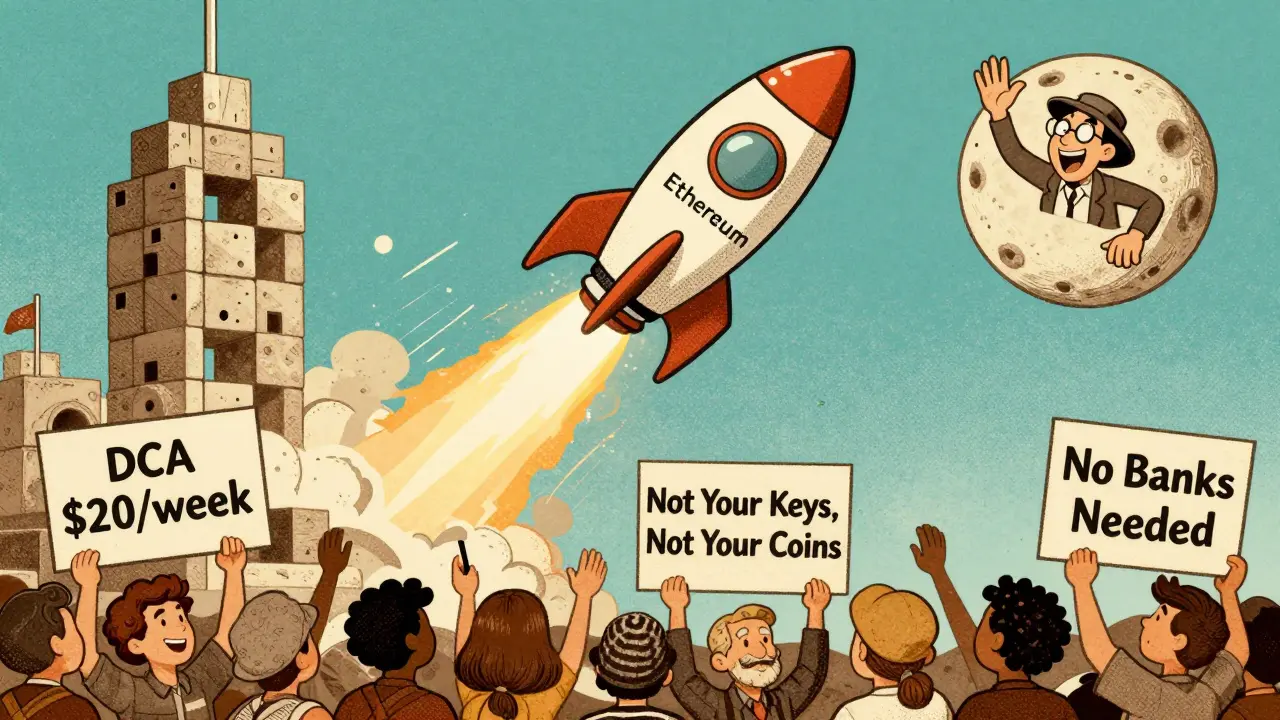
Why move it? Because Andreas Antonopoulos - one of the most respected voices in crypto - says it best: "Not your keys, not your coins." If your crypto stays on Coinbase or Binance, they control the private keys. If they get hacked, or shut down, you could lose everything. That’s why serious users use wallets they control.
Wallets: Hot vs Cold
There are two types of wallets: hot and cold.
- Hot wallets are apps on your phone or computer. Easy to use. Good for small amounts you want to trade. Examples: Coinbase Wallet, MetaMask.
- Cold wallets are physical devices - like a USB stick. They stay offline. Much safer. Best for holding larger amounts long-term. Examples: Ledger Nano X ($149), Trezor Model T ($219).
Setting up a cold wallet takes about an hour. You write down a 12- or 24-word recovery phrase. Never type it online. Never screenshot it. Store it on paper, in a safe place. If you lose it, you lose your money. Forever.
Security Is Everything
In 2022, over $3.8 billion was stolen or scammed from crypto users. Most of it? People gave away their private keys. They clicked fake links. They trusted influencers promising "double your money."
Here’s how to stay safe:
- Never share your recovery phrase. Not even with "support".
- Enable two-factor authentication (2FA) on every account.
- Use a hardware wallet for anything over $500.
- Ignore "get rich quick" posts on TikTok or Reddit.
- Only use well-known exchanges like Coinbase or Binance. Avoid random apps.
There’s no refund if you send crypto to the wrong address. It’s gone. No bank can reverse it.
What Should You Do as a Beginner?
You don’t need to trade daily. You don’t need to watch charts. The smartest strategy for most people is called dollar-cost averaging.
Here’s how it works: Every week, buy $20 of Bitcoin. No matter if the price is up or down. Do this for a year. You’ll end up with a mix of prices - and you won’t panic when the market drops. People who do this report satisfaction rates above 70%. Day traders? Only 20% succeed.
Experts recommend putting no more than 5% to 10% of your total savings into crypto. If you’re risk-averse, go lower. Suze Orman, a well-known financial advisor, says even 1% is fine if you’re not comfortable.
Most beginners spend 20 to 40 hours learning before they buy their first coin. Watch YouTube tutorials. Read beginner guides. Join Reddit communities like r/cryptocurrency or r/bitcoin. Ask questions. Don’t rush.
What’s Next for Cryptocurrency?
In 2025, Bitcoin and Ethereum ETFs launched in the U.S. and Europe. That means you can now buy crypto through your regular brokerage account - like you would Apple stock. It’s a big step toward mainstream adoption.
Technology is improving too. Bitcoin’s transaction fees dropped 90% thanks to Layer 2 networks. Ethereum is getting faster and cheaper with sharding - a new tech that could boost its speed by 1,000 times by 2026.
Regulations are catching up. The European Union passed MiCA in 2024 - the first full set of crypto rules. The U.S. is still messy, but clearer rules are coming.
Will crypto be worth $1 million per Bitcoin by 2030? Maybe. Maybe not. But one thing’s clear: digital money isn’t going away. It’s growing. And as a beginner, you don’t need to predict the future. You just need to start smart.
Is cryptocurrency legal?
Yes, in most countries, including the U.S., Canada, the EU, and Ireland. But rules vary. Some countries ban it outright (like China), while others tax it heavily. Always check your local laws before buying.
Can I lose all my money in cryptocurrency?
Yes. Prices can crash 80% in months. Scams are common. If you invest money you can’t afford to lose, you risk losing it all. Treat crypto like gambling - not savings.
Do I need to pay taxes on cryptocurrency?
Yes. In most places, selling, trading, or spending crypto triggers a taxable event. If you buy Bitcoin at $30,000 and sell it at $50,000, you owe tax on the $20,000 profit. Keep records of every transaction.
What’s the difference between Bitcoin and Ethereum?
Bitcoin is mainly digital gold - a store of value. Ethereum is a platform for apps and smart contracts. You can build games, lending systems, or NFTs on Ethereum. Bitcoin doesn’t do that. Ethereum is more flexible. Bitcoin is more stable.
Should I buy cryptocurrency now?
If you’re new, start small. Buy $20 this week. Buy $20 next week. Don’t wait for the "perfect price." The best time to start was years ago. The second best time is today. Just don’t go all in.
What to Do Next
Start with $20. Use Coinbase. Buy Bitcoin. Move it to a wallet. Learn for 30 minutes a week. Ignore the noise. In six months, you’ll know more than 90% of people who bought crypto during the last hype cycle.
There’s no rush. Crypto isn’t going anywhere. And the smarter you are about starting, the better off you’ll be - no matter where prices go next.



Comments (18)
Brenda White
ok so like crypto is just money that cant be printed by governments right? like i get it but why do people act like its the future when my uncle lost 20k on dogecoin and now he thinks he's a genius? lol
Tobias Wriedt
This is actually one of the clearest explainers I've seen 😍👏. People who say crypto is a scam don't understand blockchain. It's not magic. It's math. And math doesn't lie. 🤓💰
S F
America built the internet. America built Bitcoin. Now China and the EU want to regulate it into oblivion. Wake up people. This isn't just money. It's sovereignty. And if you're not holding BTC, you're on the wrong side of history. 🇺🇸🔥
Anastasia Thyroff
I just don't get why people are so obsessed with this when the system is still so fragile. One major exchange goes down and everything crumbles. I mean... what if the whole thing just vanishes tomorrow? I'm not ready to risk my savings on something that feels like a dream
Kira Dreamland
I started with $50 on Coinbase last year. Just bought a little every week. Didn't even check the price for months. Now I'm up 3x. The key is not trying to time it. Just show up. Consistency beats hype every time.
shreya gupta
In India, we use crypto because our rupee is collapsing. My cousin sent 5000 rupees to her sister in Bangladesh via USDT. It took 4 minutes. Bank transfer? 3 days. 15% fees. This isn't speculation. This is survival.
Derek Lynch
You don't need to be a genius to start. You just need to start. $20 this week. $20 next week. That's it. You're already ahead of 90% of people who think they have to wait for the perfect moment. The perfect moment is now. Go do it.
Shreya Baid
I am from India and I have witnessed how crypto has empowered small business owners. One tea vendor now accepts USDT. He no longer relies on unstable local banks. He saves in Bitcoin. His daughter studies abroad. This is not gambling. This is dignity.
Christopher Hoar
Lmao people think they're so smart buying BTC. Meanwhile, I'm stacking sats while you're still reading beginner guides. You're not late. You're just not ready. The real players have been HODLing since 2017. You're still on the sidelines. Get. In.
Robert Kunze
I lost everything in 2022. Got scammed by a fake Coinbase support guy. Never trusted exchanges again. Now I use a Ledger. Wrote my 12 words on paper. Locked it in a fireproof box. I'm not rich. But I'm safe. Learn from my dumbass mistake.
Sarah Zakareckis
DCA is the OG move. Dollar-cost averaging. Not day trading. Not memecoins. Just consistent buys. Your brain will thank you. Your portfolio will thank you. Your sleep schedule will thank you. This isn't a race. It's a marathon. Stay disciplined.
Heather James
Don't overthink it. Buy $20. Move it. Learn. Repeat.
Sarah Hammon
I was skeptical too. Then I read the Bitcoin whitepaper. It's not about money. It's about trust. We don't need banks to verify transactions. We have code. And code doesn't lie. That's why I'm in. Not for profit. For principle.
iam jacob
I just don't understand why everyone's so excited. I mean... what if it all crashes? What if I wake up one day and my 'crypto' is just a bunch of zeros? I feel so anxious just thinking about it. I wish I could stop caring but I can't. Why does this feel so personal?
Jesse Pals
DCA is the real MVP 🙌. I started with $10/week. Now I have 0.03 BTC. Not rich. But I'm not scared anymore. And I sleep better knowing I'm not chasing pumps. Just building. Slow. Steady. Safe.
Diane Overwise
Ah yes. The classic 'start with $20' advice. How quaint. In 2025, we're not talking about pocket change. We're talking about institutional adoption. ETFs. Central bank integration. You're still playing with Monopoly money while the adults are building the real board. But hey - keep your $20. It's cute.
Ann Liu
The post correctly identifies that Bitcoin and Ethereum comprise ~60% of the market cap. However, it omits that the top 100 tokens account for over 90%. This concentration introduces systemic risk. Diversification within crypto is not optional - it's essential.
Dionne van Diepenbeek
Why do people think crypto is the answer when governments are already launching CBDCs? It's not freedom. It's just a new system with different rules. You're trading one master for another. And you don't even see it.