
When Thailand cracked down on unlicensed crypto exchanges in April 2025, thousands of Thai traders woke up to find their favorite platforms-Bybit, OKX, Binance-gone from their screens. No warning. No grace period. Just a block. The reason? Thailand’s Securities and Exchange Commission (SEC) had just turned up the heat on foreign crypto platforms serving Thai users. This wasn’t a minor update. It was a full overhaul of the rules, and it changed everything.
Who Needs a License to Operate in Thailand?
Any crypto exchange that targets Thai customers must get licensed by the Thai SEC. It doesn’t matter if the company is based in Singapore, the U.S., or the Cayman Islands. If your platform does any of these seven things, you’re legally serving Thai users-and you need a license:
- Your website is partially or fully in Thai
- You use a .th or .ไทย domain
- You accept payments in Thai baht or through Thai bank/e-wallet accounts
- You say Thai law governs your terms or Thai courts handle disputes
- You pay for ads targeting Thai users on Google or Facebook
- You have staff or offices in Thailand helping customers
- You do anything else the SEC officially says counts
That last point is important. The SEC doesn’t leave room for loopholes. If you’re even slightly targeting Thai people, you’re in their crosshairs. And they’re not asking nicely-they’re enforcing it with instant website blocks by the Ministry of Digital Economy and Society. No court order needed. Just a click, and your site disappears in Thailand.
What Happens If You Don’t Comply?
Operating without a license isn’t just risky-it’s illegal. The penalties are harsh:
- Fines up to ฿100 million ($2.7 million)
- Prison sentences of up to 10 years for company executives
- Immediate shutdown of services
- Asset freezes and seizure of funds
Bybit and OKX didn’t get a second chance. They were blocked within days of the April 2025 rules taking effect. Even if you think you’re not targeting Thailand, if your platform has Thai language options or accepts baht, you’re already in violation. The SEC doesn’t care if you didn’t mean to. Intent doesn’t matter. Action does.
What Do Licensed Exchanges Have to Do?
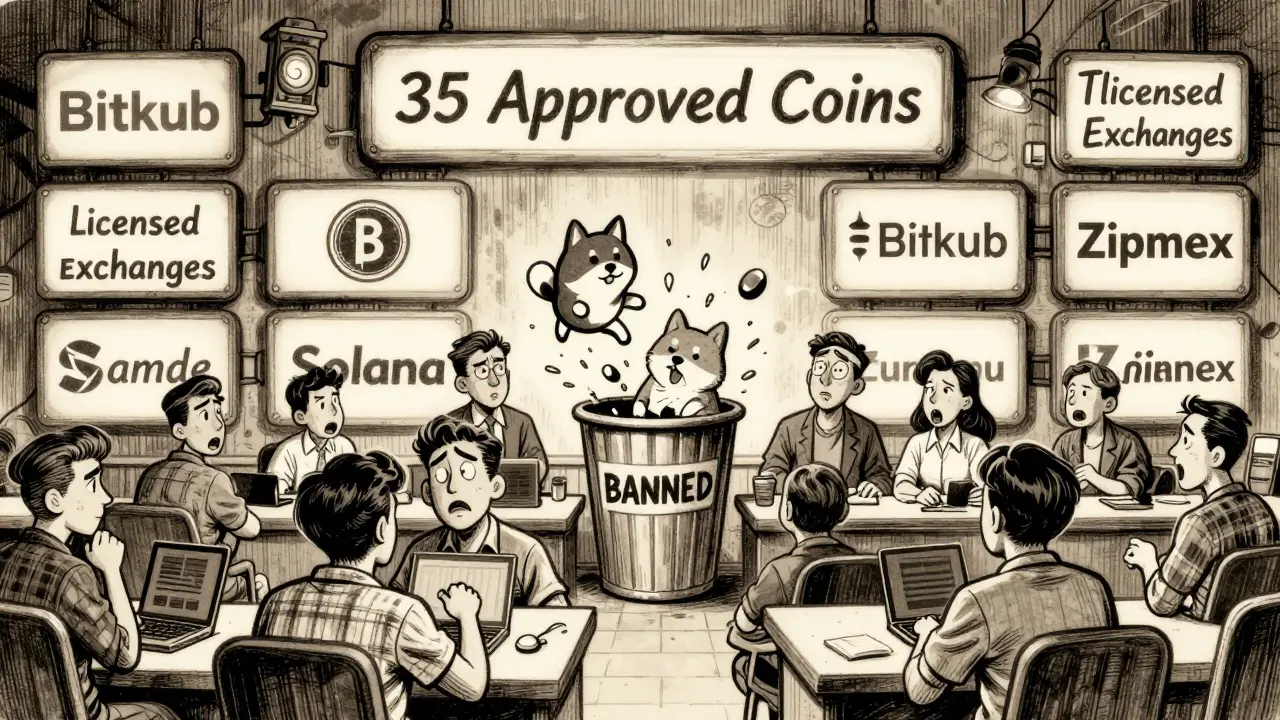
Nine exchanges are currently licensed in Thailand as of February 2025. The biggest is Bitkub. Others include Zipmex, AssetBit, and Binance Thailand. But being licensed doesn’t mean free rein. These platforms face strict limits:
- No trading of privacy coins (Monero, Zcash, etc.)
- No staking with guaranteed returns
- No lending or borrowing crypto with interest promises
- No wallet services offered to users
- No advertising crypto as payment for goods or services
- No meme tokens, fan tokens, or NFTs allowed
And the coin list? Only 35 digital assets are approved as of June 2025. That’s it. Bitcoin and Ethereum are safe. Solana? Nope. Dogecoin? Not allowed. Shiba Inu? Out. Even if a token is popular globally, if it’s not on Thailand’s official list, you can’t trade it locally. This is one of the biggest complaints from Thai traders-limited choices mean less liquidity and wider spreads.
How Much Does It Cost to Get Licensed?
Getting a license isn’t cheap. The fees are designed to keep out small players:
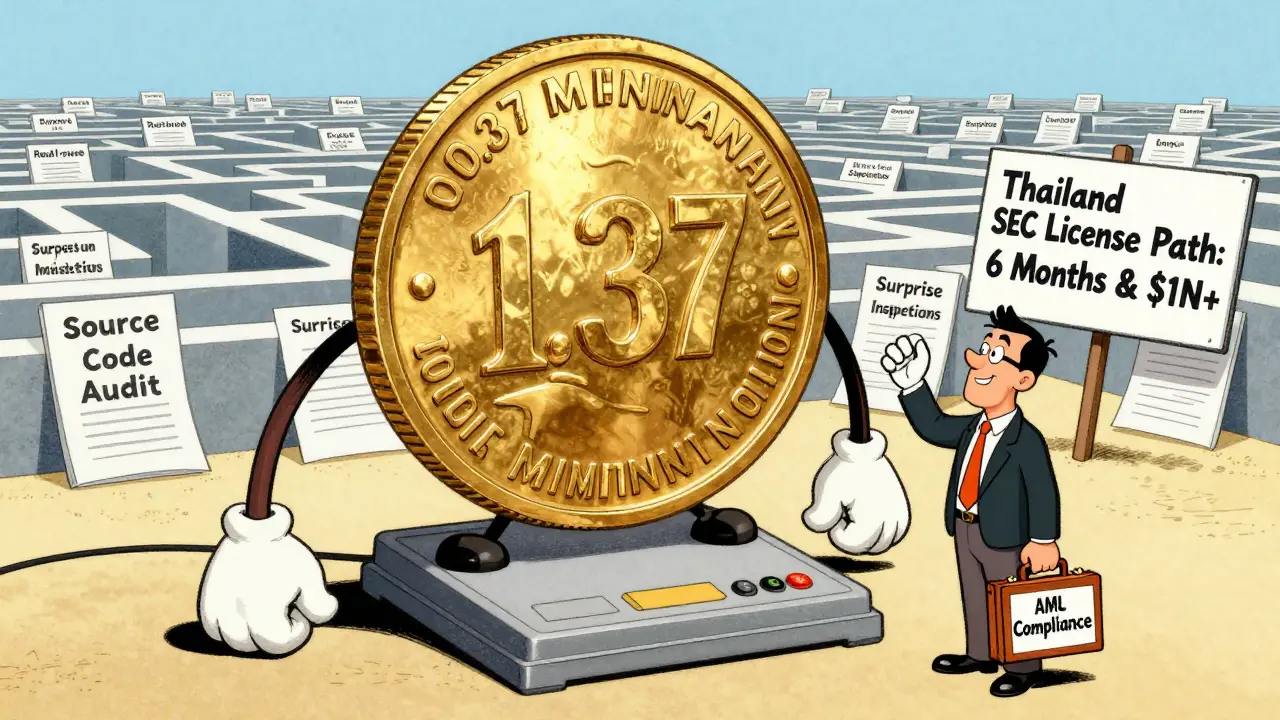
- Application fee: ฿1,000,000 ($27,400)
- Annual license fee: ฿500,000 ($13,700)
- Minimum capital requirement: ฿50 million ($1.37 million)
Plus, you need to prove you have strong anti-money laundering (AML) systems that meet FATF standards. You need source code audits from SEC-approved firms. You need real-time transaction monitoring. And you need to be ready for surprise audits at any time. Bitkub spent six months just getting their systems up to speed. Most foreign exchanges couldn’t make the deadline.
What’s the Impact on Thai Traders?
Thai crypto users are split. On one side, people praise the crackdown. On Pantip.com, one thread with over 140 upvotes said, “I haven’t seen a single scam since the foreign exchanges left.” The Royal Thai Police reported a 37% drop in crypto fraud in Q2 2025 compared to Q1.
But the other side is louder. Over 200 upvotes on another Pantip thread complained about “no liquidity, high fees, and way fewer coins.” Reddit user u/BangkokCryptoTrader said withdrawal limits are capped at ฿500,000 ($13,700) per day-too low for serious traders. Transaction fees on local exchanges average 0.25%, compared to 0.1% on international ones. And with fewer coins, traders are forced to use VPNs to access foreign platforms. Chainalysis estimates 35% of Thai crypto activity has now moved offshore.
How Does Thailand Compare to Other Countries?
Thailand’s rules are stricter than Singapore’s. MAS lets foreign exchanges operate if they meet certain standards. Thailand says no-get licensed or get blocked. It’s more like Japan’s system, but with one big difference: Japan doesn’t block foreign platforms just because they speak Japanese or accept yen. Thailand does.
Compared to the EU’s MiCA framework, Thailand lacks clarity on stablecoins and doesn’t allow cross-border licensing. A company licensed in the EU can’t automatically operate in Thailand. That’s a problem for global firms.
China bans crypto entirely. Thailand doesn’t. It just makes it hard for outsiders to play. That’s why Thailand’s framework is ranked 6.2/10 by CryptoCompare-strong protection, weak innovation.
What’s Next for Thailand’s Crypto Market?
The SEC isn’t done. In late 2025, they plan to update the Digital Asset Business Act to cover decentralized finance (DeFi) platforms. That’s a big deal. Right now, DeFi protocols aren’t regulated at all. If you’re running a lending pool or automated market maker, you’re in a legal gray zone.
Also coming in 2026: a pilot program to connect licensed exchanges with Thailand’s central bank digital currency (CBDC). That could make crypto more useful for everyday payments-if the SEC allows it.
And while meme tokens are banned, altcoin ETFs are planned for 2026. If approved, they could unlock $3 billion in new institutional money. That’s a sign Thailand still wants to be a fintech hub-just on its own terms.
Can You Still Trade Crypto in Thailand?
Yes-but only through licensed platforms. Bitkub, Binance Thailand, Zipmex, and the other seven approved exchanges are your only legal options. You can’t use Binance.com, Kraken, or Coinbase unless you’re not in Thailand. If you’re physically in Thailand and using a foreign exchange, you’re breaking the law. The SEC doesn’t care if you’re a tourist or a digital nomad. If you’re accessing the platform from within Thailand, you’re subject to their rules.
And if you’re thinking of starting your own exchange? Forget it unless you have over $1.5 million in capital, a team of compliance lawyers, and months to spare on audits. The bar is high-and it’s getting higher.
Why Does This Matter Outside Thailand?
Thailand’s approach is a warning to other countries. It shows how a small nation can take control of its digital finance space-even against global giants. If you’re a crypto platform operating internationally, Thailand’s seven-point test is now a model. If you’re a trader, it’s a reminder: location matters. Your rights depend on where you are, not where your app is hosted.
Thailand didn’t ban crypto. It didn’t kill innovation. It just said: if you want to serve our people, play by our rules. And they’re not afraid to enforce them.


Comments (14)
roxanne nott
Thailand just turned crypto into a government-approved monopoly. Classic. No innovation, just control. And people wonder why traders use VPNs.
Shubham Singh
One cannot help but observe that Thailand’s regulatory approach, while draconian, is at least unambiguous. The absence of regulatory arbitrage is, in fact, a virtue in markets plagued by opacity. One might even call it responsible governance.
Vijay n
They block Binance but let Bitkub run with 35 coins and no wallets? This is not regulation this is a trap to kill competition and hand the market to a few cronies with deep pockets and political ties. The SEC is just another branch of the Thai elite’s money machine. You think they care about fraud? They care about control. And the moment you try to leave the system? Your funds vanish. Trust me I’ve seen it happen.
Alison Fenske
I just want to say I feel so bad for Thai traders who just wanted to learn and grow their money. It’s not fair to lock them out like this. I remember when I tried to trade crypto in a country with strict rules and it felt like being trapped in a glass cage. You can see the world but you can’t touch it. I hope they find a way to make it better.
Jayakanth Kesan
Not bad. At least they’re not banning crypto outright. Some people will complain about limited coins but honestly if you’re trading Dogecoin on a Thai exchange you’re probably not here for the long game anyway. Bitkub’s fees are high but at least you know your money’s not gonna disappear overnight.
Tristan Bertles
Look I get the frustration but let’s be real - most of the foreign exchanges weren’t trying to help Thai users. They were trying to make money off them. Thailand’s rules are tough but they’re protecting people from predatory practices. If you want to trade, learn the system. It’s not impossible - just requires effort. And that’s not a bad thing.
Earlene Dollie
It’s not just about money it’s about freedom. They took our coins our choices our dreams. Now we’re stuck with a government-approved list of 35 tokens like we’re in a 1980s Soviet trading post. I cried when I couldn’t buy Shiba Inu. I’m not even joking. This isn’t regulation this is emotional terrorism.
Dusty Rogers
Thailand’s doing what the U.S. should’ve done years ago. No ads no guaranteed returns no meme coins. If you can’t meet basic compliance standards you don’t deserve to operate here. It’s not about being anti-crypto - it’s about being pro-integrity. Respect the process.
Kevin Karpiak
Why are we even talking about Thailand? This is a joke. The U.S. has real innovation. Europe has clear rules. Thailand? They’re just jealous they can’t compete so they shut everyone out. This isn’t regulation - it’s economic isolationism. And it’s pathetic.
Amit Kumar
Let me tell you something about India - we’ve seen this before. When we banned crypto in 2018 people screamed about freedom. Then we came back stronger. Thailand is doing the same. The real winners? The ones who build local solutions. Bitkub is the new Flipkart. And guess what? Thai traders will thank them in five years. Stop whining. Build something better.
Dustin Bright
35 coins?? 😭 I just want to trade my favorite memecoins... why do they hate us so much?? I’m not even rich I just want to play. I’m gonna use a vpn and cry into my ramen. 🥲
Melissa Black
The regulatory architecture here represents a paradigm shift from speculative liquidity to institutional-grade compliance. The exclusion of DeFi and staking mechanisms reflects a deliberate prioritization of capital preservation over yield maximization - a necessary corrective in a market saturated with zero-sum gambling architectures. The CBDC integration pilot is the only viable pathway forward for macroeconomic coherence.
Naman Modi
They blocked Binance but let Bitkub run with 35 coins? Classic scam. I bet the SEC owns 30% of Bitkub. That’s why they’re so strict. This isn’t regulation - it’s a heist. And the people who bought into this? They’re the ones getting robbed. Trust me I’ve been there.
Mmathapelo Ndlovu
I’m from South Africa and I’ve watched this play out in my own country. When you try to control something as wild as crypto you end up chasing shadows. But I also see the pain of people who got scammed. Maybe Thailand’s trying to protect them even if it hurts. I hope they find balance. 🌱