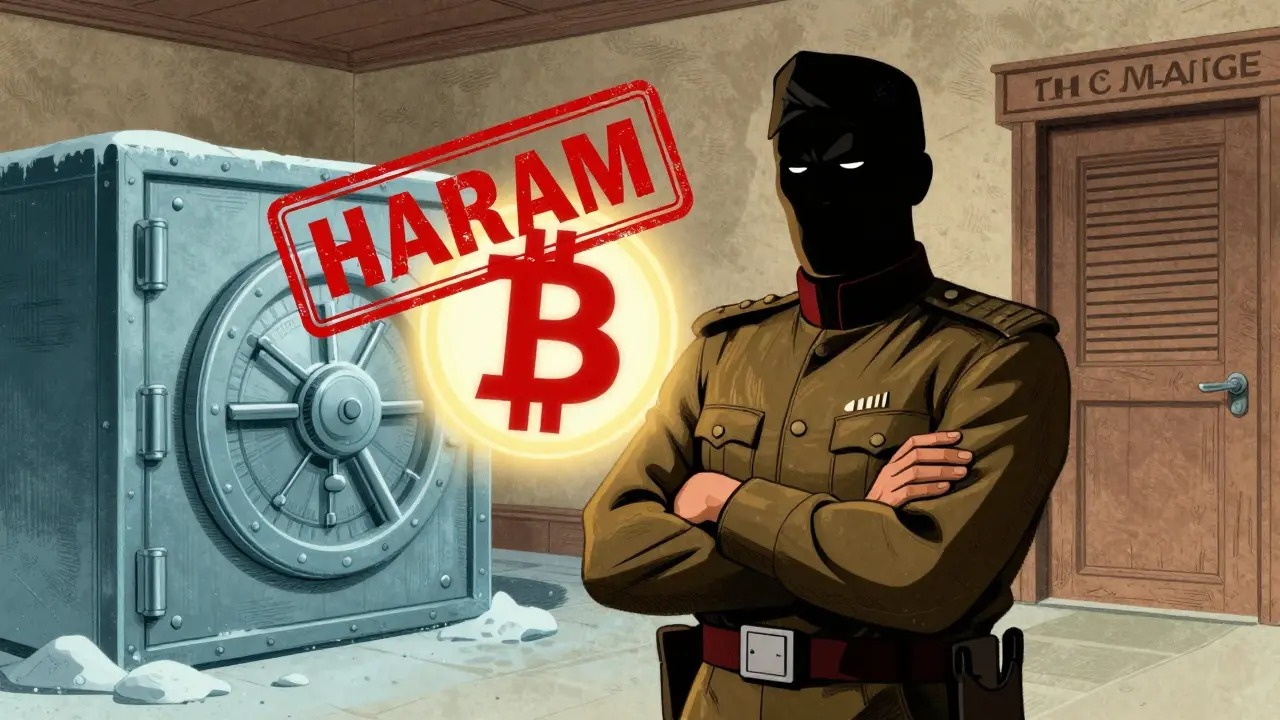
Imagine trying to send money to your family across the border, only to find every bank account frozen and every exchange shut down. For millions of Afghans, this isn't a hypothetical nightmare; it is their daily reality. Since 2022, the Taliban regime has enforced one of the strictest bans on cryptocurrency in the world. They declared Bitcoin and other digital assets haram (forbidden) under their interpretation of Sharia law. But here is the twist: despite the absolute prohibition, underground usage has skyrocketed. Why does a government that claims to protect Islamic principles also lock away billions in reserves, forcing citizens into the very financial systems they condemn? The answer lies in a complex clash between religious ideology, economic survival, and geopolitical isolation.
The Official Ruling: Why Bitcoin Is Considered Haram
To understand the ban, you have to look at how the Taliban interprets Islamic finance. On August 15, 2022, Sayed Shah Sa'adat, head of Herat Police's counter-crime unit, announced the closure of dozens of crypto exchanges. This wasn't just an administrative decision; it was a theological one. The central argument rests on two main concepts in Islamic jurisprudence: maysir (gambling/speculation) and the lack of intrinsic value.
The Da Afghanistan Bank (DAB), led by Governor Mullah Noorullah Noori, explicitly stated that cryptocurrencies contradict Islamic principles because they do not represent physical commodities like gold or silver. In traditional Sharia law, money should have tangible backing. Because Bitcoin fluctuates wildly in price and exists only as code, the regime argues it is akin to gambling. Furthermore, they claim it threatens monetary sovereignty, allowing people to bypass state-controlled banking systems.
- Lack of Intrinsic Value: The Taliban argues that since you cannot hold Bitcoin physically, it lacks the 'real-life value' required for lawful trade under their specific reading of Sharia.
- Maysir (Gambling): The volatility of crypto markets is viewed as speculative risk, which is prohibited if it resembles gambling rather than investment.
- Illicit Activities: Concerns about money laundering and terrorism financing provide a secondary, secular justification for the crackdown, aligning with global Anti-Money Laundering (AML) standards, even if the primary driver is religious.
This stance puts Afghanistan in a unique category. While countries like Egypt and Algeria also restrict crypto, they often allow some form of regulated trading or mining. Afghanistan’s ban is total. There are no licenses, no regulatory frameworks, and no exceptions. It is a blanket prohibition enforced through police raids and internet controls.
The Economic Paradox: Sanctions Drive Adoption
Here is where the situation gets complicated. The Taliban’s ban coincides with international sanctions that froze approximately $9.5 billion of Afghanistan’s foreign reserves. With the formal banking system crippled, ordinary citizens needed a way to move money. Enter cryptocurrency. Before the ban, Afghanistan was actually ranked 20th globally in the Chainalysis Global Crypto Adoption Index, processing around $740 million in transactions between July 2020 and June 2021.
You might think the ban stopped this flow. It didn’t. In fact, it pushed it underground. According to UNDP surveys from 2024, 38% of Afghans used cryptocurrency for remittances, up from just 2% before the Taliban took power in 2021. People aren't using Bitcoin to get rich quick; they are using it to survive. When banks close borders, blockchain networks remain open. Stablecoins like USDT (Tether) became crucial because they pegged to the US dollar, offering a refuge from the collapsing Afghan Afghani currency.
| Country | Regulatory Status | Sharia Interpretation | Enforcement Level |
|---|---|---|---|
| Afghanistan | Total Ban | Haram (Forbidden) | High (Raids, Arrests) |
| Saudi Arabia | Restricted/No Legal Tender | Cautious/Speculative Risk | Medium (Central Bank Warnings) |
| UAE | Regulated (VARA) | Permissible with Compliance | Low (Pro-Adoption Framework) |
| Iran | Mining Allowed, Trading Restricted | Context-Dependent | Variable (Internet Controls) |
| Egypt | Banned but Tolerated | Haram (Officially) | Medium (Periodic Crackdowns) |
Notice the contrast. The UAE created the Virtual Assets Regulatory Authority (VARA) to embrace crypto within Islamic guidelines. Iran allows mining to save energy costs. Afghanistan simply says "no." Yet, the data shows that necessity overrides ideology. The Atlantic Council forecasts a 65% probability that this prohibition will continue through 2027, not because it works, but because the regime prioritizes ideological purity over economic pragmatism.

Underground Networks: How People Bypass the Ban
If you live in Kabul or Herat today and need to send money abroad, you don't go to a bank. You go to Telegram. Peer-to-Peer (P2P) trading has become the lifeline for many. Channels like 'AfghanCryptoHelp' report weekly volumes of tens of thousands of dollars in USDT trades. These transactions happen outside the official grid, relying on trust and encrypted messaging apps.
For women, the stakes are even higher. The Taliban has severely restricted women's access to banking and employment. Roya Mahboob, founder of the Digital Citizen Fund, highlights that Bitcoin serves as a "survival tool" for Afghan women. A 2024 report documented 687 women receiving underground training in non-custodial wallets. For them, crypto isn't about speculation; it's about financial autonomy when the legal system denies them basic rights. However, this comes with severe risks. 42% of these women reported harassment from authorities when attempting transactions.
The technical barriers are also real. Internet blackouts are common. In October 2024, a nationwide blackout lasted 48 hours, affecting 13 million people. Blockchain expert Michail Angelov noted this as a wake-up call: blockchain depends on centralized internet providers, which the government can switch off. To combat this, users have turned to mesh networks and SMS-based blockchain solutions. By Q1 2025, 12,500 users had registered for services like 'CryptoSMS,' allowing basic transactions without high-speed internet.
Enforcement vs. Reality: The Cracks in the Wall
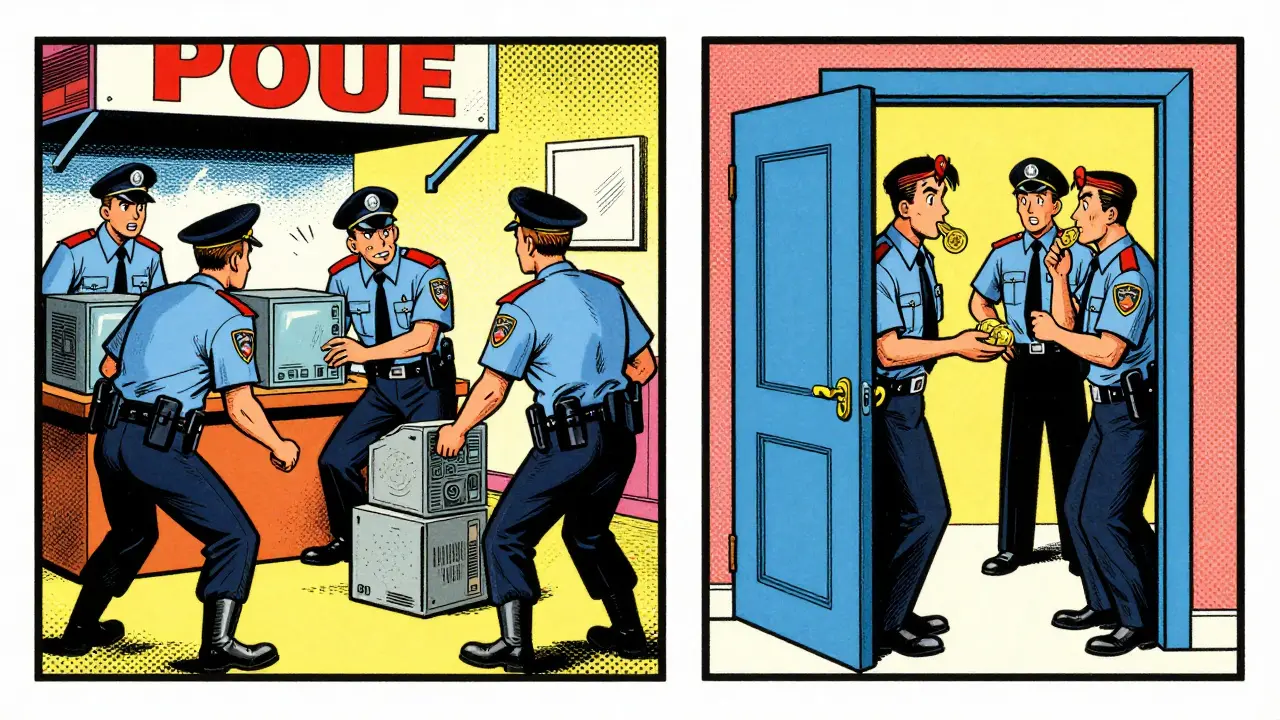
The Taliban claims to enforce the ban strictly. And they do. In Q1 2025 alone, there were 47 documented crackdowns across 15 provinces, resulting in 112 arrests. Exchanges are raided, computers confiscated, and dealers detained. The Financial Transactions and Reports Analysis Center of Afghanistan (FinTRACA) uses existing anti-money laundering laws to target crypto activities.
Yet, the enforcement is inconsistent. A December 2023 UN Security Council report revealed that some Taliban officials reportedly accepted Bitcoin payments for border crossings. This hypocrisy underscores the regime's desperation for hard currency. While publicly denouncing crypto as un-Islamic, privately, the scarcity of foreign cash makes digital assets attractive. Goldman Sachs’ 2025 Emerging Markets Report gives the ban only a 30% chance of lasting beyond 2028, suggesting that economic collapse may force the regime to tacitly tolerate limited P2P activity, similar to Iran’s current approach.
However, for the average citizen, the risk remains high. Reddit archives from r/Afghanistan contain stories of individuals losing life savings when exchanges were raided. One user, 'KabulTrader88', reported losing 1.2 Bitcoin (worth ~$52,800) during a November 2022 raid. Without legal recourse, victims have nowhere to turn. This fear keeps many from adopting more secure, decentralized methods, leaving them vulnerable to scams and confiscation.
Future Outlook: Will the Ban Lift?
Looking ahead, the tension between religious doctrine and economic survival will likely intensify. The Taliban’s Deputy Prime Minister, Mullah Abdul Ghani Baradar, reaffirmed in February 2025 that "digital currency has no place in an Islamic system." This signals no immediate policy shift. However, the pressure is mounting. GDP contracted by 20.7% between 2021 and 2023. Remittance flows through formal channels dropped from $7.1 billion pre-2021 to just $1.8 billion in 2024.
The most likely scenario is not a reversal, but a gradual erosion of the ban's effectiveness. As underground networks become more sophisticated, the government may struggle to maintain control. We could see a future where the Taliban officially maintains the ban while quietly ignoring small-scale P2P transactions, mirroring the pragmatic compromises seen in other sanctioned economies. Until then, for millions of Afghans, Bitcoin remains a forbidden fruit that tastes like freedom.
Is Bitcoin illegal in Afghanistan?
Yes, Bitcoin and all other cryptocurrencies are unequivocally illegal in Afghanistan. The Taliban regime banned all crypto-related activities, including trading, mining, and usage, in August 2022, declaring them haram (forbidden) under their interpretation of Sharia law.
Why does the Taliban consider crypto haram?
The Taliban argues that cryptocurrencies lack intrinsic physical value and are highly volatile, equating them to maysir (gambling). Additionally, they believe crypto threatens monetary sovereignty and facilitates illicit financial flows, violating Islamic principles of fair trade and stability.
Do people still use crypto in Afghanistan despite the ban?
Yes, extensively. Due to international sanctions freezing bank accounts and collapsing the formal banking system, 38% of Afghans used crypto for remittances in 2024. Most transactions occur via peer-to-peer (P2P) networks on platforms like Telegram.
What are the penalties for trading crypto in Afghanistan?
Penalties include arrest, confiscation of digital assets, and forced closure of businesses. In Q1 2025 alone, there were 112 arrests related to crypto activities. Victims of raids have no legal recourse to recover lost funds.
How do Afghans bypass internet blackouts to use crypto?
Users employ mesh networks and SMS-based blockchain solutions. Services like 'CryptoSMS' allow basic transactions without high-speed internet, helping users navigate frequent nationwide blackouts imposed by the government.





Comments (17)
Steven Jacobowitz
Wait so you are saying the government is basically forcing people into illegal activities just to survive? That sounds like a classic case of prohibition creating black markets. I mean if the banks are frozen why would anyone trust the system anyway? It seems like the religious argument is just a cover for wanting total control over money flow. Do they really think shutting down crypto stops people from sending money or does it just make it harder to track?
Mark Corpuz
It is precisely that paradox which defines the current landscape. When formal channels are obstructed by sanctions and political isolation, informal networks inevitably fill the void. The use of stablecoins like USDT offers a hedge against local currency collapse which is a rational economic response rather than speculative gambling. The theological objection regarding maysir feels somewhat disingenuous when applied to assets used primarily for preserving wealth against inflation. One must consider whether the ban serves the population or merely consolidates power within the ruling elite who can bypass these restrictions.
Karthikeyan S
lol typical western view thinking crypto is magic pill 🤡 afghans are getting scammed left and right no one talks about that part 💀 also sharia law makes sense for them dont project ur values on them 😒
Dinesh Pattigilli
Actually the whole premise is flawed because you are ignoring the cultural context completely. These people have lived under different regimes for decades and their understanding of finance is rooted in tradition not your silicon valley hype. Calling it a 'survival tool' is romanticizing poverty. They should be focusing on rebuilding agriculture not chasing digital ghosts. The elites there probably know more than you do about what works for their society.
Madhu Menon
There is a profound philosophical tension here between the concept of value as defined by physical substance versus value as defined by consensus and utility. In many ways Bitcoin represents a shift towards a more abstract form of social contract. The Taliban's adherence to a literalist interpretation of Sharia regarding commodity backing reflects a desire for stability in a chaotic world. However history shows that monetary systems evolve beyond gold standards repeatedly. Perhaps the real question is whether religious doctrine should remain static in the face of technological innovation 🤔
Narendra Kulkarni
i think its really sad how women are affected by this ban too. they cant even open bank accounts easily so crypto was one of the few ways they could have some independence. now they risk harassment just to send money to family. we need to support initiatives that help them access safe financial tools without fear.
verna kennedy
You are absolutely right about the gender disparity. The restriction on women's financial autonomy is a critical human rights issue that often gets overshadowed by the geopolitical narrative. Denying them access to banking while simultaneously banning alternative methods like crypto is a double bind that traps them in dependency. It is imperative that international aid focuses on creating secure decentralized solutions specifically designed for marginalized groups in such restrictive environments.
Kelly Tenney
I appreciate the detailed breakdown of the technical workarounds like mesh networks. It shows incredible resilience from the community. We should remember that technology is neutral but its application can be deeply empowering. Let us continue to share information about privacy tools that might help those in similar situations globally.
Caralee Robertson
its crazy how they try to block internet but people still find ways. i bet half the officials are using it themselves though. hypocrites always are.
Greg Lewis
you think they care about islam really? nah its all about power and control. they want to keep you poor and dependent so you dont rebel. crypto threatens that control thats why they hate it so much. wake up sheeple
JEVON HALL
The comparison with UAE and Iran is spot on. Regulatory frameworks matter. If Afghanistan adopted a VARA-like approach they could actually generate revenue instead of losing it to black markets. The current zero-tolerance policy is economically suicidal. Maybe they should look at how El Salvador handled it despite the risks. 🚀
Dr Lynea LaVoy
As someone who studies Islamic finance I find the Taliban's interpretation quite narrow. There are many scholars who argue that if crypto is used for trade and not speculation it can be halal. The key is transparency and avoiding riba (interest). The complete ban ignores the nuanced debates happening in other Muslim majority countries. It is a missed opportunity for educational reform.
Matthew Malone
Let's be honest here. This is exactly why we need strong borders and strict sanctions. Every time we let these regimes play games with our financial systems they get stronger. Banning crypto is the least of their problems. They are a security threat first and an economic entity second. Don't confuse sympathy with strategy.
aaliyah zahid
Sarcasm aside the reality is harsh. People are just trying to eat. While politicians debate ideology families go hungry. It is tragic how politics impacts daily life so directly. We need more empathy less judgment.
Erik Kirana
This entire discussion is trivial compared to the actual geopolitical stakes. The Taliban is a terrorist organization period. Discussing their banking policies as if they are a legitimate state actor is absurd. They should be isolated completely. Any engagement legitimizes their crimes. Stop enabling them with your naive optimism. 🙄
dan kaffeman
Typical liberal take. You want to give them bitcoin so they can buy weapons? Wake up. The US made mistakes leaving but now we cut them off and let them deal with the consequences. No free rides for terrorists. Their economy collapses fine by me.
Meg Gran
oh please spare me the patriotic speech. you think cutting off civilians punishes the taliban? it just hurts kids and old ladies. your foreign policy is a disaster and pretending otherwise makes you look stupid. maybe focus on fixing things at home before lecturing others lol