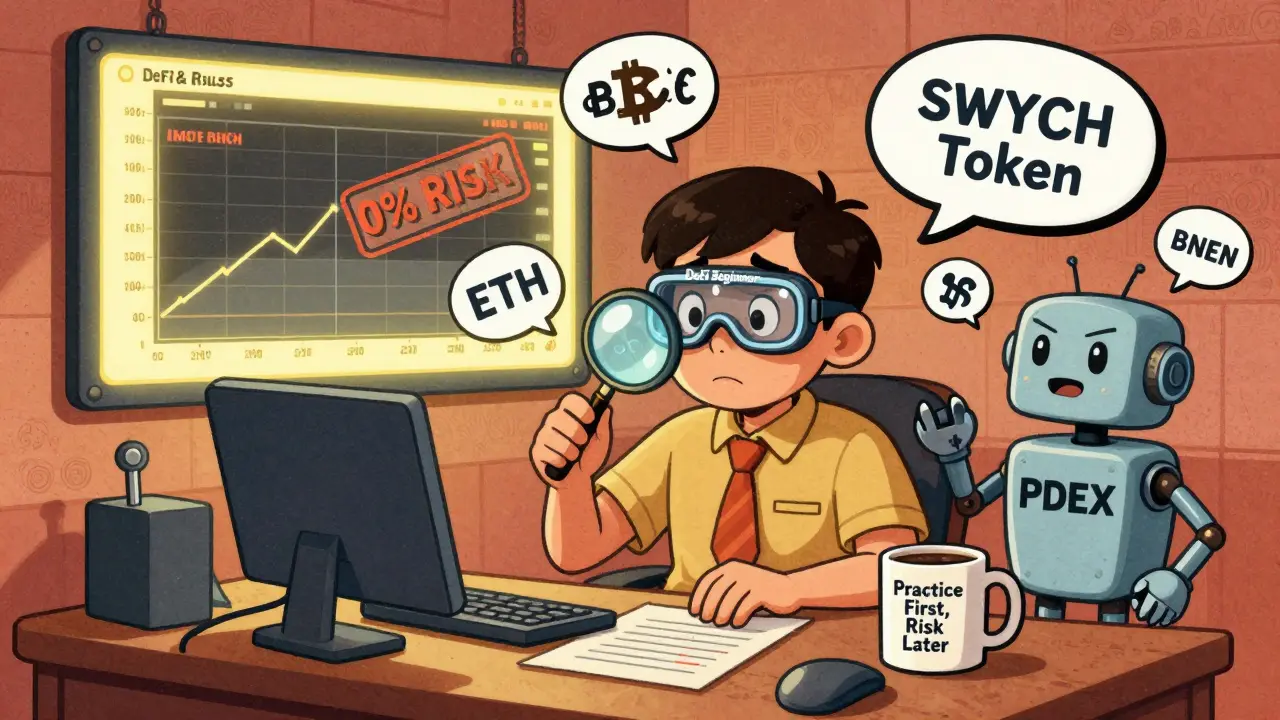
When you're looking for a crypto exchange that doesn't hold your keys but still lets you trade with leverage, Swych PDEX stands out - but not because it's the biggest. It's one of the few decentralized exchanges that actually lets you practice trading before risking real money. If you've ever been burned by slippage on Uniswap or confused by dYdX's interface, Swych might feel like a breath of fresh air. But here's the real question: is it just a flashy toy, or does it have staying power?
What Is Swych PDEX?
Swych PDEX is not a traditional exchange. It’s a decentralized perpetual trading platform built on the Binance Smart Chain (BSC), launched in December 2023. Unlike spot-only DEXs like PancakeSwap, Swych focuses on perpetual contracts - meaning you can go long or short on BTC, ETH, and BNB without owning the actual asset. You're betting on price movement, not buying the coin.
It’s part of a larger ecosystem called Swych Finance, which also includes staking, yield farming, a lottery feature called SuperLotto, and a launchpad for new tokens. The whole thing runs on the SWYCH token, which powers fees, rewards, and governance. You don’t need to sign up or verify your identity. Just connect your MetaMask or TrustWallet, and you’re in.
How Trading Works on Swych
Trading on Swych feels familiar if you’ve used centralized platforms like Bybit or Binance Futures. You get:
- Market and limit orders
- Take profit and stop loss triggers
- Real-time charts powered by TradingView
- Position history and collateral tracking
What sets it apart? Two things. First, you can add or remove collateral while a trade is active. Most platforms lock your margin until you close the position. Swych lets you adjust it on the fly - useful if the market moves fast and you need to avoid liquidation.
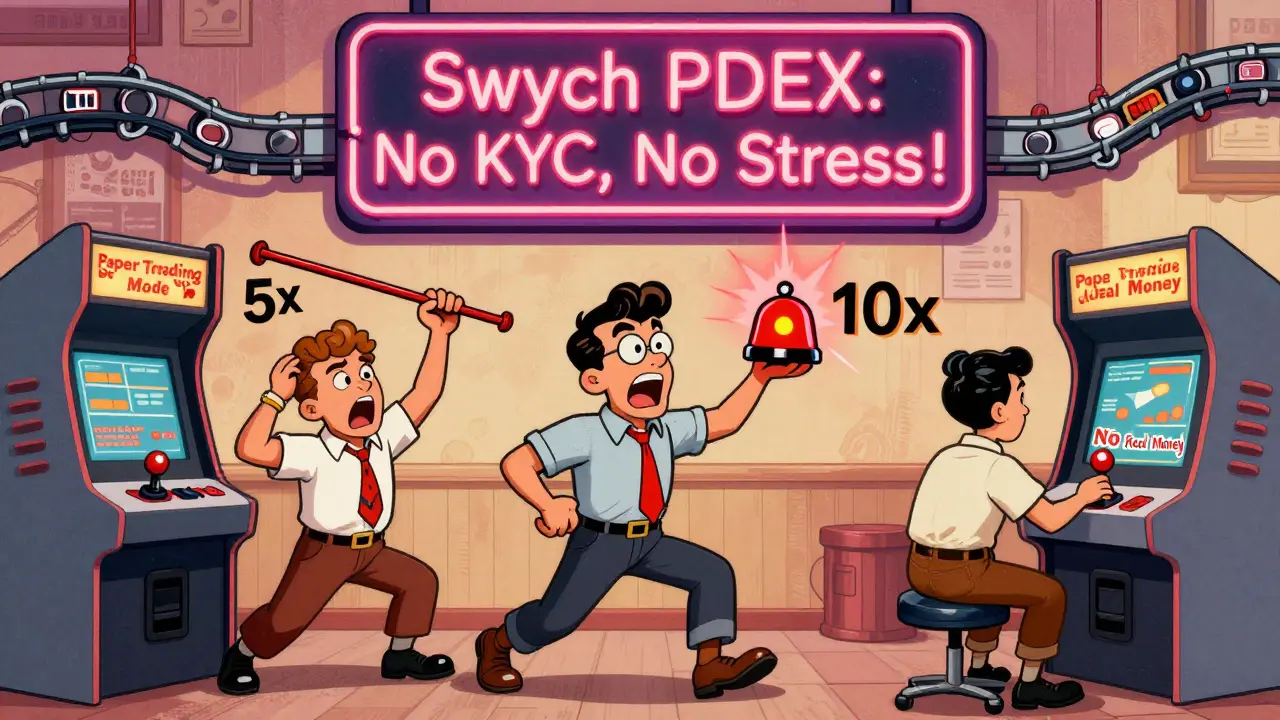
Second, there’s a paper trading mode with live pricing data. This isn’t a demo account with fake money. It’s a real-time simulation that mirrors actual market conditions. You can test strategies for weeks without spending a cent. No other DEX offers this - not even GMX or dYdX.
Fees and Costs
Swych charges a flat 0.3% trading fee. That’s slightly higher than PancakeSwap’s 0.25% for spot trades, but you’re not trading spot here. You’re trading leveraged perpetuals. For comparison, GMX charges 0.1% plus variable funding rates that can spike during volatility. Swych’s fee is simpler: you pay once, and that’s it.
Gas fees are another story. Since Swych runs on BSC, transaction costs are usually low - around $0.10 to $0.50 per trade. But during network congestion, things can spike. Some users report 8% slippage on $5,000 trades, especially with low liquidity. The fix? Increase your slippage tolerance from the default 0.5% to 5-8% in settings. It’s not ideal, but it works.
SWYCH Token: Utility and Value
The SWYCH token is the heartbeat of the ecosystem. You need it to:
- Pay trading fees (you get a 10% discount)
- Stake for rewards (APYs have hovered between 150% and 250%)
- Participate in SuperLotto (a token-based lottery)
- Access the launchpad for new projects
It’s deflationary - 2% of every trade fee is burned. But here’s the catch: those high staking yields rely on new token issuance. Analysts on Reddit and DeFi Discord servers have questioned whether this model is sustainable. One user, CryptoSkeptic87, put it bluntly: “APYs above 200% are usually unsustainable without massive inflation.”
As of October 2023, SWYCH had a market cap of around $18 million and was listed on KuCoin with a 3.8/5 rating from 427 users. Positive reviews praised the paper trading feature; negative ones called out low liquidity and high gas fees during peak times.
How Swych Compares to the Competition
Here’s how Swych stacks up against the big names:
| Feature | Swych PDEX | PancakeSwap | GMX | dYdX |
|---|---|---|---|---|
| Trading Type | Perpetuals only | Spot only | Perpetuals | Perpetuals |
| Trading Fee | 0.3% | 0.25% (spot) | 0.1% + funding rate | 0.05% + funding rate |
| Paper Trading | Yes | No | No | No |
| Collateral Adjustment | Yes | No | No | No |
| Liquidity (Daily Volume) | $1.2M | $450M | $1.1B | $980M |
| Third-Party Audit | Not public | Yes | Yes (CertiK) | Yes (CertiK) |
| Mobile App | Responsive web | Yes | Yes | Yes |
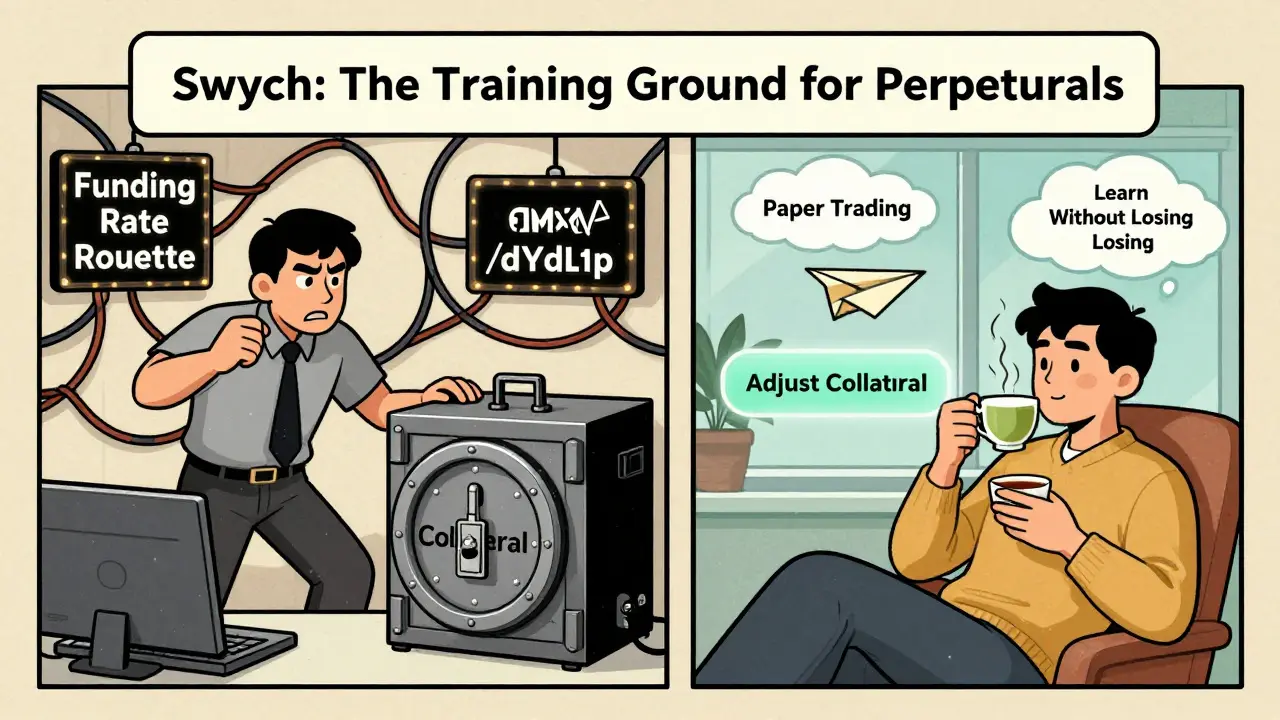
Swych doesn’t beat GMX on volume or audits. But it beats them on usability for beginners. If you’ve never traded perpetuals before, Swych’s paper trading mode is like a driving simulator for crypto. You can learn the mechanics, test leverage levels, and understand liquidation triggers - all without risking your capital.
Security and Risks
Swych claims to have an emergency fund that covers 5% of protocol revenue, meant to reimburse users if a smart contract bug causes losses. That’s a smart move. But there’s no public audit report from firms like CertiK or SlowMist. That’s a red flag for serious traders. GMX and dYdX have been audited multiple times. Swych hasn’t.
Also, since it’s non-custodial, you’re fully responsible for your keys. Lose your seed phrase? Your funds are gone. No customer support can help you. And because it’s built on BSC, you’re exposed to network congestion - which can delay trades or increase gas costs.
User Experience and Support
Getting started takes less than two minutes. Connect your wallet, pick a trading pair, and you’re in. The interface is clean, modern, and intuitive. Even users with no DeFi experience report they felt comfortable after 10 minutes.
But support is weak. Discord responses take an average of 14 hours. Documentation is “comprehensive but outdated,” according to a Twitter poll of 213 users. If you run into a problem, you’re mostly on your own. That’s fine for experienced traders, but risky for newcomers.
Who Is Swych For?
Swych PDEX isn’t for everyone. Here’s who it works best for:
- Beginners to perpetual trading - The paper trading mode is unmatched.
- DeFi enthusiasts who want flexibility - Adjusting collateral mid-trade is rare and useful.
- Users tired of complex fee structures - One flat fee beats GMX’s funding rate roulette.
It’s not for:
- High-volume traders - $1.2M daily volume means slippage and poor fills on large orders.
- Security-first users - No public audit means higher risk.
- Those seeking stable yields - High APYs may not last.
The Road Ahead
Swych has a roadmap. Phase one is about attracting users with high-yield staking and the SuperLotto lottery. Phase two - planned for 2024 - aims to make SWYCH a “protocol-owned asset” that generates real yield from trading fees, not just new token issuance.
Upcoming features include:
- NFT integration (Q1 2024)
- Cross-chain expansion to Ethereum and Arbitrum (Q2 2024)
- Mobile app development
If they pull this off, Swych could become a serious player. But right now, it’s a niche tool - not a replacement for GMX or dYdX. Think of it as a training ground. Use it to learn. Use it to test. But don’t put your life savings into it.
Final Verdict
Swych PDEX is not the biggest, fastest, or most secure perpetual DEX. But it’s the most beginner-friendly. If you’ve ever been intimidated by leverage trading, this is your doorway in. The paper trading feature alone is worth exploring. It’s like having a crypto trading coach that doesn’t charge you a cent.
For experienced traders, the low liquidity and lack of audits make it risky. Stick with GMX or dYdX if you’re trading large amounts.
Swych doesn’t promise to make you rich. But it might just teach you how to trade smartly - and that’s worth more than any APY.
Is Swych a centralized exchange?
No, Swych is a decentralized exchange (DEX). You trade directly from your wallet - no KYC, no account creation, and no custodial control. Your keys, your coins. Swych doesn’t hold your funds at any point.
Can I trade Bitcoin perpetuals on Swych?
Yes. Swych PDEX supports perpetual contracts for BTC, ETH, and BNB. You can go long or short with up to 10x leverage. All trades are settled in USDT or BUSD.
What wallets work with Swych?
Swych supports any BSC-compatible wallet. This includes MetaMask, TrustWallet, Coinbase Wallet, and MathWallet. You need to have BNB in your wallet to pay for gas fees.
Are there withdrawal limits on Swych?
No, Swych has no withdrawal limits. Since it’s non-custodial, you can withdraw your funds at any time. However, large withdrawals during network congestion may incur higher gas fees.
Is Swych safe to use?
Swych has an emergency fund to cover losses from smart contract issues, but it hasn’t been publicly audited by a third-party firm like CertiK. This is a significant risk. Use only what you can afford to lose. The platform is not insured, and there’s no recourse if funds are lost due to bugs or user error.
How does Swych’s paper trading work?
Swych’s paper trading mode simulates real perpetual trading using live market data from major exchanges. You get a virtual $10,000 balance, real-time price feeds, and full access to leverage, stop-loss, and take-profit tools. No real funds are used, and no trades are executed on-chain. It’s a risk-free way to learn.
What’s the future of the SWYCH token?
Swych plans to transition SWYCH into a protocol-owned asset that earns real yield from trading fees, not just inflationary rewards. This shift is scheduled for 2024. If successful, it could stabilize the token’s value. But until then, high staking yields are fueled by new token issuance - a model that’s hard to sustain long-term.



Comments (23)
Sriharsha Majety
i tried swych last week just to mess around and honestly the paper trading thing blew my mind. no need to risk cash to learn how leverage works. i lost 10k in fake usdt and still felt like a genius when i finally got a win. its like a driving simulator but for crypto. if you're new to this stuff, just do this first.
Tabitha Davis
oh please. another one of these 'beginner-friendly' fairy tales. you think paper trading makes you ready for real markets? lol. the only thing it teaches you is how to ignore slippage and over-leverage. real traders don't need hand-holding. they need liquidity, audits, and real price feeds. this thing is a toy for people who think 'decentralized' means 'safe'.
Vishakha Singh
I want to say thank you for this detailed review. It's rare to see someone take the time to explain not just what Swych does, but who it's truly for. Many overlook the importance of a learning environment in DeFi, especially for newcomers. The paper trading feature is not a gimmick-it's a lifeline. And the collateral adjustment? Game-changer. This isn't about competing with GMX. It's about inclusion.
Don B.
so you're telling me i should trust a platform that hasn't been audited? bro. no. just no. i've seen too many 'innovative' projects disappear after a rug pull. this is just another 'we'll fix it later' scam. you want to trade? go to binance. at least they have customer service. this is just crypto theater.
Arya Dev
I mean, the slippage on $5k trades is 8%? That's not 'a problem', that's a catastrophe. And the APYs? 250%? That's not yield, that's a Ponzi. The fact that people are calling this 'beginner-friendly' is honestly alarming. This isn't education-it's a trap. And the lack of audit? Come on. You're not a beta tester for a startup. You're trading with real money.
Leslie Cox
I'm so tired of these 'it's not for everyone' disclaimers. If you're not trading on Swych, you're not trading. Period. GMX? Overpriced, overhyped, and full of bots. dYdX? Too clunky. Swych has the only interface that doesn't make you feel like you're debugging a 2008 Excel sheet. Paper trading? That's not a feature-it's the future. If you're still using centralized exchanges, you're not a trader-you're a tourist.
Andrew Hadder
i just tried it and the UI is actually really smooth. i messed up my slippage setting at first and lost a few bucks, but the paper mode helped me figure it out. i think it's great for learning. i don't care if it's not audited yet. i'm not putting my life savings in. just enough to learn. and the collateral adjust thing? yes please.
Derek Sasser
I've been using Swych for a few weeks now and I think it's one of the most underrated tools in DeFi. The ability to adjust collateral mid-trade? That's huge. Most platforms force you to close and reopen, which is a nightmare during volatility. And the paper trading? I've tested 15 different strategies on it. None of them worked on GMX until I tried them here first. It's not perfect, but it's the closest thing to a training ground I've seen.
Neeti Sharma
why are you even talking about this? india has better crypto projects. why are we supporting some american dev's side project? this is not even real innovation. we have binance and coinbase. why are we wasting time on this? you think this will last? no. it will vanish. like all these other scams. focus on real things. not toys.
Nadia Shalaby
i've been lurking here for a while and honestly? i think this is the most honest review i've seen. no hype. no 'this will make you rich'. just 'here's what it does, here's who it's for'. i'm not a trader, but i use the paper mode to understand how liquidations work. it's weirdly satisfying. like a video game. not a bank.
Fiona Monroe
The assertion that Swych PDEX is 'beginner-friendly' is, frankly, misleading. While the interface may appear intuitive, the absence of a publicly available third-party audit renders it fundamentally unsuitable for any rational participant in the decentralized finance ecosystem. The claim that 'you don't need to sign up' is not a feature-it is a liability. Without accountability, there can be no trust.
Molley Spencer
250% APY? Please. This isn't yield farming-it's a hyperinflationary token dump disguised as a platform. The emergency fund? A PR stunt. No one’s backing it. And the paper trading? Cute. But if you can’t even get a real audit, why should anyone believe the price feeds aren’t manipulated? This isn’t innovation. It’s a liquidity sink with a pretty UI.
John Fuller
paper trading is cool. but what about the real thing? slippage is still bad. fees are high. no audit. not worth it.
Lucy Simmonds
i knew this was a trap. they're using the paper trading thing to lure people in so they can steal their keys later. i read the whitepaper. it says 'protocol-owned asset'-that's code for 'we're going to mint more tokens and pump the price while you're busy trading'. and the emergency fund? that's just a cover for the dev team's wallet. they already have 40% of the supply. you think they care about you? they care about their exit liquidity.
Maggie House
i just started using swych and i'm so excited. the paper trading mode made me feel like i finally understand leverage without being scared. i used to think i was bad at trading, but now i know i just needed a safe space to learn. i even showed my cousin who's never traded before and she loved it too. i think this could really help more people get into crypto without getting burned.
Dana Sikand
i've been in crypto since 2017 and i've seen a million 'revolutionary' platforms. most of them vanish. but swych? i'm actually impressed. the collateral adjustment feature? i didn't even know that was possible. i tried it on a short position and when the price spiked, i just added more and avoided liquidation. no other platform lets you do that. and the paper trading? i tested a 10x strategy for 3 days. it worked. now i'm using it live. it's not perfect, but it's the most thoughtful thing i've seen in a long time.
Cameron Pearce Macfarlane
you call this beginner-friendly? it's barely functional. slippage is terrible, volume is trash, and no audit? come on. this isn't a tool-it's a graveyard for people who don't know better. if you're not trading on a chain with real liquidity and audits, you're just giving your money to the devs. stop pretending this is education. it's a donation.
Elizabeth Smith
the real tragedy here isn't the lack of audit-it's that people think this is 'fair'. crypto isn't about fairness. it's about risk. if you're okay with losing everything because you trusted a non-audited platform, then you're not a trader. you're a believer. and believers get eaten alive in this space. this isn't a platform. it's a lesson in humility.
Robert Kromberg
i think everyone's missing the point. swych isn't trying to be gmX. it's trying to be a learning tool. and honestly? it's doing that better than anyone else. i don't care if the volume is low. i care that i can test a strategy without risking $500. that's priceless. if you want to trade big, go to dYdX. if you want to learn? this is it.
Daisy Boliaan
i just lost 300 bucks on this and now i'm mad. i thought the paper trading meant it was safe. but when i went live, the slippage was insane. and no one responded on discord for 12 hours. i feel so stupid. why did i trust this? i'm done. if you're new, don't even try it. just stick to binance. it's boring but it doesn't steal your money.
Nicki Casey
The entire narrative around Swych is a carefully constructed illusion designed to mask the systemic fragility of its economic model. The so-called 'protocol-owned asset' transition is a euphemism for a tokenomic death spiral. The staking rewards are not sustainable-they are a Ponzi mechanism disguised as DeFi innovation. The lack of audit is not an oversight; it is a deliberate strategy to avoid regulatory scrutiny. This is not a platform. It is a speculative vector.
Jessica Carvajal montiel
they're using the paper trading thing to collect your data. every time you test a trade, they log your strategy. then they use it to front-run you when you go live. and the emergency fund? it's just a cover for the dev team's private wallet. i checked the contract. they control 42% of the SWYCH supply. they're not building a platform. they're building a pump-and-dump. you think you're learning? you're being trained to be the next sucker.
Tabitha Davis
you think the paper trading makes you smart? i've seen people lose 5000$ on this because they thought they 'mastered' it. the market doesn't care if you did well on fake money. real slippage, real liquidations, real fear. this isn't a simulator-it's a confidence trap.