
At its core, Supply Chain Blockchain is a distributed ledger technology application that creates transparent, immutable records of transactions and events across complex supply networks. Unlike a traditional database where one admin can change the data, this system shares a single version of the truth across every partner in the chain. If a shipping container is opened prematurely or a temperature spike occurs in a pharmaceutical shipment, the record is permanent. No one can "fix" the books after the fact.
The Game-Changer for Food Safety and Recalls
If you've ever seen a massive spinach or romaine lettuce recall on the news, you know the traditional process is a nightmare. Companies spend weeks calling suppliers and digging through folders to find where the bad crop originated. In the old world, this took an average of two months. With blockchain, that window shrinks to seconds.
Take Walmart as a prime example. By prioritizing blockchain solutions, they've gained a granular view of their supply chain. When a quality issue hits, they don't have to pull every product off every shelf nationwide; they can pinpoint the exact farm and batch. This doesn't just save lives-it saves millions of dollars in wasted food and protects the brand's reputation.
Similarly, John West has implemented traceability codes on their tuna cans. For the average shopper, this transforms a generic product into a story of provenance, allowing them to trace the fish back to the individual fisherman. This level of transparency is almost impossible to achieve without a shared, immutable ledger.
Cold Chain Monitoring and Pharmaceutical Integrity
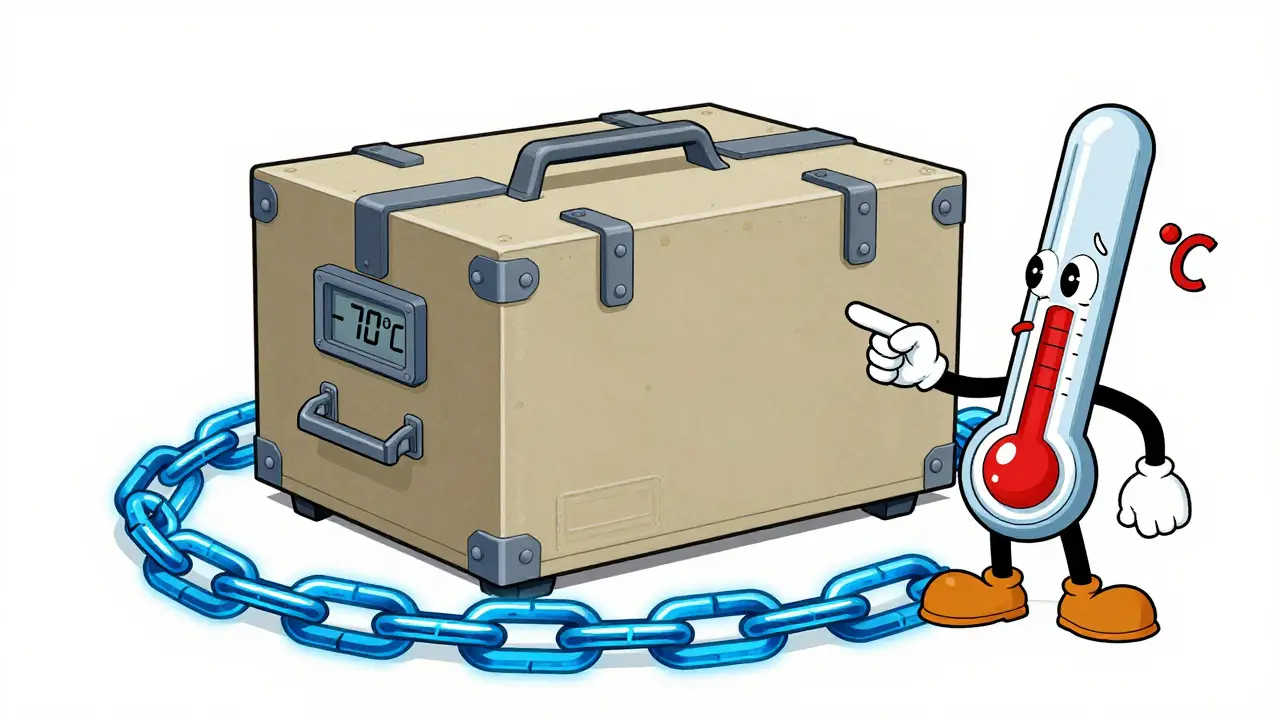
Some products are fragile. If a vaccine gets too warm, it's not just ineffective-it's waste. This is where Cold Chain Monitoring becomes critical. By integrating IoT sensors with a blockchain, companies can record environmental data like temperature and humidity in real-time. If a sensor detects a deviation, that data is written directly to the ledger.
A standout example occurred during the COVID-19 pandemic. Moderna used a blockchain system to ensure their vaccines stayed within the strict -70°C requirement throughout the journey. If the temperature drifted, the system flagged it instantly. This wasn't just about tracking; it was about automated quality assurance.
This process is often managed by Smart Contracts, which are self-executing contracts with the terms directly written into code. For instance, if a shipment of medication exceeds its temperature limit, a smart contract could automatically mark the product as unfit for use, alert the manufacturer, and trigger an insurance claim-all without a human needing to file a report.
High-Value Assets and Ethical Sourcing
Not every supply chain is about perishables. Some are about provenance and ethics. The diamond industry has long struggled with "conflict diamonds," but De Beers Group changed the game by tracking 100 high-value diamonds from the mine to the retail store. By creating a digital twin of the physical diamond, they proved the stone's origin and authenticity, effectively eliminating the possibility of fraud in those specific shipments.
The automotive industry is following a similar path. Ford Motor Company began using blockchain to trace cobalt supplies for their electric vehicle batteries. Cobalt mining is often linked to human rights abuses; by using a transparent ledger, Ford can verify that the materials in their batteries are ethically sourced. This moves blockchain from a "efficiency tool" to a "compliance tool."
| Feature | Traditional Systems | Blockchain Systems |
|---|---|---|
| Traceability Speed | Weeks to Months | Seconds to Minutes |
| Data Trust | Siloed / Manual Verification | Shared / Immutable Ledger |
| Payment Process | Manual Invoicing / Net-30/60 | Automated via Smart Contracts |
| Transparency | Limited to direct partners | End-to-end visibility (Mine to Consumer) |
Reducing Costs and Administrative Bloat
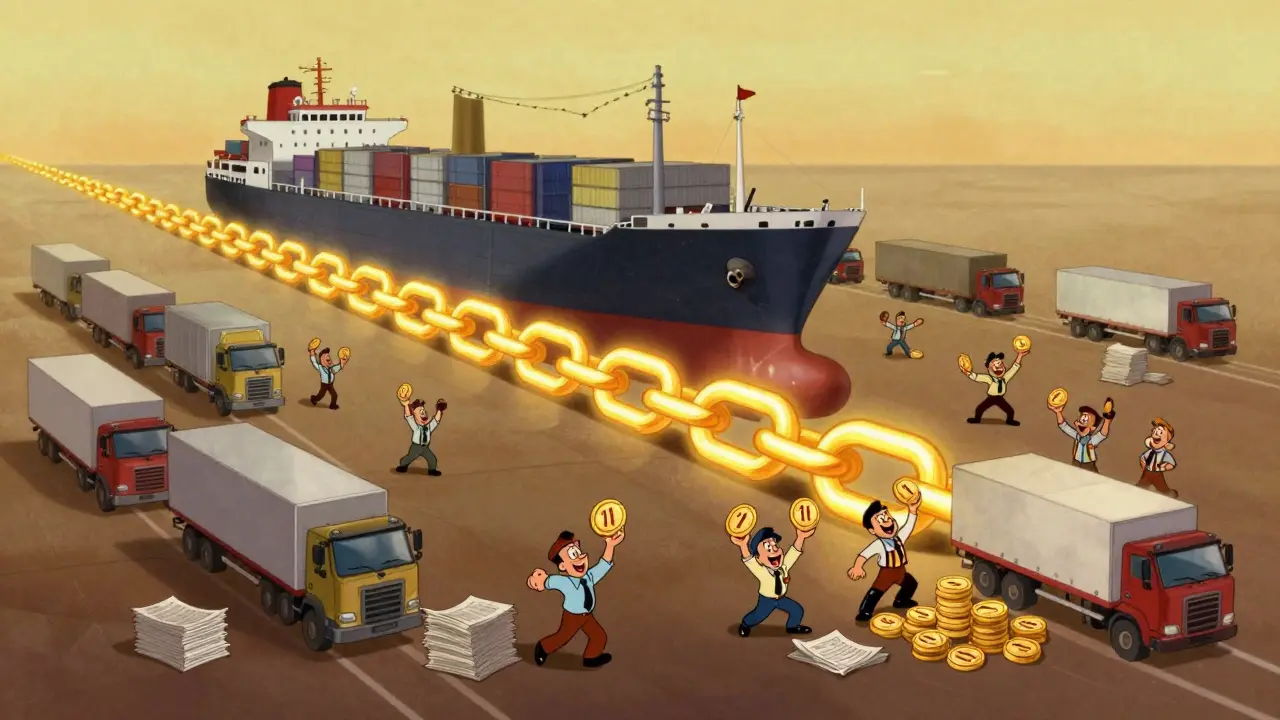
Beyond the "cool" factor of tracing a diamond, blockchain is a massive cost-cutter. The biggest drain on supply chains is often the paperwork-bills of lading, customs forms, and certificates of origin. When Maersk partnered with IBM to create the TradeLens platform, they targeted the friction in global shipping. By digitizing these documents on a ledger, they removed the need for intermediaries to verify signatures and stamps.
The financial impact is concrete. A German startup called Tracifier integrated Oracle Blockchain into its management database and saw a reduction in food processing costs of up to 40% for its customers. This happens because the system eliminates redundant data entry and prevents the costly errors that occur when different partners have different versions of the same spreadsheet.
Logistics giants like FedEx have also joined forces with the Blockchain in Transport Alliance (BiTA). Their focus is on streamlining dispute resolutions. Instead of arguing over where a package was lost or who damaged a pallet, both parties look at the immutable record of the sensor data and timestamps. The data is the judge, and the dispute is settled instantly.
The Next Frontier: Tokenization and AI
We are moving past simple tracking. The next phase is the Tokenization of goods. This involves creating a digital representation of a physical asset. Instead of moving a piece of paper that says "I own this oil," you move a digital token. This allows for faster transactions and even enables smaller businesses to access decentralized financing platforms, as they can use their tokenized inventory as collateral.
When you combine this with AI and IoT, you get a predictive supply chain. Imagine an AI that sees a weather delay in the Pacific, checks the blockchain to see which shipments are affected, and automatically triggers a smart contract to reroute a different shipment from a closer warehouse-all without a human manager intervening. This is the direction companies like ADNOC (Abu Dhabi National Oil Company) are exploring by tracking oil from the well to the customer via IBM's technology.
Implementation Hurdles: It's Not All Smooth Sailing
If blockchain is so great, why isn't everyone using it? The biggest hurdle isn't the tech; it's the people. For a blockchain to work, everyone in the chain-the farmer, the trucker, the warehouse manager, and the retailer-must agree to use the same system. This is known as the "network effect." If the trucker still uses a clipboard and a pencil, the digital chain is broken.
There is also a steep learning curve. Teams have to move away from traditional ERP (Enterprise Resource Planning) mindsets and understand distributed ledger principles. Moreover, the hardware costs are real. To get a truly "smart" supply chain, you need thousands of IoT sensors that can withstand extreme conditions, from the heat of a desert to the freezing depths of a shipping container.
Does blockchain replace existing supply chain software?
No, it doesn't replace it; it enhances it. Most companies integrate blockchain with their existing ERP systems. The blockchain acts as the "shared truth" layer that connects different companies' internal databases, ensuring that everyone is looking at the same data without giving up control of their private internal records.
Is blockchain expensive to implement?
The cost varies. Using a ready-made platform like Oracle Blockchain can lower the entry barrier. However, the primary costs aren't just software, but the IoT hardware (sensors) and the time required to onboard all your suppliers and partners onto the network.
Can data on a blockchain be changed if a mistake is made?
That's the point of immutability: you cannot delete or change a previous block. However, if a mistake was made, a "correction transaction" is added. This means the ledger shows both the error and the correction, providing a full audit trail of who changed what and when.
Which industries benefit the most from blockchain supply chains?
Currently, the food and pharmaceutical industries lead the way due to strict regulatory requirements and safety concerns. However, the automotive, luxury goods (diamonds/watches), and energy sectors are rapidly adopting it for ethical sourcing and asset tracking.
What are smart contracts in the context of supply chains?
Smart contracts are pieces of code that automatically trigger an action when certain conditions are met. For example, "If the GPS shows the ship has entered the port AND the sensor shows the temperature stayed below 5°C, THEN release 50% of the payment to the carrier." This removes the need for manual invoicing and trust-based waiting periods.
Moving Forward: Your Path to Adoption
If you're looking to implement these systems, don't try to boil the ocean. Start with a single, high-pain point. If you struggle with food spoilage, focus on cold chain monitoring. If you're worried about ethics, focus on raw material provenance.
For those in the pharmaceutical or food sectors, your first step should be auditing your current "data gaps." Where does the information stop? Where are you relying on a phone call to verify a shipment? Those gaps are exactly where a blockchain ledger provides the most value. Once you have a simple traceability pilot running, you can scale into the more complex world of smart contract automation and tokenized payments.

Comments (20)
Eric Raines
Everyone's acting like this is some magic trick but it's basically just a database that's hard to edit. Most people don't even get how the hashing works. If the data entered at the source is garbage, the blockchain just gives you immutable garbage. Garbage in, garbage out, plain and simple. It's not reinventing the wheel, it's just putting a fancy lock on the wheel.
Caiaphas Konkol
Of course they want us to use "immutable ledgers." Just imagine the level of surveillance once every single movement of every single product is tracked by a centralized-decentralized hybrid system. It's a dream for the globalists to have a total map of all resource flows in real-time. Wake up and see the grid being built around us.
Jason M
This is an absolutely monumental shift in how we perceive value and trust! Imagine the empowerment of a small-scale farmer in a developing nation who can finally prove the organic origin of their crop and bypass the predatory middlemen who have squeezed them for generations. It's not just about efficiency, it's about human dignity and the democratization of the global marketplace! We are witnessing the birth of a more honest world!
praveen subbiah
India is going to dominate this sector because our tech talent is just on another level! My country will lead the way in implementing these smart contracts for agriculture. It's simply inevitable that we will be the global hub for supply chain innovation because of our sheer drive and brilliance!
Clair Geary
this is such a wild ride for the food industry lol. imagine just scanning a can and seeing the actual vibes of where the fish came from. totally flips the script on corporate secrecy
Yvette P
Oh sure, let's just ignore the massive energy overhead required to maintain these distributed nodes while we're "saving the planet" with EV batteries. I'm sure the latency in consensus algorithms is just a tiny detail when you're trying to scale to millions of IoT pings per second across a global network. It's just lovely how we prioritize the buzzword over the actual throughput metrics and the sheer architectural nightmare of integrating legacy SAP systems with a modern ledger. Truly a masterpiece of corporate optimism.
Hannah Rubia
The integration of IoT sensors with a distributed ledger provides a robust framework for ensuring the integrity of pharmaceutical cold chains. By utilizing smart contracts to automate compliance, organizations can significantly mitigate the risk of human error in temperature logging. This systemic approach ensures that regulatory standards are met with a high degree of precision and transparency.
Eric Raines
Typical academic answer. Real world isn't a textbook.
Jagdish Sutar
It's wonderful to see how this can bring more transparency to the farmers. In India, many smallholders could benefit from this by proving their product quality to international buyers.
Sarah Ingrams
really hope this helps the people in the mines
Kyle Bush
USA all the way! 🇺🇸 We build the tech, the rest of the world just uses it! 🚀 Keep it coming! 💎
Matthew Morse
too many buzzwords for a basic tracking system
Candace Sherrard
It is interesting to consider how the concept of ownership shifts when we move toward the tokenization of physical assets. We are essentially stripping the physical object of its primary identity and replacing it with a digital proxy, which suggests that in the future, the record of the item may actually hold more perceived value than the item itself, provided the ledger remains the ultimate source of truth in a world of increasing synthetic replicas.
Paige Raulerson
The De Beers example is a bit simplistic. They've always controlled the market; this is just a digital rebranding of their existing monopoly. Hardly a revolution.
Findlay Duncan Lyon
Spot on. Huge time saver.
Ali Tate
The sheer audacity of thinking a bunch of code can replace the grit and gut feeling of real logistics. It's all fancy window dressing for the suits who've never stepped foot in a warehouse. Absolute joke.
Kathleen Bergin
This is just a fancy list. Everyone knows it's just about money.
Charlie Queen
Love the idea of the world connecting like this! 🌍 Imagine the cultural exchange when we can track a coffee bean from a small village in Ethiopia all the way to a cafe in NYC! ☕✨
Ellie Drews
It's definitely a process and we should be patient with the smaller companies who can't afford all these sensors yet. Let's support them through the transition instead of just demanding they change overnight.
Tara Aman
Let's get this implemented everywhere! The potential to stop child labor in mining is such a huge win for everyone! Let's push for this!