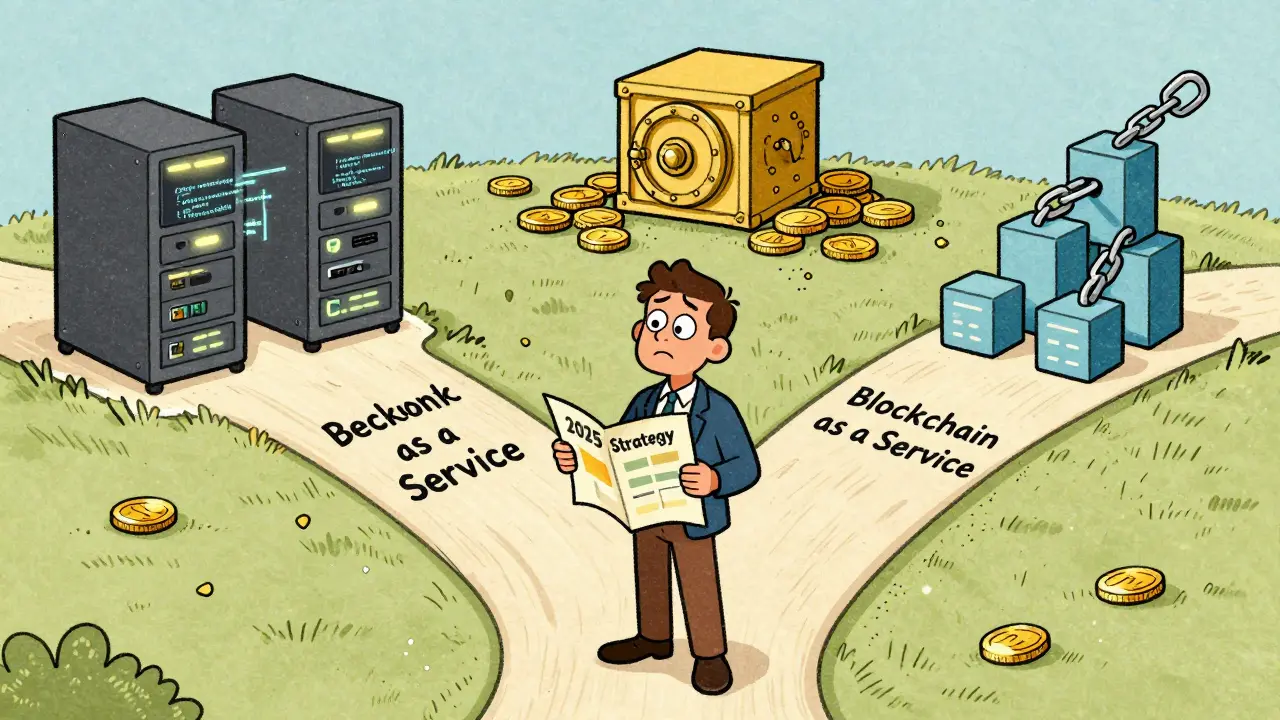
When you hear the acronym BaaS is a term that refers to three distinct but interconnected cloud service models: Backend as a Service, Banking as a Service, and Blockchain as a Service, your first reaction might be confusion. And honestly? It’s justified. The same letters describe completely different technologies depending on whether you’re talking to a software engineer, a fintech CEO, or a blockchain developer.
In 2025, this ambiguity isn’t just a linguistic quirk-it’s a strategic minefield. Choosing the wrong "BaaS" provider can derail a product launch, violate financial regulations, or lock you into incompatible infrastructure. Whether you need to offload server management, embed banking features into an app, or deploy smart contracts without managing nodes, understanding which sector of BaaS applies to your project is critical.
This guide cuts through the noise. We’ll break down the major players in each category, explain what they actually do, and help you decide which one fits your specific needs. No fluff, just the facts you need to make an informed decision in the current market landscape.
Backend as a Service (BaaS): Powering App Logic
If you are building a mobile or web application, Backend as a Service is a cloud computing model where providers handle server-side logic, database management, and authentication, allowing developers to focus on frontend user experience. Instead of spinning up AWS EC2 instances and configuring firewalls yourself, you use APIs provided by these platforms.
The market in 2025 is split between legacy giants and agile open-source challengers. Here are the key contenders:
- Firebase: Google’s platform remains the default choice for many startups. It offers real-time databases, authentication, and hosting. Its freemium model starts at $0, making it accessible for hobby projects, though enterprise scaling costs can rise quickly.
- AWS Amplify: Amazon’s full-stack solution integrates deeply with the broader AWS ecosystem. It provides pay-as-you-scale pricing for authentication, APIs, and storage. If your company already uses AWS, this reduces vendor fragmentation.
- Supabase: Positioned as an open-source alternative to Firebase, Supabase has gained massive traction. It relies on PostgreSQL, offering real-time subscriptions and edge functions. Transparency in pricing and data ownership appeals to privacy-conscious teams.
- Back4App: This platform specializes in Parse Server hosting. Since Facebook discontinued the original Parse service, Back4App has become the go-to for teams relying on the open-source Parse Community version for mobile backend needs.
- Nhost: For GraphQL-first architectures, Nhost delivers built-in authentication and file storage alongside PostgreSQL databases. It simplifies complex data fetching for modern frontend frameworks.
The trend here is clear: developers want flexibility. Closed ecosystems like Firebase are facing pressure from open-source options like Supabase and Appwrite, which allow self-hosting. This shift gives companies more control over their data residency and compliance requirements.
Banking as a Service (BaaS): Embedding Finance
Banking as a Service is a business model that allows non-bank entities to offer financial services such as payments, accounts, and lending by integrating with licensed banks via APIs. In 2025, BaaS is no longer niche; it’s central to the embedded finance revolution. Brands like Uber, Shopify, and even retail chains now offer financial products directly within their apps.
The European market leads this charge due to favorable regulatory frameworks like PSD2 and EMI licensing. Key providers include:
- Solarisbank: A fully-licensed platform dominating Europe. They provide core banking infrastructure, including account issuance, cards, and lending solutions. Their expansion into other regions makes them a global player for digital banks.
- Treezor: Based in Paris and part of the Societe Generale group, Treezor offers API-driven payments, e-wallets, and SEPA processing. With licenses across 25 European countries, they provide passporting capabilities that simplify cross-border operations.
- ClearBank: Built specifically for tech-native businesses, ClearBank positions itself as innovation-friendly infrastructure. They cater to fintechs that need flexible, scalable payment rails rather than traditional banking constraints.
- Railsr: After recapitalization in 2023, Railsr has rebuilt its momentum as an embedded finance platform. They serve clients in Europe and Asia with comprehensive APIs for BaaS and Cards-as-a-Service.
- Itexus: A global provider focusing on custom-built solutions. Unlike plug-and-play platforms, Itexus excels in full-stack development and security-first design for complex fintech integrations.
Choosing a BaaS provider requires careful consideration of regulatory coverage. If you operate only in the UK, ClearBank might suffice. But if you need pan-European reach, Treezor or Solarisbank’s EMI licenses offer significant advantages. Always verify the provider’s compliance tools, especially for KYC (Know Your Customer) and AML (Anti-Money Laundering) checks.

Blockchain as a Service (BaaS): Infrastructure for Web3
Blockchain as a Service is a cloud-based offering that enables enterprises to build, host, and manage blockchain applications without maintaining the underlying node infrastructure. This is crucial for companies wanting to leverage distributed ledger technology (DLT) for supply chain tracking, digital assets, or decentralized finance (DeFi) without hiring a team of cryptographers.
The 2025 landscape features specialized providers catering to different blockchain protocols:
- Rapid Innovation: Currently standing out for affordability and speed. They offer a 90-day deployment guarantee and combine blockchain expertise with AI and Web3 development. Ideal for businesses needing quick, cost-effective launches.
- Kaleido: Provides a comprehensive blockchain business cloud. It supports multiple protocols and consensus mechanisms, making it suitable for enterprise consortia that require interoperability between different blockchains.
- Blockstream: Focused heavily on Bitcoin. They offer satellite API services and Liquid Network solutions, appealing to institutions looking to enhance Bitcoin’s scalability and privacy features.
- BlockApps: Specializes in Ethereum-based enterprise solutions. Their tools simplify smart contract development and deployment, reducing the technical barrier for corporate adoption.
- tZERO: Targets capital markets and digital asset trading. Their platform is designed for regulated environments, ensuring compliance while enabling tokenized securities trading.
The integration of AI into blockchain development is a notable trend. Providers like Rapid Innovation are leveraging AI to optimize smart contract audits and automate testing, reducing time-to-market significantly.
| Category | Primary Use Case | Key Technical Requirement | Top Provider Example |
|---|---|---|---|
| Backend as a Service | Mobile/Web App Development | API Integration, Database Management | Firebase / Supabase |
| Banking as a Service | Embedded Financial Products | Regulatory Compliance, KYC/AML | Solarisbank / Treezor |
| Blockchain as a Service | Distributed Ledger Applications | Node Management, Smart Contracts | Kaleido / Rapid Innovation |

How to Choose the Right Provider in 2025
Selecting a BaaS provider isn’t just about feature lists. It’s about alignment with your long-term strategy. Consider these factors:
- Scalability: Can the provider handle 10x traffic growth? AWS Amplify and Firebase excel here due to their massive cloud infrastructure. For blockchain, Kaleido’s multi-protocol support ensures you aren’t locked into a single chain.
- Security & Compliance: Especially critical for Banking BaaS. Ensure providers like Solarisbank or ClearBank have robust SOC2 certifications and GDPR compliance. For blockchain, look for providers offering audited smart contract templates.
- Cost Structure: Freemium models (Firebase, Supabase) are great for MVPs but can become expensive at scale. Evaluate total cost of ownership, including data egress fees and API call limits.
- Ecosystem Lock-in: Open-source options like Supabase and Appwrite reduce vendor lock-in risk. You can self-host if needed. Proprietary platforms may offer easier setup but limit future flexibility.
- Support & Documentation: Rapid Innovation’s 90-day guarantee reflects confidence in support quality. Check community forums and documentation depth before committing.
Don’t ignore regional strengths. European BaaS providers benefit from strong regulatory frameworks. If you’re targeting EU customers, partnering with Treezor or Solarisbank simplifies legal hurdles compared to using US-centric providers.
Future Trends Shaping BaaS
The convergence of AI and BaaS is accelerating. In Backend BaaS, AI-driven analytics help predict user behavior and optimize server loads. In Banking BaaS, AI enhances fraud detection and personalized lending decisions. In Blockchain BaaS, AI automates smart contract auditing and gas fee optimization.
We’re also seeing increased consolidation. Acquisitions like Treezor by Societe Generale signal that traditional banks are buying into the BaaS space to stay relevant. Expect more partnerships between legacy financial institutions and agile fintech providers.
Modularity is another key trend. Platforms like Bankable and Railsr emphasize plug-and-play components. Businesses no longer need all-or-nothing solutions; they can pick specific modules-like card issuance or payment processing-and integrate them seamlessly.
As we move further into 2026, the distinction between these BaaS types will blur slightly through integration. Imagine an app that uses Backend BaaS for UI, Banking BaaS for payments, and Blockchain BaaS for loyalty tokens-all managed through a unified dashboard. Providers who enable this interoperability will lead the next wave.
What is the difference between Backend as a Service and Banking as a Service?
Backend as a Service (BaaS) handles technical infrastructure like databases and authentication for apps. Banking as a Service (BaaS) allows businesses to offer financial products like loans or payments by connecting to licensed banks via APIs. One is for code; the other is for money.
Is Supabase better than Firebase?
It depends on your needs. Firebase is easier to start with and integrates well with Google services. Supabase is open-source, uses PostgreSQL, and offers more control over data. Choose Supabase if you value data portability and prefer SQL.
Which BaaS provider is best for European banking?
Solarisbank and Treezor are top choices. Both hold EMI licenses allowing them to operate across 25 European countries. Treezor is part of Societe Generale, adding stability, while Solarisbank focuses heavily on digital banking infrastructure.
Do I need Blockchain as a Service for my startup?
Only if your product relies on decentralized ledgers, smart contracts, or digital assets. If you just need a secure database, standard Backend BaaS is cheaper and simpler. BaaS saves you from managing complex node infrastructure.
Are there free BaaS options available?
Yes. Firebase, Supabase, and Appwrite offer generous free tiers for small projects. However, monitor usage closely. Costs can spike rapidly with high traffic or large data storage needs.