You’ve probably heard the hype around decentralized exchanges. They promise freedom, low fees, and direct control over your assets. But not every DEX is built for everyone. In fact, some are so small that using them feels more like an experiment than a serious trading strategy. That’s exactly where KaiaSwap fits in.
If you are looking for a place to trade Bitcoin or Ethereum with deep liquidity, stop reading now. You won’t find it here. KaiaSwap is a highly specialized, tiny corner of the crypto world. It operates exclusively on the Kaia blockchain (formerly known as Klaytn). As of early 2026, this platform supports only four coins and four trading pairs. Its entire 24-hour trading volume hovers around $78. Yes, you read that right-less than one hundred dollars a day.
So why does it exist? And should you ever touch it? Let’s break down what KaiaSwap actually is, who it might serve, and why most traders should look elsewhere.
The Hard Numbers: Volume, Pairs, and Reality
When reviewing any exchange, we start with the data. The numbers don’t lie, even if they tell a surprising story. According to market trackers like CoinGecko, KaiaSwap is statistically invisible compared to industry giants. While Uniswap processes over $1 billion in daily volume and PancakeSwap handles nearly half a billion, KaiaSwap moves less money in a day than you might spend on lunch.
| Exchange | 24h Volume | Trading Pairs | Primary Chain |
|---|---|---|---|
| Uniswap v3 | $1.24 Billion | 15,000+ | Ethereum/Multi-chain |
| PancakeSwap | $487 Million | 1,200+ | Binance Smart Chain |
| Trader Joe | $28.3 Million | 500+ | Avalanche |
| KaiaSwap | $78.73 | 4 | Kaia (Klaytn) |
This disparity isn't just about size; it's about utility. With only four trading pairs, your options are extremely limited. The most active pair is STKAIA/WKLAY (Staked KAIA against Wrapped KLAY), which accounts for roughly $55 of that total daily volume. Another pair involves PING/WKLAY. If you don't hold these specific tokens, KaiaSwap has nothing for you.
The bid-ask spread-the difference between the buy and sell price-is around 0.75%. For such a micro-exchange, this might seem reasonable, but remember: you are trading in a pool with almost no other participants. This means high slippage risk if you try to move any significant amount of capital. A "significant" amount here might be just a few hundred dollars.
How KaiaSwap Works: The Technical Setup
KaiaSwap functions as a standard Automated Market Maker (AMM). This means there are no order books with buyers and sellers matching prices. Instead, you trade against a liquidity pool-a smart contract holding reserves of two tokens. When you swap, you pull from one side of the pool and add to the other, with the price adjusting automatically based on the ratio of assets.
To use it, you need a Web3 wallet compatible with the Kaia network. The native wallet for this ecosystem is Kaikas, though MetaMask can also work if configured correctly for the Kaia chain. You will need KAIA or WKLAY (Wrapped KLAY) to pay for gas fees and execute trades.
Here is the catch: KaiaSwap lacks advanced features. There are no limit orders, no stop-losses, and no margin trading. It is a basic swap interface. If you are used to platforms like GMX or dYdX that offer perpetual futures or complex derivatives, KaiaSwap will feel primitive. It is designed for simple spot swaps within the Kaia ecosystem only. There is no cross-chain bridging built directly into the UI, meaning you must manage bridge transfers separately if you want to move assets in or out.
Liquidity Risks: Why Small Pools Matter
In decentralized finance, liquidity is king. High liquidity means you can buy or sell large amounts without moving the price drastically. Low liquidity does the opposite. KaiaSwap suffers from critically low liquidity.
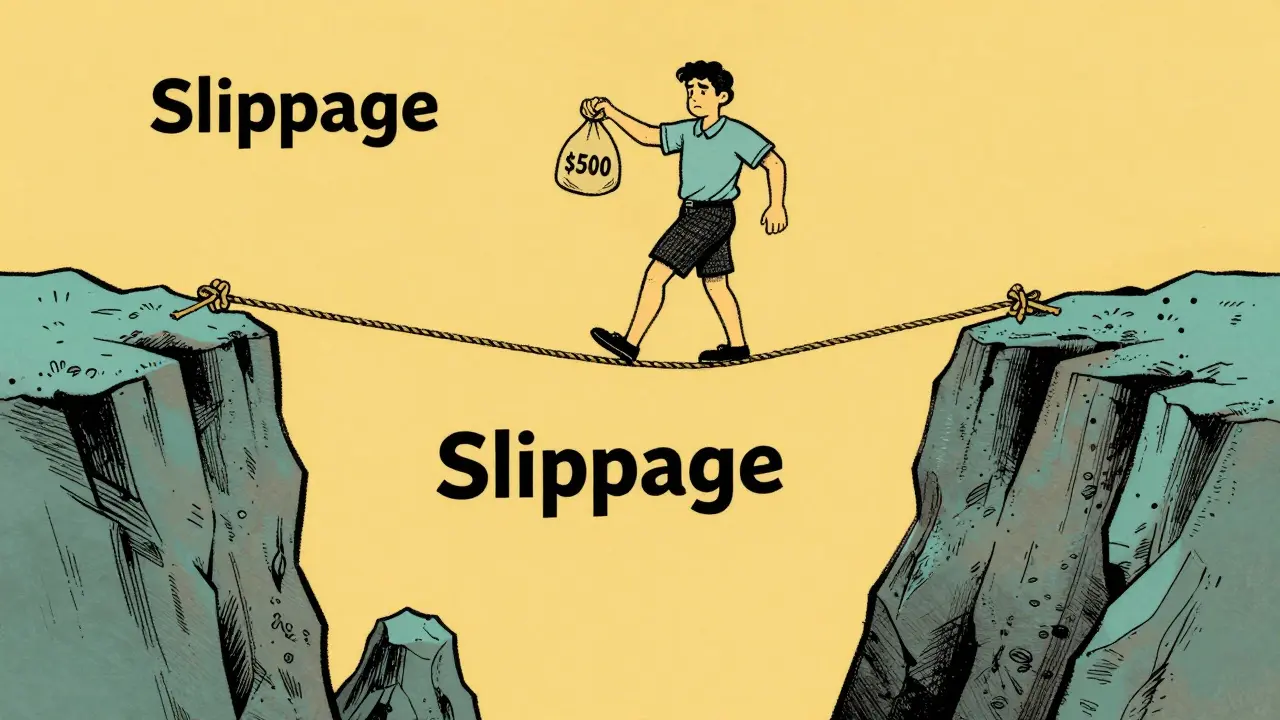
Data shows order book depths of only $45 to $107 at +/- 2% price points. What does this mean for you? Imagine trying to sell $500 worth of STKAIA. Because the pool is so shallow, your single transaction could eat up all available liquidity, causing the price to crash instantly. You would end up receiving far fewer WKLAY tokens than expected. This is called slippage, and on KaiaSwap, it is a constant threat for any trade above a trivial amount.
Furthermore, the lack of users creates a feedback loop. Fewer users mean less liquidity. Less liquidity attracts fewer users because of higher costs and risks. Industry analysts at Messari noted in late 2025 that 78% of new DEXs on emerging chains fail to reach $100k daily volume within six months. KaiaSwap is nowhere near that threshold. This raises serious questions about its long-term viability.
Safety, Security, and Trust Score
Is KaiaSwap safe? That depends on how you define safety. Technically, as a decentralized protocol, you retain custody of your funds until you approve a transaction. There is no central company holding your money that can go bankrupt or freeze your account. This is the core promise of DeFi.
However, "safe" also implies reliability and audit quality. KaiaSwap was established in 2024, making it a very young project. As of mid-2026, there is scarce public information regarding comprehensive third-party security audits of its smart contracts. Without visible audit reports from firms like CertiK or Trail of Bits, you are trusting the code blindly.
User feedback is virtually non-existent. There are no reviews on Trustpilot, minimal discussion on Reddit, and no community sentiment analysis available. Compare this to Uniswap, which has thousands of user discussions and a robust support ecosystem. On KaiaSwap, if something goes wrong-if a transaction fails or a bug exploits your funds-you have no customer support team to call. You are on your own.
The regulatory landscape for KaiaSwap is also unclear. The Kaia Foundation, based largely in South Korea, has strong corporate ties (LG Electronics, Shinhan Bank), but they have not published explicit compliance frameworks for their DEX partners. Unlike dYdX, which implemented geo-blocking for restricted jurisdictions in 2025, KaiaSwap appears open to all, which could pose legal risks depending on your location.
Who Should Actually Use KaiaSwap?
Let’s be honest: for 99% of crypto traders, KaiaSwap is not the right tool. If you want to trade major assets, earn yield through stable strategies, or access deep markets, stick to Uniswap, PancakeSwap, or centralized exchanges like Binance.
However, there is a tiny niche where KaiaSwap makes sense:
- Kaia Ecosystem Purists: If you are deeply invested in the Kaia blockchain and specifically need to swap STKAIA or PING tokens, this may be the only direct venue.
- Low-Stakes Experimenters: If you have spare KAIA tokens and want to test DeFi mechanics with amounts too small to care about slippage ($10-$20 trades), it works fine.
- Liquidity Providers (With Caution): If you believe strongly in the Kaia token's future, you might provide liquidity to earn fees. But beware: Impermanent Loss is a real risk, especially in volatile, low-volume pools.
For everyone else, the friction of connecting wallets, managing gas fees, and dealing with thin liquidity outweighs any potential benefit. The time cost alone of finding this exchange and setting up your wallet is higher than the savings you’d get from slightly lower fees on larger platforms.

Alternatives: Better Options for Most Users
If KaiaSwap doesn't fit your needs, where should you go? Here are three better alternatives depending on your goals:
- Uniswap (Ethereum & L2s): The gold standard for DEXs. Massive liquidity, thousands of pairs, and robust security. Best for serious traders who prioritize safety and selection.
- PancakeSwap (BNB Chain): Lower fees than Ethereum, huge variety of tokens, and gamified features like lotteries and NFTs. Great for beginners and casual traders.
- Thorchain / THORSwap: If you want to trade native assets across different blockchains (e.g., BTC to ETH) without wrapping tokens, Thorchain offers true cross-chain swaps with deep liquidity.
Each of these platforms has proven track records, active communities, and sufficient volume to handle meaningful trades without destroying your entry price.
Final Verdict: Proceed With Extreme Caution
KaiaSwap is a functional piece of software, but it is not a robust financial instrument. It serves a microscopic segment of the crypto market. Its existence highlights the fragmentation of the DeFi space, where hundreds of chains launch their own mini-exchanges hoping to capture value.
As of June 2026, KaiaSwap remains a novelty rather than a necessity. The lack of volume, limited pairs, and absence of advanced features make it unsuitable for anything beyond trivial transactions. If you do decide to use it, keep your positions small, understand the slippage risks, and never invest more than you can afford to lose due to technical failures or liquidity drains.
For the vast majority of users, sticking to established, high-volume DEXs is the smarter, safer, and more efficient choice. Don't let the allure of a "new" chain distract you from the fundamentals of good trading: liquidity, security, and usability. KaiaSwap currently checks none of those boxes effectively.
Is KaiaSwap safe to use?
KaiaSwap is decentralized, meaning you control your keys, but safety also depends on smart contract security and liquidity depth. As a new platform with limited public audits and extremely low volume, it carries higher risks than established DEXs like Uniswap. Use only small amounts you are willing to lose.
What tokens can I trade on KaiaSwap?
Currently, KaiaSwap supports only four trading pairs, primarily involving STKAIA (Staked KAIA) and PING against WKLAY (Wrapped KLAY). It does not support major cryptocurrencies like Bitcoin or Ethereum directly.
Why is the trading volume so low?
KaiaSwap is a niche exchange focused solely on the Kaia blockchain ecosystem. It lacks marketing, liquidity incentives, and cross-chain functionality, resulting in minimal user adoption and daily volumes under $100.
Do I need a specific wallet for KaiaSwap?
Yes, you need a Web3 wallet compatible with the Kaia network. The recommended wallet is Kaikas, but MetaMask can also be used if configured to connect to the Kaia chain RPC endpoints.
Are there hidden fees on KaiaSwap?
While KaiaSwap advertises a simplified fee model, you must pay gas fees in KAIA for every transaction. Additionally, due to low liquidity, you may experience high slippage, which acts as an implicit cost by giving you a worse exchange rate.