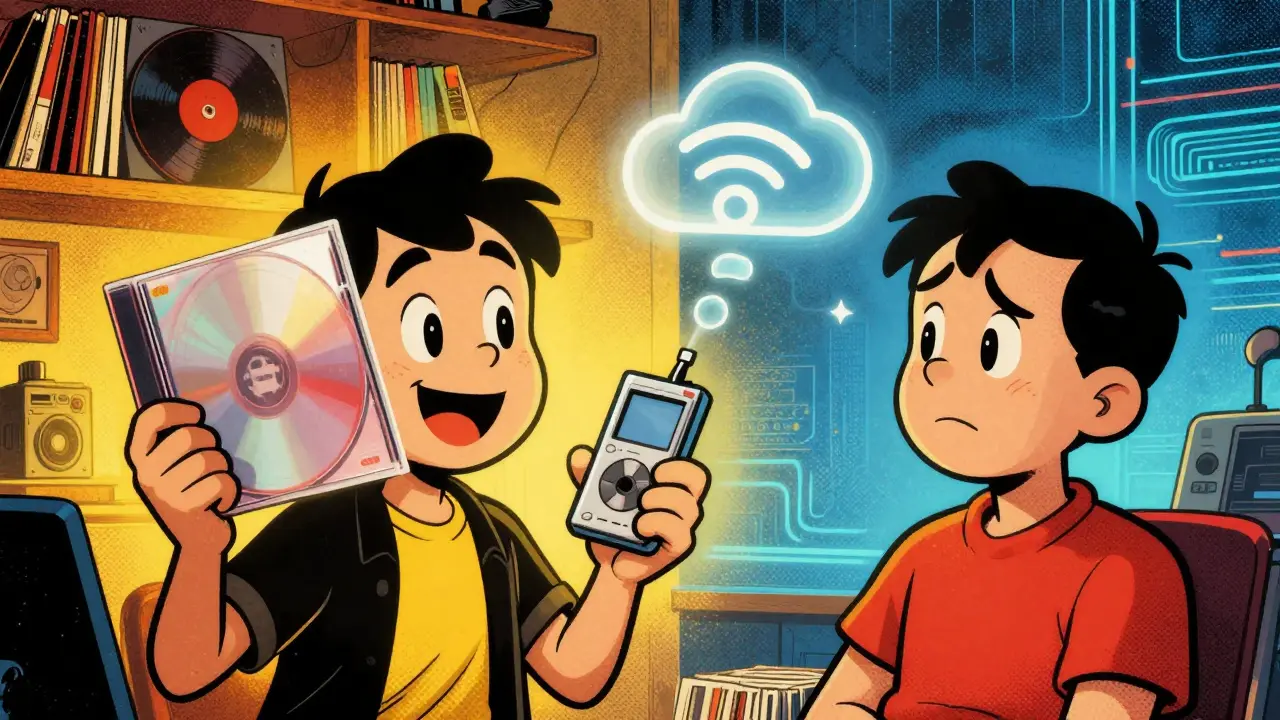
Remember when buying a song meant owning it? You bought a CD or downloaded an MP3, and that file was yours. Today, you rent access to millions of songs through streaming services. But what if you could actually own a piece of the music you love again? That’s where Music NFTs come in. It’s been a wild ride since the hype cycle of 2021. Back then, Kings of Leon dropped their album as an NFT and made $2 million in a week. Everyone thought this was the end of Spotify. Fast forward to mid-2026, and the dust has settled. The speculative bubble burst, but something real remains. NFTs aren’t just jpegs anymore; they’re becoming functional tools for artists to get paid fairly and fans to connect deeper with their favorite musicians. So, are music NFTs dead? Hardly. They’ve just grown up. Here is how the technology is reshaping the industry right now, stripping away the noise to focus on utility, revenue, and actual ownership.
From Speculation to Utility: What Actually Changed?
The biggest shift in the last two years is the move from "buy this rare image" to "this token does something useful." In 2021, most people bought NFTs hoping the price would go up. By 2025 and into 2026, the market corrected. Trading volumes dropped significantly after the initial craze, which scared off casual investors but kept serious players around. Today, about 78% of new music NFTs offer concrete benefits. These aren’t just digital receipts; they are keys to exclusive experiences or shares in future earnings. Think of it like this: instead of buying a t-shirt that sits in your closet, you buy a pass that gets you backstage, early access to tours, or even a tiny slice of the royalty pie every time the song plays on the radio. This shift towards utility has stabilized the market. According to Technavio’s 2024 analysis, the global Music NFT Market is projected to reach nearly $6.5 billion by 2029. That’s not because everyone is flipping tokens for quick cash; it’s because labels and independent artists are building sustainable business models on top of blockchain infrastructure.
Why Artists Are Finally Getting Paid Fairly
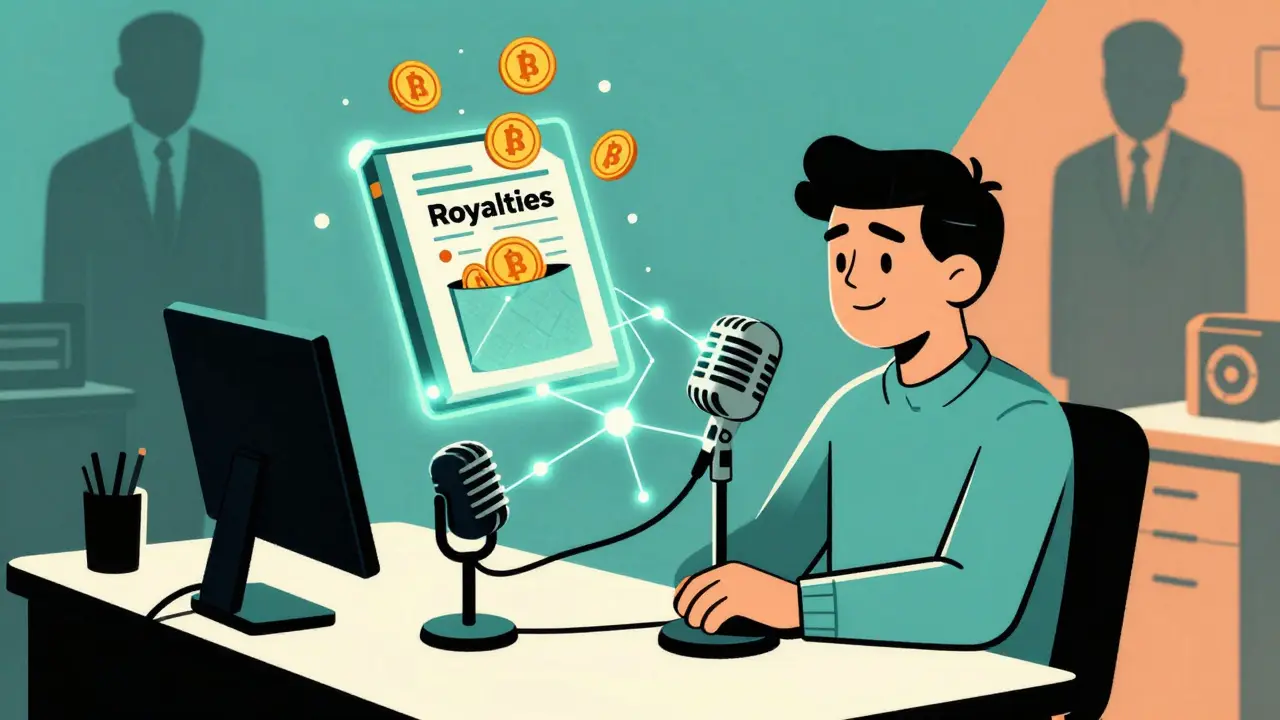
Let’s talk money, because that’s why we’re here. The traditional music industry model is broken for creators. When you stream a song on major platforms, the artist typically sees only 12% to 15% of the revenue. The rest goes to labels, distributors, publishers, and administrators. On top of that, waiting for those checks can take 12 to 18 months. NFT platforms like Royal and Opulous flip this script. By cutting out the middlemen, artists can keep 70% to 90% of the revenue from direct sales. More importantly, they can program smart contracts to handle royalties automatically. Here is how it works: An artist mints an NFT representing a song. Fans buy it. Every time that song is streamed or played publicly, the smart contract instantly distributes a percentage of the earnings back to the wallet addresses of the NFT holders. No waiting six months for a statement. No complex paperwork. Just code executing payments within 72 hours. For independent artists, this difference between surviving and thriving is massive. One indie musician reported making more in one week selling 500 NFTs at $25 each than he did in two years on Spotify.
The Three Main Types of Music NFTs in 2026
Not all music NFTs are created equal. If you are looking to get involved, whether as a fan or an artist, you need to understand the three distinct models dominating the space right now.
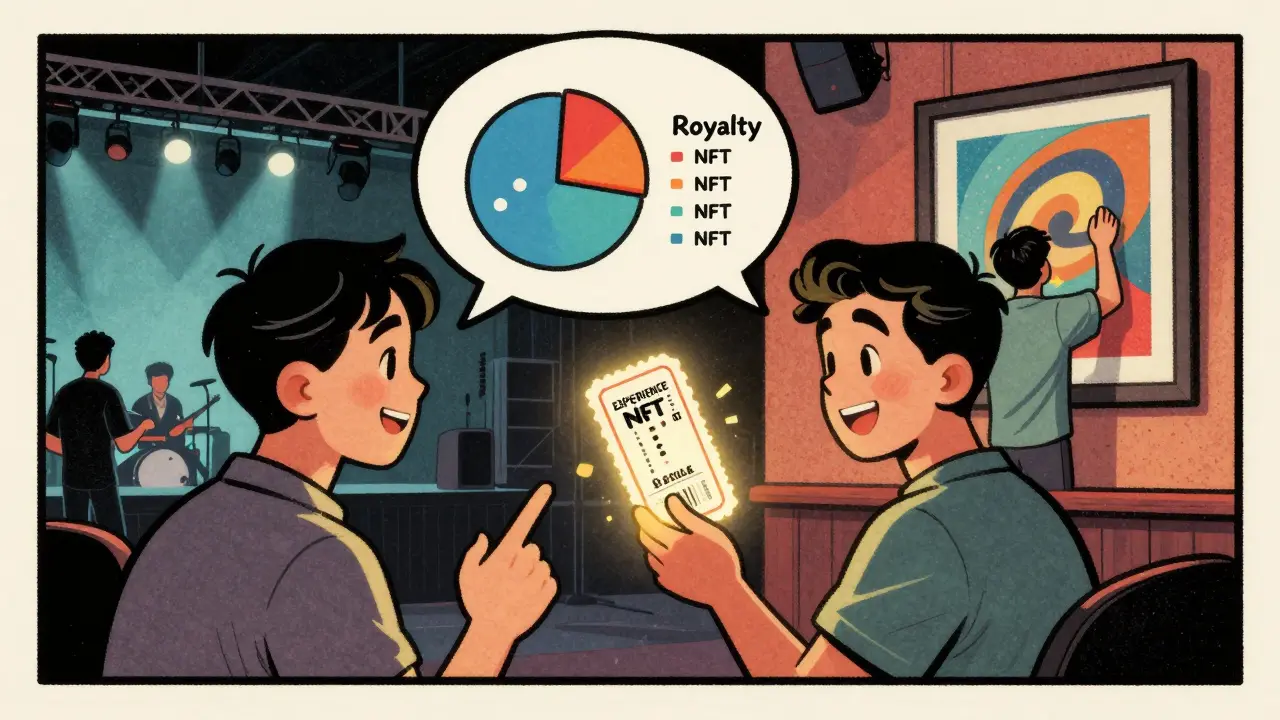
- Royalty NFTs: These give buyers fractional ownership of a song’s income. Platforms like Royal allow fans to buy credits that represent a tiny percentage (like 0.0001%) of publishing rights. When the song streams, you earn micro-payments. It’s like being a shareholder in a specific track. Average annual returns hover around 8-12%, depending on the song’s popularity.
- Experience NFTs: These function like premium concert tickets or VIP passes. Holding the NFT might grant you access to private listening parties, meet-and-greets, or exclusive content. A 2024 Billboard study found that these experiences lead to 73% higher fan retention compared to standard ticketing. You aren’t just buying a product; you’re buying a relationship with the artist.
- Collectible NFTs: These are closer to the original concept-digital art paired with music. They sell for anywhere from $1,500 to $6,000 per piece. While less common now than in 2021, they still hold value for super-fans who want a unique, verifiable piece of memorabilia.
| Feature | Royalty NFTs | Experience NFTs | Collectible NFTs |
|---|---|---|---|
| Primary Value | Passive Income | Access & Community | Exclusivity & Art |
| Average Price Range | $10 - $100 | $50 - $500 | $1,500 - $6,000+ |
| Best For | Investors & Data Fans | Superfans & Tour Goers | Art Collectors |
| Revenue Share for Artist | High (70-90%) | Very High (Direct Sale) | High (Direct Sale) |
| Platform Examples | Royal, Sound.xyz | Yellowheart, Moment House | Catalog, Nifty Gateway |
Technical Barriers: Is It Still Too Hard?
One of the biggest criticisms of NFTs has always been usability. Setting up a crypto wallet, managing seed phrases, and paying gas fees felt like rocket science for the average music listener. This barrier kept mainstream adoption low. Only about 15% of music consumers owned cryptocurrency in 2025, compared to 85% using streaming services. However, the tech is catching up. Ethereum still handles the majority of high-value transactions, but its fees were historically prohibitive. That’s why many music platforms have migrated to Polygon or Solana. These blockchains offer transaction fees averaging just $0.01, compared to Ethereum’s historical average of over $1.20. This small change makes buying a $20 NFT feasible without worrying about spending $5 on network fees. Platforms like Sound.xyz and Audius have also simplified the user interface. You no longer need to be a developer to mint or buy. Many platforms now allow credit card purchases, converting fiat currency to crypto behind the scenes. The learning curve for artists has dropped from 28 hours to about 12 hours on average, thanks to better documentation and community support on Discord servers.
Regulatory Clarity and Trust Issues
You can’t talk about the future without addressing the elephant in the room: regulation. In 2022, the lack of clear rules led to scams and failed promises. Remember Lil Pump’s NFT project? He promised royalties and perks that never materialized, leading to a $1.2 million class-action settlement. That kind of behavior damaged trust across the entire industry. By 2026, things are getting tighter. The EU’s MiCA framework provided clearer guidelines for digital assets, including music NFTs. In the U.S., the Copyright Office issued updated guidance requiring platforms to verify copyright ownership before minting. This means fewer fakes and more accountability. Trust is also being rebuilt through transparency. Platforms like Royal score high on user reviews because they show exactly where the money is going. You can see the smart contract execution in real-time. However, challenges remain. A 2024 study by the Mechanical Licensing Collective found that only 35% of NFT royalty distributions correctly identified all rights holders. Metadata issues persist, meaning some producers or songwriters might still miss out unless the primary artist meticulously inputs their details during minting.
Who Wins and Who Loses?
The impact of NFTs isn’t uniform. Independent artists are the biggest winners. With 68% of music NFT creators being independents, this technology levels the playing field against major labels. Electronic and dance genres dominate, holding 42% of the market share, likely due to their early adoption of digital communities and crypto culture. Major labels are adapting too. Universal Music Group launched its own platform, 'Eiffel,' processing a significant chunk of catalog sales. They aren’t trying to kill streaming; they’re using NFTs to monetize their back catalogs and engage superfans in ways Spotify can’t. Fans win if they care about supporting artists directly. You get closer access and potentially passive income. But if you just want background music for your commute, NFTs add unnecessary complexity. Streaming will remain the dominant format for consumption. NFTs are for engagement and ownership, not replacement.
What Comes Next?
Looking ahead to late 2026 and beyond, several trends are emerging. First, integration with the metaverse is accelerating. Fortnite hosted over 120 virtual concerts in 2024, generating millions in NFT ticket sales. Second, AI is entering the mix. Sony’s 'Dream Machine' creates personalized album art based on listener data, making each NFT truly unique. The most exciting development is the push for standardized royalty protocols. The Music Blockchain Alliance aims to launch an industry-wide standard by Q2 2026. This would mean your NFT bought on one platform could be traded or redeemed on another, breaking down silos. Ultimately, the future of NFTs in music isn’t about replacing Spotify. It’s about creating a parallel economy where value flows directly from creator to supporter. The speculation is gone. The utility is here. And for the first time in decades, the system is starting to look fairer for the people making the music.
Are music NFTs a good investment in 2026?
It depends on your goals. If you are looking for quick flips, the speculative bubble has largely burst, and volatility remains high. However, if you buy royalty NFTs from artists you believe in, you can earn passive income through streaming shares. Treat it like supporting a small business rather than trading stocks. Diversify and focus on artists with strong fanbases.
How do I start buying music NFTs?
First, set up a compatible crypto wallet like MetaMask. Then, fund it with cryptocurrency (ETH, SOL, or MATIC). Most modern platforms like Royal or Sound.xyz allow you to connect your wallet and browse collections directly. Look for platforms that accept credit cards to simplify the process. Always verify the artist’s official links to avoid scams.
Do NFTs replace streaming services like Spotify?
No. Streaming is for discovery and casual listening. NFTs are for ownership, community, and direct financial support. They serve different purposes. Most fans will continue to use Spotify for convenience while using NFTs to support their top-tier favorite artists exclusively.
Is it safe to invest in music NFTs?
Safety varies by platform and project. Reputable platforms like Royal and Opulous have transparent smart contracts and high user ratings. However, risks include market volatility, potential loss of access if a platform shuts down, and regulatory changes. Never invest more than you can afford to lose, and always do your own research on the artist and the platform’s history.
Which blockchain is best for music NFTs?
Polygon and Solana are currently preferred for music NFTs due to their low transaction fees and fast speeds. Ethereum is still used for high-value collectibles but is less practical for everyday transactions due to higher gas costs. Check which blockchain the specific platform or artist uses before connecting your wallet.
Comments (19)
Winston Lacewing
Oh, please. Spare me the utopian fantasy where artists are suddenly treated like kings 👑 because they minted a jpeg. I’ve seen enough of this blockchain circus to know that 99% of these “utility” claims are just marketing fluff designed to fleece the desperate fans who still think buying a token makes them part of the family 🤡. It’s not utility; it’s exploitation with extra steps.
Kristine Lawson
The assertion that NFTs provide "fair" payment is fundamentally flawed and lacks empirical rigor. While the article cites specific platforms, it ignores the systemic volatility inherent in cryptocurrency markets, which renders any promised revenue stream precarious at best. Furthermore, the environmental impact of even low-fee blockchains remains a significant ethical concern that cannot be dismissed as mere "noise." One must question whether the convenience of smart contracts outweighs the moral implications of supporting an industry built on speculative excess.
Tawny Holmes
Royalty NFTs are basically micro-investing scams for people who don’t understand finance. The 8-12% return sounds good until you factor in the platform fees, gas costs, and the fact that most indie songs never get played again after week one. Don’t buy it unless you’re donating money to your favorite artist directly.
Jessie Smith
Y’all really think this changes anything? It’s just another layer of abstraction between the art and the ear. The "utility" is a mirage, a digital ghost haunting the server farms while the real musicians starve in their garages. We’re trading one master for another, just with more code and less soul. The pretension of calling it "ownership" is laughable when the underlying asset is just a pointer to a file that can vanish if the host goes down. True ownership was the CD rack, dusty and tangible, not this ephemeral crypto-wankery.
Drew M
I have to disagree with the cynicism here, honestly! ✨ There is something genuinely beautiful about the idea of direct patronage returning to the arts. When I bought that Experience NFT for the local jazz band, I didn’t just get a ticket; I got a conversation with the drummer that lasted twenty minutes. That human connection is priceless, regardless of the blockchain underneath. It’s not about flipping for profit; it’s about valuing the creator as a person, not just a content machine. 🎶💖
Deep Rahman
When we consider the philosophical underpinnings of ownership in the digital age, we must ask ourselves what it truly means to possess something that has no physical form. Is it the data itself, or is it the social contract that says this data belongs to us? In my view, the shift towards utility suggests that we are moving away from possession as control and towards possession as participation. This is a profound change in how humans relate to value. It reminds me of ancient guild systems where membership granted rights and privileges rather than just material goods. Perhaps we are seeing a rebirth of community-based economics through technology. The long-term implications for societal structure could be significant if this model scales beyond music into other creative fields. We are essentially voting with our wallets for a different kind of economy.
Melissa Beckwith
I have spent considerable time analyzing the whitepapers of various platforms like Royal and Sound.xyz, and while the theoretical framework is sound, the practical implementation reveals significant gaps in transparency regarding royalty distribution algorithms. Many users report discrepancies between expected and actual payouts, suggesting that the "smart contract" automation is not as infallible as marketed. Additionally, the liquidity crisis in secondary markets means that even if you hold a royalty-bearing NFT, you may be unable to exit your position without accepting a steep loss. This illiquidity traps capital and discourages new entrants, creating a closed loop that benefits early adopters and platform operators disproportionately. Without standardized auditing protocols for these smart contracts, trust remains fragile and easily shattered by a single high-profile failure.
Josephine Finlayson
I appreciate the nuanced discussion here! It’s important to remember that every new technology has growing pains, but dismissing it entirely might mean missing out on genuine opportunities for connection. If we approach this with open minds and careful research, we can support artists in ways that were previously impossible. Let’s focus on the positive potential while staying vigilant about risks. 🌟
Tuan Nguyen
The entire premise is structurally unsound. You are conflating fan engagement metrics with economic viability. The "utility" described is merely gamified loyalty programs wrapped in blockchain jargon to justify higher price points. Most consumers lack the technical literacy to manage wallets securely, making them vulnerable to phishing attacks and irreversible transactions. The market is saturated with low-quality assets created by bots, diluting the value proposition for legitimate artists. Until there is regulatory enforcement on consumer protection within these decentralized platforms, this remains a niche hobby for tech enthusiasts rather than a viable mainstream alternative to streaming.
Hazel Fruitman
i mean its nice that artists can keep more money but lets be real most people arent gonna bother setting up a wallet just to listen to a song. its too much hassle. plus i dont trust these companies to actually pay out. they always promise the moon and then disappear. why fix something that isnt broken? spotify works fine for me.
Autumn Story
I totally see where everyone is coming from, and it’s okay to feel skeptical! Change can be scary, especially when it involves money and new tech. But maybe we can look at this as a chance to support creators more directly? Even if it’s just for special events, it feels nice to know your money is going straight to them. No need to judge those who try it or those who stick to streaming. Everyone has their own journey! 😊✨
Mark Tuason
It is interesting to observe the divergence in opinions regarding the practical application of NFTs in the music industry. While some argue for the inefficiency of the current model, others highlight the potential for enhanced artist-fan relationships. A balanced perspective might acknowledge that both streaming and NFTs serve distinct purposes: accessibility versus exclusivity. Collaboration between traditional platforms and blockchain initiatives could potentially mitigate some of the usability barriers mentioned earlier.
Ella Collinson
The semantic drift in defining "utility" within the Web3 ecosystem is problematic. Stakeholders are leveraging vague terminology to obscure the lack of intrinsic value in many tokenized assets. The reliance on third-party infrastructure introduces centralization risks that contradict the decentralization narrative. Furthermore, the tax implications of receiving micro-payments via smart contracts create administrative burdens for holders that outweigh the marginal financial benefits. This dissonance between ideological promises and operational realities undermines long-term adoption.
Ray Arney
I guess it depends on who you ask. Some guys I know love the idea of owning a piece of a track, but others think it’s all hype. Seems like it’s still pretty early days though. Maybe give it another year or two to see if it sticks around.
Andrew Schneider
Oh, boo hoo! Here we go again with the "it’s too hard" complaints 🙄. If you can’t figure out how to use a wallet, maybe stay off the internet? It’s not rocket science, it’s basic digital literacy. And let’s not pretend Spotify is "fair" either-they pay fractions of a cent per stream! At least NFTs offer a shot at actual ownership instead of renting airwaves from Big Tech overlords. Wake up sheeple! 🐑💸
Eric Braddock
You think this is about fairness? Think again. This is a coordinated effort by major labels to tokenize debt and lock consumers into proprietary ecosystems. The "smart contracts" are backdoors for surveillance capitalism. They want your biometric data linked to your wallet address. The EU regulations are just a smokescreen to legitimize the tracking mechanisms. Don’t let them turn your passion into a data point. Resist the narrative. 🚫👁️
Nick G
As someone who has engaged with communities across multiple continents, I find that the cultural context significantly influences how NFTs are perceived. In some regions, the concept of communal ownership resonates deeply, whereas in others, individualistic views dominate. It is crucial to foster dialogue that respects these diverse perspectives. By understanding the global implications, we can develop frameworks that are inclusive and equitable. Technology should bridge divides, not widen them. Let us strive for a harmonious integration of innovation and tradition.
Nick Wengel
I think it’s cool that artists have more options now. Whether you use it or not is up to you. Just do your research before spending money. It’s a tool, nothing more, nothing less.
Alicia Hull
This article glosses over the critical issue of copyright infringement in the NFT space. How can we trust a system where verification is optional? I demand stricter enforcement mechanisms before considering any investment. The current lack of accountability is unacceptable. Artists deserve better than this Wild West scenario. Fix the legal framework first, then talk about utility!