You’ve probably seen the buzz around Marnotaur is a decentralized finance (DeFi) liquidity protocol that enables secure undercollateralized margin trading through smart contracts and Chainlink price feeds. The project rebranded from '5X' to focus on a hybrid model combining utility tokens with NFT-based revenue sharing., especially if you are deep in the crypto trenches. There’s talk of an airdrop, a new generative NFT collection, and a chance to earn passive income. But here is the hard truth: this isn’t your typical "connect wallet and get free coins" scenario. The Marnotaur ecosystem operates on a specific set of rules designed to reward active participants, not casual browsers.
If you are looking for the details on the TAUR Generative NFT Collection and how it ties into the broader Marnotaur Team Airdrop narrative, you need to understand the mechanics behind the curtain. This guide breaks down exactly what you need to hold, where to buy the assets, and whether the potential rewards justify the entry cost.
What Is the Marnotaur Ecosystem?
To understand the NFT drop, you first have to grasp what powers it. Marnotaur is not just an art project; it is a functional financial platform. It allows users to trade with leverage without needing to over-collateralize their positions-a risky but potentially lucrative feature in DeFi. The platform uses smart contracts to manage liquidity pools and opens leverage positions based on real-time data from Chainlink.
The native fuel for this engine is the TAUR Token is the utility cryptocurrency powering the Marnotaur liquidity protocol, used for trading fees, governance, and qualifying for NFT-based profit-sharing campaigns. As of mid-2026, TAUR trades across multiple exchanges including Gate.io, Bybit, Kraken, and Binance, with prices fluctuating between $0.0024 and $0.0026 depending on the venue.. This token is essential because the NFTs alone do not grant access to the platform's benefits. You need both the digital collectible and the currency to participate in the revenue distribution.
The project has evolved significantly since its Token Generation Event (TGE) in October 2021. After raising $1.65 million through ICOs and private rounds, the team moved through rigorous testing phases: Public Alpha ($10 limits), Public Beta ($100 limits), and Public Gamma ($1,000 limits). Now, they are pushing toward full public live status, expanding across chains like Ethereum, Binance Smart Chain, Polygon, Avalanche, HECO, and Solana.
The Generative NFT Collection Explained
The core of the current hype is the Generative NFT Collection. Unlike static JPEGs, these NFTs are algorithmically generated, meaning each one has unique traits determined by code. But in the Marnotaur world, aesthetics are secondary to utility. These NFTs act as keys.
Here is how the mechanism works:
- Ownership Requirement: You must hold at least one Marnotaur NFT in your wallet.
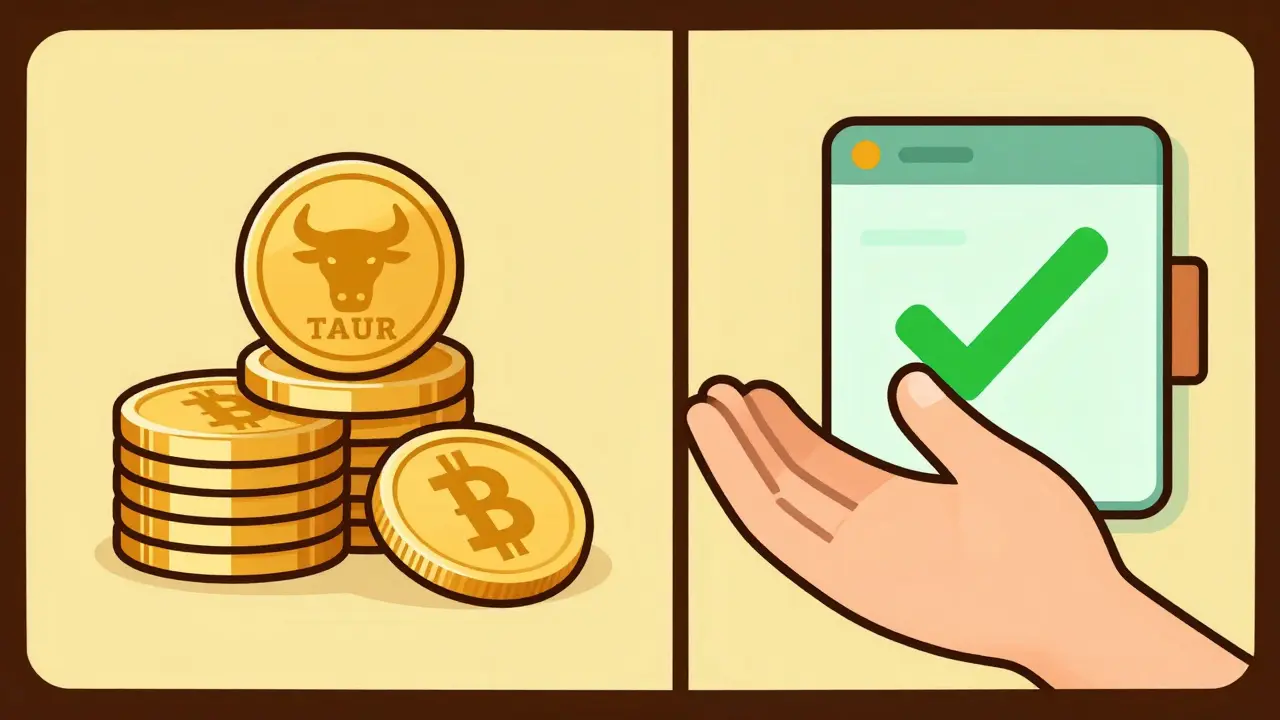
- Token Staking Threshold: You must also hold a minimum equivalent of $500 in TAUR tokens.
- Profit Sharing: Meeting both criteria qualifies you for the platform’s revenue distribution campaign.
This structure filters out speculators who might flip the NFT immediately after minting. The team wants holders who are committed to the ecosystem long enough to generate actual trading volume and liquidity. The public launch of this collection was scheduled for October 4th, 2025, marking a critical milestone in their roadmap.
| Requirement | Details | Purpose |
|---|---|---|
| NFT Ownership | 1+ Marnotaur Generative NFT | Verifies community membership and commitment |
| Token Holding | $500+ worth of TAUR | Ensures liquidity and aligns holder incentives with platform growth |
| Wallet Connection | Supported chains (ETH, BSC, Polygon, etc.) | Enables seamless interaction with smart contracts |
Is There a Traditional Airdrop?
Many users search for "Marnotaur airdrop" expecting free tokens dropped into their wallets simply for following social media accounts or joining Discord servers. Based on the available data, there is no evidence of a zero-cost airdrop. Instead, what is being marketed as an "airdrop" is likely the initial distribution of the NFT collection itself or the subsequent profit-sharing payouts.
In the crypto space, terminology can be misleading. When projects announce an "airdrop," they sometimes mean a targeted distribution to early supporters who completed specific tasks (like whitelisting) during earlier phases. If you were part of the Alpha, Beta, or Gamma testing phases, you may have received priority access or discounted rates for the NFT collection. For newcomers, however, the barrier to entry is financial.
Be cautious of scams claiming to offer free Marnotaur NFTs. Always verify links through official channels. The legitimate path involves purchasing the NFT on a supported marketplace and buying TAUR tokens on reputable exchanges.
TAUR Token Economics and Price Volatility
Before committing $500+ to the holding requirement, you need to look at the token’s performance. TAUR is highly volatile. In recent months, it has shown mixed signals:
- Short-term: Prices have hovered around $0.0024-$0.0026, with daily changes ranging from -3% to +5%.
- Medium-term: Weekly gains have reached up to 18%, while monthly performance has seen spikes of over 50%.
- Long-term: Despite annual gains of ~42%, the token still trades nearly 99.8% below its all-time high in BTC terms.
This volatility presents both risk and opportunity. If TAUR surges, your $500 holding requirement becomes easier to meet, and the value of your profit-share increases. If it drops, you may need to buy more tokens to maintain eligibility, effectively increasing your capital exposure.
The fully diluted valuation (FDV) stands at approximately BTC 2.73, assuming all 150 million TAUR tokens are in circulation. The distribution schedule included a 20% unlock at TGE, followed by gradual monthly or quarterly releases to prevent market dumping. This means supply pressure could increase over time, potentially affecting price stability.
How to Participate: Step-by-Step Guide
If you decide the risk-reward ratio makes sense for your portfolio, here is how to position yourself correctly:
- Set Up a Multi-Chain Wallet: Since Marnotaur supports Ethereum, BSC, Polygon, Avalanche, HECO, and Solana, use a wallet like MetaMask or Phantom that can interact with these networks. Ensure you have native tokens (ETH, MATIC, SOL, etc.) for gas fees.
- Acquire TAUR Tokens: Buy TAUR on major exchanges like Gate.io, Bybit, Kraken, or Binance. Transfer them to your personal wallet. Keep track of the USD value to ensure you meet the $500 threshold.
- Purchase the NFT: Visit the official Marnotaur marketplace or authorized partner platforms. Mint or buy a Generative NFT. Verify the contract address to avoid counterfeit collections.
- Verify Eligibility: Connect your wallet to the Marnotaur dashboard. Check if your NFT and TAUR balance are recognized. Some platforms require manual staking or approval of the token allowance.
- Monitor Profit Distribution: Once qualified, keep an eye on the platform’s analytics page for updates on revenue generation and payout schedules. Payouts are typically distributed in TAUR tokens.
Risks and Considerations
No DeFi investment is without risk. Here are the key factors to weigh:
- Smart Contract Risk: Like any protocol, Marnotaur relies on code. Bugs or exploits could lead to loss of funds. While the team has undergone multiple testing phases, audits are never 100% guaranteed.
- Market Risk: TAUR’s price is tied to broader crypto market trends. A bear market could devalue your holdings significantly.
- Liquidity Risk: If few users trade on the platform, revenue generation slows, reducing your profit share. The success of the NFT campaign depends on user adoption.
- Regulatory Uncertainty: Undercollateralized lending faces scrutiny in many jurisdictions. Changes in regulations could impact the platform’s operations.
Additionally, consider the opportunity cost. The $500 locked in TAUR plus the cost of the NFT represents capital that could be deployed elsewhere. Calculate your expected return based on historical platform performance and compare it to safer alternatives.
Future Roadmap and Expansion
Marnotaur is not standing still. The team plans to expand to Moonbeam, Cardano, and Near Protocol in the coming months. This multi-chain strategy aims to reduce transaction costs and reach a wider audience. Each new chain integration requires technical adjustments but also opens doors for new liquidity pools.
The project’s focus remains on undercollateralized margin trading, a niche that appeals to experienced traders seeking higher leverage without tying up excessive capital. If Marnotaur can maintain security and provide consistent returns, the NFT collection could become a valuable asset within the DeFi landscape. However, execution is everything. The transition from testing phases to full public live status will reveal the true strength of their infrastructure.
Is the Marnotaur NFT airdrop free?
No, there is no traditional free airdrop. To participate in the profit-sharing campaign, you must purchase a Marnotaur Generative NFT and hold at least $500 worth of TAUR tokens. Any claims of free NFTs should be verified carefully to avoid scams.
Which blockchains support the Marnotaur NFT?
The collection is available on Ethereum, Binance Smart Chain, Polygon, Avalanche, HECO, and Solana. Future expansions include Moonbeam, Cardano, and Near Protocol.
How much TAUR do I need to hold?
You need to hold a minimum equivalent of $500 in TAUR tokens. Given the token's volatility, monitor the price closely to ensure you remain above this threshold.
Where can I buy TAUR tokens?
TAUR is traded on several centralized exchanges, including Gate.io, Bybit, Kraken, and Binance. Always check the latest trading pairs and fees before executing trades.
What happens if TAUR price drops below my $500 holding?
If the value of your TAUR holdings falls below $500, you may lose eligibility for the profit-sharing campaign until you replenish your balance. This highlights the importance of monitoring market conditions.
When was the Marnotaur NFT collection launched?
The public launch of the Generative NFT Collection was scheduled for October 4th, 2025. Prior to this, the project underwent Alpha, Beta, and Gamma testing phases.
Is Marnotaur safe to use?
Like all DeFi protocols, Marnotaur carries risks related to smart contracts and market volatility. While the team has conducted extensive testing, always conduct your own research and only invest what you can afford to lose.
How does the profit sharing work?
Holders of both a Marnotaur NFT and sufficient TAUR tokens receive a portion of the platform's revenue generated from trading fees and other operations. Payouts are typically distributed in TAUR tokens.
Can I sell my Marnotaur NFT?
Yes, you can sell your NFT on supported marketplaces. However, selling the NFT will disqualify you from the profit-sharing campaign unless you acquire another eligible NFT.
What is the total supply of TAUR tokens?
The total supply of TAUR tokens is 150 million. The distribution includes a 20% unlock at TGE, followed by gradual monthly or quarterly releases to manage market supply.
Comments (15)
Melissa L
honestly this is so confusing lol
Mélanie Boulay
I have been following the Marnotaur project for quite some time now, and I must say that the transition from their previous identity to this new hybrid model combining utility tokens with NFT-based revenue sharing is a rather significant shift in strategy that warrants careful consideration. It is important to note that while the concept of undercollateralized margin trading through smart contracts and Chainlink price feeds sounds intriguing on paper, the actual implementation details regarding security audits and liquidity depth are not entirely clear to me at this present moment. Furthermore, the requirement to hold both an NFT and a substantial amount of TAUR tokens creates a barrier to entry that might exclude many potential participants who are merely curious about the ecosystem rather than fully committed investors. I believe it is crucial for anyone considering involvement to thoroughly read the whitepaper and understand the risks associated with smart contract vulnerabilities before committing any funds. The volatility of the TAUR token itself adds another layer of complexity, as maintaining the $500 holding threshold could become challenging during bearish market conditions. It is also worth mentioning that the multi-chain expansion plans to Ethereum, Binance Smart Chain, Polygon, Avalanche, HECO, and Solana suggest a broad ambition, yet executing across such diverse networks requires robust technical infrastructure. One must wonder if the team has the necessary resources to manage these integrations effectively without compromising security or user experience. The profit-sharing mechanism seems appealing in theory, but historical data on similar DeFi protocols often reveals that sustainable yields are difficult to maintain over long periods. Therefore, I would advise extreme caution and perhaps starting with a very small allocation to test the waters before diving deeper into this ecosystem. The generative nature of the NFTs is interesting, but unless the aesthetic value holds up or the utility proves indispensable, they may lose their appeal quickly. Overall, while the innovation is commendable, the execution risks remain high.
nancy jarecki
Let us be absolutely clear here: this is not an 'airdrop' in any semantic sense that a sophisticated investor would recognize; it is a thinly veiled capital raise disguised as community engagement, leveraging the buzzword-heavy lexicon of 'generative art' and 'profit-sharing' to mask what is essentially a speculative liquidity trap for the retail masses who lack the financial literacy to discern between genuine utility and mere marketing vaporware. The notion that one must acquire an NFT and stake $500 in a highly volatile, low-cap asset like TAUR to participate in a revenue distribution scheme reeks of classic rug-pull precursor dynamics, where early insiders are likely positioned to dump their holdings once the necessary liquidity is injected by unsuspecting holders trying to meet arbitrary thresholds. The jargon surrounding 'undercollateralized margin trading' is particularly egregious, as it implies a level of sophistication and risk management that is rarely present in projects with such opaque governance structures and questionable audit trails. Furthermore, the reliance on Chainlink oracles does not mitigate the inherent risks of smart contract exploits, which remain the Achilles heel of nearly every DeFi protocol that promises high yields without commensurate transparency. To suggest that this is a passive income opportunity is intellectually dishonest; it is active speculation with elevated downside risk, predicated on the hope that later entrants will provide the liquidity needed to sustain the illusion of profitability. The multi-chain expansion narrative is merely a distraction tactic, designed to create an aura of ubiquity and legitimacy while the core value proposition remains fundamentally unproven and potentially unsustainable. Anyone who falls for the 'free coins' misconception is clearly operating under a severe delusion, ignoring the basic economic principles that dictate that there is no such thing as a free lunch in decentralized finance. The true cost here is not just the initial outlay for the NFT and tokens, but the opportunity cost of capital tied up in an illiquid, high-risk asset class with no guaranteed exit strategy. It is disheartening to see how easily the crypto community can be manipulated by such superficial branding exercises, mistaking algorithmic generation for intrinsic value. This project exemplifies the worst tendencies of the current market cycle, where hype supersedes substance and complexity obscures incompetence. I would strongly advise against engaging with this ecosystem unless one possesses a profound understanding of advanced derivatives trading and is prepared to absorb total loss of principal. The pretense of 'community membership' via NFT ownership is a cynical manipulation of social proof, designed to foster a false sense of belonging among those desperate for financial validation. In reality, you are merely a source of liquidity for those who entered earlier and intend to exit sooner. The entire structure is predicated on continuous growth, which is statistically improbable in a maturing market environment. Thus, the rational actor should view this not as an investment opportunity, but as a case study in behavioral economics and the exploitation of cognitive biases within digital asset markets.
Robert Hundley
Hey guys! :D I think its pretty cool how they are using NFTs for more than just pictures! :)
ross harris
The existential dread of the modern trader is perfectly encapsulated in this grotesque amalgamation of financial instruments and digital collectibles, a surreal theater where we dance around the precipice of ruin hoping the music doesn't stop. We are not merely buying tokens; we are purchasing tickets to a carnival run by algorithms, where the prize is a mirage of profit shared among those who managed to cling to the edge of the cliff the longest. The 'Marnotaur' name itself evokes a mythical beast, half-man half-bull, suggesting a creature that is part human greed and part market force, trampling everything in its path regardless of collateral. To hold the NFT is to wear a badge of honor in a war that has no end, only escalating stakes and diminishing returns. The $500 threshold is not a fee; it is a toll paid to the gods of volatility, a sacrifice required to prove your devotion to the cult of yield. And what do we get in return? A sliver of the bloodletting, a drop of sweat from the brow of the system, distributed in the very currency that threatens to evaporate beneath our feet. It is a beautiful tragedy, really. We seek stability in chaos, order in entropy, and find only the cold, hard logic of code executing our demise. The generative aspect of the NFTs is poetic; each one unique, just like our individual paths to financial oblivion. Some will shine, others will fade, but all will eventually be sold to pay for the next round of gas fees. The multi-chain expansion is like spreading butter on a burnt toast; it covers the damage but does not change the underlying flavor of failure. We are building castles on sand, hoping the tide recedes before it washes us away. The profit sharing is a lie we tell ourselves to sleep at night, a comforting fiction that masks the brutal truth of zero-sum games. In the end, we are all just characters in a story written by developers who will cash out long before the final chapter. So buy the dip, mint the NFT, and pray to the blockchain gods that they smile upon your wallet. For in this digital purgatory, hope is the only currency that truly matters.
Ryan Peters
This is exactly why American innovation is being stifled by these globalist crypto schemes. They want you to lock up your money in unstable foreign chains while our domestic banks sit on billions. Wake up!
Carl Belgrave
You are absolutely right! This is a disaster for our economy. Only weak people fall for this. Real patriots keep their money in stable assets.
Carl Hanzel
Oh please. Everyone is so naive. You think locking up money makes you safe? The house always wins. Enjoy your losses.
Maurice Flynn
It is fascinating to observe the interplay between utility and speculation in this model. Perhaps the true value lies not in the immediate profits, but in the learning experience gained from navigating such complex systems. Stay chill.
Rob Morton
I wonder if the philosophical implications of owning a piece of a decentralized protocol outweigh the financial risks. What do you think about the nature of ownership in this context?
Routh Middaugh
I think it's important to consider all sides! The technology is promising! But the risks are real! We must balance enthusiasm with caution! ;)
Daniel J. Cox
As someone who loves exploring different cultures, I find the global reach of this project interesting. Maybe it brings people together? :) Let's see how it plays out.
Emma Rémond
The sheer audacity of this proposal is breathtaking. To think that one could derive meaningful utility from such a convoluted structure is laughable. It is a testament to the declining standards of financial engineering.
ELNORA JEFFERSON
Ugh. Another one of these things. Why do I even bother reading this stuff. It's all the same scam wrapped in fancy words. Boring.
John Curry
In the grand tapestry of human endeavor, this project stands as a stark reminder of our collective desire for meaning amidst chaos. Will we rise above the greed, or succumb to it? The answer lies within each of us.