
Back in the early days of digital trust, a block was just a timestamped receipt. Today, it is a complex data structure carrying everything from simple currency transfers to complex financial derivatives. If you look at how block architecture has evolved since 1991, you see a clear shift from simple record-keeping to sophisticated, parallelized computing systems. This isn't just about making transactions faster; it is about redefining what a decentralized ledger can actually do.
The journey started with a need for security, not speed. Early designs focused on preventing tampering. Modern designs focus on throughput and modularity. Understanding this evolution helps you choose the right chain for your project or investment. Let's break down how we got here, generation by generation.
The Pre-Bitcoin Era: Timestamping and Merkle Trees
Before Satoshi Nakamoto released Bitcoin in 2008, the concept of chaining blocks existed in academic circles. In 1991, Stuart Haber and W. Scott Stornetta published a paper on cryptographically secured chains designed to prevent document timestamp tampering. Their goal was simple: prove that a document existed at a specific time without a central authority.
By 1992, they added a crucial innovation: the Merkle tree. This allowed multiple document hashes to be grouped into a single block. It made the system more efficient. They even published these hashes in The New York Times weekly starting in 1995 under their company Surety. However, these were not public ledgers. They were private, permissioned systems for legal evidence.
This era established the core principle of immutability. But it lacked consensus. There was no way for strangers to agree on the truth of the chain without trusting a central party. That gap would define the next breakthrough.
Generation 1: Bitcoin and the Monolithic Model
In 2009, Bitcoin launched the first fully decentralized blockchain. Satoshi introduced Proof of Work (PoW) to solve the double-spend problem without trusted intermediaries. The block architecture was straightforward but revolutionary.
A standard Bitcoin block contains:
- Transaction data: Inputs and outputs moving value between addresses.
- Timestamp: Recorded in Unix time format.
- Merkle root: A hash representing all transactions in the block.
- Nonce: A 32-bit field used in mining to meet the difficulty target.
- Previous block hash: Linking it securely to the chain history.
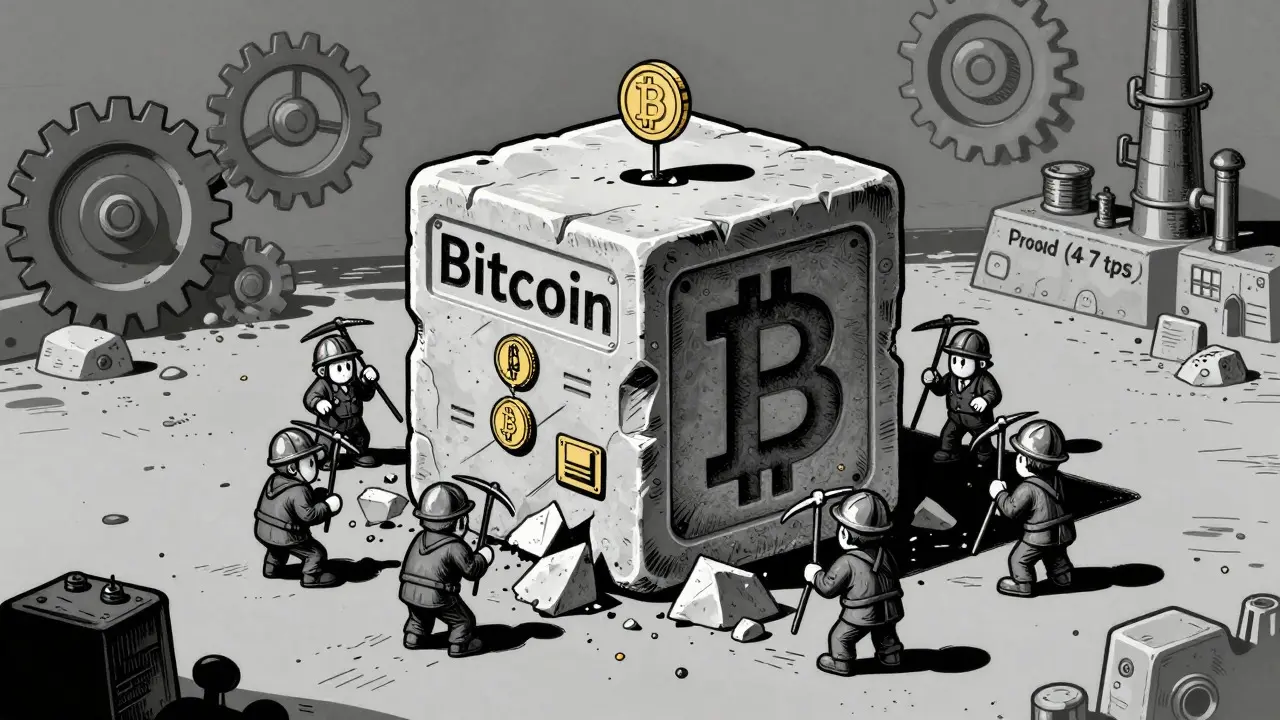
Bitcoin’s design prioritized security and decentralization over scalability. The block size was capped at 1MB until a 2017 hard fork increased it slightly. This limitation meant Bitcoin could only process 4-7 transactions per second (tps). For a global payment network, that sounds slow. But for a store of value-"digital gold"-it works perfectly. The monolithic nature of Bitcoin means every node validates every transaction. This creates high security but limits growth.
| Feature | Bitcoin (Gen 1) | Ethereum (Gen 2) |
|---|---|---|
| Primary Use Case | Value Transfer | Smart Contracts / DeFi |
| Block Size Limit | 1MB (effectively) | Gas Limit (~15-30M gas) |
| Throughput (TPS) | 4-7 tps | 15-30 tps |
| Consensus Mechanism | Proof of Work (PoW) | Proof of Stake (PoS) post-Merge |
| Programmability | Limited (Script) | Turing-complete (Solidity) |
Generation 2: Ethereum and Smart Contracts
When Ethereum launched in 2015, it changed the game. Blocks no longer just moved money; they executed code. This introduction of smart contracts turned the blockchain into a world computer.
Ethereum’s block architecture included a "gas limit" instead of a fixed byte size. Gas measures computational effort. This allowed developers to write complex applications like Decentralized Finance (DeFi) protocols. However, this flexibility came with a cost. As demand grew, so did congestion. During peak times in 2021, gas fees spiked to over $150 per transaction.
Ethereum also introduced "uncle blocks" to improve security by rewarding miners who found blocks that didn’t make it into the main chain. While innovative, the fundamental issue remained: the network was still monolithic. Every node had to execute every smart contract. This created the "blockchain trilemma": you could have security and decentralization, but not scalability.
Generation 3: Scaling Solutions and Rollups
Between 2018 and 2021, the industry realized that putting everything on the main chain wasn't sustainable. Enter Layer-2 solutions. These architectures process transactions off-chain and then commit proofs to the main Ethereum blockchain.
Two main types emerged:
- Optimistic Rollups: Projects like Optimism and Arbitrum assume transactions are valid unless someone challenges them within a fraud-proof window. This keeps costs low while relying on Ethereum for final settlement.
- ZK-Rollups: Using zero-knowledge proofs, projects like StarkNet generate cryptographic validity proofs. These are mathematically guaranteed to be correct, offering faster finality and higher security.
This phase marked the beginning of specialization. Instead of one chain doing everything, different layers handled different jobs. Execution happened off-chain, while the main chain provided security and data availability.
Generation 4: Modular Blockchains and Parallel Processing
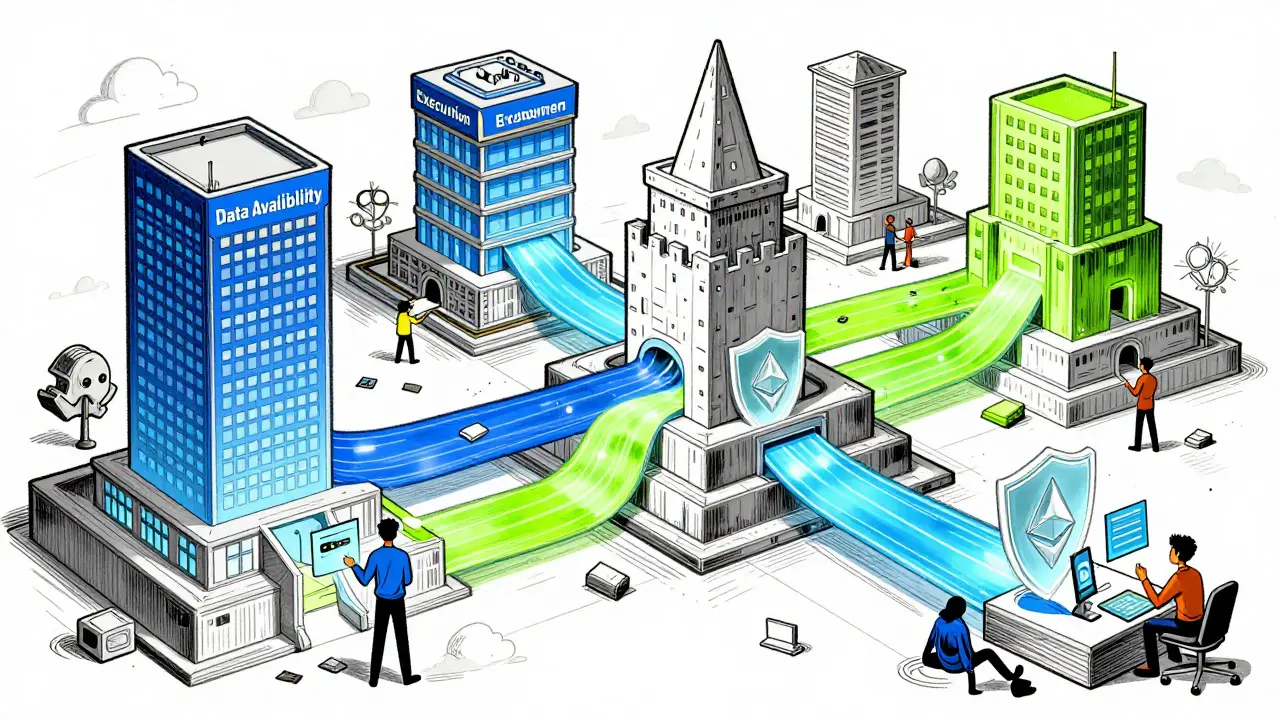
As of 2026, we are in the era of modular blockchains. The monolithic model is being replaced by systems where functions are decoupled. You now have separate layers for:
- Data Availability (DA): Networks like Celestia ensure data is accessible but don’t execute it.
- Execution: Specialized chains or rollups process transactions.
- Settlement: Usually Ethereum, which finalizes disputes and secures assets.
- Consensus: The mechanism agreeing on the state, often separated from execution.
Solana took a different path. Instead of modularity, it optimized the monolithic model through parallel processing. Using Proof of History (PoH), Solana creates a verifiable delay function that timestamps events before they reach consensus. This allows its Sealevel runtime to process thousands of transactions simultaneously. Solana claims up to 65,000 tps with 400ms block times.
However, high performance comes with trade-offs. Solana has experienced several network outages due to memory pressure and validator synchronization issues. Meanwhile, modular chains like those built on Celestia offer flexibility but introduce complexity in cross-chain communication.
The Role of Zero-Knowledge Proofs in Future Architecture
Perhaps the most significant architectural shift is the integration of zero-knowledge (ZK) proofs beyond just rollups. Projects like Mina Protocol maintain a constant blockchain size of 22KB using recursive zk-SNARKs. This means you don’t need to download the entire history to verify the current state.
This approach prioritizes cryptographic compression over raw storage. As blockchains grow, storing terabytes of data becomes impractical for average users. ZK-proofs allow light clients to verify transactions instantly, keeping the network truly decentralized.
Ethereum’s upcoming Deneb upgrade (Proto-Danksharding) aims to reduce rollup costs by 90% by introducing "blobs" of data specifically for Layer-2s. This hybrid approach combines modular DA with ZK-efficiency, setting the standard for future block design.
Practical Implications for Developers and Users
If you are building an application, the choice of architecture matters. Bitcoin remains the best option for pure value storage. Ethereum is ideal for complex DeFi apps needing deep liquidity. Solana suits high-frequency trading or gaming due to low latency. Modular stacks like Polygon’s AggLayer help manage multi-chain fragmentation.
For developers, learning curves vary. Bitcoin requires strong cryptography knowledge. Ethereum demands mastery of Solidity and gas optimization. Modular development introduces new concepts like data availability sampling and fraud proofs. Tools like Hardhat and Truffle have matured, but debugging cross-chain interactions remains challenging.
Enterprise adoption is accelerating. With regulations like the EU’s MiCA requiring transaction tracing, permissioned variants of Ethereum and Hyperledger Fabric 3.0 are gaining traction. JPMorgan’s Onyx platform processes over $1.5 trillion in assets, proving that institutional-grade blockchains can scale when tailored for specific needs.
Challenges and Trade-offs in Modern Design
No architecture is perfect. The blockchain trilemma still applies. High throughput often sacrifices decentralization. Complex modular systems face interoperability hurdles. According to a Deloitte 2024 survey, 78% of organizations cite incompatible data formats as a major barrier to integration.
Energy consumption remains a concern for PoW chains. Bitcoin uses approximately 110 TWh annually. Ethereum reduced its usage by 99% after switching to Proof of Stake. Yet, even PoS networks require significant hardware resources for validators.
Security risks persist. The Terra/Luna collapse showed how flawed economic mechanisms can destroy billions in value regardless of underlying tech. Architects must balance innovation with robustness. Over-specialization could lead to fragmentation, undermining the network effects that make blockchains valuable.
What Comes Next?
The future points toward seamless interoperability. The Interop Alliance, formed in 2025, is developing standardized interfaces for cross-chain communication. Imagine moving assets between Bitcoin, Ethereum, and Solana without bridges or wrappers. Standardized APIs will make this possible.
We will also see more AI-driven optimization. Machine learning models could dynamically adjust block sizes, gas prices, and sharding parameters based on real-time network conditions. This adaptive architecture could resolve many current bottlenecks.
Ultimately, block architecture will continue to evolve from rigid, one-size-fits-all structures to flexible, composable ecosystems. The key is choosing the right tool for the job. Whether you need the security of Bitcoin, the programmability of Ethereum, or the speed of Solana, understanding these architectural differences empowers better decisions.
What is the difference between monolithic and modular blockchains?
Monolithic blockchains like Bitcoin handle all functions-execution, consensus, data availability-in a single layer. Modular blockchains split these tasks across specialized layers. For example, Celestia handles data availability while Ethereum handles settlement. This separation improves scalability but adds complexity.
Why did Ethereum switch from Proof of Work to Proof of Stake?
Ethereum switched to Proof of Stake (PoS) in the "Merge" to reduce energy consumption by 99% and increase efficiency. PoW required massive computational power, leading to high electricity use. PoS relies on validators staking ETH, making it more sustainable and allowing for faster upgrades like sharding.
How do Layer-2 solutions improve blockchain scalability?
Layer-2 solutions process transactions off the main chain and batch them together. They then submit a compressed proof or summary to the main chain. This reduces congestion and lowers fees. Optimistic Rollups assume validity, while ZK-Rollups provide mathematical proofs of correctness.
Is Solana more secure than Ethereum?
Security depends on definition. Ethereum has a larger validator set and deeper decentralization, making it highly resistant to attacks. Solana offers higher throughput but has experienced outages due to hardware constraints. Both are secure, but Ethereum prioritizes decentralization while Solana prioritizes performance.
What is the role of Merkle trees in block architecture?
Merkle trees allow efficient verification of large datasets. By hashing pairs of transactions recursively, they create a single "root" hash. This lets nodes verify if a transaction is in a block without downloading the entire block. It saves bandwidth and speeds up validation.