Imagine buying Bitcoin today and selling it exactly one year from now for double the price. In most of Europe, you’d hand over a chunk of that profit to the government immediately. But if you’re sitting in Lisbon or Porto, that gain might just stay yours entirely. This is the reality for many digital asset investors who have moved to or are considering Portugal, a country that has carved out a unique niche as one of the few European havens for long-term cryptocurrency holders.
The landscape changed dramatically in 2023. Before then, Portugal was famous for its blanket tax exemption on crypto. That era ended with the new State Budget rules. However, don’t let the headlines scare you off. The current system is actually smarter and more predictable than the old one. It creates a clear path for serious investors while taxing active traders. If you understand the difference between holding and trading, you can still keep your long-term profits tax-free.
How the New Rules Work: The One-Year Rule
To navigate this correctly, you need to understand how the Portuguese Tax Authority (Autoridade Tributária e Aduaneira, the national body responsible for collecting taxes and enforcing tax laws in Portugal) classifies your income. They split crypto activities into three main buckets. Your tax bill depends entirely on which bucket your activity falls into and how long you hold your assets.
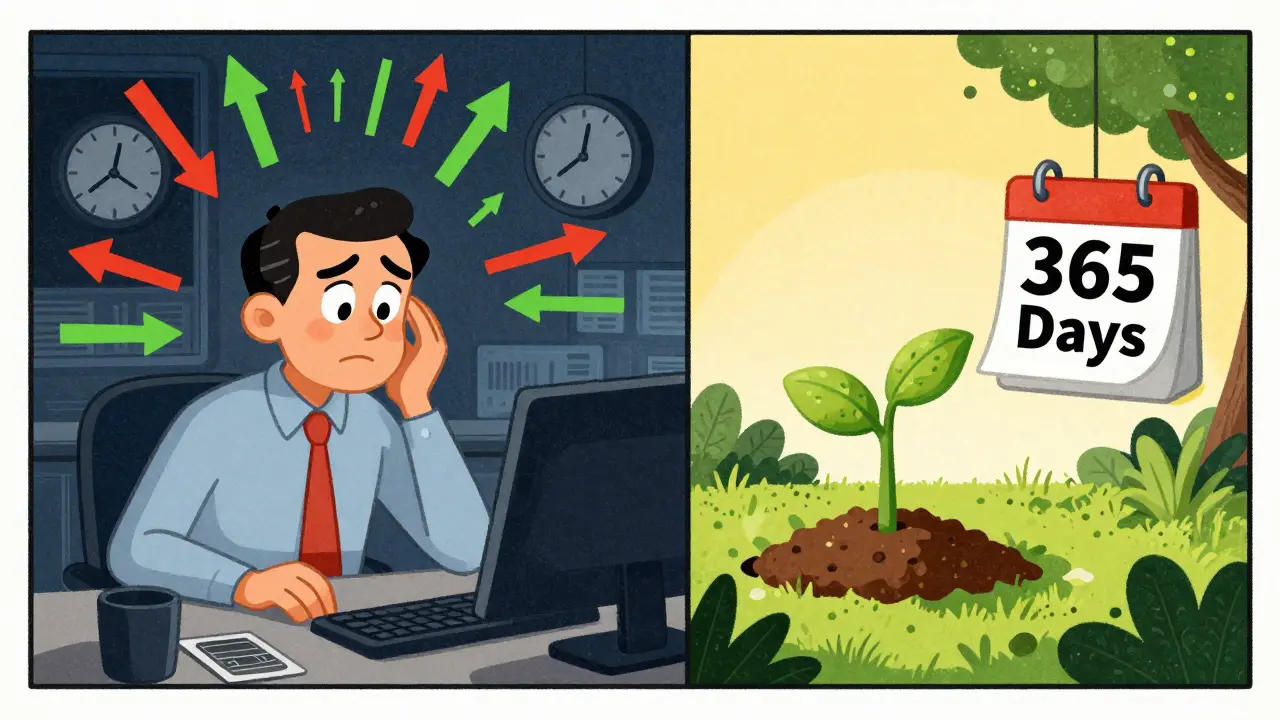
The golden rule is simple: time is money. Specifically, 365 days. If you buy a cryptocurrency and hold it for more than one year before converting it to fiat currency (like Euros), the profit is completely exempt from personal income tax. This applies to major coins like Bitcoin and Ethereum, as well as most altcoins, provided they aren’t classified as securities.
Here is how the three categories break down:
- Category G (Capital Gains): This covers profits from selling crypto. If you sell after less than 365 days, you pay a flat 28% tax. If you sell after more than 365 days, you pay 0%. Note that this exemption only triggers when you convert crypto to fiat. Swapping Bitcoin for Ethereum does not trigger a taxable event, meaning your clock doesn't reset.
- Category E (Passive Income): This includes staking rewards, lending interest, or dividends from tokenized stocks. These are taxed at a flat 28% rate regardless of how long you hold the underlying asset. You cannot defer this tax by waiting a year.
- Category B (Business Income): If you trade frequently, mine crypto professionally, or run a node for validation, the authorities may view this as self-employment. This income is taxed progressively, ranging from 14.5% to 53%, depending on your total annual income.
Who Is This For? Investors vs. Traders
This system isn't designed for day traders. If you are constantly buying and selling within hours or days, the 28% flat rate on short-term gains will apply every time. For high-frequency traders, this can add up quickly. However, for the "buy and hold" investor, Portugal remains arguably the best place in the EU to park your digital wealth.
Let’s look at a real-world scenario. Suppose you move to Portugal in January 2026. You buy €10,000 worth of Solana. By December 2026, it’s worth €20,000. If you sell it in January 2027 (after holding it for over 365 days), you pay nothing. If you sell it in November 2026, you owe 28% on the €10,000 profit-that’s €2,800 gone instantly.
This distinction forces a discipline that many investors lack. It encourages long-term thinking rather than chasing quick pumps. For digital nomads and remote workers who already live a location-independent lifestyle, aligning their investment strategy with this one-year rule is a no-brainer.
Comparing Portugal to Other European Havens
You might be wondering why not just go to Germany or Switzerland? While other countries offer perks, Portugal’s framework is uniquely straightforward for residents. Let’s compare the numbers.
| Country | Long-Term Holding (>1 Year) | Short-Term Gain Rate | Staking/Lending Income |
|---|---|---|---|
| Portugal | 0% (Tax-Free) | 28% Flat | 28% Flat |
| Germany | 0% (Tax-Free) | ~25-27% (Solidarity Surcharge) | Taxed as Capital Income |
| France | 30% Flat (Flat Tax) or Progressive | 30% Flat (Flat Tax) or Progressive | 30% Flat (Flat Tax) or Progressive |
| Spain | 19-28% (Progressive) | 19-28% (Progressive) | Up to 47% (Income Tax) |
| Italy | 26% Flat | 26% Flat | 26% Flat |
As you can see, Germany is Portugal’s closest competitor. Both offer tax-free status for holdings over one year. However, Portugal’s flat 28% rate for short-term gains is often easier to manage than Germany’s slightly complex solidarity surcharges and progressive brackets for business-like trading. France and Spain are significantly more expensive for crypto enthusiasts, especially regarding staking rewards, where Spain can push effective rates near 50% for high earners.
Critical Exceptions: When the Exemption Doesn't Apply
Before you pack your bags, there are two major traps that could void your tax-free status. The Portuguese law is specific about what qualifies for the exemption.
- EEA Requirement: The tax exemption for long-term gains generally applies to cryptocurrencies held within the European Economic Area (EEA). If you hold tokens on exchanges or wallets located outside the EEA without proper reporting, or if the tokens themselves are issued by entities outside the EEA in certain structures, complications can arise. Most major centralized exchanges serving Portugal operate within EU regulatory frameworks (MiCA), so this is rarely an issue for standard users, but offshore DeFi protocols require careful scrutiny.
- Securities Classification: Not all tokens are created equal. If a token is legally classified as a security (similar to a stock) rather than a utility or payment token, different rules may apply. Currently, most major cryptocurrencies like Bitcoin and Ethereum are treated as non-security assets for tax purposes in Portugal. However, if a project is deemed a security by local regulators, the long-term exemption might not shield you.
Additionally, remember that the exemption applies to realized gains. If your portfolio goes up in value but you don’t sell, you owe nothing. This is known as a realization basis. Taxes are only triggered when you convert crypto to fiat or use it to purchase goods and services.
Record Keeping: Your Best Defense
In Portugal, ignorance is not a defense. The burden of proof is on you. To claim the zero-tax rate on long-term gains, you must prove you held the asset for more than 365 days. This means meticulous record-keeping is non-negotiable.
You need to track:
- Acquisition Date: Exactly when you bought or received the crypto.
- Cost Basis: How much you paid (including fees).
- Sale Date: When you converted it to fiat.
- Proceeds: How much fiat you received.
Using software like CoinTracking or Koinly is highly recommended. These tools connect to your exchanges and wallets via API, automatically importing transactions and calculating your holding periods. They generate reports compatible with Portuguese tax forms. Without these records, the tax authority may assume your gains are short-term and assess the 28% tax retroactively, plus penalties.

Strategic Planning for 2026 and Beyond
With the Markets in Crypto-Assets (MiCA) regulation fully rolling out across the EU, Portugal is aligning its compliance standards with the rest of the bloc. This brings more clarity but also stricter anti-money laundering (AML) checks. Exchanges will ask for more documentation, and cross-border transactions will be monitored closely.
For those considering relocation, the timing matters. If you become a tax resident in Portugal, your worldwide crypto income becomes subject to these rules. Make sure you calculate your potential tax liability based on your current portfolio. If you have large amounts of crypto that matured in another country, consult a specialist. Moving residency doesn't erase past tax obligations in your home country.
Furthermore, consider the option of integrating short-term gains into your overall income. For some individuals with lower total incomes, adding the 28% taxable amount to their salary might result in a lower effective tax rate due to deductions and allowances. A local accountant can run these simulations for you.
Frequently Asked Questions
Is crypto really tax-free in Portugal?
Only under specific conditions. Cryptocurrency gains are tax-free if you hold the assets for more than 365 days (one year) before converting them to fiat currency. Short-term gains (less than one year) are taxed at a flat 28% rate. Staking and lending income are always taxed at 28%.
Does swapping crypto for crypto trigger taxes?
No. According to current Portuguese tax guidance, exchanging one cryptocurrency for another (e.g., Bitcoin for Ethereum) is not considered a taxable event. The tax obligation only arises when you convert crypto to fiat currency (like Euros) or use it to buy goods and services. However, you must keep records of the swap to establish the cost basis for the new asset.
What happens if I am a professional trader?
If the tax authority determines that your crypto activities constitute a business (frequent trading, mining, or professional validation), your income falls under Category B (Self-Employment Income). This is taxed progressively at rates between 14.5% and 53%, depending on your total annual income, and you may need to register as a business entity.
Do I need to declare crypto holdings if I don't sell?
While unrealized gains are not taxed, you may still need to declare the existence of crypto assets in your annual tax return for transparency and anti-money laundering purposes, especially if the value exceeds certain thresholds. Always consult with a local tax advisor to ensure full compliance with reporting requirements.
How does Portugal compare to Germany for crypto taxes?
Both countries offer tax-free status for crypto held longer than one year. Portugal applies a flat 28% tax on short-term gains, whereas Germany uses a combination of income tax rates and solidarity surcharges (typically around 25-27%). Portugal’s system is often considered simpler for pure capital gains, but both are among the most favorable jurisdictions in Europe.