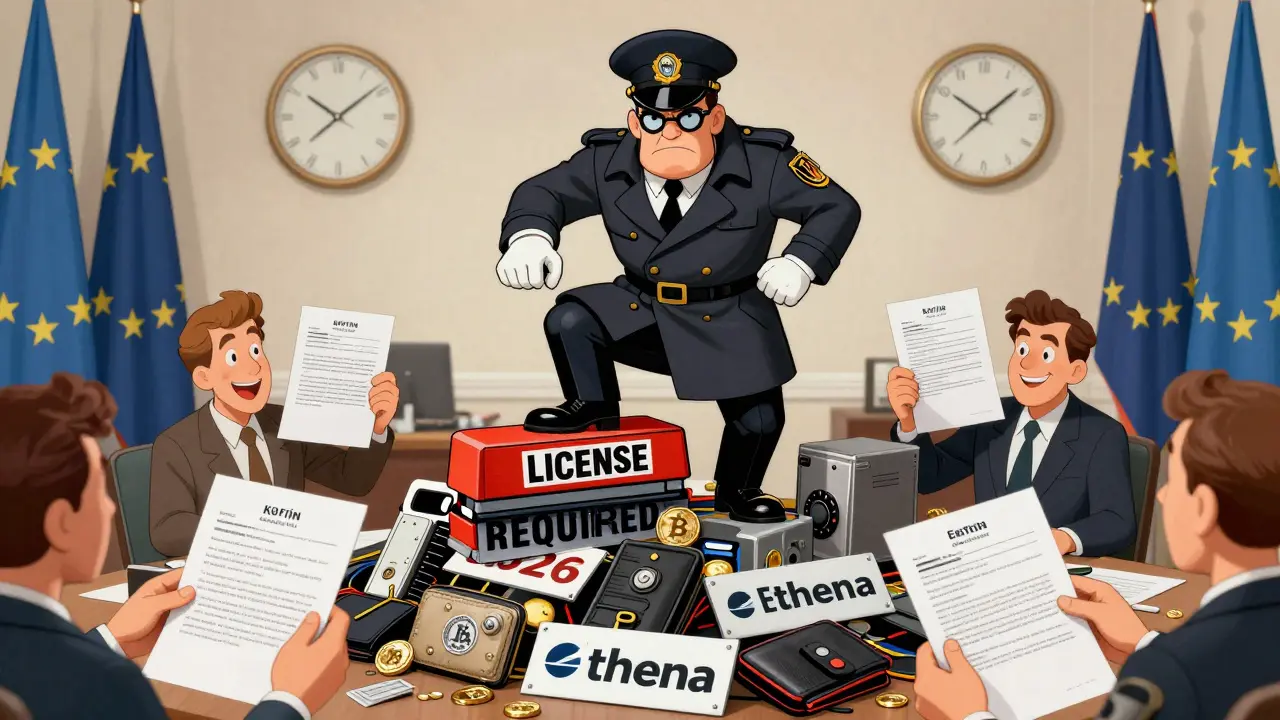
Germany doesn’t ban cryptocurrency. It regulates it - and BaFin is the agency making sure it’s done right. If you’re running a crypto business in Germany, or even just serving German customers from abroad, you need to understand what BaFin expects. This isn’t about guesswork. It’s about licenses, rules, and real consequences.
What Is BaFin, and Why Does It Matter?
BaFin - short for Bundesanstalt für Finanzdienstleistungsaufsicht - is Germany’s financial watchdog. It doesn’t just oversee banks and insurance companies. Since 2013, when Bitcoin was officially recognized as a unit of account, BaFin has been in charge of crypto too. Today, that means every crypto exchange, custody provider, staking service, or trading platform that touches German users must be licensed by BaFin.
It’s not optional. In 2025, BaFin shut down Ethena GmbH’s operations in Germany because its USDe stablecoin didn’t meet MiCAR requirements. Token holders had until August 6, 2025, to redeem their tokens. That’s not a warning. That’s enforcement.
When Do You Need a BaFin License?
You don’t need a license just because you accept Bitcoin as payment for your coffee shop. But if you’re doing anything beyond that - even a little - you might be crossing the line.
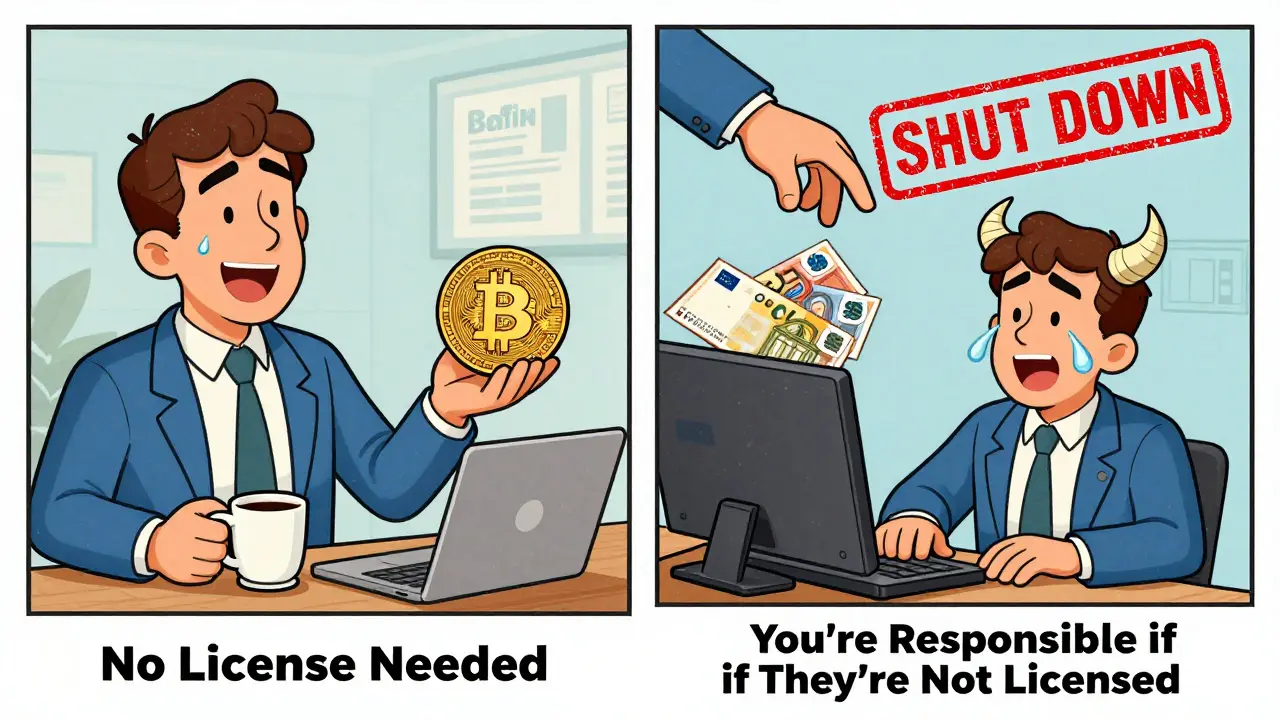
- Accepting crypto as payment? No license needed. Simple sales, like selling goods or services for Bitcoin, are fine.
- Using a third-party payment processor? Watch out. If that processor isn’t licensed by BaFin and they convert your crypto to euros, you could be held responsible. BaFin has gone after businesses for this exact reason.
- Running a crypto exchange? License required.
- Offering custody services? License required. Since 2020, holding crypto for others is a regulated financial service.
- Running a mining pool or advertising regular crypto trades? License required. If you’re actively creating a market - even on forums - BaFin sees that as a financial service.
The rule is simple: if your activity helps sustain, create, or facilitate a crypto market, you need authorization. Not a gray area. Not a suggestion. A legal requirement under the German Banking Act (KWG).
The New Rules: MiCAR and What It Changes
Since January 2025, the EU’s Markets in Crypto-Assets Regulation (MiCAR) has taken over as the main rulebook. Germany’s old laws - like the Kryptomärkte-Aufsichtsgesetz (KMAG) - are being phased out. But BaFin is still the one enforcing it.
MiCAR brings three big changes:
- White papers are mandatory. If you’re launching a new crypto asset - even a stablecoin - you must submit a detailed white paper to BaFin before offering it to the public. No vague marketing fluff. You need technical specs, risk disclosures, and governance details.
- Uniform rules across the EU. If you’re licensed in Germany, you can offer services across the EU. But you still need BaFin’s approval first.
- Stricter IT security. Your systems must meet minimum cybersecurity standards. BaFin checks this. Fail, and your license gets pulled.
And it’s not just about startups. Existing providers had until December 31, 2025, to transition to MiCAR-compliant licenses. If you didn’t apply by then, you’re operating illegally.
Anti-Money Laundering: The Travel Rule in Practice
Germany’s Crypto Asset Transfer Regulation (KryptoWTransferV) enforces the FATF’s "travel rule." That means every crypto transfer over €1,000 must carry information about who sent it and who received it.
Here’s how it works in real life:
- When someone sends ETH from your exchange to another wallet, you must collect: full name, address, and wallet ID of the sender and receiver.
- If you’re a business receiving crypto from a customer, you must verify their identity - same as a bank would.
- Failure to comply? Fines. Suspension. Or worse - criminal charges.
This isn’t just paperwork. It’s real-time tracking. BaFin expects you to log, store, and report this data for at least five years.
What About Taxes? The 2025 Updates
BaFin doesn’t handle taxes - the Federal Ministry of Finance does. But they’re now closely aligned.
In March 2025, Germany updated its crypto tax rules. Here’s what changed:
- "Virtual currencies" is gone. The term is now "crypto assets." That includes tokens, NFTs, and stablecoins.
- Staking income is taxed differently. Passive staking (like locking ETH in a wallet) is treated as interest. Active staking (running a node) is business income.
- DeFi is now clearly defined. Lending, borrowing, and yield farming on decentralized platforms are taxable events.
- You must track daily market values. Every trade, swap, or transfer must be recorded with the euro value at the time it happened.
- Keep records for 10 years. Not 5. 10. BaFin and the tax office can audit you anytime.
If you’re trading crypto in Germany, you’re not just dealing with BaFin. You’re also dealing with the taxman. And they’re talking to each other.
Who Does BaFin Target?
It’s not just big exchanges. BaFin goes after anyone who creates a connection to Germany.
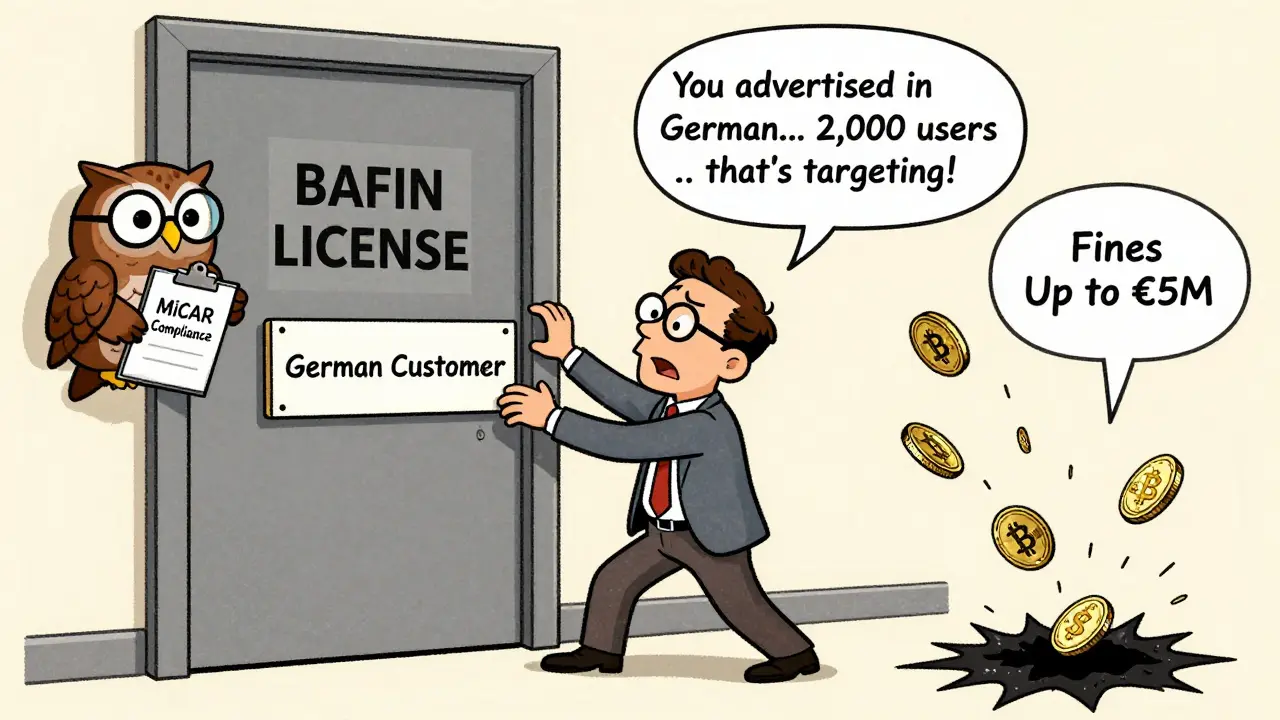
Let’s say you’re a U.S.-based crypto wallet provider. You have no office in Germany. But your website is in German. You run ads targeting Berlin users. You have 2,000 German customers. BaFin considers that a domestic connection. You need a license.
Same goes for foreign companies with German branches. Even if you’re only serving non-residents from that branch, you’re under BaFin’s watch.
But if a German user randomly finds your website and signs up on their own? That’s passive service. No license needed. The line is thin - and BaFin is watching.
How Fast Can You Get Licensed?
Five years ago, getting a BaFin license took 18 months. Now? Some companies got approved in under 90 days.
Why the change? After the Wirecard scandal, BaFin became overly cautious. But today, they’ve learned to be thorough - not slow. They now require:
- A compact application - no 200-page binders.
- Clear organizational charts.
- Proof of IT security systems.
- Proof of AML/KYC procedures.
They’re not looking for perfection. They’re looking for competence. If you can show you’ve done your homework, they’ll move fast.
What Happens If You Ignore the Rules?
Don’t assume you’ll get away with it.
On June 25, 2025, BaFin ordered Ethena GmbH to stop all operations. They didn’t give a warning. They didn’t offer a grace period. They shut it down.
Other companies have faced:
- Fines up to €5 million.
- Personal liability for directors.
- Public warnings on BaFin’s website.
- Criminal investigations.
There’s no "slippery slope." If you’re operating without a license and BaFin finds out, they act.
What Should You Do Now?
Here’s your checklist for 2026:
- Identify what services you’re offering. Are you just accepting crypto? Or are you trading, custodying, or staking?
- Check if you’re targeting German customers - even if you’re based abroad.
- If you need a license, start the application now. BaFin’s portal is open. The deadline for old licenses passed in 2025.
- Implement AML/KYC with full travel rule compliance. Use tools that auto-collect sender/receiver data.
- Prepare your white paper if launching a new crypto asset. Include risks, tech specs, and governance.
- Keep daily records of all crypto transactions with euro values. Save receipts, wallet logs, and tax reports.
Germany isn’t trying to scare crypto away. It’s trying to make it safe. The rules are clear. The consequences are real. The path to compliance? It’s not easy - but it’s straightforward.
Do I need a BaFin license if I’m a freelancer accepting Bitcoin for services?
No, if you’re just accepting Bitcoin as payment for your freelance work - like designing a website or writing content - you don’t need a license. But if you’re converting those payments into euros through a third-party service, and that service isn’t licensed by BaFin, you could be at risk. Stick to direct payments and keep records.
Can I operate a crypto exchange from outside Germany and serve German users?
Only if you’re truly passive. If your website is in German, you advertise in German, or you have more than a handful of German users, BaFin considers that targeting the German market. That triggers licensing requirements. You must get licensed - or stop serving German customers.
What happens if my crypto custody provider gets shut down by BaFin?
Your assets are at risk. BaFin doesn’t guarantee custody. If a provider loses its license, they may freeze accounts or freeze withdrawals. Always choose a BaFin-licensed custodian - and check their license status regularly on BaFin’s public register.
Is mining crypto legal in Germany?
Yes - but only if you’re mining for yourself. If you run a mining pool that accepts participation from others, you’re offering a financial service. That requires a BaFin license. Individual miners don’t need one.
Do I need to report crypto gains to the tax office even if I didn’t cash out?
Yes. Swapping one crypto for another - say, BTC for ETH - is a taxable event in Germany. You must report the euro value at the time of the trade. Even if you never convert to euros, the tax office still wants to know what you traded and when.
Germany’s crypto rules aren’t perfect - but they’re clear. BaFin isn’t an obstacle. It’s a guide. And if you follow the steps, you won’t just avoid trouble - you’ll build a business that lasts.





Comments (15)
Peggi shabaaz
Honestly this was super helpful. I was worried about my freelance gig accepting BTC but now I know I'm good as long as I don't use sketchy processors. Just keep it simple and log everything. Thanks for laying it out like this.
Holly Perkins
i think u meant 2025 but u wrote 2026 in the title lol. also why so much text i got bored after paragraph 3
Sanchita Nahar
Germany is just being extra. Why do they care if I trade crypto? I'm not hurting anyone. Just let people do their thing.
Ben Pintilie
LMAO imagine having to submit a whitepaper just to run a stablecoin 😭. This is why I stick to DeFi. BaFin can't touch me in my wallet.
Desiree Foo
It's not about freedom. It's about responsibility. If you're profiting from crypto, you owe it to society to follow the rules. No one likes a free rider who thinks they're above the law.
Kaz Selbie
Let's be real - BaFin is just scared of losing control. They're clinging to 20th century banking models while the world moves on. This isn't regulation. It's control. And it's gonna backfire.
Robbi Hess
I just read this whole thing and my soul left my body. Five years of record keeping? White papers? Travel rule enforcement? I didn't sign up for a full-time job just to hold Bitcoin.
Keturah Hudson
As someone who moved from India to the US, I can say this: Germany's approach is actually the most balanced I've seen. Not too strict, not too loose. It’s like they’re trying to build a highway, not a wall.
Gaurav Mathur
MiCAR is a psyop. The EU doesn't want crypto. They want to control every transaction. This is the beginning of a digital surveillance state. You think your wallet is private? Think again.
Jeremy Lim
I... I just... I don't know if I can handle all this paperwork. 😥 I just want to buy some ETH and not think about it. Why does everything have to be so complicated?
John Doyle
You got this! Seriously, if you take it step by step - identify your activity, check the rules, use the tools - it’s doable. I helped a friend get licensed in 60 days. It’s a grind, but worth it. You’re not alone.
kelvin joseph-kanyin
🚀 BaFin is just trying to make crypto safe for everyone! No more rug pulls. No more shady stables. This is the future. Embrace the system! 💪💎
Crystal McCoun
I really appreciate how thorough this is. I’ve been advising small businesses on crypto compliance, and honestly, most of them have no idea about the travel rule or MiCAR. This checklist? Perfect. I’m saving this for my next client meeting.
Donna Patters
The fact that you even consider this ‘straightforward’ reveals a fundamental misunderstanding of financial sovereignty. This is not compliance. It is submission.
Michelle Cochran
I’ve been thinking about this deeply. The real issue isn’t licensing - it’s the erosion of autonomy. When every transaction must be tracked, when every wallet must be identified - we’re no longer citizens. We’re data points. And that, my friends, is the true cost of ‘safety’.