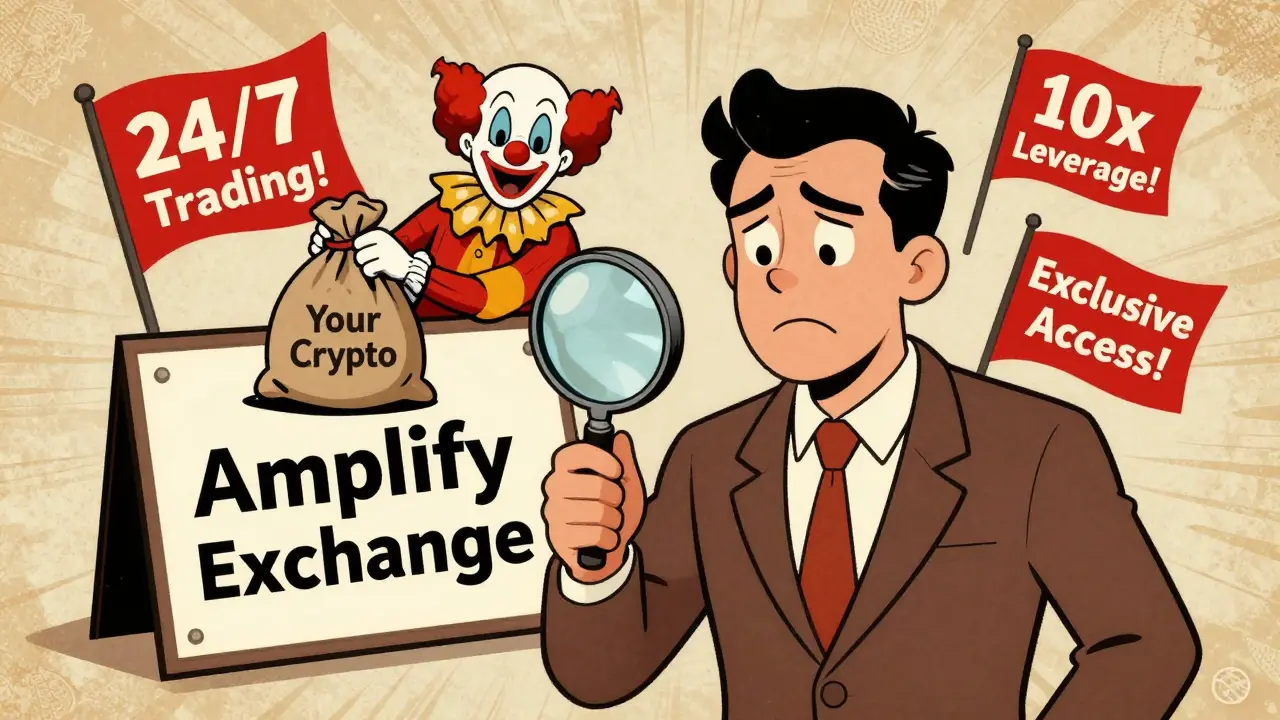
There is no such thing as Amplify Exchange as a cryptocurrency trading platform. If you’ve seen ads, social media posts, or YouTube videos pushing "Amplify Exchange" as the next big crypto exchange, you’re being targeted by a scam or misleading marketing. This isn’t a case of a new startup flying under the radar - it’s a case of zero credible presence anywhere in the crypto industry.
What is Amplify Exchange supposed to be?
People searching for "Amplify Exchange" are often confused because they’re mixing up two completely different things: a fake crypto exchange and a real financial product called the Amplify BLOK ETF. The BLOK ETF, managed by Amplify Investments LLC, is an exchange-traded fund that invests in companies involved in blockchain and cryptocurrency - like Coinbase, MicroStrategy, and Nvidia. It does not let you buy Bitcoin, Ethereum, or any other crypto directly. You can’t deposit dollars, trade altcoins, or withdraw to a wallet. It’s a stock fund you buy through your brokerage, like Fidelity or Robinhood. Calling it an "exchange" is misleading at best.
There’s also Axway’s AMPLIFY Platform, which is a tool for managing APIs in enterprise software. Zero connection to crypto trading. No users. No wallets. No trading pairs. Just corporate tech.
Why does Amplify Exchange keep popping up?
Scammers love to piggyback on real brand names. "Amplify" sounds professional. It’s used by legitimate financial firms, so it gives fake platforms a veneer of credibility. You’ll see ads promising "24/7 trading," "up to 10x leverage," or "exclusive access to new tokens" - all classic red flags. These sites often use fake testimonials, stock photos of smiling traders, and countdown timers to create urgency. Some even clone the UI of Binance or Kraken to trick users into entering their private keys or seed phrases.
When you try to withdraw funds from one of these fake exchanges, you’ll get excuses: "Maintenance," "KYC verification failed," or "Your account is frozen for compliance." Then the site vanishes. The domain expires. The Telegram group goes silent. Your crypto is gone.
How to spot a fake crypto exchange
Real exchanges don’t hide. They’re listed on CoinMarketCap, CoinGecko, and trusted review sites like CryptoCompare and Trustpilot. Here’s how to check if an exchange is real:
- Search for it on CoinMarketCap or CoinGecko - if it’s not there, it’s not real.
- Check the website’s domain - fake exchanges often use .xyz, .info, or misspellings like "AmplifyExchnage.com".
- Look for regulatory licenses - Binance, Kraken, and Coinbase are registered with financial authorities in the U.S., EU, or Asia. No legitimate exchange operates without some form of compliance.
- Read independent reviews - if the only reviews are on the exchange’s own site or YouTube ads, that’s a red flag.
- Check the team - real exchanges publish names, LinkedIn profiles, and backgrounds of their founders. Fake ones use "John Doe, CEO" with no traceable history.
Amplify Exchange fails every single one of these checks. There’s no domain history, no regulatory filings, no team, no customer support logs, and no transaction records on blockchain explorers.

What’s really behind the Amplify Exchange hype?
Behind the scenes, this is likely a pump-and-dump scheme disguised as a trading platform. Scammers create fake websites, run paid ads on TikTok and Instagram targeting new crypto users, and lure people in with promises of quick profits. Once you deposit even $50, they lock your funds and disappear. Some even use AI-generated voices in video ads to sound like "verified traders" - all scripted, all fake.
There’s no evidence Amplify Exchange has ever processed a single trade. No blockchain analytics firm, no crypto investigator, no journalist has ever reported on it - because there’s nothing to report. The only mention of "Amplify" in crypto circles is the BLOK ETF, which is not an exchange and doesn’t trade crypto directly.
Real alternatives to Amplify Exchange
If you’re looking for a trustworthy crypto exchange in 2025, here are the top five with real track records:
- Binance - Largest exchange globally, over 90 million users, supports 350+ coins, low fees, advanced trading tools.
- Kraken - U.S.-based, strong security, regulated in multiple jurisdictions, offers up to 5x leverage on major pairs.
- Coinbase - Beginner-friendly, insured custody, regulated in the U.S., great for buying crypto with a bank card.
- OKX - High liquidity, built-in trading bots, supports derivatives and staking.
- KuCoin - Wide selection of altcoins, no KYC for small trades, popular in Europe and Asia.
All of these exchanges have been operating for years, have public audit reports, and are listed on major financial data platforms. You can verify their legitimacy in minutes.

What to do if you already lost money to Amplify Exchange
If you deposited funds into a site called Amplify Exchange, act fast:
- Stop sending any more money.
- Do not click on any "recovery service" ads - those are scams too.
- Report the site to your local financial regulator (in Ireland, that’s the Central Bank of Ireland).
- File a report with Action Fraud (UK) or IC3 (U.S.) if you’re in those regions.
- Share your experience on Reddit’s r/CryptoScams or Trustpilot to warn others.
Recovering crypto from a fake exchange is nearly impossible. The goal now is to prevent others from falling for the same trap.
Final warning
There is no Amplify Exchange. It does not exist. It never has. Any website, app, or social media account claiming otherwise is trying to steal your money. Don’t be fooled by fancy names, fake logos, or YouTube influencers in suits. If it sounds too good to be true - and it’s not on CoinMarketCap - it’s a scam.
Stick to the big names. Do your homework. Protect your keys. And never, ever trust a crypto exchange you can’t verify in under five minutes.


Comments (16)
Janet Combs
so i just got dm'd by some guy on instagram saying "amplify exchange is the future lol" and i was like... wait, what? i thought that was a typo for amplify b lok? now i feel dumb but also really glad i didn't deposit anything.
vaibhav pushilkar
Exactly. Always check CoinGecko first. If it’s not there, it’s not real. Saved me from a fake exchange last year. Don’t overthink it.
Dan Dellechiaie
Oh wow, so the scammers are just repackaging "Amplify" like it’s some crypto brand now? Classic. They think if you say "blockchain" and slap on a gradient logo, you’re legit. Meanwhile, the real BLOK ETF is just chillin’ in your Fidelity account, doing its boring, regulated job while these clowns try to sell you phantom BTC on a .xyz domain.
And don’t even get me started on the AI voiceovers. I heard one yesterday - sounded like a Siri glitch on a motivational podcast. "Amplify Exchange - where your portfolio goes supernova!" Bro, my portfolio’s not a rocket, it’s a savings account with crypto exposure.
Vyas Koduvayur
Let’s be honest - the entire phenomenon is a textbook case of brand hijacking in the attention economy. The term "Amplify" has legitimate financial lineage - Amplify Investments, founded in 2014, manages the BLOK ETF, which tracks blockchain equities, not direct crypto assets. The scammers exploit semantic overlap: they don’t need to invent a new word, they just need to truncate and miscontextualize a real one. This isn’t even sophisticated phishing - it’s linguistic parasitism. The average user, especially those new to crypto, conflates "exchange" with "investment vehicle" because they’ve been conditioned by marketing to treat all financial terminology as interchangeable. The real vulnerability isn’t technical literacy - it’s terminological confusion. And that’s why these scams persist. The solution isn’t more warnings - it’s standardized nomenclature enforced by regulators. Until then, expect more "Amplify Exchanges" - next up, "Coinbase Capital" and "Binance Capital Partners" - all of which are just websites with stock photos of men in hoodies holding laptops.
roxanne nott
Amplify Exchange? More like Amplify Scam. I saw a TikTok ad for it yesterday. The guy was wearing a suit in a garage with a green screen. I swear, if I had $50, I’d have sent it. Glad I checked first.
SHEFFIN ANTONY
Oh wow, so now even the fake exchanges have PR teams? "Amplify Exchange" - sounds like a corporate wellness retreat for crypto bros. I bet their customer service is a bot named "BinanceBot 3000" that replies with "Your withdrawal is being processed by our quantum blockchain compliance AI" and then ghosts you. Honestly, I’m impressed. They’ve turned fraud into a branding exercise. Next they’ll launch a podcast called "The Crypto Amplify Hour" with a guy in a suit whispering "trust the process" over lo-fi beats.
Meanwhile, real exchanges like Kraken and Binance? They don’t need to lie. They’re just… there. Quietly moving billions. No countdown timers. No "exclusive access." Just cold, hard, regulated infrastructure. The fact that people still fall for this nonsense says more about our collective attention span than about the scammers’ ingenuity.
Also, why is it always .xyz? Is that the new .com for fraud? I’d like to see a domain registrar sue these people for trademark dilution. Or better yet - make them pay for the domain fees for life. Let them live in the digital purgatory they created.
Jake Mepham
Man, I’ve seen so many of these fake exchanges pop up over the years - and honestly, it’s heartbreaking. I remember helping a friend in Nigeria who lost $800 to something called "BitPulse" - same exact script: YouTube ads, fake testimonials, countdown timers. He was so embarrassed, didn’t tell anyone for weeks. But when he finally opened up, we sat down and went through the checklist: CoinMarketCap? No. Team profiles? Fake LinkedIn. Domain? .info. KYC? No real form, just a screenshot of a form they made in Canva. It’s not even complicated. The tools to avoid this are free and obvious. The real tragedy isn’t the money - it’s the trust. People start believing crypto is a wild west because of scams like this, when really, the real platforms are the most regulated financial tools we’ve ever had. If you’re new, stick to Coinbase, Kraken, Binance. Learn the basics. Don’t chase hype. And if you see someone promoting "Amplify Exchange" - gently tell them to check CoinGecko. You might save them from a year of regret.
Sheila Ayu
Wait… so… you’re saying… there’s NO such thing as Amplify Exchange?!?!?!?!? But I saw it on YouTube! And it had a logo! And a whitepaper! And a Telegram group with 12,000 members! And… and… the guy in the video said he made $47,000 in 3 days!!??!?!?!
…Oh.
…Oh no.
…I think I already deposited $200.
Sarah Glaser
It’s fascinating how deeply rooted the human desire for quick wealth is - and how easily it’s weaponized. The word "Amplify" carries connotations of growth, potential, and transformation - all emotionally charged concepts. Scammers exploit this by attaching these meanings to a phantom entity, creating a cognitive shortcut that bypasses critical thinking. The BLOK ETF, in contrast, is transparent, regulated, and grounded in real asset performance. The contrast isn’t just operational - it’s philosophical. One promises transformation through speculation; the other offers participation through ownership. The scam thrives on myth. The legitimate platform thrives on data. The tragedy is that myth is far more seductive.
Cathy Bounchareune
I swear, every time I think crypto scams can’t get weirder, they invent a new one. I saw a TikTok ad for "Amplify Exchange" last week - the guy was holding a laptop in front of a wall that looked like it was painted by a 5-year-old with glitter. He said "This is the future of finance!" and then flashed a QR code. I paused the video and Googled it. Found this post. Thank you, internet gods. I almost sent $100 to a guy named "CryptoKing420" on Telegram. I’m still shaking.
Also, the fact that they use "Amplify" makes me think they’re just Googling "top crypto companies" and stealing names. Like, did they not notice Amplify Investments has been around since 2014? Or that the BLOK ETF has a 10-year track record? It’s like trying to sell a fake Rolex called "Rolex Premium Edition" and hoping people don’t notice the missing "x".
Radha Reddy
Thank you for this comprehensive breakdown. As someone who recently introduced my parents to crypto, I’ve been on high alert for these kinds of scams. The emotional manipulation is what worries me most - the urgency, the exclusivity, the fear of missing out. These aren’t just financial traps; they’re psychological ones. I’ve shared this post with my family and friends. Knowledge is the best defense.
Jordan Renaud
There’s a quiet dignity in real platforms. They don’t need to shout. They don’t need to promise moonshots. They just exist - steady, transparent, accountable. Scammers are like fireworks: loud, flashy, and gone in seconds. The real ones are like the stars - you have to know where to look, but they’ve been there all along. I hope this post helps people pause before they click. Not every opportunity is worth taking. Sometimes, the wisest move is to wait.
Ashley Lewis
How is this even a topic? It’s not a debate. It’s not a gray area. It’s a scam. End of story. If you didn’t know this by now, you shouldn’t be touching crypto at all. Your money isn’t safe - your judgment isn’t either.
Craig Fraser
I’ve seen this exact scam pop up three times in the last 18 months under different names - "NexusTrade," "CryptoLift," now "Amplify." Same playbook. Same fake UI. Same Telegram group with 10,000 bots. It’s not even creative anymore. The only thing that changes is the name. Honestly, I think the scammers are just using a template. Someone in a basement in Nigeria has a Notion doc with 50 fake exchange names and a stock photo folder. They just swap out the logo and launch. It’s corporate fraud with the efficiency of a McDonald’s franchise.
Shubham Singh
It is not surprising that individuals with minimal financial literacy fall prey to such transparently fraudulent constructs. The use of the term "Amplify" is a linguistic fallacy, exploiting the semantic inertia of legitimate entities. One must question the educational infrastructure that permits such ignorance to persist in the digital age. The onus is not on regulators to police every .xyz domain - it is on the individual to exercise due diligence. Failure to do so is not a victimhood - it is negligence.
Lloyd Yang
I want to say thank you for writing this. Not just because it’s accurate - but because it’s kind. So many people are scared to speak up about getting scammed. They feel stupid. Ashamed. Like they’ve failed. But this post doesn’t shame - it empowers. It gives people a checklist, a path forward, and most importantly - it reminds them they’re not alone. I’ve worked with people who lost everything to these fake exchanges. Some never recovered. But the ones who shared their story? They became the protectors. They warned their cousins, their coworkers, their Reddit communities. That’s the real power here. Not the warning - but the courage to speak it. So thank you. For the facts. For the clarity. And for giving people the words to say: "I was fooled. But I won’t let it happen again." I’m sharing this with my entire family. Especially my uncle who just bought a $500 NFT from a guy named "CryptoDaddy" on Discord.