Have you ever seen a coin ticker that looks like USDC.A and wondered if it’s a new investment opportunity or just another version of the USD Coin you already know? It’s easy to get confused when crypto tickers start looking like complex math equations. You aren’t alone in feeling puzzled. The world of stablecoins is getting crowded, and new variations pop up all the time.
Let’s clear up the confusion right away. USDC.a Bridged ART20 (USDC.A) is a fully collateralized, USD-pegged stablecoin launched by ArtaFoundation in June 2025. It isn’t a speculative asset meant to skyrocket in price. Instead, it’s designed to stay locked at $1.00, serving as a reliable tool for transactions and decentralized finance (DeFi) within the ArtaBlockchain ecosystem. If you’re looking to make money from price swings, this isn’t your ticket. But if you need a stable medium of exchange with advanced technical features, this might be exactly what you’ve been looking for.
The Core Concept: What Makes USDC.a Different?
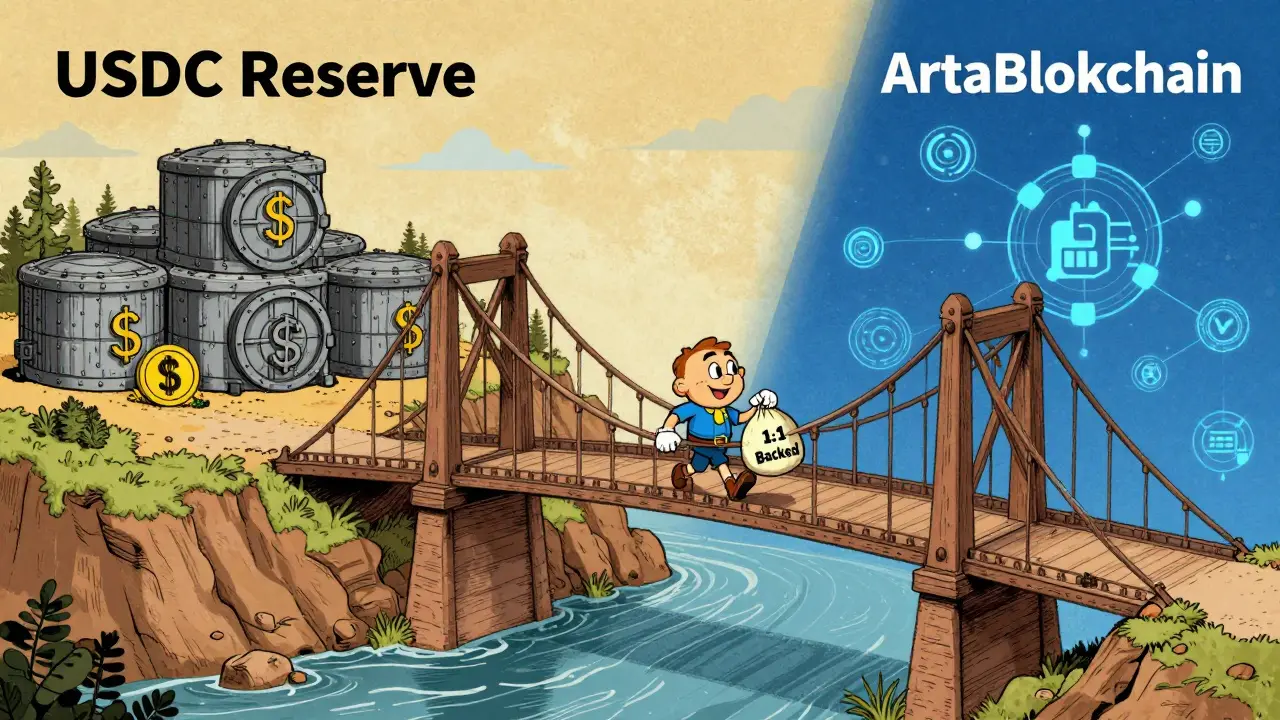
At its heart, USDC.a is a bridge. It connects the reliability of USD Coin (USDC)-one of the most trusted stablecoins in the market-to the specific environment of the ArtaBlockchain. Think of it like having a passport that lets you travel freely between two countries without changing your currency.
Every single token of USDC.a is backed 1:1 by actual USDC held in regulated custodial accounts. This means for every USDC.a in circulation, there is one dollar’s worth of USDC sitting safely in reserve. This model is fundamentally different from algorithmic stablecoins, which rely on complex code and market incentives to maintain their peg. Remember the collapse of Terra’s UST in 2022? That was an algorithmic failure. USDC.a avoids that risk entirely by using hard assets as collateral.
The "Bridged" part of the name tells you how it works technically. It doesn’t create new value; it wraps existing value. When you hold USDC.a, you are essentially holding a receipt for USDC that lives on a different blockchain network. This allows users to access the benefits of the ArtaBlockchain while keeping the stability they trust from Circle’s USDC.
Understanding the ART20 Token Standard
Here is where things get interesting for developers and power users. USDC.a doesn’t just use the standard ERC-20 or BEP-20 protocols you see everywhere. It operates on the ART20 token standard, introduced by ArtaFoundation. This standard adds layers of functionality that traditional tokens simply don’t have.
Why does this matter to you? Because it changes how you interact with the token. Here are the key features built into the ART20 architecture:
- Programmable Permissions: Developers can set custom rules for transfers. Imagine a scenario where a company pays salaries in USDC.a, but the tokens are programmed so employees can only spend them on approved vendors until payday. Or perhaps a charity ensures donations can only go to verified relief funds. These restrictions are baked into the code.
- Transaction Fee Delegation: In many blockchains, the sender pays the gas fees. With ART20, the receiver or a third party can pay the transaction costs. This is huge for user experience. It makes sending money feel more like sending an email than paying a bank fee.
- Optional Compliance Zones: Regulatory compliance is a headache for crypto projects. ART20 allows for optional zones where tokens adhere to specific legal requirements. This could mean automatic KYC (Know Your Customer) checks or geographic restrictions, making it easier for institutions to adopt the token without fear of breaking laws.
- Gas Optimization: The architecture is designed to reduce computational load, meaning faster transactions and lower costs for everyone involved.
These features turn USDC.a from a simple store of value into a programmable financial instrument. It’s not just cash; it’s smart cash.
Market Performance and Stability as of May 2026
Let’s look at the numbers. As of May 2, 2026, USDC.a is trading exactly where it should be: around $1.00 to $1.01 USD. On major exchanges like Binance, Coinbase, and Crypto.com, you’ll see minimal volatility. Over the last 24 hours, price movements have ranged between -0.11% and +0.01%. This isn’t exciting for day traders, but it’s perfect for anyone who wants to preserve capital.
| Metric | Value |
|---|---|
| Current Price | $1.00 - $1.01 USD |
| Market Capitalization | $10.09 Billion |
| Total Supply | 10 Billion USDC.A |
| 24-Hour Trading Volume | ~$2,770 USD |
| All-Time High | $1.02 USD (August 29, 2025) |
A few things stand out here. First, the market cap of over $10 billion sounds massive, but remember, for stablecoins, market cap equals total supply in circulation. It doesn’t necessarily mean high demand or active trading. In fact, the 24-hour volume of roughly $2,770 is surprisingly low relative to that cap. This suggests that most USDC.a tokens are being held in wallets or used as collateral in DeFi protocols rather than actively traded back and forth on exchanges.
This low volatility is a feature, not a bug. If USDC.a were swinging wildly between $0.90 and $1.10, it would fail its primary purpose as a unit of account. The fact that it has maintained its peg since its launch in June 2025 demonstrates the strength of its reserve backing.
How USDC.a Compares to Other Stablecoins
You might ask, "Why do I need USDC.a when I already have USDC, USDT, or DAI?" Great question. Each stablecoin serves a slightly different niche.
Tether (USDT) is the oldest and most widely used, but it has faced scrutiny over transparency. DAI is decentralized and over-collateralized by crypto assets, which introduces liquidation risks during market crashes. Binance USD (BUSD) has largely been phased out due to regulatory pressure. USDC sits in the middle: transparent, regulated, and fiat-backed.
So where does USDC.a fit in? It’s not trying to replace USDC globally. It’s optimizing USDC for specific environments. If you are operating within the ArtaBlockchain ecosystem, using native USDC might require bridging fees, delays, or compatibility issues. USDC.a removes those friction points. It offers the same safety as USDC but with the added benefit of ART20’s programmability. For a developer building a compliant payment app on ArtaBlockchain, USDC.a is the superior choice because it handles the regulatory logic internally.

Risks and Considerations
No financial product is without risk, and USDC.a is no exception. While it mitigates the risk of algorithmic collapse, it introduces other factors you should consider.
First, there is counterparty risk. USDC.a depends entirely on the reserves held by ArtaFoundation. While these are described as "regulated custodial accounts," you are trusting ArtaFoundation to manage these reserves correctly. If ArtaFoundation faces operational failures, legal challenges, or cyberattacks, your USDC.a could be at risk. Always verify the latest audit reports and regulatory status of the foundation.
Second, there is liquidity risk. With a daily trading volume of only ~$2,770 against a $10 billion market cap, selling large amounts of USDC.a quickly could be difficult. You might find yourself unable to offload significant holdings without impacting the price or waiting for buyers. This makes USDC.a better suited for holding or transacting within the ecosystem rather than as a quick exit strategy.
Finally, consider regulatory dependency. Since USDC.a relies on USDC, any regulatory crackdown on Circle (the issuer of USDC) will directly impact USDC.a. If USDC loses its peg or is delisted from major exchanges, USDC.a becomes worthless overnight. They are intrinsically linked.
Who Should Use USDC.a?
This token isn’t for everyone. If you are a casual investor looking for quick gains, keep scrolling. USDC.a won’t give you those returns.
However, USDC.a is ideal for:
- Developers building applications on ArtaBlockchain who need a stable, programmable currency with low gas fees.
- Merchants in jurisdictions where ART20’s compliance zones help meet local banking regulations.
- DeFi Users who want to earn yield on stable assets within the Arta ecosystem without exposing themselves to volatile crypto pairs.
- Institutions requiring transparent, fiat-backed assets with customizable transfer permissions for payroll or escrow services.
If you fall into one of these categories, USDC.a offers a robust, secure, and efficient solution. It bridges the gap between traditional financial stability and modern blockchain flexibility.
Is USDC.a the same as USDC?
No, they are not the same. USDC is the original stablecoin issued by Circle on networks like Ethereum. USDC.a is a bridged version of USDC that exists specifically on the ArtaBlockchain. While both are pegged to the US Dollar and backed 1:1 by reserves, USDC.a uses the ART20 token standard, offering additional features like programmable permissions and fee delegation that standard USDC does not have.
Can I lose money holding USDC.a?
While USDC.a is designed to stay at $1.00, you can still face risks. If the ArtaFoundation fails to maintain its reserves, suffers a security breach, or faces regulatory shutdowns, the value of USDC.a could drop. Additionally, because it is a bridged asset, you are exposed to the health of the underlying USDC. If USDC de-pegs from the dollar, USDC.a will likely follow suit.
Where can I buy USDC.a?
As of May 2026, USDC.a is listed on major exchanges including Binance, Coinbase, and Crypto.com. However, liquidity appears limited based on recent trading volumes. You may also be able to acquire it through decentralized exchanges (DEXs) within the ArtaBlockchain ecosystem by swapping other assets.
What is the ART20 token standard?
ART20 is a token standard developed by ArtaFoundation that enhances traditional token models. It includes features such as programmable permissions (allowing custom rules for transfers), transaction fee delegation (letting receivers pay fees), and optional compliance zones for regulatory adherence. It is designed to be more flexible and efficient than standard ERC-20 or BEP-20 tokens.
Why is the trading volume of USDC.a so low?
The low trading volume (~$2,770 daily) is typical for utility-focused stablecoins. Most users hold USDC.a to use it within DeFi protocols, as collateral, or for transactions within the ArtaBlockchain, rather than to trade it speculatively. Since its value doesn't change significantly, there is little incentive for frequent buying and selling.
Is USDC.a safe for long-term storage?
Storing USDC.a is generally safe if you use a secure wallet compatible with the ArtaBlockchain. However, long-term storage carries the risk of smart contract vulnerabilities or changes in the regulatory landscape affecting ArtaFoundation. For very long-term savings, many investors prefer holding the underlying USDC directly on established networks like Ethereum or Solana to minimize intermediary risk.
Who is behind ArtaFoundation?
ArtaFoundation is a team based in Singapore. They launched USDC.a in June 2025. Being based in Singapore suggests alignment with the Monetary Authority of Singapore (MAS) frameworks, which are known for being relatively progressive yet strict regarding cryptocurrency regulations. This location choice aims to provide credibility and regulatory clarity for institutional users.
Does USDC.a earn interest?
USDC.a itself does not automatically earn interest just by being held in a wallet. However, you can deposit USDC.a into various Decentralized Finance (DeFi) lending protocols or liquidity pools on the ArtaBlockchain to earn yield. The rates vary depending on market demand and the specific platform you use.