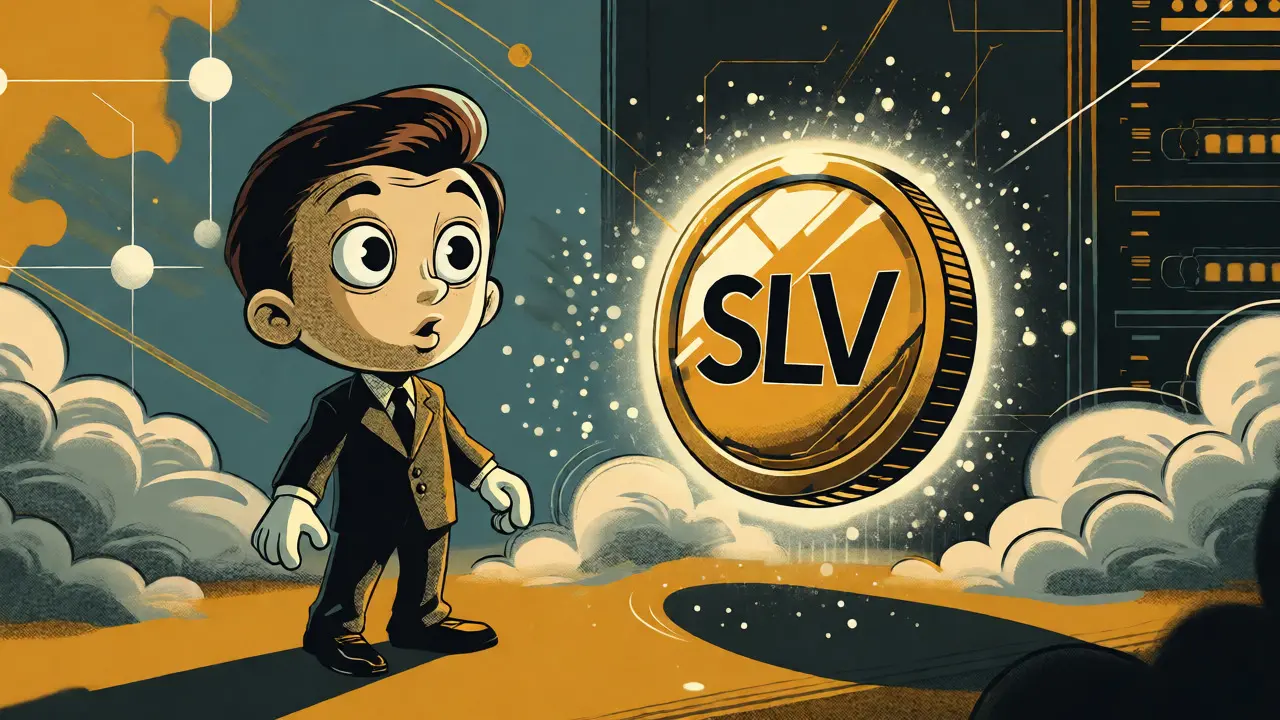
You might have seen Slavi Coin pop up in a random wallet drop or a niche Telegram group and wondered: what on earth is this? It’s not Bitcoin. It’s not Ethereum. And if you look at its trading volume, it’s barely moving at all. Yet, it has a whole ecosystem, a mobile app, and promises of massive yields. So, what is Slavi Coin (SLV), and does it actually matter?
The short answer is that SLV is a utility token designed to power a specific, proprietary financial ecosystem called Slavi. It launched back in 2021 on the Binance Smart Chain. But here’s the catch: while the tech stack sounds impressive, the market reality is starkly different. As of late 2026, SLV trades with near-zero volume, making it one of the most illiquid assets you’ll find in the crypto space. If you’re thinking about buying it for quick gains, you need to understand exactly what you’re getting into before you connect your wallet.
The Core Identity: Utility Over Speculation
Most people buy crypto hoping the price goes up. Slavi Coin tries to be different. It isn’t really meant to be a speculative asset you trade every day. Instead, it functions as the internal currency of the Slavi decentralized multi-chain finance ecosystem. Think of it like casino chips. You can’t spend them at the grocery store, but inside the casino, they are essential for playing games, eating, and staying in the room.
According to the project’s documentation, SLV is the native currency for the Slavi Wallet and mobile DApp. Its primary job is to let users access DeFi services like trading, staking, and yield farming within their platform. The company behind it, identified in some reviews as UAB Slavi Development Corp., frames SLV as a "branded internal control token." This means its value is tightly coupled to how much people actually use the Slavi app. If nobody uses the app, the token has little reason to hold value outside of pure speculation.
Technical Specs: Built on BNB Smart Chain
Technically, Slavi Coin is a BEP-20 token. That means it lives on the BNB Smart Chain (BSC). This was a popular choice in 2021 because BSC offered lower transaction fees than Ethereum, which is crucial for a platform promising frequent interactions like staking and swapping.
The contract address for SLV is 0x187d0bf09572b10c89e717b9473e07a5a157855a. If you plug this into BscScan, you’ll see the basic mechanics: 18 decimals and a total supply capped at 1 billion tokens. However, don’t trust the data aggregators blindly. There is a significant discrepancy in reported supply figures across platforms. While official docs state 1 billion, sites like CoinMarketCap have listed conflicting numbers, sometimes showing a circulating supply higher than the max supply due to self-reported data errors. Always verify the contract directly on the blockchain explorer rather than relying on third-party trackers.
| Attribute | Value / Detail |
|---|---|
| Token Name | Slavi Coin |
| Symbol | SLV |
| Network | Binance Smart Chain (BEP-20) |
| Total Supply | 1,000,000,000 SLV (Official Docs) |
| Decimals | 18 |
| Launch Year | 2021 |
The Yield Promise: High APRs and Token Burns
If you dig into the early marketing materials from 2021, Slavi pitched itself as a high-yield opportunity. They promised staking rewards of up to 200% APR. For context, traditional savings accounts offer around 1-4%. Even aggressive DeFi protocols rarely sustain 200% without huge risks. How did they plan to pay this out? Through inflationary rewards and a deflationary burn mechanism.
The idea was simple: when you unstake your SLV, a tiny fraction (0.075%) of the staked amount gets burned-permanently removed from circulation. This creates scarcity over time. Combined with liquidity pools for pairs like SLV-USDT and SLV-BUSD, the goal was to incentivize long-term holding. But here’s the reality check: those 200% APRs were often paid out in more SLV tokens. If the token price drops faster than the yield accrues, your real return can easily be negative. In a low-volume environment, high advertised yields are often a trap for new investors who don’t account for price depreciation.
Liquidity Crisis: Why Volume Is Zero
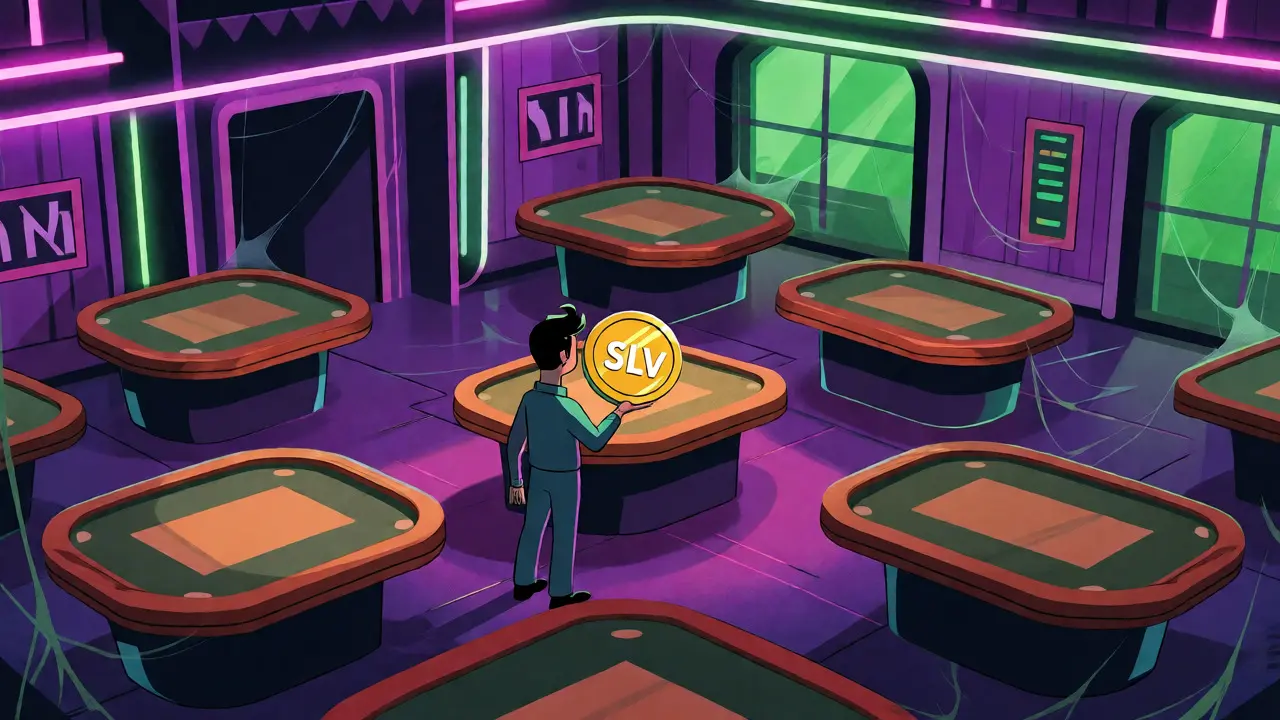
This is the elephant in the room. Throughout 2024, 2025, and into 2026, multiple data providers like CoinGecko, Poloniex, and Coinbase report 24-hour trading volumes for SLV effectively at $0.00. Yes, zero. Not "low," but literally no recorded trades in many snapshots.
Why does this matter? Liquidity is oxygen for any cryptocurrency. Without it, you can’t sell. You might own 1 million SLV tokens, but if there are no buyers, that’s just digital dust. The fully diluted valuation (FDV) has hovered under $1 million USD in recent years, down from nearly $32 million in early 2022. This collapse suggests that the initial hype didn’t translate into sustained adoption. The project remains a micro-cap asset, meaning it’s highly susceptible to manipulation and lacks the depth needed for serious institutional or retail investment.
Is Slavi a Scam or Just Stagnant?
Skepticism is healthy in crypto. Review sites like Revieweek explicitly ask, "Is Slavi a Scam?" This question arises partly because of the tight coupling between the token and the proprietary app. If the app fails, the token likely becomes worthless. Unlike Bitcoin, which has value independent of any single company, SLV depends entirely on the execution of UAB Slavi Development Corp.
There’s no evidence of a rug pull-the team hasn’t disappeared overnight-but the lack of transparency regarding regulatory compliance and the stagnant development updates raise red flags. The project lists support channels via Telegram and email, but active community engagement seems minimal. It’s less of a scam and more of a zombie project: technically alive, but functionally dormant. The ambitious roadmap for an NFT marketplace and cross-chain bridges hasn’t visibly materialized in a way that drives user growth.
How to Buy and Store SLV Today
If you still want to get exposure to SLV, you won’t find it on major exchanges like Binance or Kraken for direct fiat purchases. Crypto.com lists it informationally but states it’s "not tradable yet." Your best bet is decentralized exchanges (DEXs) on BSC, such as PancakeSwap, where the SLV/WBNB pair exists. Alternatively, smaller centralized exchanges like SLEX or Poloniex may list it, but again, expect thin order books.
To buy, you’ll typically swap BNB or USDT for SLV. Once you have it, you should move it to a self-custody wallet like MetaMask or Trust Wallet. Do not leave it on an exchange unless you trust that specific platform implicitly. Given the low volume, slippage could be high, so always check the quote carefully before confirming the transaction.
Final Verdict: Who Should Consider SLV?
Slavi Coin is not for the faint of heart, nor is it for the average investor looking for steady growth. It’s a speculative play on a niche ecosystem that has struggled to gain traction since its 2021 launch. The technology is sound enough-it’s a standard BEP-20 token-but the market demand is virtually non-existent.
If you’re already using the Slavi mobile app for its specific features, then holding SLV makes sense as a utility requirement. But if you’re looking at SLV purely as an investment vehicle hoping for a 100x return, you’re fighting against extremely low liquidity and uncertain fundamentals. The risk of capital stagnation-or even total loss due to lack of exit liquidity-is high. Treat it as experimental money, not core portfolio holdings.
What is the main use case for Slavi Coin?
Slavi Coin (SLV) serves as the native utility token for the Slavi decentralized multi-chain finance ecosystem. It is primarily used within the Slavi Wallet and mobile DApp to access DeFi services such as trading, staking, yield farming, and paying for platform-specific features and fees.
Which blockchain network does Slavi Coin operate on?
Slavi Coin operates on the Binance Smart Chain (BSC) using the BEP-20 token standard. This allows for faster and cheaper transactions compared to the Ethereum network, facilitating the high-frequency interactions required by its DeFi applications.
Why is the trading volume for SLV so low?
The low trading volume reflects limited market adoption and liquidity. Despite being listed on several data aggregators and minor exchanges, there is little active buying or selling pressure. This indicates that the token is primarily held within the closed Slavi ecosystem rather than traded broadly by external speculators.
Can I buy Slavi Coin on major exchanges like Binance?
No, Slavi Coin is generally not available for direct purchase on major tier-1 exchanges like Binance or Coinbase. Investors typically acquire SLV through decentralized exchanges (DEXs) on the BNB Smart Chain, such as PancakeSwap, or through smaller centralized exchanges like SLEX or Poloniex.
What is the total supply of Slavi Coin?
According to official project documentation and smart contract data, the maximum total supply of Slavi Coin is fixed at 1,000,000,000 (1 billion) tokens. Note that some third-party trackers may display conflicting circulating supply figures due to data reporting errors.