Failed DEX: Why Decentralized Exchanges Collapse and What to Avoid
When a failed DEX, a decentralized exchange that lost liquidity, users, or trust and stopped functioning as intended. Also known as a collapsed DeFi platform, it’s not just a technical glitch—it’s a warning sign that the project never had real demand or sustainable incentives. Most DEXes launch with hype, airdrops, and flashy websites. But without real trading volume, locked liquidity, or a working team, they turn into digital ghosts. You’ve probably seen one: a token with zero trading, a website that loads slowly, and a Discord full of bots asking you to "claim your free tokens." That’s not a DEX. That’s a graveyard.
A decentralized exchange, a peer-to-peer crypto trading platform that doesn’t rely on a central company to hold your funds. Also known as a non-custodial swap protocol, it should let you trade tokens directly from your wallet using smart contracts. But many so-called DEXes skip the hard parts—security audits, liquidity mining, community governance—and just dump a token on Uniswap or a clone. Take BitUBU, a crypto exchange that offered low fees but no transparency or security disclosures. It wasn’t a DEX, but it had the same problem: no trust. Or Spectre, a project falsely marketed as an exchange but actually just a worthless privacy token with no infrastructure. These aren’t outliers—they’re the norm. Over 80% of new DEXes launched in 2021 and 2022 are now inactive. Their tokens trade for pennies, if at all. Their websites are parked domains. Their teams vanish.
Why does this keep happening? Because anyone can spin up a DEX clone in a weekend. All you need is a template, a token contract, and a Twitter thread. Real DEXes like Uniswap or SushiSwap survive because they solve real problems: deep liquidity, low slippage, and user trust. Failed ones just promise free tokens and never deliver. Look at OpenDAO (SOS), a token airdropped to OpenSea users that had zero utility and no development after launch. Or NextEarth (NXTT), a metaverse token that promised land ownership but now trades for less than a fraction of a cent. Both had hype. Neither had staying power. The same pattern shows up in fake airdrops like BSC AMP (BAMP), a token with 99.6% of supply locked and zero trading, or SecretSky.finance (SSF), a site claiming an airdrop with no app, no volume, and no team. These aren’t projects. They’re traps.
So how do you tell the difference? Check the liquidity. Look at the trading volume on DEX Screener or DeFiLlama. If it’s under $10,000 a day and the team is anonymous, walk away. If the token contract hasn’t been audited, or the devs hold 70% of supply, that’s not decentralization—that’s a rug pull waiting to happen. The failed DEX isn’t a technical term. It’s a label for every crypto project that promised freedom but delivered fraud. Below, you’ll find real case studies of these collapses—what went wrong, who got hurt, and how to avoid becoming the next victim.
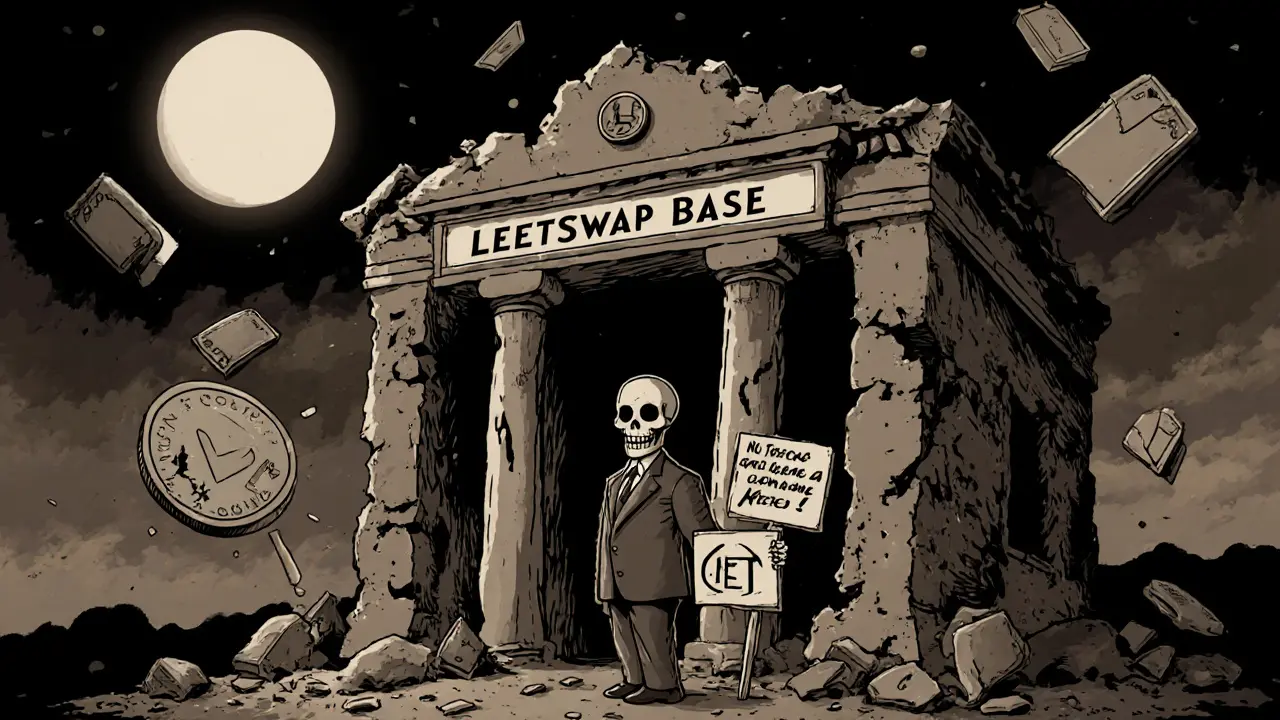
LeetSwap (Base) was a failed decentralized exchange that collapsed after a July 2023 exploit. With zero trading volume, no team response, and no recovery options, it stands as a warning for crypto users.
Continue reading