You want to trade crypto without handing over your keys to a centralized company. That’s the promise of decentralized exchanges (DEXs). But not all DEXs are created equal. Some are bustling hubs of liquidity; others are digital ghost towns. MakiSwap is a decentralized cryptocurrency exchange built on the Huobi Eco Chain (HECO) that currently shows signs of being inactive and potentially fraudulent. If you’ve stumbled upon this name in a search result or an old forum post, you need to know the truth before you connect your wallet.
The short answer? Stay away. As of mid-2026, MakiSwap is effectively dead. It has zero trading volume, no active pairs, and its native token, MAKI, has crashed by nearly 100%. More importantly, multiple watchdogs have flagged it as a potential Ponzi scheme. This review breaks down why this platform failed and what you should look for instead.
The Quick Reality Check: Key Takeaways
- Status: Inactive / Abandoned. No trading volume since late 2024/early 2025.
- Risk Level: Extremely High. Flagged as a potential scam by WikiBit and other reviewers.
- Token Performance: The MAKI token is down ~99.7% from its all-time high, trading near $0.003.
- Infrastructure: Built on HECO (Huobi Eco Chain), which itself has seen massive decline in relevance.
- Verdict: Do not deposit funds. Use established alternatives like Uniswap or PancakeSwap.
What Is MakiSwap? A Brief History
To understand why MakiSwap failed, we first need to look at what it was supposed to be. Launched in 2021 by the team behind Unilayer, MakiSwap positioned itself as an automated market maker (AMM) on the Huobi Eco Chain (HECO). Its goal was simple: allow users to swap tokens, provide liquidity, and farm yield with low fees.
On paper, the specs looked decent for the time. It charged a standard 0.2% trading fee. It promised no deposit or withdrawal fees because it operated non-custodially-meaning you kept control of your assets in your own Web3 wallet. The native token, MAKI, served governance functions and fee distribution.
However, the timing was poor. MakiSwap launched during the peak of the DeFi boom, but it relied heavily on HECO. While HECO offered cheap transactions, it lacked the developer ecosystem and security reputation of Ethereum or Binance Smart Chain (BSC). When the broader market cooled and major players migrated to multi-chain solutions, single-chain platforms like MakiSwap struggled to retain users.
Current Status: A Ghost Town in 2026
If you visit MakiSwap today, you won’t find traders. You’ll find silence. Here are the hard numbers as of July 2026:
| Metric | MakiSwap (2026) | Healthy DEX Average |
|---|---|---|
| 24-Hour Volume | $0.00 | $10M - $1B+ |
| Active Trading Pairs | 0 | 1,000+ |
| Total Value Locked (TVL) | Negligible | $100M+ |
| Development Activity | None since 2021 | Weekly updates |
| User Reviews | 2.3/5 (Mostly negative) | 4.0+/5 |
Zero volume means there is no liquidity. Without liquidity, you cannot trade. Even if you managed to find a pair, the "slippage" (the difference between expected price and executed price) would likely eat your entire investment. The platform’s Alexa ranking of #1,469,379 confirms that almost no one visits the site anymore.
The Red Flags: Why Experts Call It a Scam
It’s not just about bad performance. There are serious allegations surrounding MakiSwap. Reputable crypto analysis platforms like WikiBit have explicitly labeled the MAKI token as an "air coin project." They cite overwhelming user complaints suggesting the structure resembles a Ponzi scheme.
What does this mean for you? It suggests that early investors may have been paid using funds from later entrants, rather than genuine trading profits. When new money stopped flowing in, the system collapsed. User reviews highlight specific issues:
- Inaccessible Funds: Users reported being unable to withdraw their assets after providing liquidity.
- No Support: Customer service channels are silent. There is no team to contact when things go wrong.
- Fake Yield: Promised farming rewards were never distributed or were inflated to attract victims.
Price prediction models from WalletInvestor and PricePrediction.net reflect this lack of confidence. They forecast the MAKI token dropping further toward $0.0009, essentially rendering it worthless. With a market cap of only ~$200,000, there is no institutional interest to save it.
Technical Limitations: The HECO Problem
MakiSwap’s fate is tied to the Huobi Eco Chain (HECO). Once a popular alternative for low-cost transactions, HECO has lost significant ground. Major projects migrated to Arbitrum, Optimism, or Solana due to better scalability and lower long-term costs.
Using MakiSwap required users to bridge funds from Ethereum or BSC to HECO. Bridging involves trust assumptions and transaction fees. If the destination chain (HECO) becomes irrelevant, those bridged assets become stranded. For a beginner, this process is confusing and risky. For an expert, it’s inefficient.
Furthermore, smart contracts on MakiSwap have not been audited recently. In the world of DeFi, un-audited code is a ticking time bomb. Hackers often target abandoned projects because they know there will be no emergency response team to pause contracts or drain funds to safety.
Better Alternatives for Decentralized Trading
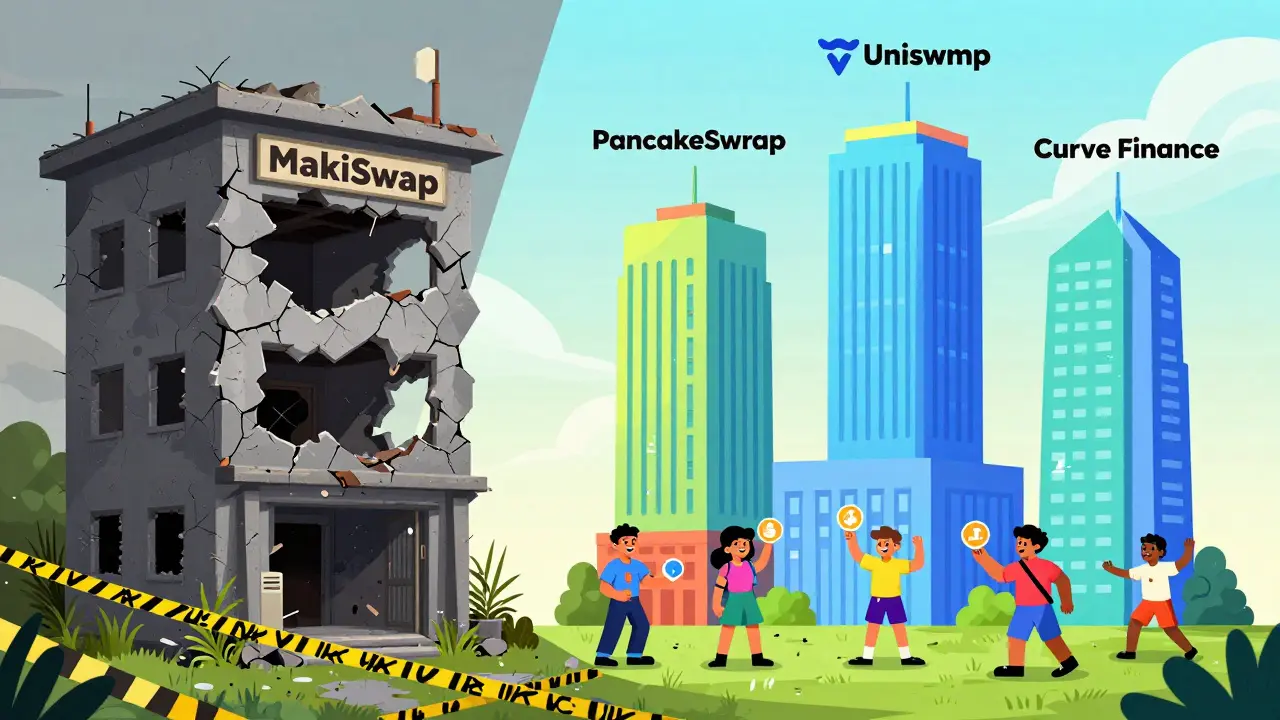
If you want the benefits of a DEX-privacy, self-custody, and access to new tokens-you have much safer options. Here is how MakiSwap compares to industry leaders:
| Platform | Network | Key Advantage | Safety Rating |
|---|---|---|---|
| Uniswap | Ethereum, L2s | Largest liquidity, most trusted | High |
| PancakeSwap | BSC, Ethereum | Low fees, huge community | High |
| Curve Finance | Multi-chain | Best for stablecoin swaps | High |
| MakiSwap | HECO | None | Avoid |
Uniswap remains the gold standard. It operates on Ethereum and its Layer-2 networks (like Arbitrum and Optimism), offering deep liquidity and rigorous security audits. PancakeSwap is the best choice if you want low fees similar to what HECO once offered, but with a vibrant, active ecosystem on Binance Smart Chain.
How to Spot Dead DEXs Like MakiSwap
Not every obscure exchange is a scam, but many are. Here is a checklist to protect yourself:
- Check Volume: Use sites like CoinGecko or DefiLlama. If 24-hour volume is under $10k, walk away.
- Verify Audits: Look for recent smart contract audits from firms like CertiK or OpenZeppelin. Old audits don’t count if the code has changed.
- Assess Community: Join their Discord or Telegram. Are real people talking, or just bots posting "To the Moon!"? Silence is a bad sign.
- Look for Roadmap Updates: Active projects post regular development logs. If the last update was two years ago, the team has likely left.
- Search for Complaints: Google "[Project Name] scam" or "[Project Name] Ponzi." If warning sites flag it, believe them.
Final Verdict: Do Not Use MakiSwap
MakiSwap is a cautionary tale. It started with a reasonable premise but failed due to poor execution, reliance on a declining blockchain, and alleged fraudulent behavior. In 2026, it offers no value to traders. Connecting your wallet to such a platform exposes you to unnecessary risk, including potential loss of funds through malicious smart contracts.
Your capital is safer on established platforms with transparent teams, active development, and millions of dollars in locked value. Don’t let curiosity cost you your savings. Stick to Uniswap, PancakeSwap, or Curve, and keep your crypto secure.
Is MakiSwap a scam?
While legally proving a scam can be difficult, multiple independent review platforms like WikiBit have flagged MakiSwap as a potential Ponzi scheme. Combined with zero development activity, zero trading volume, and user reports of inaccessible funds, it exhibits all the hallmarks of a fraudulent or abandoned project. You should treat it as unsafe.
Can I still trade on MakiSwap?
Technically, you might be able to connect your wallet, but practically, no. There are no active trading pairs and no liquidity. This means you cannot buy or sell tokens because there is no one on the other side of the trade. Any attempt to interact with the smart contracts could result in lost gas fees.
What happened to the HECO chain?
Huobi Eco Chain (HECO) announced plans to shut down its mainnet in favor of focusing on other ventures. As the underlying blockchain loses support and developers migrate elsewhere, applications built on it, like MakiSwap, become obsolete and insecure.
Is the MAKI token worth investing in?
No. The MAKI token has dropped over 99% from its all-time high and trades at a fraction of a cent. Analysts predict further declines. With no utility, no development, and negative sentiment, it holds no investment value.
What is a safe alternative to MakiSwap?
For general trading, use Uniswap (on Ethereum or Layer-2s) or PancakeSwap (on BSC). For stablecoin swaps, Curve Finance is highly recommended. These platforms have billions in TVL, regular audits, and active communities.
Why did MakiSwap fail?
MakiSwap failed due to a combination of factors: reliance on the declining HECO network, lack of innovation compared to larger competitors, failure to maintain liquidity, and alleged unethical practices that drove users away. Without a strong community and technical updates, DEXs cannot survive.