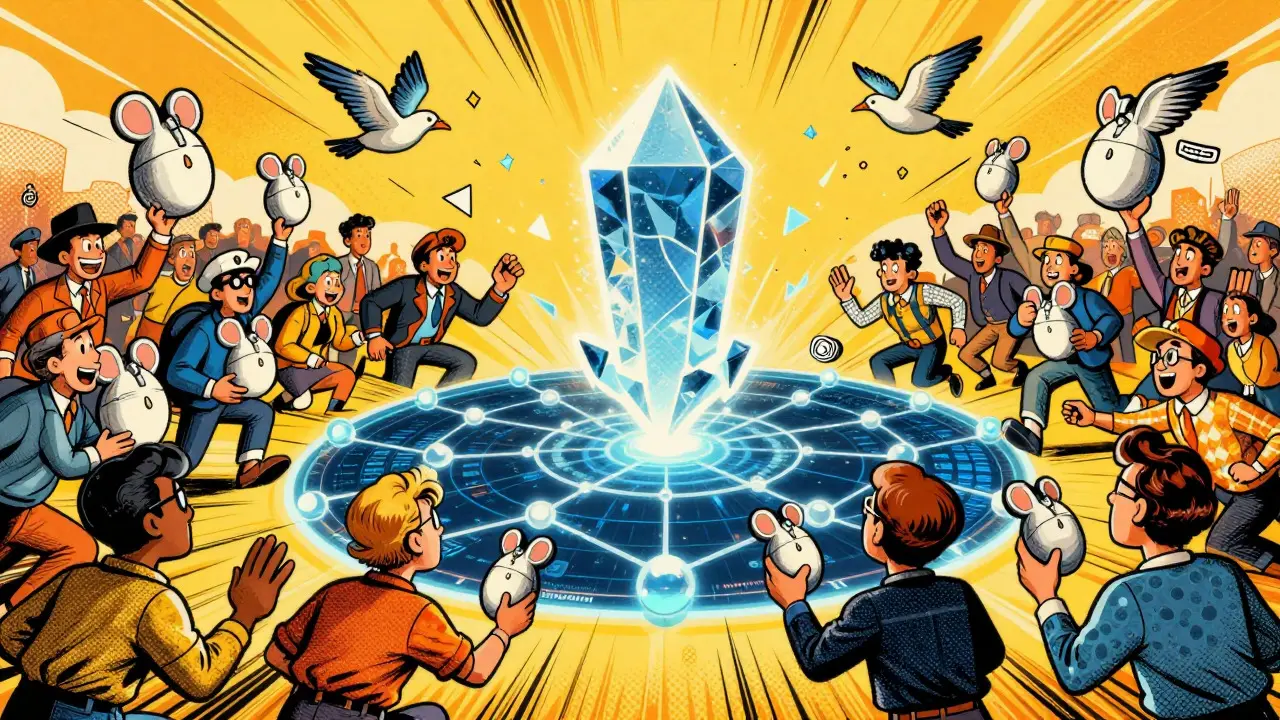
Remember when every other day seemed to bring a new NFT airdrop promising free digital assets? If you stumbled upon the "Lunar Crystal" campaign back in early 2022, you might be wondering what actually happened. Did the tokens ever hit the market? Is the project still alive? Or did it just vanish into the blockchain ether like so many others before it?
The short answer is that the Lunar Crystal NFT Airdrop was a brief flash in the pan during the Q1 2022 bull run. Launched by a DeFi ecosystem called Lunar on the Binance Smart Chain (BSC), it promised passive earnings and community engagement through simple tasks. However, unlike major players that survived the subsequent bear market, Lunar left very little footprint. This guide breaks down exactly what the airdrop was, how it worked, and why it likely disappeared from your radar.
What Was the Lunar Crystal NFT Airdrop?
To understand the current silence around this project, we have to look at its origins. The Lunar Crystal NFT Airdrop is a promotional distribution event launched in March 2022 by the Lunar DeFi ecosystem to drive user acquisition on Binance Smart Chain. It wasn't a standalone art collection; rather, it was a marketing tool designed to onboard users into the Lunar platform, which operated using the LNR token.
The core value proposition of Lunar at the time was "passive earnings." The idea was that by holding the LNR token or participating in their ecosystem, users could earn rewards without active trading. The NFT airdrop served as the entry ticket. According to records from AirdropAlert.com, the campaign officially commenced on March 1, 2022. Participants were guaranteed "at least 1 NFT" upon completing specific engagement activities. This low barrier to entry was typical for utility-focused NFT drops of that era, aiming for volume over exclusivity.
Unlike high-profile projects that minted thousands of unique, hand-drawn artworks, the Lunar Crystal NFTs were likely generative or template-based, focusing on function rather than artistic rarity. There was no VIP tier, no whitelist lottery, and no complex staking requirement mentioned in the initial announcements. You did the tasks, you got the NFT, and presumably, access to the LNR ecosystem.
How Participation Worked: The CoinMarketCap Connection
One of the most distinct features of this airdrop was its distribution channel. Instead of forcing users to connect wallets directly to a potentially risky third-party dApp, Lunar directed participants to engage "through CoinMarketCap." This suggests an integration with CoinMarketCap’s MISO platform or a similar partnership framework common in 2022.
Here is what the participation workflow likely looked like based on standard practices of that period:
- Create or Link Account: Users needed a verified CoinMarketCap account.
- Social Verification: Following Lunar’s official Twitter (now X) and joining their Telegram or Discord communities was standard practice to prove human activity.
- Wallet Connection: Since the project lived on BSC, users had to connect a BSC-compatible wallet, such as MetaMask or Trust Wallet, to receive the NFT.
- Task Completion: Completing the required social checks would trigger the allocation of the NFT.
This method reduced the immediate risk of phishing scams, which were rampant in 2022. By leveraging a trusted aggregator like CoinMarketCap, Lunar borrowed some credibility. However, it also meant that if the partnership fell through or the technical integration failed, the entire distribution mechanism could stall. In fact, the lack of detailed procedural documentation compared to competitors suggests this integration may not have been as seamless as advertised.
Technical Specs and the Missing Documentation
If you are looking for a whitepaper, smart contract audit, or GitHub repository for the Lunar Crystal NFTs, you will likely come up empty-handed. This is a red flag worth noting. While many small projects operate without public audits, the complete absence of technical details makes verification difficult.
We know the following confirmed facts:
- Blockchain: Binance Smart Chain (BSC). This choice offered lower gas fees than Ethereum, making it attractive for mass-market airdrops.
- Token Standard: Likely BEP-721 (the BSC equivalent of ERC-721 for NFTs).
- Associated Token: LNR (Lunar Token).
- Smart Contract Address: Not publicly documented in major archives.
The lack of a verifiable smart contract address means that if you received the NFT, checking its authenticity or metadata on a block explorer like BscScan would have been challenging without the specific contract hash. Furthermore, there is no record of trait rarity distributions or total supply caps. Was it a collection of 10,000? 50,000? Without this data, assessing the scarcity value of any individual NFT is impossible.
Compare this to contemporaries like Baby Ape Beast (BAB), which explicitly documented 150 traits and reserved the first 50 mints for VIP holders. That level of transparency built trust. Lunar’s opacity, while perhaps intentional to keep things simple, ultimately hindered long-term community formation.
Why Did Lunar Disappear? Analyzing the Project's Fate
So, where is Lunar today? As of August 2026, the project appears to have been abandoned or significantly rebranded beyond recognition. Here is the evidence trail:
1. Website Pivot: The domain lunar.io still exists, but its content has shifted. Archives from late 2023 show the site describing itself as building "products & services designed to bring the next billion humans into crypto through simple, magical experiences." Noticeably absent are references to the LNR token, the Crystal NFTs, or DeFi mechanics. The technology stack description mentions Azure and .NET, suggesting a move toward more traditional software development or enterprise solutions rather than pure DeFi.
2. Absence from Trackers: Major airdrop tracking platforms like AirdropBee and CoinGecko’s historical archives do not list Lunar among successful or ongoing projects post-2022. If the LNR token had significant liquidity or community support, it would appear in DeFi dashboards. Its silence suggests either zero liquidity or delisting from major exchanges.
3. No Community Footprint: Unlike projects that maintained active Discord servers or Twitter threads discussing updates, Lunar’s social media presence faded. There are no documented user testimonials, complaint threads, or success stories from 2023, 2024, or 2025. This "information vacuum" is a classic sign of a project that lost momentum after the initial hype cycle.
The combination of these factors points to a likely scenario: the airdrop was a one-time marketing experiment. Once the initial user base was acquired (or failed to be acquired), the team pivoted to other product ideas, leaving the LNR token and NFTs behind. This is unfortunately common in the 2022 wave of BSC-based DeFi projects, where many teams burned through capital quickly and struggled to sustain interest during the 2022-2023 bear market.
Comparing Lunar Crystal to Other 2022 Airdrops
To put the Lunar Crystal experience in perspective, let’s compare it to two other notable airdrops from the same period. This helps illustrate why some projects survive and others fade.
| Feature | Lunar Crystal (LNR) | Baby Ape Beast (BAB) | Luna Dating (LSTR) |
|---|---|---|---|
| Blockchain | Binance Smart Chain | Binance Smart Chain | Ethereum / Multi-chain |
| Distribution Channel | CoinMarketCap Integration | Project Portal + Socials | Telegram Bot |
| Transparency | Low (No public contract docs) | Medium (Roadmap published) | High (Step-by-step bot instructions) |
| Unique Selling Point | Passive Earnings Model | VIP Tier + 3D NFTs | Dating App Utility |
| Current Status (2026) | Abandoned / Rebranded | Inactive / Low Volume | Active but Niche |
As you can see, Lunar Crystal lacked the "stickiness" of its competitors. BAB offered a clear progression path (VIP holders getting special items), and Luna had a tangible real-world use case (dating). Lunar’s promise of "passive earnings" is powerful, but only if the underlying protocol generates revenue. Without visible revenue streams or sustained developer activity, the promise rings hollow.

Is It Too Late to Claim Anything?
If you are reading this in 2026 hoping to claim your Lunar Crystal NFT, here is the realistic assessment:
The window is almost certainly closed. Most airdrops have a claim period of 30 to 90 days. Even if the window remained open longer, the infrastructure supporting the claim (smart contracts, backend servers) often goes offline after a year or two due to maintenance costs. Given that the project announcement was in March 2022, that is over four years ago.
However, if you somehow managed to claim the NFT back in 2022 and it is still sitting in your MetaMask or Trust Wallet, here is what you should check:
- Check Your Wallet History: Look for a transaction labeled "Transfer" or "Mint" involving an NFT on the BSC network around March-April 2022.
- Verify on BscScan: If you find the transaction, copy the token ID and check it on BscScan. If the contract is still active, you might see the NFT details. If the contract shows no recent activity, it is effectively dead code.
- Assess Value: Even if the NFT exists, does it have utility? Can you stake it? Does it give you access to anything? Without a functioning marketplace or governance role, it is likely just a digital souvenir.
Do not spend significant gas fees trying to interact with old contracts unless you have verified they are still operational. On BSC, gas fees are low, but interacting with abandoned contracts can sometimes result in locked funds if the contract logic is flawed.
Lessons for Modern Crypto Investors
The story of the Lunar Crystal NFT Airdrop serves as a cautionary tale for anyone participating in crypto campaigns today. Here are three key takeaways:
- Documentation Matters: Always look for a public smart contract address, a whitepaper, or at least a detailed roadmap. If a project hides its technical details, assume the worst until proven otherwise.
- Follow the Developer Activity: Check the commit history on GitHub or the consistency of updates on Twitter. A project that goes silent for six months is likely dead, regardless of what the website says.
- Utility Over Hype: "Passive earnings" is a great concept, but it requires a sustainable business model. Ask yourself: Where does the money come from? If the answer isn't clear, the sustainability is questionable.
In 2026, the crypto landscape is more mature. Projects that survive now tend to have strong developer communities, audited code, and clear revenue models. The wild west of 2022, where any team could launch an airdrop and disappear, has largely given way to more structured ecosystems. While opportunities still exist, due diligence is no longer optional-it is essential.
Frequently Asked Questions
Is the LNR token still tradable?
As of 2026, the LNR token has minimal to no presence on major centralized exchanges like Binance or Coinbase. It may still trade on decentralized exchanges (DEXs) on BSC, but liquidity is likely extremely low. Check DEX aggregators like DexScreener for current pair volumes before attempting to buy or sell. High slippage is expected due to low liquidity.
Where can I find the Lunar Crystal NFT smart contract address?
The official contract address was never widely publicized in major crypto news outlets or tracked on top-tier explorers. If you participated in 2022, check your wallet transaction history for the mint event. Use the transaction hash to look up the involved contract on BscScan. If you cannot find it, the contract may have been deprecated or simply never indexed properly by major tools.
Did Lunar rebrand to a different name?
There is no definitive evidence of a direct rebrand where the LNR token migrated to a new symbol. The lunar.io domain continues to operate, but the branding has shifted away from DeFi specifics. It is possible the company pivoted to a broader Web3 consumer app focus, abandoning the specific LNR tokenomics. Monitor the official website footer or legal terms for any entity name changes.
Was the Lunar Crystal airdrop a scam?
It is unlikely to be classified as a "rug pull" scam in the traditional sense because users didn't pay upfront fees to enter. However, it suffered from poor execution and lack of follow-through. The absence of clear documentation and the eventual disappearance of the project suggest negligence or strategic abandonment rather than malicious theft. You lost time and opportunity cost, but likely not principal capital.
Can I still get the NFT if I missed the 2022 deadline?
Almost certainly not. Airdrop windows are strictly enforced by smart contracts. Unless the developers manually distributed remaining NFTs later (which is rare and undocumented for this project), the mint function would have closed. Any claims being sold on secondary markets in 2026 should be treated with extreme skepticism, as they may be counterfeit or non-functional.