
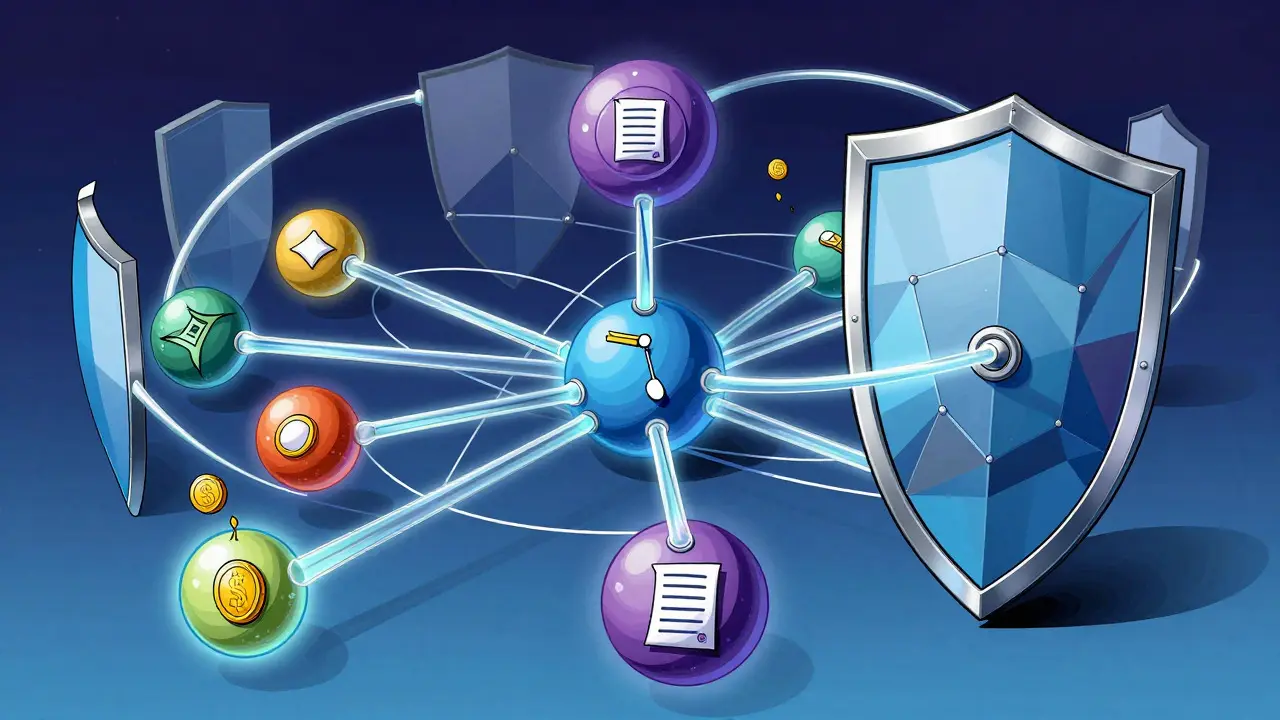
Imagine trying to send a text message from an iPhone to a Nokia phone from the early 2000s. It just doesn’t work because they speak different languages. For years, blockchains were exactly like that-digital islands stuck in isolation. If you held Bitcoin, you couldn't easily use it on Ethereum. If you had assets on Solana, accessing DeFi protocols on Polygon felt impossible without selling everything and buying new tokens.
That changed with blockchain interoperability, which is the technical capability allowing distinct blockchain networks to exchange data and value directly without centralized intermediaries. This isn't just a nice-to-have feature; it's the infrastructure that turns separate ledgers into a connected web. Today, you can move 0.001 BTC from the Bitcoin network to an application on another chain seamlessly. But how does that actually happen under the hood? Let’s break down the mechanics, the protocols, and the security risks involved.
The Core Problem: Why Isolated Chains Fail
Without interoperability, every blockchain operates as a silo. This creates three major friction points for users and developers:
- Fragmented Liquidity: Assets are trapped in specific ecosystems, making it hard to find trading pairs or lending opportunities across chains.
- User Friction: Moving value between chains often required using centralized exchanges (CEXs), introducing counterparty risk and custody issues.
- Inefficiency: Developers had to build complex workarounds to access data or assets located on other networks, slowing down innovation.
Interoperability solves this by enabling direct peer-to-peer communication between chains. It allows for "arbitrary messaging," meaning blockchains can share not just token balances, but smart contract calls, identity verification, and complex data structures. This transforms the ecosystem from a collection of standalone apps into an integrated digital economy where value flows freely.
Understanding Inter-Blockchain Communication (IBC)
One of the most robust solutions for this problem is the Inter-Blockchain Communication (IBC) protocol, designed primarily for the Cosmos Hub ecosystem but applicable elsewhere. IBC uses a two-layer architecture to ensure secure and ordered data transfer.
The first layer is the TAO layer (Transport, Authentication, and Ordering). Think of this as the postal service. It establishes secure connections between chains, verifies the identity of the sender using light clients, and ensures messages arrive in the correct order. The second layer is the APP layer (Application). This handles the actual content of the message, specifying how data is packaged so the receiving chain understands it.
IBC relies on three core components:
- Hubs and Zones: Hubs act as central routers. Individual blockchains (zones) connect to a hub, which then relays transactions to other zones. It’s less like a mesh and more like a star topology, simplifying connection management.
- Packet Transactions: These are the data units containing sender info, recipient info, and transaction details. They travel from source zone → hub → destination zone.
- Smart Contracts: Each participating chain implements IBC modules via smart contracts that manage the orderly transfer of these packets.
Establishing a connection isn't instant. It follows a strict four-message handshake process:
- OpenInit: The initiating chain sends its info and intent to communicate.
- OpenTry: The destination chain verifies the source's data using its Light Client.
- OpenACK: The source chain confirms the destination's info via its own Light Client check.
- OpenConfirm: Both sides confirm, establishing the open connection.
Chainlink CCIP: A Different Approach
While IBC focuses on a specific ecosystem structure, Chainlink CCIP (Cross-Chain Interoperability Protocol) aims to be a universal standard for any blockchain. CCIP provides a single interface for cross-chain messaging and token transfers, integrating oracle services into a programmable framework.
Given that approximately $1.2 billion USD has been lost to cross-chain exploits historically, CCIP was built with a security-first mindset. It leverages experts like Ari Juels and Dan Boneh to implement features such as a Risk Management Network for monitoring malicious activity and decentralized oracle computation from high-quality node operators.
CCIP handles token transfers through router contracts. When you initiate a transfer, tokens go to associated pools deployed on both the source and destination chains. There are two main ways to execute this:
- Direct End-User Interaction: Using the
ccipSendfunction, which anyone can call without access control restrictions. - Sender Contracts: Integrated into dApps, these manage fee payments and message generation automatically, providing a smoother user experience.

Comparing Major Interoperability Protocols
Choosing the right protocol depends on your specific needs: whether you prioritize ecosystem integration, universal connectivity, or asset-specific utility. Here is how the leading solutions stack up:
| Protocol | Primary Architecture | Key Strength | Best For |
|---|---|---|---|
| IBC | Hub-and-Zone (Star Topology) | High throughput within Cosmos ecosystem; strong security via light clients | Cosmos-based applications and high-frequency data sharing |
| Chainlink CCIP | Oracle-Network Based | Universal compatibility; enterprise-grade security standards | Cross-ecosystem token transfers and institutional adoption |
| Liquidity Layer | Shared Security / Restaking | Unified liquidity pool across multiple chains | DeFi protocols wanting seamless asset movement without bridging delays |
Note that while IBC and CCIP focus on communication layers, newer concepts like the Liquidity Layer aim to abstract the bridging process entirely, creating a unified pool of assets that can be accessed instantly across partner chains.
Security Risks and Mitigation Strategies
Let’s be honest: cross-chain communication is risky. Bridges have been the weakest link in DeFi security for years. The main vulnerabilities include:
- Smart Contract Bugs: Errors in the code handling packet transfers or token locking.
- Oracle Manipulation: If a protocol relies on external data feeds, those feeds could be hacked or manipulated.
- Validator Collusion: In proof-of-stake systems, if validators collude, they might validate false states on another chain.
To mitigate these, modern protocols use several strategies:
- Light Clients: Instead of trusting a full node, the receiving chain runs a lightweight version of the source chain’s consensus mechanism to verify state changes independently.
- Decentralized Oracles: Using multiple independent node operators to report data reduces the chance of a single point of failure.
- Risk Monitoring Networks: Real-time monitoring of cross-chain activity to detect anomalies before they become exploits.
The Future of Cross-Chain Connectivity
The trend is moving toward "invisible" interoperability. Users won't care which chain their assets are technically stored on; they will just see a unified balance. Future developments focus on universal standards that accommodate diverse consensus mechanisms, from Proof-of-Work to Proof-of-Stake to Directed Acyclic Graphs (DAGs).
As the ecosystem matures, we expect to see more complex applications, such as using BTC holdings to secure loans on DeFi platforms built on different networks, or trading bitcoin fractions for unique digital assets without multi-step conversions. The goal is a seamless digital economy where value and information flow as freely as email travels between different providers today.
Frequently Asked Questions
What is the difference between a bridge and interoperability?
A bridge is a specific tool used to move assets between two chains. Interoperability is the broader capability that allows chains to communicate, share data, and execute smart contract calls across boundaries. All bridges facilitate interoperability, but interoperability includes much more than just asset transfer, such as identity sharing and data queries.
Are cross-chain transactions safe?
They are safer now than five years ago, but risk remains. Protocols like IBC and CCIP use light clients and decentralized oracles to reduce trust assumptions. However, no system is 100% immune to bugs or attacks. Always check the total value locked (TVL) and audit history of a protocol before moving large sums.
How long does a cross-chain transfer take?
It varies by protocol. Some optimized bridges complete transfers in minutes, while others may take hours depending on finality times of the underlying chains. IBC transfers are typically fast due to the hub structure, while CCIP transfers depend on the speed of the oracle network and destination chain block times.
Can any blockchain connect to any other blockchain?
Theoretically, yes, but practically, it requires implementation. A chain must integrate the necessary smart contracts or middleware to support a specific interoperability protocol. Not every chain supports every protocol. For example, a chain might support IBC but not CCIP, limiting its connectivity options.
What is a Light Client in the context of blockchains?
A Light Client is a simplified version of a blockchain's consensus algorithm that runs on a different chain. It allows the second chain to verify the validity of blocks from the first chain without storing the entire ledger. This enables trustless verification, meaning you don't need to fully trust the bridge operator; you trust the math of the light client.




Comments (17)
Shawn Schaerer
It is imperative that we acknowledge the profound philosophical implications of this technological shift. The notion that digital value can traverse boundaries without centralized intermediaries challenges the very fabric of modern economic trust structures. We must ask ourselves: does this connectivity truly liberate the individual, or does it merely create a more complex web of dependencies? The efficiency gains are undeniable, yet the security risks remain a formidable hurdle that demands rigorous scrutiny. One cannot simply dismiss the potential for systemic failure in such an interconnected ecosystem. The light client mechanism is elegant, but elegance does not guarantee invulnerability against sophisticated adversarial attacks. We stand at a precipice where innovation outpaces regulation, and this disparity is dangerous. It is our duty to demand transparency from these protocol developers before they become entrenched powers. The future of finance depends on whether we prioritize decentralization over convenience. Let us not be seduced by the smooth user experience while ignoring the underlying fragility. A robust system requires redundancy, not just speed. This article provides a good overview, but lacks the critical depth needed for serious analysis. We need more than just features; we need guarantees. The path forward is uncertain, but the direction is clear: towards greater integration. We must remain vigilant.
Linda Leeuwesteijn
Omg this made so much sense to me! 🌟 I always felt like blockchains were just random islands floating around with no way to talk to each other. The iPhone vs Nokia analogy was perfect because I still have an old phone in my drawer lol. 😂 It’s really cool to know that now you can actually move stuff between them without selling everything first. I used to think bridging was super risky and complicated, but reading about IBC makes it feel a bit safer? Maybe? 🤔 Also, who knew there was such a thing as a 'light client'? Sounds like magic to me! ✨ Thanks for breaking it down so nicely!
Sarah Campbell
Great article!! But let's be real... most of these protocols are just fancy ways for tech bros to get rich while the rest of us get rugged 💀🇺🇸. I mean, why do we even need all these chains if Bitcoin works fine?? Just use BTC and stop overcomplicating things with your little 'interoperability' nonsense. The US should be leading this space, not some random oracle network run by outsiders! 🚩
Phelan Deihl
I’ve been quietly following the development of CCIP for a while now. It’s fascinating how they integrated the oracle layer directly into the messaging framework. It feels less like a bridge and more like a universal translator for smart contracts. The risk management aspect is what really caught my attention. In a world where bridges are constantly getting hacked, having a dedicated monitoring network seems like a necessary evolution rather than just a nice-to-have feature.
Ami Elizabeth
honestly i dont get why people are so hyped. its just moving tokens from one place to another right? why cant we just keep it simple. also the spelling in that table was kinda off imo. anyway nice read tho 👍
Dina Lazarova
One assumes the reader possesses a baseline understanding of distributed systems, yet here we are, being fed spoonfuls of basic networking concepts dressed up as revolutionary blockchain theory. The comparison to email providers is somewhat reductive, given the vastly different consensus mechanisms involved. Still, for the layperson, it serves its purpose adequately. The emphasis on security is welcome, though one hopes the implementation matches the marketing rhetoric. It is tedious to wade through such elementary explanations, but necessary for the uninitiated masses. Do try to elevate the discourse in future iterations.
Alexander Scheel
How delightful to see someone finally articulate the distinction between a bridge and true interoperability with such clarity. It is a shame that so many in this space conflate the two, mistaking a simple asset swap for genuine cross-chain communication. The moral imperative here is clear: we must build systems that serve the user, not the speculator. Security is not a checkbox; it is a fundamental right. Let us hope these protocols live up to their promise of decentralized trust. Otherwise, we are merely building castles on sand. A well-written piece, albeit slightly dry in its technical details. One appreciates the rigor, however.
manish jha
The hub-and-zone topology of IBC is efficient but creates a central point of congestion. In India, we understand the value of decentralized networks better than most. If the Cosmos Hub goes down, the entire ecosystem suffers. This is a design flaw that needs addressing. True decentralization requires mesh networks, not star topologies. We must learn from past mistakes. The future belongs to those who build resilient systems. Do not be fooled by the hype. Look at the code. That is where the truth lies. Respect the technology, but question the structure.
Ashley Snyder
Love that the future section talks about 'invisible' interoperability! It would be so nice if users didn't have to worry about which chain they're on. I'm pretty new to DeFi so this all feels a bit overwhelming but it's cool to see how far we've come. Hope the security gets better soon too! 🙏
Susan Kiley
Oh, darling, isn't it exquisite when the tech world tries to explain itself to the common man? 😒 The drama of cross-chain exploits is nothing compared to the drama of trying to understand what a 'light client' actually does without falling asleep. But hey, if it saves you from losing your life savings in a rug pull, then who am I to judge? Just don't expect me to hold your hand through the handshake process. We're adults here (mostly). 🙄✨
alex fordy
This is a really thoughtful breakdown. 🧠 I appreciate how you highlighted the difference between arbitrary messaging and simple token transfers. It’s easy to overlook that nuance when everyone is just focused on moving assets. The security section was particularly helpful for me, as I’m always worried about validator collusion. Thanks for making such a complex topic feel approachable! 🙌
Nia Franklin
Wow!!! This is so incredibly interesting!!! 🎨💡 I never thought about blockchains as 'digital islands' before, but that paints such a vivid picture! The idea of 'arbitrary messaging' sounds like something out of a sci-fi novel!! 🚀 It’s wild to think that we might soon be able to use our BTC for loans on totally different platforms without all that messy conversion stuff!! 🤯 I’m a bit confused about the DAG part though, but I love that it’s mentioned!! Keep writing amazing stuff!! ❤️🔥📝
Sonia Gomez Gomez
You guys really need to stop trusting these 'decentralized' oracles. It's just a bunch of insiders playing games. 😤 Why do we need so many layers? Simplify it! The average person doesn't care about TAO layers or APP layers. They care about their money staying safe. Stop complicating things with your jargon. We deserve better than this half-baked infrastructure. 😡
SHIV SHANKAR KANTA
the soul of the blockchain is lost in this mechanical dance of packets and handshakes. we trade freedom for convenience. the light client is a cage disguised as a key. we are building a prison of interdependence. the validators are the jailers. the users are the inmates. and we call it progress. how tragic. how beautiful. how wrong.
Daniel Brown
Just to add to the previous points, the four-message handshake in IBC is crucial for preventing replay attacks. Many people skip over this detail, but it’s the backbone of the security model. Without proper ordering and authentication at the TAO layer, the whole system collapses. It’s a classic example of doing the boring, foundational work correctly. The industry often rushes to build flashy dApps on top of shaky foundations. This post does a good job of highlighting the importance of the underlying mechanics. We need more engineers thinking about these low-level details, not just UI/UX designers.
Marco Maldonado
Finally some common sense! Most of these protocols are over-engineered garbage. Just stick to the big ones like Ethereum and Solana and forget about the rest. The US needs to step up and regulate this mess before it blows up in our faces. Don't trust any foreign oracle networks. Bring it home boys! 🇺🇸🔥
Darren Moon
While the exposition is competent, it suffers from a lack of critical engagement with the economic incentives driving adoption. The 'Liquidity Layer' concept is intriguing, but the capital efficiency metrics are rarely discussed in such broad strokes. One wonders if the abstraction of bridging delays will persist under stress conditions. The narrative of 'seamless' integration often masks significant friction costs in gas fees and latency. Nevertheless, a solid primer for the novice investor seeking to navigate this fragmented landscape. Do consider revisiting the security assumptions with a more skeptical lens.