DID standards are changing how we prove who we are online-without relying on Google, Facebook, or any central company. For years, your digital identity was locked inside someone else’s system. If a platform shut down, lost your data, or changed its rules, you lost control. Decentralized Identifiers (DIDs) fix that. They let you own your identity the same way you own a private key. No middleman. No permissions. Just you and your cryptographic proof.
What Exactly Is a DID?
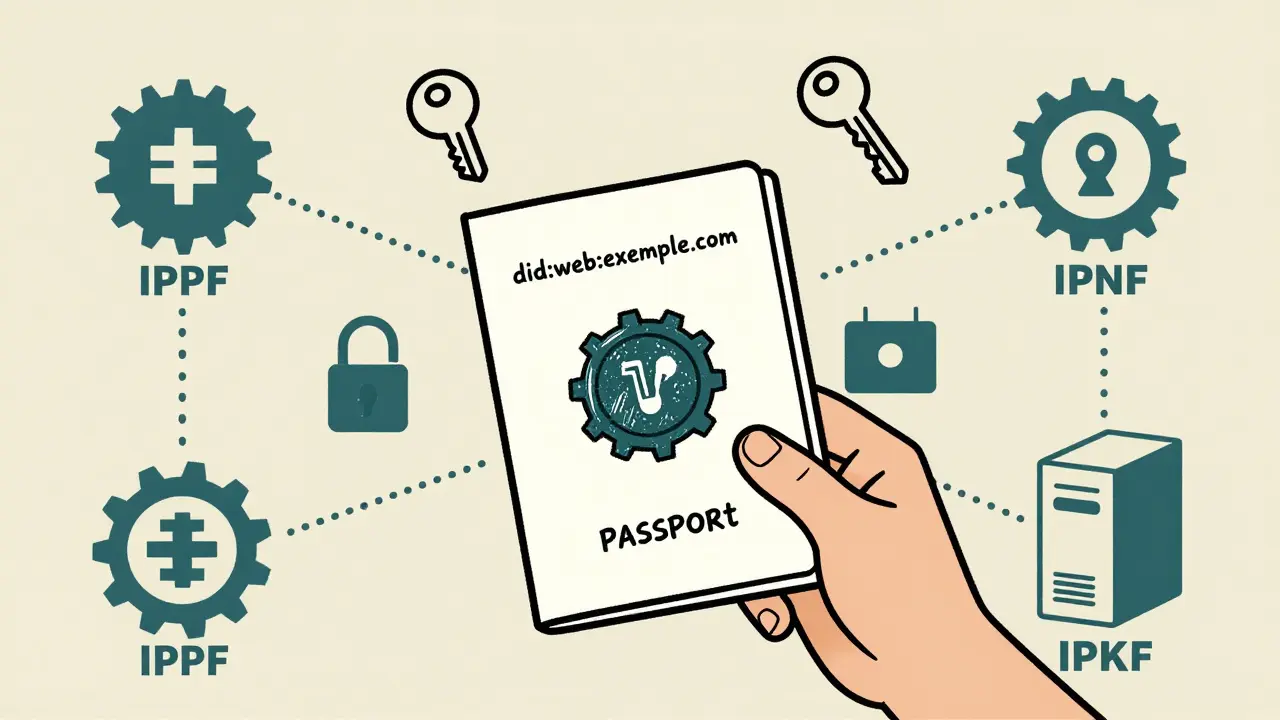
A DID is a unique string-like a username, but better. It doesn’t point to a server. It doesn’t need a company to issue it. You create it yourself, using tools you trust. The W3C, the same group that set up HTML and HTTPS, defined DIDs in their official DID Core v1.0 specification. They call it a "globally unique identifier" designed for "verifiable, decentralized digital identity."Think of it like a digital passport you print yourself. The passport number is public. Anyone can look it up. But only you hold the secret signature that proves you own it. No government agency controls it. No corporation owns it. You do.
DIDs are built to be permanent, resolvable, and cryptographically secure. They follow a simple format: did:method:identifier. For example, did:ethr:0x123... means it’s tied to an Ethereum address. did:web:example.com means it’s hosted on a website you control. The method part tells the system how to find and verify it.
How DIDs Work: The Protocol Stack
DID protocols don’t run on one single technology. They’re designed to work across blockchains, databases, peer-to-peer networks, or even traditional servers. This flexibility is intentional. The W3C doesn’t force you into one system. You pick what fits.Under the hood, DIDs use a layered structure-like the OSI model used in networking. Each layer handles a different job:
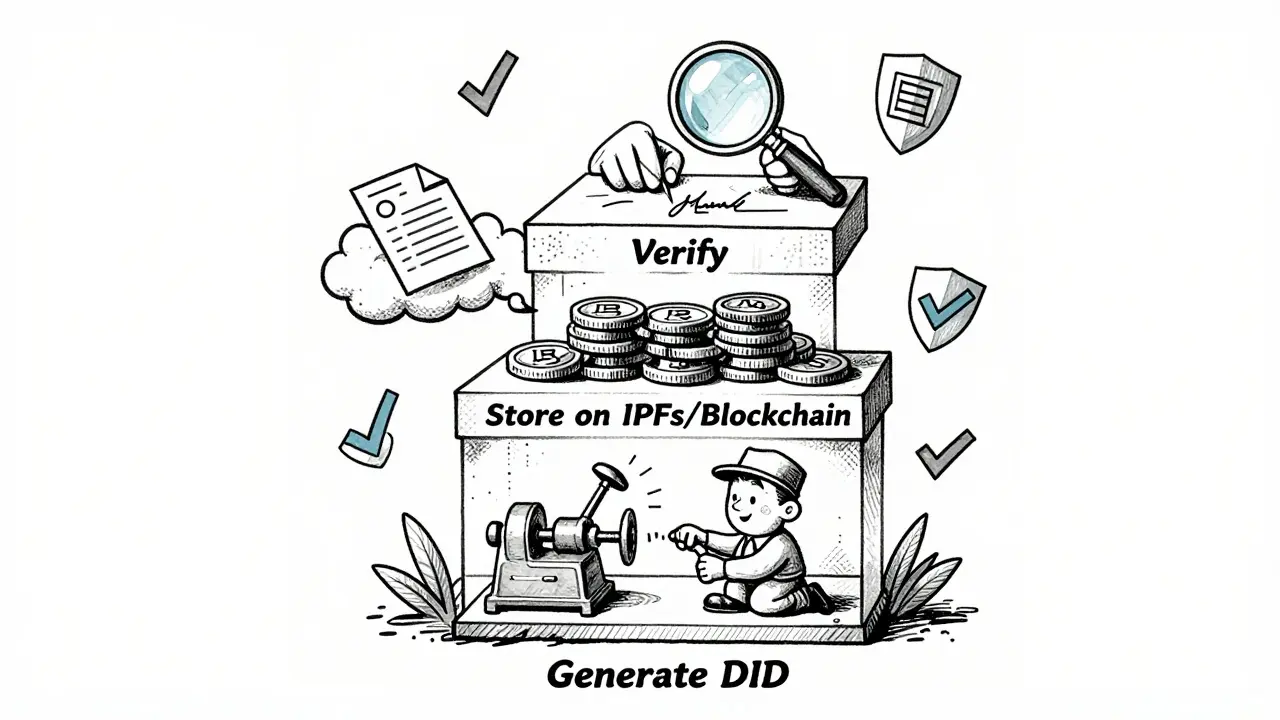
- Layer 1: Identifier Generation - You create your DID using a cryptographic algorithm. This generates a public key and a private key. The public key becomes part of your DID document. The private key stays with you.
- Layer 2: DID Document Storage - Your DID document lives wherever you choose. It could be on a blockchain like Ethereum or Polygon, in a decentralized file system like IPFS, or even on your own server. The document contains your public keys, authentication methods, and service endpoints.
- Layer 3: Resolution - When someone needs to verify your identity, they resolve your DID. Their system fetches your DID document from the storage location and checks the cryptographic signatures.
- Layer 4: Verification & Communication - Once resolved, you can prove things: "I own this DID," "I signed this document," or "I’m authorized to access this service." This happens using digital signatures, not passwords.
This layered design means you can swap out one part without breaking the rest. Need a faster way to store DID documents? Switch from blockchain to IPFS. Need stronger encryption? Upgrade your key type. The system stays intact.
Verification Relationships: Proving Control Without Revealing Everything
One of the most powerful features of DIDs is how they handle verification. You don’t have to hand over your whole life to prove a single thing.DID documents include "verification relationships." These define what you can do with your identity. For example:
authentication- Lets you log in to a service using your DID.assertionMethod- Lets you sign claims, like "I graduated from Harvard."keyAgreement- Lets others encrypt messages only you can read.
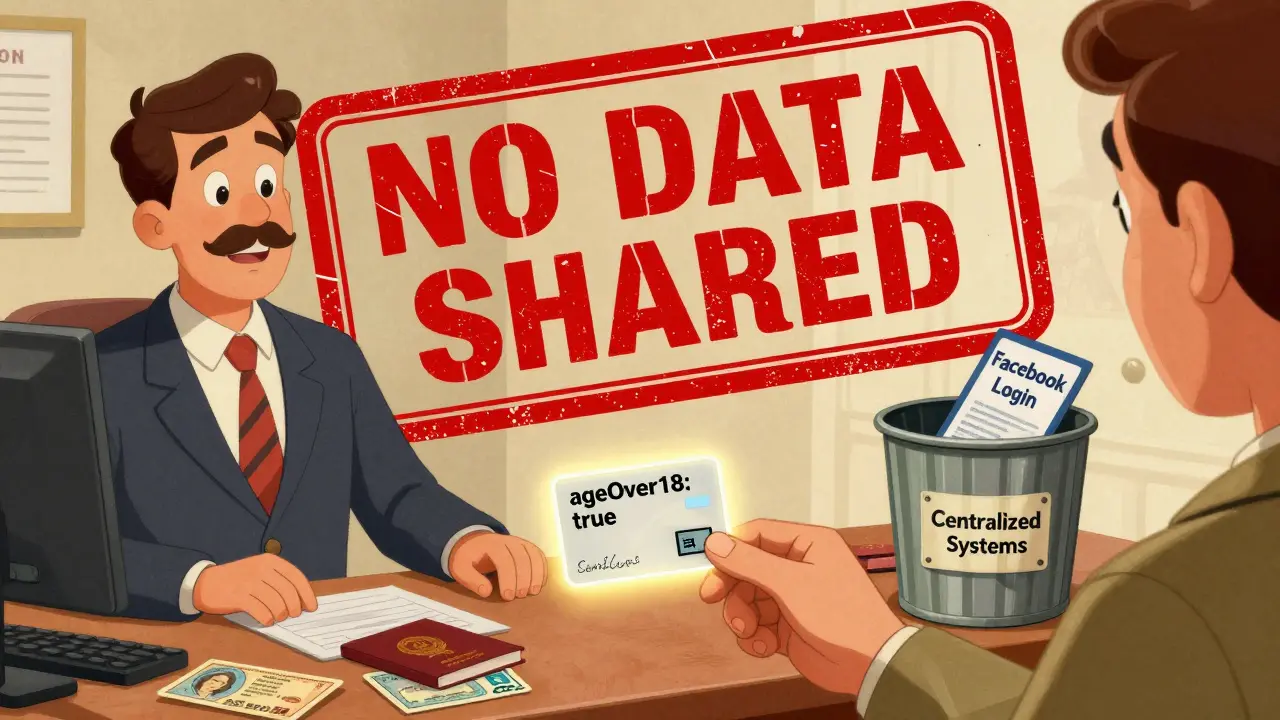
Imagine you’re applying for a loan. The bank asks: "Can you prove you’re over 18?" With traditional systems, you’d send your driver’s license or passport scan. With DIDs, you generate a verifiable credential-signed by your government-that says "ageOver18: true." You send only that. The bank verifies the signature. They never see your name, address, or birth date.
This is called "minimal disclosure." It’s privacy by design. You control what’s shared. No more handing over your entire digital footprint just to sign up for a newsletter.
Why DIDs Are Different From Traditional Identity Systems
Centralized systems-like Facebook Login or Google Accounts-give you convenience. But they also give the company control. They can delete your account. They can track you across apps. They can sell your data.Federated systems-like SAML or OAuth-are better. They let you use one login across multiple sites. But they still rely on a central authority. If that authority goes down, you’re locked out.
DIDs remove the middleman entirely. You’re not logging in to a system. You’re proving control over an identifier you own. No one can shut it down. No one can alter it. No one can track you unless you allow it.
And because DIDs are standardized, they work across platforms. A DID you create for a healthcare app can be used for a government portal, a crypto wallet, or a job application. It’s interoperable by default.
Real-World Use Cases Already Happening
DIDs aren’t theoretical. They’re being used today:- Healthcare - Patients in Estonia and Canada use DIDs to control access to their medical records. Doctors get verified access only when needed.
- Education - Universities in the EU issue verifiable diplomas as DIDs. Employers scan a QR code to confirm a degree is real-without contacting the school.
- Government - Finland’s digital ID system now supports DIDs. Citizens use them to sign tax forms, vote, and access public services.
- Crypto - Wallets like MetaMask and Phantom now support DID-based login. You don’t need to copy-paste long wallet addresses. You just prove you own your DID.
These aren’t pilot projects. They’re live, production systems. And they’re growing because they solve real problems: fraud, data leaks, and user lock-in.
Challenges and Limitations
DIDs aren’t perfect. They’re still new. Here’s what’s holding them back:- Usability - Most people don’t understand private keys. If you lose it, you lose your identity. Wallets are improving, but we’re not there yet.
- Adoption - Websites still rely on email and passwords. Switching to DIDs requires infrastructure changes. Big companies move slowly.
- Regulation - Laws like GDPR require the right to be forgotten. But DIDs are permanent by design. Solutions like key rotation and revocation are being built, but they’re not universal.
- Fragmentation - There are dozens of DID methods: did:ethr, did:web, did:ion, did:key. Not all systems support them all. Interoperability is improving, but it’s not seamless.
These aren’t dealbreakers. They’re growing pains. The same issues slowed down HTTPS in the early 2000s. Today, it’s everywhere.
What’s Next for DID Standards?
The W3C is already working on the next wave:- DID Resolution - A standard way for any system to find and verify any DID, no matter where it’s stored.
- Verifiable Credentials - A companion standard that lets you issue, present, and verify claims (like diplomas, licenses, or memberships) tied to your DID.
- Privacy-Preserving Protocols - Zero-knowledge proofs are being integrated so you can prove something without revealing the underlying data at all.
Expect to see DIDs woven into browsers, operating systems, and apps over the next 3-5 years. Apple, Microsoft, and Google are watching closely. They’ll adopt them when users demand control over their data.
For now, the movement is led by developers, privacy advocates, and governments who see a future where identity isn’t owned by corporations-but by people.
Are DIDs the same as blockchain addresses?
No. A blockchain address (like an Ethereum wallet) is one way to create a DID, but not the only way. DIDs can also be based on web domains, peer-to-peer networks, or even traditional databases. The key difference is that a DID comes with a structured document that defines how to verify it, while a blockchain address is just a string of characters. You can turn a blockchain address into a DID, but not all DIDs are blockchain-based.
Can I have multiple DIDs?
Yes. One of the biggest advantages of DIDs is that you can create as many as you want. You might have one for work, one for personal use, one for crypto, and one for healthcare. Each can have different keys, different data, and different levels of visibility. This lets you separate your identities and protect your privacy. No more mixing your job history with your political opinions.
What happens if I lose my private key?
If you lose your private key, you lose control of your DID. There’s no password reset button. That’s why recovery methods are critical. Some systems use multi-signature recovery (requiring 2 of 3 trusted contacts to restore access). Others use social recovery or backup phrases. New standards are being developed to make this safer, but right now, it’s your responsibility. Treat your private key like a house key-don’t lose it.
Do I need to pay to use DIDs?
Most DIDs are free to create. If you use a method like did:key or did:web, there’s no cost. If you use a blockchain-based method like did:ethr, you might pay a small gas fee to register the DID on the chain. But once created, there are no recurring fees. Unlike centralized identity services that charge for premium features, DIDs are open and permissionless. You pay only if you choose a service that adds value on top.
How do I start using DIDs today?
Start with a DID wallet. Try Sovrin, Trinsic, or Web DID Resolver. These tools let you generate a DID, store your keys, and issue verifiable credentials. You can also experiment with platforms like Microsoft ION or Ethereum-based DID registries. Most are open-source and free. The best way to learn is to create one, then use it to sign a simple message or verify a credential.
Comments (14)
Callan Burdett
DID is the future and I’m here for it. No more giving Big Tech my soul in exchange for logging into a forum. I just generated my first did:web and it felt like unlocking a secret door in my own house. Finally, I’m not a product.
ASHISH SINGH
So let me get this straight - you’re telling me we’re gonna replace passwords with crypto keys that if you lose, you lose your entire digital existence? Sounds like a scam designed by people who think the average human can remember more than two passwords. Next they’ll ask us to memorize our own DNA sequence.
Vinod Dalavai
Man, I love this. I’ve been playing with Sovrin for a month now. Made a DID for my art portfolio - no more sending PDFs that get lost in email. People scan a QR, boom, verified credentials. 😊 Also, my cat’s name is now in my DID metadata. Why not? It’s my identity.
Anna Gringhuis
Let’s be real - this is just blockchain with a nicer suit. You still need to trust someone to run the resolver. And who’s gonna explain this to my 70-year-old aunt who still thinks ‘cloud’ is a weather phenomenon? This isn’t liberation, it’s elitist tech theater.
Nishakar Rath
Who the hell needs identity when you can just be anonymous? DIDs are just another way to track you under the guise of freedom. You think you own your identity? You’re just trading one corporate cage for a blockchain cage with more complicated locks
nathan yeung
Really digging the minimal disclosure thing. I’ve got one DID for my freelance gigs, another for my activism stuff - never mixed. Feels like having separate wallets for different parts of life. Simple. Smart.
Jill McCollum
Just tried creating a DID with my university’s verifiable credential - it was surprisingly easy. My grandma asked if I could send her my ‘digital ID’ so she could prove I’m her grandkid at the pharmacy. I showed her the QR code. She said ‘Honey, this is witchcraft.’ I said ‘No, it’s just math.’ 😅
Chidimma Okafor
The elegance of DID lies not in its technical architecture but in its philosophical rupture: the dismantling of identity as a commodity. We have been conditioned to believe that our personhood must be mediated through corporate gatekeepers - yet here, we reclaim sovereignty through cryptographic self-assertion. This is not merely innovation; it is epistemological liberation. The W3C, in their quiet wisdom, have laid the foundation for a post-corporate civil society of identity. One must ask: if the self is not owned, can it still be exploited?
Michael Jones
Minor correction: The format is did:method:identifier, not did:method/identifier. Also, ‘did:key’ doesn’t require storage - it’s self-certifying. Small details matter when you’re building infrastructure. This is important stuff.
Alexis Dummar
Imagining a world where you don’t have to give your birthdate to get a discount on coffee… it’s kinda beautiful. I mean, who even needs to know I’m 34? I just wanna buy a latte. DIDs feel like the internet finally grew up.
Hailey Bug
Real talk: if you lose your key, you’re done. No recovery, no customer service, no ‘forgot password?’ Just gone. This isn’t freedom - it’s responsibility with a side of dread. I’m all for it, but we need better UX before this goes mainstream.
Anthony Ventresque
What if you want to be forgotten? GDPR says you can delete data, but DIDs are immutable. Isn’t that a conflict? I get the security, but… what if I change my name, my beliefs, my life? Can I retire my DID? Or am I stuck with my past forever?
Chris O'Carroll
THEY’RE COMING FOR YOUR IDENTITY. I SAW IT IN A DREAM. A SHADOWY CORPORATION CALLED ‘W3C INC.’ IS USING DID TO TRACK YOUR THOUGHTS THROUGH YOUR KEY AGREEMENT PROTOCOLS. THEY’RE SELLING YOUR VERIFIABLE CREDENTIALS TO AD TARGETING ALGORITHMS. YOU THINK YOU OWN IT - BUT YOU’RE JUST A NODE IN A BLOCKCHAIN GHOST NETWORK.
Andre Suico
Great breakdown. The real win here isn’t the tech - it’s the shift in power. For the first time, users can control how much of themselves they reveal. That’s not just better security. It’s human rights engineering. Still, adoption will take time. We need more tools that hide the complexity behind a simple button.