
Imagine you’re standing in a Moscow café, ready to pay for your coffee with Bitcoin. You pull out your phone, open your wallet, and scan the QR code. But wait-would that transaction actually be legal? The answer isn't a simple yes or no. It depends entirely on whether you're buying a sandwich in St. Petersburg or settling an invoice with a supplier in Germany. As of August 2026, Russian cryptocurrency regulations maintain a strict divide: using crypto for domestic purchases is banned, while specific international transactions are permitted under tight experimental rules.
This regulatory split creates a confusing landscape for anyone holding digital assets in the region. You can own coins freely, but spending them locally puts you at risk of significant penalties. To navigate this safely, you need to understand exactly where the line is drawn between legal ownership and illegal payment usage.
The Core Rule: Domestic vs. International Use
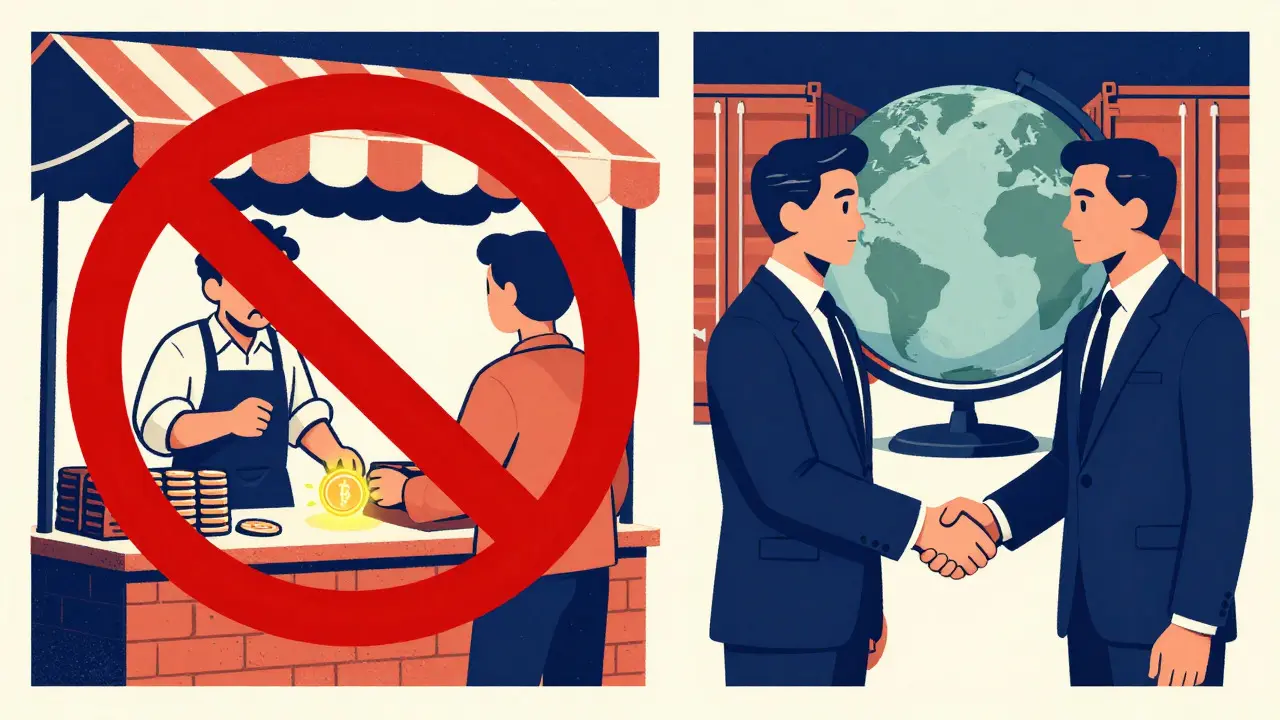
The fundamental principle governing cryptocurrency in Russia is that the ruble remains the sole legal tender for internal commerce. The law explicitly prohibits using anything else to buy goods or services within the country's borders. This means if you try to pay a local vendor, landlord, or utility provider with Ethereum or Tether, you are technically breaking the law.
However, this ban doesn't apply to everything. There is a narrow exception known as the Experimental Legal Regime (ELR). This framework allows Russian companies to use cryptocurrencies for international settlements. Specifically, it enables businesses to transact with foreign partners who accept digital assets. This pathway was largely designed to help Russian firms bypass financial sanctions imposed after 2022, allowing them to keep global trade flowing when traditional banking channels were restricted.
For ordinary citizens, the ELR offers very little direct benefit. It primarily targets corporate entities and "highly qualified" investors. Regular people cannot simply use the ELR to buy groceries or pay rent. If you are an individual trying to settle a personal debt or purchase a car using crypto from another person in Russia, you are likely operating outside the legal protection of the ELR.
What Happens If You Pay Locally?
Until recently, the penalty for using crypto domestically was vague. Laws existed, but enforcement mechanisms were weak. That changes significantly in 2026. Authorities are implementing stricter enforcement measures that include substantial fines and asset confiscation.
If caught using cryptocurrency for a domestic payment, individuals face fines ranging from 100,000 to 200,000 rubles. For companies, the stakes are much higher, with penalties between 700,000 and 1 million rubles. Beyond the cash fine, any cryptocurrency used in the unauthorized transaction may be confiscated by the state. This double punishment-paying a fine and losing the asset-makes the risk financially unattractive for most users.
These rules specifically target "shadow" transactions. Since 2021, many informal deals have moved into grey areas, especially those attempting to circumvent sanctions. The new legislation aims to close these loopholes by clearly defining responsibility for violations. It’s not just about catching big corporations; automated systems are now being deployed to detect undisclosed holdings and suspicious transfer patterns among individuals.
Tax Obligations and Reporting Requirements
Owning crypto is legal, but hiding it is not. Russian tax law requires meticulous record-keeping. You must report all cryptocurrency-related income, including spot trades, mining rewards, staking yields, airdrops, lending returns, and NFT sales. All values must be converted to rubles at official exchange rates for reporting purposes.
The deadlines are strict. Income from the previous year must be filed by April 30, and taxes must be paid by July 15. Missing these dates can trigger severe consequences. If your unreported transactions total 45 million rubles or more over two of the last three years, you risk fines of 500,000 to 2,000,000 rubles. In extreme cases, non-compliance can lead to forced labor or imprisonment for up to five years.
Even smaller errors carry weight. Failing to report minor transactions can result in fines of 50,000 rubles plus a penalty of up to 40% on unpaid taxes. While mining and trading activities are exempt from VAT, they still fall under the standard income tax base. This means every profit you make from flipping coins or earning interest needs to be declared.
Current Market Reality and Adoption Trends
Despite the strict rules, crypto adoption in Russia hasn't disappeared-it has shifted. According to data from Chainalysis, Russia dropped to the bottom of the top 10 in their Global Adoption Index in 2025, down from 7th place the previous year. This decline reflects the chilling effect of regulatory uncertainty and the lack of centralized local exchanges.
However, the volume of activity remains massive. In 2025, crypto-facilitated trade reached 1 trillion rubles. This figure highlights how much business is still being done through digital assets, primarily via the ELR for international deals. Many Russians still hold significant amounts of crypto, with the total market value estimated to exceed $40 billion. The user base has grown by 15% annually since 2021, driven by the desire for asset diversification and access to global markets.
Without licensed domestic exchanges, most citizens rely on foreign platforms to buy and sell. This adds friction and risk, as these platforms can sometimes restrict accounts based on geopolitical tensions. A group of lawmakers has recently urged the Central Bank to license domestic exchanges, which could streamline compliance and reduce reliance on offshore services.

Key Regulatory Entities and Their Roles
Navigating these rules involves understanding who enforces them. The Central Bank of Russia plays the primary role in overseeing the financial system. Historically, the Central Bank has been skeptical of cryptocurrencies, viewing them as volatile investment instruments rather than stable payment methods. They actively push for maintaining the ruble's dominance in domestic commerce.
In contrast, other government bodies show more openness. Ivan Chebeskov, Deputy Head of the Russian Treasury, has advocated for a comprehensive national strategy that leverages cryptocurrencies to develop the economy. This internal disagreement suggests that future policies might evolve, potentially expanding the scope of the ELR or introducing new frameworks for digital assets.
The State Duma, particularly its financial market committee led by Anatoly Aksakov, is drafting the specific laws that define penalties and reporting duties. Their recent proposals focus heavily on closing enforcement gaps, ensuring that the theoretical ban on domestic payments becomes practically enforceable through fines and confiscation.
| Scenario | Legal Status | Potential Penalty | Notes |
|---|---|---|---|
| Buying coffee with USDT | Illegal | 100k-200k RUB + Confiscation | Domestic payment ban applies |
| Company paying German supplier in BTC | Legal (via ELR) | None (if compliant) | Must fit Experimental Legal Regime criteria |
| Holding ETH in a wallet | Legal | None | Ownership is not prohibited |
| Failing to report taxable gains | Illegal | Up to 2M RUB or Prison | Depends on total unreported amount |
Practical Tips for Navigating the System
If you live in Russia or do business there, here are some practical steps to stay compliant:
- Keep detailed records: Track every transaction, including date, counterparty, amount in crypto, and equivalent ruble value. Automated tools can help, but manual verification is safer.
- Use the ELR for B2B only: Ensure any international crypto payment is part of a formal commercial contract that qualifies under the Experimental Legal Regime. Personal transfers abroad may still be scrutinized.
- File taxes on time: Don't wait until the deadline. File by April 30 and pay by July 15. Late filings increase the risk of penalties.
- Avoid P2P domestic payments: Unless you are certain the recipient accepts crypto legally, stick to rubles for local debts and purchases. The risk of confiscation is real.
- Monitor legislative updates: The regulatory landscape is shifting. Watch for announcements from the State Duma and Central Bank regarding potential expansions or further restrictions.
The situation in Russia is unique because it combines strict domestic control with pragmatic international flexibility. While you won't be paying for bread with Bitcoin anytime soon, the door remains open for serious business operations looking to utilize digital assets globally. Understanding this distinction is key to avoiding costly mistakes.
Can I buy groceries with cryptocurrency in Russia?
No. Using cryptocurrency to buy goods or services within Russia is currently prohibited by law. Doing so makes you liable for fines of 100,000 to 200,000 rubles and potential confiscation of the assets used.
Is it legal to own Bitcoin in Russia?
Yes, owning cryptocurrency is legal. However, you must report any income generated from trading, mining, or staking to the tax authorities by April 30 each year.
What is the Experimental Legal Regime (ELR)?
The ELR is a special legal framework that allows Russian companies to use cryptocurrencies for international settlements. It is designed to facilitate cross-border trade and bypass certain financial restrictions, but it does not permit general domestic consumer payments.
How much are the fines for using crypto illegally in 2026?
For individuals, fines range from 100,000 to 200,000 rubles. For legal entities, fines are higher, ranging from 700,000 to 1 million rubles. Additionally, the cryptocurrency used in the violation may be confiscated.
Do I need to pay VAT on crypto mining?
No, mining and trading activities are exempt from VAT in Russia. However, the profits from these activities are subject to standard income tax and must be reported in rubles.


Comments (23)
Calliope Clio
Oh, the sheer audacity of a nation trying to regulate the future while still struggling with basic internet speeds in rural areas 😂
It is absolutely fascinating how they try to maintain this pretentious facade of 'sovereign financial stability' while simultaneously forcing their corporate sector into a digital black market. It’s like watching a toddler try to operate a jet engine; you know it’s going to explode, but you’re too polite to tell them.
The fines are laughable, really. Two hundred thousand rubles? That’s pocket change for anyone who actually understands the crypto space. They think scaring off the little guys will stop the flow of capital? Please. The real money has always moved in the shadows, and now the state is just providing a convenient legal framework for those shadows to formalize themselves under the guise of 'international settlement.'
I find the whole 'Experimental Legal Regime' to be a masterclass in bureaucratic obfuscation. It’s not innovation; it’s survival. And honestly, if I were a Russian oligarch, I’d be laughing all the way to the Swiss bank account, because that’s where the ELR really shines. Not for buying coffee, mind you, but for moving billions without leaving a trace on the domestic ledger.
Tasha Davis
This is so interesting! 🌟
I never realized how different it was from here in the US. We have so many options for paying with crypto at local stores, so it’s wild to hear about the strict ban in Russia.
But I love that they are allowing companies to use it for international deals! That sounds like such a smart way to keep business running smoothly despite all the sanctions. It shows that when people want to do business, they find a way! 💪
Also, did you know that keeping good records is super important everywhere? Even in places where crypto is totally legal, taxes can get tricky. So maybe we should all start being more careful with our spreadsheets? Just a thought!
Rod Sidoroff
You are clearly looking at this through the lens of a tourist, not an investor.
The nuance here is not about 'buying coffee.' It is about the structural integrity of the ruble as a reserve currency. If you allow domestic hyperinflationary assets to circulate freely, you destroy the monetary policy toolset of the central bank. It is elementary economics, yet most of you refuse to grasp it.
The ELR is not a loophole; it is a targeted valve release. You control the pressure by restricting the volume to B2B cross-border flows. This prevents the domestic consumer base from de-dollarizing (or rather, de-rubling) their daily lives while still allowing the industrial complex to function globally. It is a sophisticated mechanism, and your outrage proves you don't understand the mechanics of sovereign debt management.
Jennifer Ulmer
It makes me think about the nature of trust.
We often talk about crypto as a technology, but really it's a social contract. In Russia, the social contract seems to say that the state must hold the pen. Everywhere else, the code holds the pen. Both are valid ways to organize society, but they lead to very different kinds of freedom.
I wonder if the next generation will even remember what a 'domestic payment ban' felt like. Or if it will become a historical footnote, like the gold standard. Time will tell.
Jade Brown
Let's cut through the fluff and look at the actual liquidity metrics, shall we?
What you're calling a 'ban' is effectively a velocity dampener. By restricting domestic spend, they are artificially inflating the holding period for retail investors. This creates a massive sell-pressure event whenever the ELR window opens or closes. It’s a classic pump-and-dump cycle controlled by the state, dressed up in regulatory language.
The fine structure is also a red herring. The real cost is the compliance overhead. For any mid-cap firm, the cost of legal counsel to navigate the ELR criteria dwarfs the 1 million ruble fine. You're pricing out the SMEs, which means only the giants survive. This isn't regulation; it's a hostile takeover of the private sector by the public one. And don't get me started on the tax reporting requirements. Converting volatile assets to fiat at a single point in time? That's accounting suicide. It guarantees massive variance in reported income, which invites audit hell. Smart money knows this and stays offshore. Dumb money pays the fine. Simple as that.
Stephanie Millar
Hello! It is lovely to see such a detailed breakdown of the situation! I am from the UK, and we have our own struggles with crypto regulations, but this certainly seems... unique!
I was particularly struck by the mention of the Central Bank's skepticism. It reminds me of how our own regulators have been slow to catch up with fintech innovations. It is a common theme across borders, isn't it? The tension between innovation and stability is a universal challenge for policymakers.
I hope the new laws bring some clarity for the businesses involved. It must be quite stressful operating in such a shifting landscape! Wishing you all the best with your research!
Nikki keller
It is interesting to observe how cultural attitudes toward risk shape these policies.
In many Western societies, there is a higher tolerance for individual financial risk, which allows for more decentralized solutions. In Russia, the historical weight of state control seems to make that tolerance lower. Neither approach is inherently 'wrong,' but they produce different outcomes for the average citizen.
I appreciate the balanced tone of the article. It avoids the typical hype or doom-mongering and sticks to the facts. That is refreshing in a space that is often clouded by speculation. It helps us all understand the reality behind the headlines.
miranda gamboa
Great points everyone! I’ve been following the ELR framework closely because it represents a significant shift in how emerging markets handle capital controls.
The key metric to watch here is the 'compliance leakage.' As the automated detection systems mentioned in the post roll out, we’ll likely see a spike in grey-market P2P transactions before they dry up completely. This is a classic adoption curve pattern: restriction leads to evasion, which leads to stricter enforcement, which eventually normalizes the behavior.
For anyone in the institutional space, this is actually a green light for due diligence. If you can prove your counterparty is using the ELR correctly, you’re getting access to a deep pool of Russian trade finance that is otherwise inaccessible. It’s a niche, but a lucrative one. Don’t sleep on the B2B angle just because the retail story is negative. The volume is still there, it’s just wearing a different hat.
Kiran Jayaram
this is all nonsense. the government is just trying to control everything. why should they care how i pay for my coffee? its my money. the fines are stupid. 200k rubles is nothing. they are scared of the people. they want to keep us poor and dependent on the state. typical authoritarian move. no freedom in russia. ever. wake up sheeple.
Uday N M
Russia is a different beast. Do not compare it to India or the US. Here, the state is the economy. Crypto is a threat to the state's power. So naturally, they crush it locally but let it flow abroad where it serves their interests. Simple logic. Stop romanticizing chaos.
Melissa G
One must consider the geopolitical context when analyzing these regulatory shifts.
The prohibition on domestic use is not merely an economic decision; it is a political statement. By enforcing the ruble's supremacy within the borders, the state reinforces its authority over the populace. The allowance for international use, conversely, is a pragmatic concession to global trade realities.
This duality reflects a broader strategy of 'sovereign isolationism' combined with 'strategic engagement.' It is a complex balancing act that requires precise legislative calibration. The penalties outlined in the article serve as the enforcement teeth for this delicate equilibrium. Without them, the distinction between legal and illegal usage would blur, undermining the entire regulatory framework.
Patrick Pat
So, basically, if you're rich enough to hire a lawyer, you're fine. If you're not, enjoy losing your wallet and half your paycheck. Brilliant system, really. Very democratic of them. I'm sure the average Russian citizen loves having their financial freedom 'optimized' by the state. Can't wait to see how that plays out in the next election cycle. Oh wait, there aren't any. Sorry, got ahead of myself.
Claudio Perrone
thats the thing tho... its not just about money. its about control. the state wants to know where every kopeck goes. crypto breaks that. so they kill it at home. but they need it abroad to pay for oil and gas. its a double life. the russian people live a double life too. two wallets. one for the state, one for the real world. its exhausting. but thats life in the empire. you adapt or you die. simple philosophy.
Aaron Morrissey
It is, indeed, a profound testament to the resilience of human enterprise that commerce continues to flourish even amidst such labyrinthine regulatory mazes.
One might argue that the current situation is a temporary aberration, a storm that will pass, leaving behind a more robust and transparent financial architecture. Yet, history suggests that states rarely relinquish power once seized. The ELR may well become the permanent fixture, a narrow corridor through which the elite shuttle their wealth, while the masses remain tethered to the traditional fiat system.
Nevertheless, the sheer scale of the activity-trillions of rubles in trade-indicates that the demand for alternative settlement methods is undeniable. To suppress it entirely would be to strangle the economy itself. Thus, the compromise stands, fragile yet functional, a bridge between the old world and the new.
Patrick Quairoli
you guys are missing the big picture. the feds are tracking every transaction. the elr is just a front. they are building a database of every crypto holder in russia. once they have it, they can freeze accounts anytime. its a trap. join the resistance. go dark. use mixers. dont trust the banks. dont trust the state. they are coming for your coins. wake up people. the matrix is closing in. #freedom #cryptowars
Zothana Pachuau
Nice analysis, but let's be real. The 'fines' are just a suggestion until they decide to enforce them. Then it's not 200k, it's your house. But hey, at least you can buy your groceries with the same coin you used to bribe the inspector. Very efficient. Love the synergy.
Linda Leeuwesteijn
Just wanted to add that if you're traveling to Russia, make sure you have plenty of cash on hand! 💵🇷🇺
It's always good to be prepared for unexpected situations. And hey, maybe try a local café that accepts cards instead? No harm in asking! 😊
Stay safe out there, folks! Travel responsibly! ✈️🌍
Ami Elizabeth
honestly idk why everyone is so stressed about this. just use cash. its 2026 not 1826. unless you are a trader or something then yeah deal with it. but for regular people? just stick to the ruble. its easier. less headache. why complicate things? life is short. drink your coffee and chill.
Walker Perry
THEY ARE STEALING YOUR FREEDOM
Look at the fine print. They call it a 'fine' but it is confiscation. They want to own your assets. Why? Because they are communists. Always have been. Always will be. The ELR is a lie to keep the oligarchs happy while the rest of us suffer. Wake up America. This is what happens when you ignore foreign threats. They are testing us. Next they will come for Bitcoin here. Prepare for war. The end is near.
Marco Maldonado
Listen up. You're all wrong. The ban is smart. Look at Venezuela. Look at Argentina. When you let crypto run wild, inflation eats the poor alive. Russia is protecting the weak. Yes, it's heavy-handed. But it works. The ruble is stable. The shops have goods. Your 'freedom' to pay in Bitcoin just means you can't afford milk. That's not freedom. That's poverty. Respect the strong hand. It keeps the lights on.
Quang Thai Tran
It is imperative to note that the term 'allowed' is somewhat misleading in this context.
Legally, the instrument is permitted for specific purposes; practically, the barrier to entry is prohibitive for all but the most sophisticated entities. One must distinguish between theoretical legality and operational viability. The ELR is a theoretical construct for the majority of the population. Therefore, for practical purposes, domestic crypto payments are non-existent, not merely illegal. This semantic precision is crucial for accurate risk assessment in any cross-border transaction involving Russian counterparties.
Kate Staab
Sigh. Another country choosing control over liberty. Typical.
I suppose if you like living under a microscope, this is perfect for you. Just don't expect sympathy when your 'experimental regime' collapses under the weight of its own contradictions. The fines are a joke, but the principle is insulting. Enjoy your regulated coffee. It probably tastes like ash anyway.
Abigail Sparks
STOP PANICKING AND READ THE LAW!
If you are a business owner, you HAVE to use the ELR. It is the only way to stay compliant. If you are a retail user, just stop using crypto for rent. It is that simple. The fines are real. The confiscation is real. Do not be a hero. File your taxes by April 30. Mark your calendar. Use a spreadsheet. Be organized. The system is tough, but it is predictable. Respect the rules and you will be fine. Now get back to work!