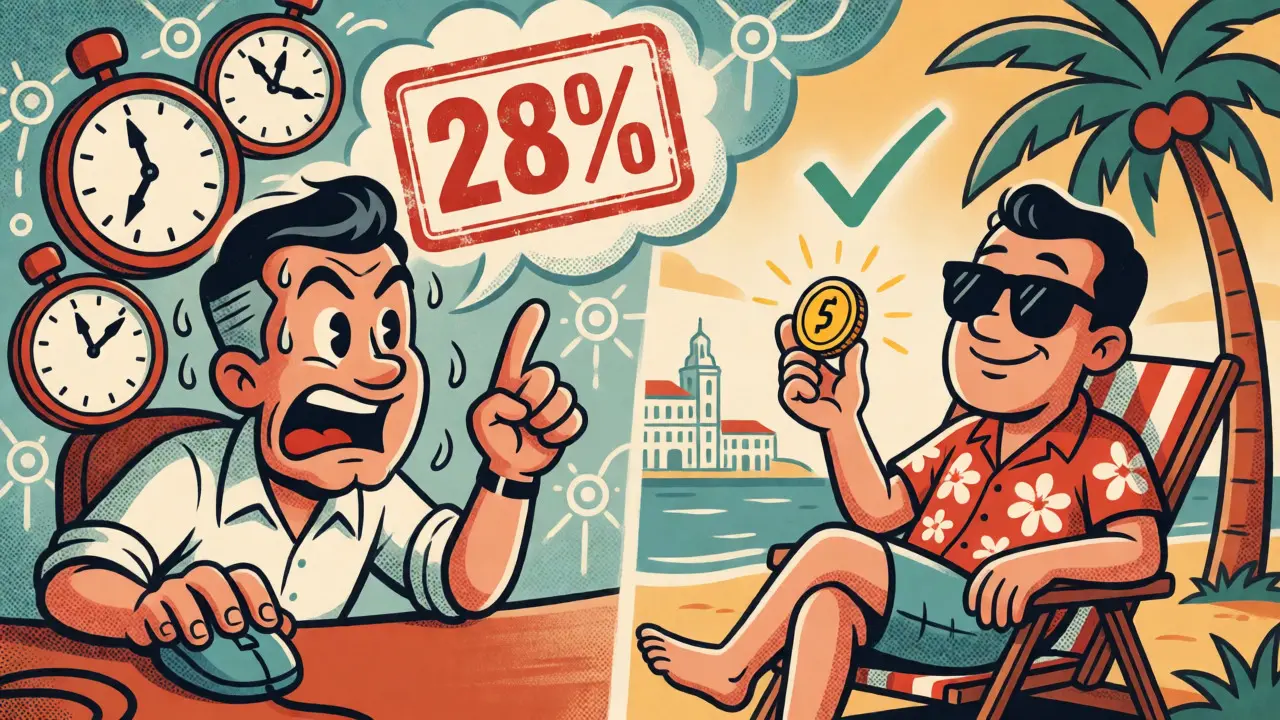
You might have heard that Portugal is still a crypto paradise. That was true for years, but the landscape shifted dramatically when the 28% short-term crypto tax was introduced as part of broader tax reforms affecting digital asset investors. If you are trading frequently or holding assets for less than a year, this flat rate hits your profits directly. But here is the twist that many overlook: if you hold for more than 365 days, you often pay nothing at all. This dual structure creates a clear incentive to stop day-trading and start HODLing. Let’s break down exactly how this works so you don’t get caught off guard by the Portuguese tax authority.
The Core Rule: Holding Periods Matter More Than You Think
The heart of Portugal’s current regime hinges on time. The tax authorities draw a hard line at 365 days. Any cryptocurrency you sell or swap within this window is considered a short-term gain. These gains are subject to a flat 28% tax rate applied specifically to cryptocurrency gains from assets held for less than 365 days. It doesn’t matter if you made €100 or €100,000; the percentage remains fixed. This simplicity is appealing compared to progressive income tax brackets, but it penalizes active traders who flip coins quickly.
On the flip side, assets held for longer than one year fall into a different category entirely. Historically, these long-term holdings were completely tax-free. While regulations are tightening under EU harmonization efforts, the core principle remains attractive for patient investors. If you buy Bitcoin today and sell it next month, you owe 28%. If you sell it in thirteen months, you likely owe zero. This distinction forces you to think strategically about your entry and exit points. Are you willing to wait out the volatility to save nearly a third of your profit? For many, the answer is yes.
Choosing Your Tax Method: Flat Rate vs. Progressive Brackets
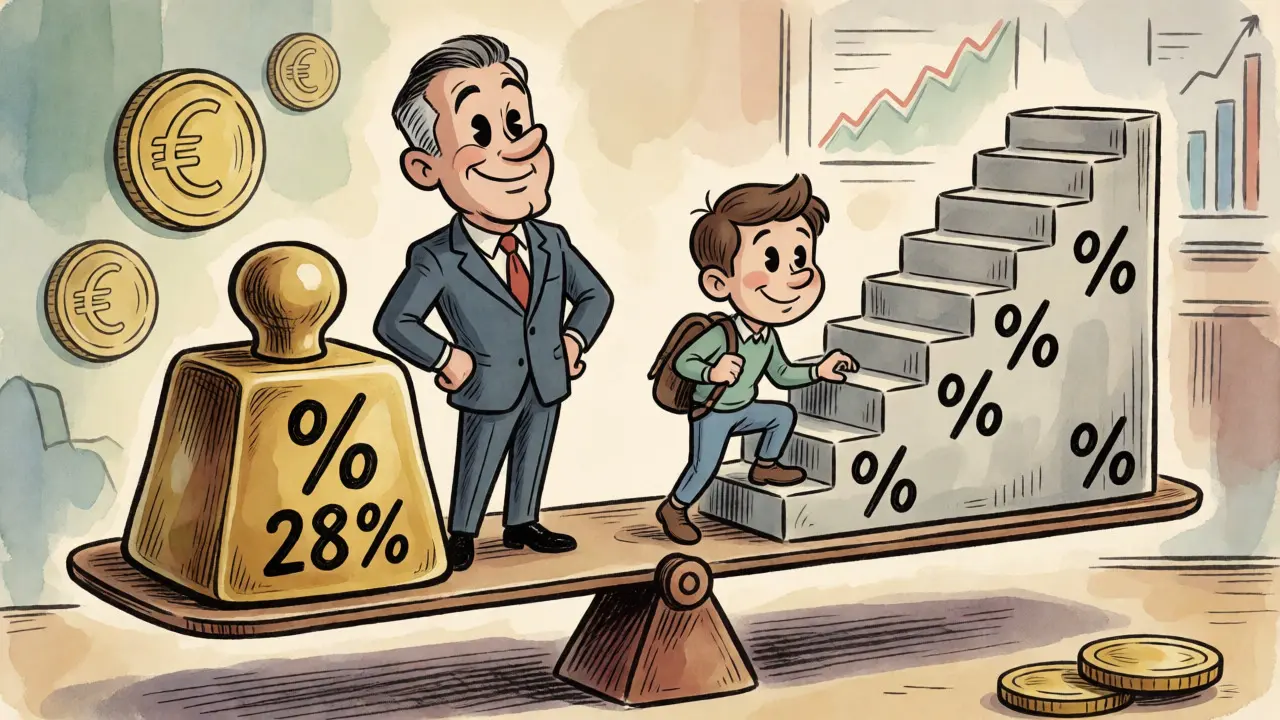
Here is where things get interesting. You aren’t always forced to pay the flat 28%. Portuguese taxpayers have the option to aggregate their cryptocurrency gains with their total annual income. This means your crypto profits could be taxed under Portugal’s progressive income tax system instead. Why would you do this? Because if your total income is low, the progressive rates might actually be lower than 28%.
Let’s look at the numbers. In recent tax years, the lowest bracket starts around 13.25% for income up to roughly €7,700. As your income rises, so does the rate, climbing through tiers like 18%, 23%, and eventually hitting 48% for high earners. If you are a student or someone with modest other income, adding crypto gains to your regular income might result in a much smaller tax bill than the flat 28%. However, if you are a high earner, aggregating could push you into the top brackets, resulting in a higher effective rate than the flat tax. You need to run the numbers both ways before filing.
| Tax Option | Rate Structure | Best For |
|---|---|---|
| Flat Rate | Fixed 28% | High-income individuals seeking simplicity |
| Aggregation | Progressive (13.25% - 48%) | Low-income individuals or those with losses to offset |
Staking, Lending, and Passive Income
Not all crypto activity is trading. If you earn rewards from staking Ethereum or lending Solana, how are those taxed? Generally, passive income from these activities falls under the same 28% flat rate unless you qualify as a professional trader. This includes yields from decentralized finance protocols and liquidity provision rewards. The key factor here is intent and volume. If you stake casually, it’s passive income. If you run a complex validator setup and trade constantly, the tax office might view you differently.
Professional status changes everything. If the authorities deem you a professional trader, your profits aren’t capital gains anymore; they are business income. Business income is taxed under the progressive system, which can range from 14.5% to over 50% depending on your total earnings. Determining this status isn’t always black and white. Factors include your trading frequency, the sophistication of your strategies, and whether crypto is your primary source of livelihood. If you treat trading like a full-time job, expect to be taxed like one.
Filing Requirements and Record-Keeping
You cannot just guess your taxes. Portugal requires detailed reporting through the Portal das Finanças online platform. You will file your main income tax return, known as Modelo 3, along with specific annexes. Anexo G handles capital gains reporting, separating cryptocurrencies held less than 365 days from those held longer is crucial for tracking your sales. If you earned staking rewards, you’ll likely use Anexo E. Professional traders use Anexo B. Missing these details can lead to penalties.
Meticulous record-keeping is non-negotiable. You need to track every transaction: purchase date, sale date, amount, and the price in euros at the exact moment of the transaction. If you used multiple exchanges or wallets, consolidating this data is a nightmare without software. Many expats report struggling with calculating holding periods for dollar-cost averaging strategies. Did you buy BTC weekly? Each week’s purchase has its own 365-day clock ticking. Use specialized crypto tax software to automate this. It saves hours of manual calculation and reduces the risk of human error during an audit.

The End of NHR and New Residency Rules
If you moved to Portugal recently, you might be confused about the Non-Habitual Residence (NHR) program. This famous scheme offered significant tax benefits, including potential exemptions on foreign-sourced income. However, the NHR program closed to new applicants in January 2024. Existing beneficiaries continue to enjoy their perks for up to ten years, but new residents starting after 2024 face standard tax rules. This means no special exemptions for most newcomers. You are subject to the full 28% short-term tax and integrated into the progressive system immediately.
This shift impacts the attractiveness of Portugal for digital nomads and international investors. While it’s no longer the tax haven it once was, it remains competitive compared to other EU nations. Countries like France apply a flat 30% tax regardless of holding period. Germany taxes short-term gains as income at rates up to 45%. Spain taxes savings income between 19% and 28% but lacks Portugal’s complete long-term exemption. Portugal strikes a balance, generating revenue while rewarding patience.
EU Harmonization and Future Outlook
Portugal doesn’t operate in a vacuum. The European Union’s Markets in Crypto-Assets (MiCA) regulation, implemented in 2024, aims to standardize frameworks across member states. While MiCA focuses on operations rather than taxation, it pushes countries toward greater transparency. Portugal’s approach is seen as a middle ground-strict enough to satisfy Brussels, friendly enough to keep the industry alive. Lisbon continues to thrive as a blockchain hub, hosting major conferences despite the tax changes.
Looking ahead, expect further clarifications on what constitutes a "professional" trader. The definition is currently subjective, leading to anxiety among active users. We may also see adjustments to the 28% rate based on market conditions. For now, the strategy is clear: minimize short-term trades, maximize long-term holds, and keep impeccable records. If you are unsure, consult a local tax advisor who specializes in crypto. The cost of advice is far less than the cost of a mistake.
Do I pay tax if I swap one crypto for another?
Yes, generally speaking, swapping one cryptocurrency for another is considered a disposal event. If you swap Bitcoin for Ethereum after holding the Bitcoin for less than 365 days, any gain realized on the Bitcoin is subject to the 28% short-term tax. You must calculate the value of the Bitcoin in euros at the time of the swap to determine the gain.
Is mining income taxed differently?
Mining income is typically treated as business income or self-employment income, not capital gains. This means it is subject to progressive income tax rates and social security contributions, rather than the flat 28% capital gains tax. When you later sell the mined coins, the sale itself may trigger a separate capital gains tax event depending on the holding period from the date you received the coins.
What happens if I lose money on a trade?
Capital losses can usually offset capital gains in the same tax year. If you have short-term losses, they can reduce your taxable short-term gains. Some losses can also carry forward to future years, but the rules on netting against long-term exempt gains are strict. Always verify the current netting rules with a tax professional, as they can change annually.
Does the 28% tax apply to NFTs?
The treatment of NFTs can vary. Generally, if an NFT is classified as a financial instrument or investment asset, similar capital gains rules apply. However, if it is considered a personal collection item or a work of art, different rules might apply. Specific exemptions exist for appropriately classified NFT transfers, but the classification depends heavily on the nature of the NFT and the holder's intent.
Can I choose the flat rate even if I am a high earner?
Yes, you can generally choose the flat 28% rate for short-term gains. However, if your total income including crypto gains exceeds certain thresholds, you might be obligated to aggregate them with ordinary income. This prevents high-income individuals from using the flat rate to avoid progressive taxation on substantial gains. Check your specific situation against the latest tax brackets.