
Running a crypto exchange from Singapore used to be a gray area. You could set up shop, serve clients overseas, and mostly fly under the radar. That ended abruptly on June 30, 2025.
The Monetary Authority of Singapore is a global financial hub that has implemented one of the world's strictest cryptocurrency regulatory frameworks through the Financial Services and Markets Act (FSMA) closed the loophole. If you are looking to launch or expand a digital asset platform here, you need to understand that the rules have shifted from "permissionless innovation" to "strict supervision." This isn't just paperwork; it’s a complete overhaul of how crypto exchanges are platforms facilitating the trading of digital assets that must now comply with stringent local licensing and anti-money laundering standards operate within the city-state.
Why the Sudden Crackdown?
You might wonder why the government tightened the screws so quickly. It wasn't arbitrary. The collapse of major players like Three Arrows Capital and Terraform Labs in 2022 shook confidence in the sector. More importantly, regulators realized they couldn't supervise firms that were physically present but operationally invisible because they only served foreign clients.
The Monetary Authority of MAS is the central bank and financial regulatory authority of Singapore responsible for enforcing the Payment Services Act and the Financial Services and Markets Act made its position clear: no more regulatory arbitrage. As Chengyi Ong from Chainalysis noted, financial integrity is a red line. The goal is to prevent Singapore from becoming a base for illicit activity. If your business model relies on hiding behind offshore clients while operating locally, the door is shut.
The Two Pillars: PSA and FSMA
To navigate this landscape, you need to look at two main laws. They work together, but they cover different bases.
First, there is the Payment Services Act (PSA) 2019 is legislation governing payment service providers in Singapore, establishing license categories based on transaction volume and operational scope. This has been the foundation since 2020. It categorizes licenses by how much money moves through your system. Then, there is the newer Financial Services and Markets Act (FSMA) 2022 is comprehensive legislation effective June 30, 2025, that introduces the Digital Token Service Provider framework to regulate all crypto activities regardless of client location. This is where things get serious for everyone involved in digital tokens.
PSA License Tiers
Under the PSA, your license depends on your monthly transaction value. Here is how it breaks down:
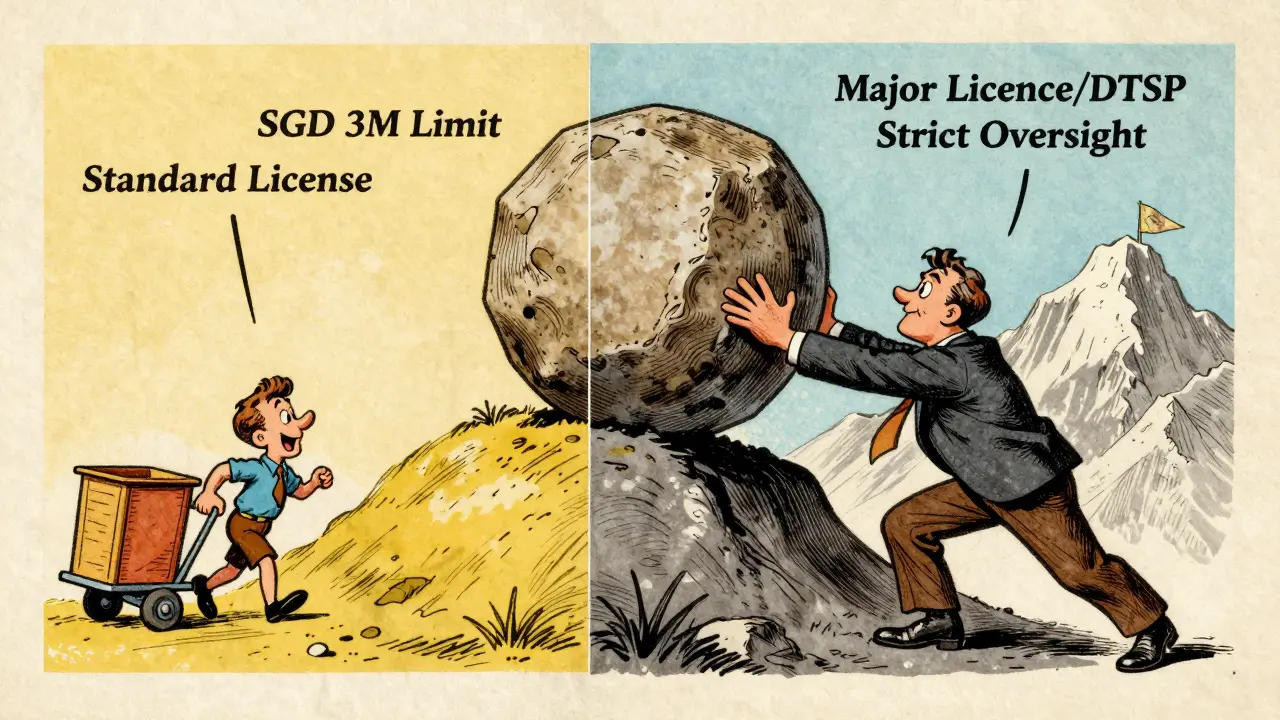
- Standard Payment Institution License: For smaller operators processing up to SGD 3 million monthly. You need SGD 100,000 in minimum capital. This covers basic customer due diligence and regular reporting.
- Major Payment Institution License: For large-scale operations exceeding SGD 3 million monthly. The capital requirement jumps to SGD 250,000. You also face enhanced compliance measures, advanced risk management, and comprehensive auditing.
- Exempt Payment Service Provider: For very specific low-risk activities. This requires notification to MAS rather than a full license, but comes with strict operational restrictions.
The New DTSP Framework
The real game-changer is the Digital Token Service Provider (DTSP) is a new entity classification under FSMA requiring licensing for any firm providing digital token services, eliminating previous exemptions for offshore-only clients regime. Effective June 30, 2025, this applies to almost everyone. Unlike the European Union's MiCA regulation, which gave companies years to adapt, Singapore offered zero transitional period. You either met the high compliance standards immediately or ceased operations.
| Feature | Standard Payment Institution | Major Payment Institution | DTSP (Under FSMA) |
|---|---|---|---|
| Monthly Transaction Limit | Up to SGD 3 million | Above SGD 3 million | No limit (applies to all DTSPs) |
| Minimum Capital | SGD 100,000 | SGD 250,000 | Varies by risk profile (often aligned with PSA tiers) |
| Client Scope Restriction | Can serve domestic/international | Can serve domestic/international | Must license even if serving ONLY offshore clients |
| Compliance Intensity | Basic AML/KYC | Enhanced monitoring, audits | Strict MAS oversight, immediate effect |
What You Need to Apply
Applying for these licenses is not a simple form fill-out. It is an extensive documentation process. MAS wants to see that you can survive market shocks and police your own users effectively. Here is what you need to prepare:
- Comprehensive Business Plan: Detail your mission, business model, projected revenues, expenses, and marketing strategy. Show them exactly how you plan to make money and grow.
- KYC and AML Policies: Your Know Your Customer and Anti-Money Laundering procedures must meet Singapore-compliant standards. This includes detailed steps for customer verification and ongoing transaction monitoring.
- Internal Operating Policies: Document how you handle transactions, secure customer funds, manage risks, and ensure compliance. Every process needs a written protocol.
- Risk Assessment Documentation: Identify potential threats, outline market monitoring procedures, and explain your mitigation strategies. Prove you know where the dangers lie.
- Audit Reports: Provide annual internal and external audit reports regarding financial operations and regulatory compliance.
- Capital Proof: Demonstrate you have the authorized capital ready. This means showing fund availability documentation or confirmed financial support.
How Long Does It Take?
Time is money, especially in crypto. Be realistic about your timeline. Getting a Standard Payment Institution License typically takes 3 to 6 months if you have professional legal and compliance support. If you are aiming for a Major Payment Institution License, expect the process to stretch between 6 and 12 months. The delay usually comes from enhanced due diligence requirements and multiple rounds of document revisions. MAS feedback is professional but highly technical. Many applicants find themselves submitting their documents several times before meeting the regulator's exacting standards.
Singapore vs. The World
Where does Singapore stand compared to other jurisdictions? It sits in a unique middle ground. On one side, you have countries like China with restrictive bans. On the other, you have offshore havens with lax rules. Singapore chooses strict regulation with clarity.
Compared to the United States' fragmented state-by-state approach, Singapore offers a unified national standard under MAS. This makes compliance easier to plan for. However, the entry barrier is higher than some competitors. Switzerland, for instance, often requires several million Swiss francs in capital for similar operations. Singapore's SGD 100,000 to SGD 250,000 range is more accessible for medium-sized operators, provided you can handle the operational rigor. Hong Kong is emerging as a competitor with its own licensing framework, but Singapore's early implementation and comprehensive scope give it a first-mover advantage in the region.

Common Pitfalls to Avoid
Many startups stumble at the same hurdles. Don't let yours be one of them.
- Ignoring Offshore Clients: Thinking you don't need a license because you only serve foreigners is the biggest mistake. The DTSP rule killed that exemption.
- Underestimating Compliance Costs: Legal fees, consultants, and compliance software add up quickly. Factor these into your budget from day one.
- Poor Documentation: Vague policies get rejected. Be specific. Show exactly how you monitor transactions and verify identities.
- Lack of Local Presence: While remote work is common, having a substantive local presence helps demonstrate commitment and facilitates supervision by MAS.
Is It Worth It?
For well-capitalized, compliance-focused operators, the answer is yes. The regulatory clarity provides a stable environment to build trust with institutional partners and retail users alike. Being a licensed entity in Singapore signals quality and safety in a market rife with scams. However, for small teams or those relying on offshore arbitrage, the barriers may be too high. The long-term viability of your project depends on your ability to absorb these costs and adhere to the strict oversight. Singapore is positioning itself as the benchmark for regulated crypto hubs in Asia. If you want to play in the big leagues, you need to follow their rules.
When did the new FSMA crypto regulations take effect in Singapore?
The Financial Services and Markets Act (FSMA) provisions regarding Digital Token Service Providers took effect on June 30, 2025. There was no transitional period, meaning firms had to comply immediately or cease operations.
Do I need a license if I only serve offshore clients?
Yes. Under the new DTSP framework, the exemption for firms serving only offshore clients was removed. Any entity providing digital token services from Singapore must obtain a license, regardless of where their customers are located.
What is the minimum capital required for a crypto exchange license?
For a Standard Payment Institution License, the minimum capital is SGD 100,000. For a Major Payment Institution License, it is SGD 250,000. Specific DTSP requirements may vary based on risk assessment but generally align with these PSA tiers.
How long does the application process take?
Obtaining a Standard Payment Institution License typically takes 3-6 months. A Major Payment Institution License can take 6-12 months due to enhanced due diligence and stricter scrutiny of compliance systems.
What are the key differences between PSA and FSMA licenses?
The Payment Services Act (PSA) focuses on payment transaction volumes and has existed since 2020. The Financial Services and Markets Act (FSMA), effective 2025, introduces the DTSP framework which regulates all digital token activities comprehensively, closing loopholes for offshore-only businesses and imposing stricter immediate compliance standards.
Who regulates crypto exchanges in Singapore?
The Monetary Authority of Singapore (MAS) is the primary regulator. They oversee both the Payment Services Act and the Financial Services and Markets Act, ensuring that all digital asset platforms meet anti-money laundering and consumer protection standards.