
Imagine sending money to a supplier in Mexico or paying a freelancer in Europe. In the old banking world, you’d wait three days for the funds to clear and pay a fee that could eat up 5% of your budget. Now, picture doing that same transfer in under ten seconds with a cost that barely registers on your spreadsheet. That is not science fiction anymore; it is the reality of blockchain payments, which have evolved from experimental tech into mainstream financial infrastructure. By 2026, the gap between traditional banking rails and decentralized networks has widened so much that sticking with legacy systems often feels like choosing to send a fax when an email would do.
The core promise of blockchain in finance is simple: remove the middlemen. Traditional wire transfers rely on a chain of correspondent banks, each taking a cut and adding processing time. Blockchain networks operate on distributed ledgers where transactions are verified by code, not committees. This shift doesn’t just make things faster; it fundamentally changes the economics of moving value across borders. For businesses and individuals alike, understanding these benefits isn't just about keeping up with trends-it's about protecting your bottom line.
The Speed Factor: From Days to Seconds
Time is money, especially in global commerce. When you send a wire transfer through the SWIFT network, the money doesn't move instantly. It hops from bank to bank, clearing houses, and regulatory checkpoints. According to industry data from BVNK in late 2024, these traditional cross-border transfers typically take 3 to 5 business days to settle. During those days, your capital is stuck in limbo, unable to be used for inventory, payroll, or investment.
Contrast this with modern blockchain networks. Networks optimized for payments, such as Ripple (XRP) and Stellar (XLM), process transactions in mere seconds. Even newer high-performance chains like Avalanche achieve finality in under a second. For a logistics company waiting for payment before releasing goods, the difference between 8 seconds and 4 days can mean the difference between a smooth operation and a stalled supply chain.
It’s worth noting that not all blockchains are created equal. Bitcoin, while secure, averages around 10 minutes per block confirmation, making it less ideal for instant retail payments. Ethereum has improved significantly but can still face congestion. The real speed leaders today are Layer 2 solutions like Polygon and dedicated payment protocols like RippleNet. These systems handle thousands of transactions per second (TPS), ensuring that your payment clears even during peak market hours.
Cost Efficiency: Cutting Fees by Up to 80%
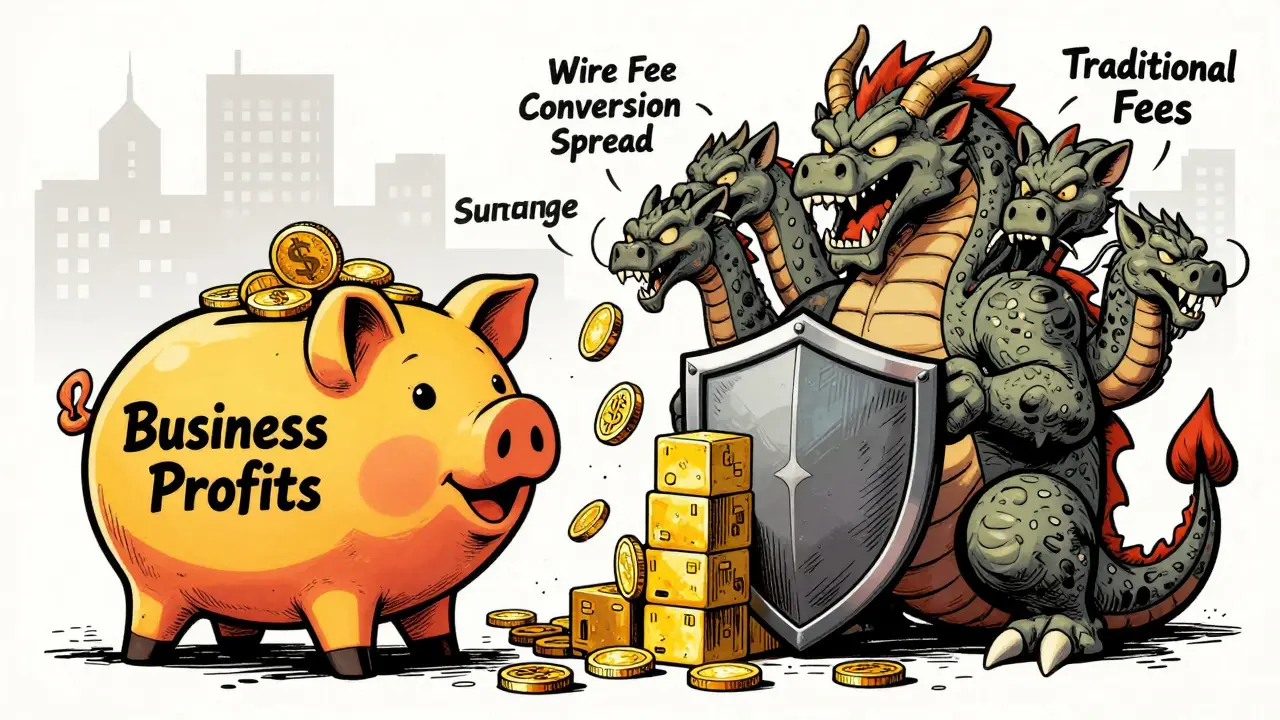
If speed grabs your attention, the cost savings will likely keep you there. Traditional payment processors charge a complex web of fees. You have the base transaction fee (often 2.9% to 3.5%), fixed charges per transaction ($0.30-$0.49), currency conversion spreads (1%-5%), and international transaction surcharges (1.5%-2%). When you add these up, sending $10,000 internationally can easily cost you $500 or more in hidden and explicit fees.
Blockchain payments strip away most of these layers. Because there are no intermediary banks demanding correspondent fees, the costs drop dramatically. CoinLaw reported in early 2025 that blockchain-based cross-border payments cut transaction fees by 70% to 80% compared to traditional channels. On networks like Stellar, the fee per transaction is approximately 0.00001 XLM, which translates to fractions of a cent. Even on busier networks like Polygon, fees often stay below $0.01.
| Fee Type | Traditional Banking/Processors | Blockchain Networks (e.g., Ripple, Stellar) |
|---|---|---|
| Transaction Fee | 2.9% - 3.5% + fixed fee | 0.00001 XLM - $0.01 |
| Currency Conversion | 1% - 5% spread | Negligible (market rate) |
| International Surcharge | 1.5% - 2% | None |
| Total Estimated Cost | 5% - 10%+ | < 0.5% |
Consider an e-commerce retailer processing $500,000 in annual sales. Using traditional gateways, they might pay $35,000 in fees. Switching to a crypto payment gateway could reduce that to $5,000, saving $30,000 annually. That is capital that stays in your business, not in the pockets of intermediaries.
Choosing the Right Network for Your Needs
Not every blockchain is built for payments. Some are designed for smart contracts, others for storage, and some purely for value transfer. Selecting the right network depends on your specific use case: speed, cost, or ecosystem compatibility.
- Ripple (XRP): Ideal for enterprise cross-border settlements. Banks and large institutions use RippleNet because it offers fast settlement times and established compliance frameworks. It processes billions in monthly volume, providing liquidity and stability.
- Stellar (XLM): Best for smaller transactions and remittances. Its near-zero fees make it perfect for micro-payments and sending money to emerging markets where banking infrastructure is limited.
- Polygon: Great for businesses already in the Ethereum ecosystem. It offers low fees and fast confirmations while maintaining security through Ethereum’s mainnet.
- Avalanche: High throughput and sub-second finality make it suitable for high-frequency trading platforms or large-scale commercial applications requiring immediate certainty.
- Bitcoin Lightning Network: While Bitcoin itself is slow, its Layer 2 solution, the Lightning Network, enables instant, cheap micropayments, though adoption is still growing compared to other options.
For most businesses looking to replace traditional wires, Ripple and Stellar offer the smoothest transition due to their focus on fiat-on/off ramps and existing partnerships with financial institutions.
The Role of Stablecoins in Reducing Volatility
One of the biggest hurdles to adopting blockchain payments was price volatility. If you accept Bitcoin today, it might be worth significantly less tomorrow. This risk made merchants hesitant. Enter stablecoins.
Stablecoins like USDC (USD Coin) and USDT (Tether) are pegged to the US dollar. They give you the speed and low cost of blockchain technology without the wild price swings of cryptocurrencies. By Q1 2025, stablecoins were processing over $1.2 trillion in commercial payment volume. McKinsey predicted in early 2025 that tokenized cash solutions would drive a material shift in the payments industry, reducing friction and costs globally.
Using stablecoins allows businesses to hold assets in a digital format that moves instantly but retains the predictable value of fiat currency. This hybrid approach is what’s driving the rapid adoption we see in 2026, particularly among Fortune 500 companies integrating blockchain into their treasury management strategies.
Implementation Challenges and Risks
While the benefits are clear, switching to blockchain payments isn't without challenges. It requires technical integration, staff training, and careful regulatory navigation.
Integration Complexity: Connecting blockchain APIs to existing ERP systems can take 4 to 6 weeks for small businesses and up to 14 weeks for enterprises. You need developers who understand both traditional software architecture and blockchain mechanics. Reconciling blockchain transactions with traditional accounting books remains a common pain point, cited by 63% of companies in Deloitte’s 2025 survey.
Regulatory Uncertainty: Regulations vary wildly by jurisdiction. The IMF warned in March 2025 that without coordinated international frameworks, blockchain systems could create new financial silos. Businesses operating in multiple countries must ensure their chosen provider complies with local AML (Anti-Money Laundering) and KYC (Know Your Customer) laws.
Volatility and Security: Even with stablecoins, there is counterparty risk. You must choose reputable providers. Additionally, unlike credit cards, blockchain transactions are irreversible. There are no chargebacks. This means fraud prevention becomes your responsibility. You need robust internal controls to verify counterparties before sending funds.

Real-World Success Stories
Data tells one story, but user experiences tell another. In April 2025, a business user on Reddit’s r/Fintech community shared their experience switching supplier payments from the US to Mexico using RippleNet. They reported payment times dropping from 4 days to 8 seconds, and fees falling from 5.2% to 0.35%. On $1.2 million in annual transactions, this saved them $187,000.
Trustpilot reviews for major blockchain payment processors like BVNK show high satisfaction rates, with users citing "dramatically lower international transfer costs" as the primary benefit. However, caution is warranted. A European e-commerce platform suffered a $220,000 loss in February 2025 when their custom blockchain solution failed during holiday traffic spikes, causing 72 hours of delays. This highlights the importance of choosing proven, scalable infrastructure over DIY solutions.
Future Outlook: What to Expect in 2026 and Beyond
The trajectory for blockchain payments is upward. Gartner predicted that by 2027, 50% of Fortune 500 companies will use blockchain for at least one major cross-border payment function. We are seeing major players enter the space: Visa integrated Solana-based payments in April 2025, and the European Central Bank launched a cross-border CBDC pilot involving 17 banks earlier that year.
Fees are expected to compress further. Bernstein Research forecasts average blockchain payment fees to hit 0.25% by 2026. As central bank digital currencies (CBDCs) develop, we may see a hybrid system where public blockchains handle the settlement layer while private banks manage the customer interface. For now, however, private blockchain solutions and stablecoin networks offer the most accessible path for businesses seeking immediate cost and speed benefits.
Is it safe to use blockchain for business payments?
Yes, if you use established networks and reputable providers. The underlying cryptography is highly secure. However, you must manage your own keys securely and be aware that transactions are irreversible. Unlike credit cards, there is no chargeback mechanism, so verifying your counterparty is crucial to avoid fraud.
Which blockchain is best for international transfers?
For large enterprise transfers, Ripple (XRP) is currently the leader due to its banking partnerships and speed. For smaller remittances or micro-transactions, Stellar (XLM) is often preferred because of its near-zero fees. Both networks are designed specifically for cross-border value transfer.
How do I handle taxes on blockchain payments?
Tax treatment varies by country. In many jurisdictions, receiving cryptocurrency is considered a taxable event (capital gains). Using stablecoins may simplify this, as they are often treated similarly to foreign currency exchanges. Always consult with a tax professional familiar with digital assets in your region to ensure compliance.
Can I integrate blockchain payments into my existing website?
Yes, through crypto payment gateways like BitPay, Coinbase Commerce, or specialized B2B solutions. These services provide plugins for major e-commerce platforms like Shopify and WooCommerce, allowing customers to pay with crypto while you receive settled funds in fiat or stablecoins.
What are the biggest risks of switching to blockchain payments?
The main risks include regulatory uncertainty, potential integration complexity with legacy accounting systems, and the lack of consumer protection features like chargebacks. Additionally, if you hold volatile cryptocurrencies instead of stablecoins, you face market risk. Choosing regulated providers and using stablecoins mitigates most of these issues.