Imagine trying to trade cryptocurrency without jumping between five different apps, managing three separate wallets, and calculating gas fees for every single swap. It’s a nightmare that most traders accept as normal. Terrace (TRC) is a utility token powering a unified, non-custodial crypto trading terminal designed to aggregate liquidity from centralized and decentralized exchanges into one interface. Instead of treating you like a tech expert who knows how to bridge assets across chains, Terrace aims to make institutional-grade trading accessible to everyone.
The TRC token isn’t just another speculative asset; it’s the fuel for an ecosystem built to solve liquidity fragmentation. Whether you are a retail investor tired of hidden fees or an institution looking for better execution paths, understanding what Terrace does-and why the TRC token matters-is key to seeing if this platform fits your strategy.
The Core Problem: Liquidity Fragmentation
To understand Terrace, you first need to grasp the problem it solves. The crypto market is incredibly fragmented. Your favorite token might be listed on Binance, but the best price for a smaller altcoin might only exist on a decentralized exchange (DEX) like Uniswap or a specialized OTC desk. Traditionally, moving money between these venues requires manual bridging, swapping, and waiting. This process is slow, expensive, and risky.
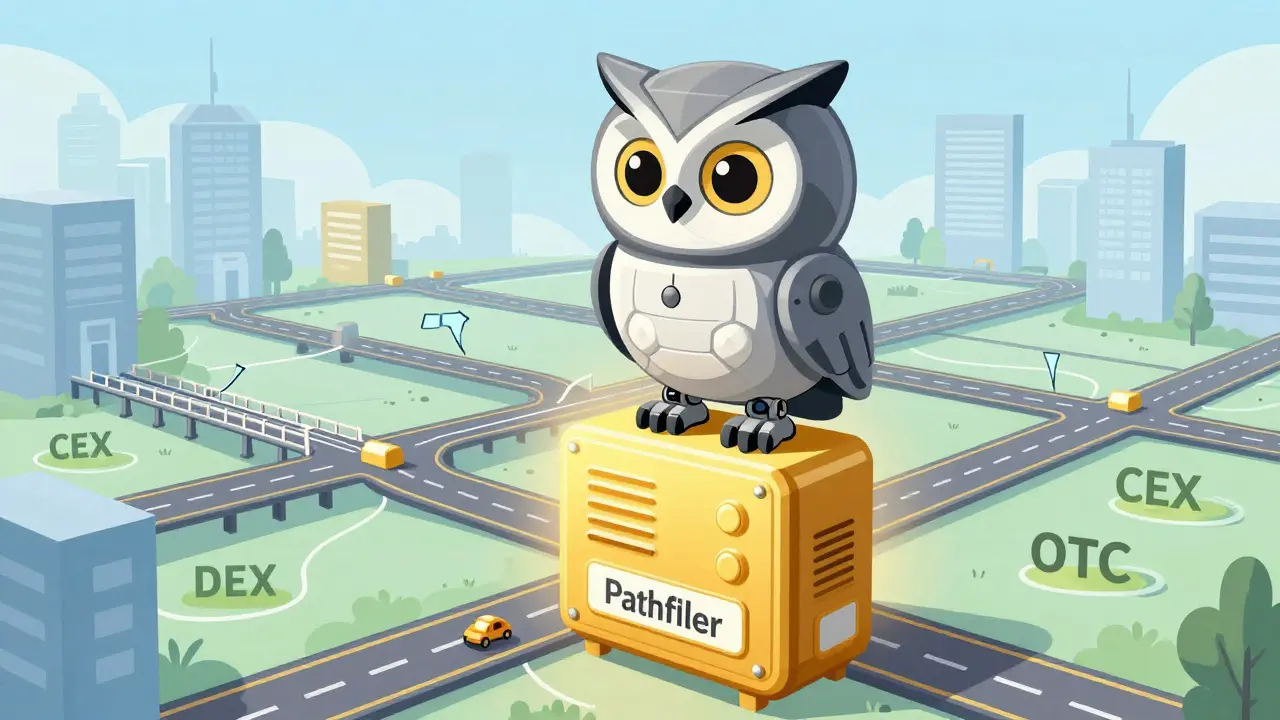
Terrace aggregates liquidity from over 40 centralized exchanges (CEX), decentralized exchanges (DEX), market makers, and OTC platforms. By connecting to more than 13 blockchain networks, it creates a single view of the entire market. You don’t see "Binance liquidity" or "Ethereum liquidity" separately. You see the best available price for your trade, regardless of where it lives.
How the Terrace Platform Works
Terrace operates as a non-custodial trading terminal. This means you never deposit your funds into Terrace’s wallets. You retain full control of your private keys and assets. This is a critical distinction from traditional exchanges like Coinbase or Binance, where you must trust the company to hold your money safely.
Here is how the technology under the hood works:
- Pathfinder Engine: This proprietary algorithm scans billions of potential trading paths in real-time. If you want to buy a specific token, Pathfinder checks every connected venue to find the route that gives you the best price with the lowest slippage.
- Atomic Execution: Complex trades involving multiple chains or swaps happen atomically. If one part of the transaction fails, the whole thing reverts. You don’t end up with half your funds stuck on a bridge.
- Gas-Free Trading: One of the biggest headaches in DeFi is paying gas fees. Terrace covers all blockchain transaction fees automatically, deducting them from the final proceeds. You focus on the trade, not the network costs.
- Layer 2 Order Book Visibility: Traders get transparent visibility into order books across integrated platforms, allowing for smarter decision-making based on actual depth rather than estimated prices.
What is the TRC Token?
The TRC token is the native utility token of the Terrace ecosystem, used for fee discounts, staking benefits, and future governance.
Launched on March 12, 2025, on exchanges like Gate.io, MEXC, and Aerodrome, TRC serves several practical purposes within the platform:
- Fee Discounts: Paying platform fees (trading, portfolio management) with TRC tokens reduces your costs compared to paying in stablecoins or other cryptocurrencies.
- Staking Benefits: Holding and staking TRC unlocks lower base fees and access to premium fee tiers. The more you stake, the cheaper your trading becomes.
- Future Governance: As Terrace evolves toward its own protocol blockchain, TRC will likely play a role in governing the network and clearing settlements.
- Buyback and Burn: The tokenomics model includes potential periodic buybacks and burns, which can reduce supply and potentially support value over time.
Tokenomics and Supply Details
Understanding the numbers behind TRC helps you assess its scarcity and distribution. Here are the key metrics as of mid-2025:
| Metric | Value |
|---|---|
| Total Supply | 1,000,000,000 TRC |
| Initial Circulating Supply | 13% - 20% |
| Circulating Supply (Reported) | ~220 Million TRC |
| Market Cap (Approx.) | $651,527 (varies by price source) |
| Fully Diluted Valuation (FDV) | Dependent on emission schedule |
Note that price data varies significantly between aggregators. For instance, CoinGecko reported TRC at approximately $0.0086, while other sources like Crypto.com showed prices closer to $0.0041 during similar periods. Always check multiple sources before making investment decisions.
Terrace vs. Traditional Exchanges and Aggregators
Where does Terrace fit in the crowded crypto landscape? It positions itself as a hybrid between institutional prime brokers and consumer-friendly DEX aggregators.
- vs. Centralized Exchanges (CEX): Unlike Binance or Coinbase, Terrace is non-custodial. You keep your keys. However, Terrace offers access to CEX liquidity, giving you the safety of self-custody with the depth of centralized markets.
- vs. DEX Aggregators (1inch, Matcha): Tools like 1inch only scan decentralized exchanges. Terrace scans both CEX and DEX liquidity, plus OTC desks. This is crucial for large orders that would slip heavily on a pure DEX.
- vs. Institutional Desks (Coinbase Prime, FalconX): These services require high minimums and complex onboarding. Terrace democratizes this access, offering institutional-grade path optimization to retail users via KYC-verified tiers.
Who Is Terrace For?
Terrace isn’t for everyone, but it targets two distinct groups effectively:
1. Retail Traders Who Hate Complexity
If you are tired of connecting wallets to ten different sites, worrying about gas spikes on Ethereum, or missing out because a token isn’t on your preferred exchange, Terrace simplifies this. The gas-free feature and unified interface save time and money.
2. Institutional Traders Needing Liquidity Depth
Institutions often struggle with fragmented liquidity. Terrace’s ability to execute atomic cross-chain trades and access OTC markets makes it a powerful tool for executing large volumes without moving the market price against themselves.
Risks and Considerations
No crypto project is without risk. Here is what you should watch out for:
- Smart Contract Risk: Even though Terrace is non-custodial, interacting with the platform involves smart contracts. While audits are standard, bugs can still occur.
- Token Volatility: TRC is a low-cap token with high volatility. Its price can swing dramatically based on adoption rates and broader market sentiment.
- Regulatory Uncertainty: Access to CEX and OTC liquidity requires KYC verification for some features. Regulatory changes could impact how these aggregated venues operate.
- Dependency on Partners: Terrace relies on integrations with 40+ exchanges. If a major partner delists or changes API access, functionality could be affected.
Getting Started with Terrace
If you want to try Terrace, here is the general workflow:
- Connect Your Wallet: Since it’s non-custodial, you start by connecting a Web3 wallet like MetaMask or Rabby.
- Choose Your Tier: Decide if you want DeFi-only access (no KYC) or full access to CEX/OTC liquidity (requires KYC verification).
- Acquire TRC (Optional): Buy TRC on supported exchanges like Gate.io or MEXC if you want fee discounts. Stake it in the Terrace dashboard to unlock benefits.
- Execute Trades: Select your asset pair. Pathfinder will automatically show you the best route. Confirm the trade, and let the system handle the cross-chain mechanics and gas fees.
Is Terrace a centralized or decentralized exchange?
Terrace is neither purely a CEX nor a DEX. It is a non-custodial trading terminal that aggregates liquidity from both centralized exchanges, decentralized exchanges, and OTC markets. You maintain custody of your assets, but you access the best prices from various venues through a single interface.
What is the use case for the TRC token?
The TRC token is used to pay for platform fees at a discounted rate, stake for additional fee reductions and tier access, and eventually participate in governance on the planned Terrace protocol blockchain. It acts as the economic engine of the ecosystem.
Does Terrace charge gas fees?
No, Terrace offers gas-free trading. The platform automatically covers all blockchain transaction fees and deducts them from the final transaction proceeds. This eliminates the need for users to hold native tokens like ETH or SOL for gas.
Can I use Terrace without KYC?
Yes, Terrace offers a DeFi-only access mode that does not require Know-Your-Customer (KYC) verification. However, to access centralized exchange liquidity, OTC markets, and market maker pools, you must complete KYC verification.
Where can I buy TRC tokens?
TRC tokens were launched on March 12, 2025, and are available on exchanges such as Gate.io, MEXC, and Aerodrome. Additional listings on major platforms may follow as the ecosystem grows.