You’ve probably seen the buzz around CSM airdrop campaigns lately. If you’re looking for free tokens, Crust Shadow is one of the names popping up on social media and crypto forums. But before you start clicking links or connecting your wallet, you need to know exactly what CSM is, how these airdrops work, and whether they are on CoinMarketCap, Binance, or directly from the protocol, and most importantly, how to stay safe while claiming them.
This guide cuts through the noise. We’ll break down the current state of Crust Shadow (CSM), explain the mechanics behind recent token distributions, and give you a step-by-step checklist to participate without risking your funds. Whether you are a seasoned DeFi user or new to Web3, understanding the value proposition of decentralized storage is key to making smart moves in this space.
What Is Crust Shadow (CSM)?
To understand the airdrop, you first need to understand the asset. Crust Shadow is a decentralized storage protocol operating as an active parachain on the Kusama network. It serves as the canary network for the broader Crust Network ecosystem, which focuses on providing distributed file system capabilities similar to Amazon S3 but built for the Web3 world.
Here’s why that matters to you:
- Parachain Status: Crust Shadow holds leased core ID 6 on Kusama, with operations secured until October 5, 2035. This long-term lease signals stability and commitment from the team.
- Token Utility: The native token, CSM, is used to pay for storage services, stake for network security, and govern the protocol. When miners provide storage space via IPFS integration, they are rewarded in CSM.
- Ecosystem Fit: It bridges the gap between traditional cloud storage costs and decentralized efficiency, targeting edge computing and dApp scenarios where low latency and high performance are critical.
Unlike meme coins that rely solely on hype, CSM has underlying utility in the decentralized infrastructure sector. However, utility doesn’t guarantee price action, which brings us to the market context.
Current Market Context for CSM (June 2026)
Before chasing an airdrop, it helps to know what the token is worth. As of early June 2026, CSM is trading in a volatile range. Recent data shows the token hovering around $0.0032, with significant swings depending on broader crypto market sentiment.
| Metric | Value | Context |
|---|---|---|
| Current Price | ~$0.0032 | Subject to rapid fluctuation |
| 7-Day Change | +38.90% | Outperforming global crypto average |
| 24-Hour Volume | $11,311 | Indicates moderate liquidity |
| Fear & Greed Index | 55 (Greed) | Suggests cautious optimism |
| RSI (14-day) | 58.92 | Neutral momentum |
While a 38% weekly increase looks impressive, remember that CSM has also seen declines of over 50% in previous 90-day periods. Volatility is part of the game. An airdrop gives you exposure to this volatility without upfront capital, but you must be prepared for the price to move either way after you claim your tokens.
Understanding the Major CSM Airdrop Campaigns
Airdrops come in different flavors. For Crust Shadow, there have been two primary types of distributions that users should distinguish between: platform-hosted giveaways and protocol-native incentives.
1. Platform-Hosted Giveaways (e.g., CoinMarketCap)
One of the most visible campaigns involved a massive pool of 9,000,000 CSM tokens hosted on CoinMarketCap. Here’s how these typically work:
- The Pool: A large number of tokens is set aside for distribution.
- Winners: Often limited to a specific number of participants (e.g., 1,000 winners).
- Reward Size: Individual caps apply, such as 9,000 CSM per winner.
- Requirements: Usually involve following social media accounts, joining Telegram/Discord communities, or completing simple tasks like retweeting or signing up for a newsletter.
Note: These campaigns are often time-sensitive. If you missed the initial window, you cannot retroactively claim. Always check the official announcement channels for deadlines.
2. Protocol-Native Incentives (Storage & Staking)
Beyond marketing giveaways, Crust Shadow incentivizes actual usage. This is where the real long-term value lies. Users who rent storage space or nodes that provide storage earn CSM rewards. While not a "free money" click-and-claim airdrop, this mechanism effectively distributes tokens to those who contribute to the network’s health. New users often receive bonus multipliers during launch phases, which function similarly to airdrops for active participants.
Step-by-Step: How to Participate Safely
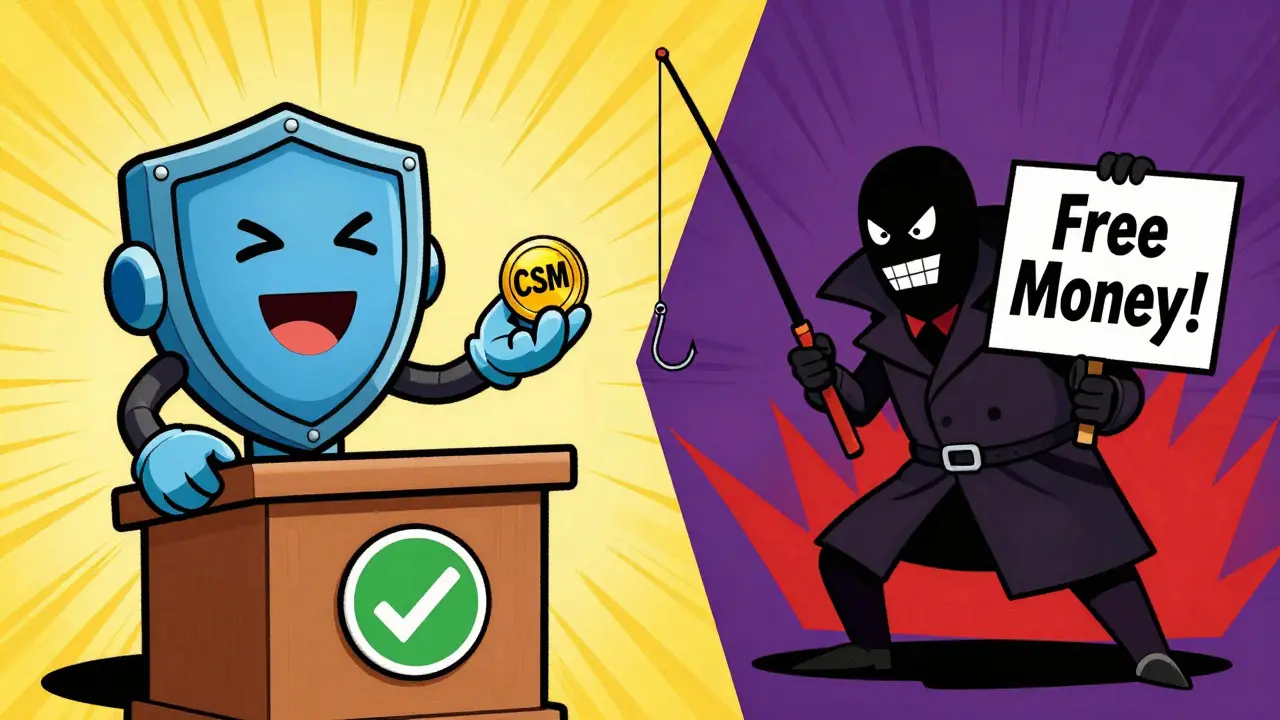
If there is an active campaign running right now, follow this strict protocol to ensure you don’t get scammed. The crypto space is full of phishing sites designed to look like legitimate airdrop pages.
- Verify the Source: Never trust a link from a random Twitter DM or email. Go directly to the official Crust Network website or their verified social media handles (Twitter/X, Discord, Telegram). Look for the blue checkmark or community verification badges.
- Check the Contract Address: For any Ethereum-based interactions, verify the token contract. The CSM ERC-20 contract address is
0x2620638eda99f9e7e902ea24a285456ee9438861. If a site asks you to interact with a different address, stop immediately. - Use a Burner Wallet: For platform-hosted airdrops that require wallet connections, use a secondary wallet with minimal funds. Do not connect your main holding wallet to unknown dApps or claim sites.
- Complete Tasks Carefully: If the airdrop requires social engagement, do it manually. Avoid using bots, as many projects blacklist automated accounts.
- Wait for Official Confirmation: Legitimate airdrops will announce the distribution method publicly. If you are asked to send ETH or KSM to "unlock" your airdrop, it is a scam. Real airdrops are free.
Security Risks and Red Flags
Scammers love airdrop season. They create fake landing pages that mimic CoinMarketCap or Binance interfaces. Here is what to watch out for:
- Spelling Errors: Check URLs carefully.
crust-shadow-airdrop.commight be fake, whileairdrop.crust.networkis likely legitimate. - Urgency Tactics: Phrases like "Claim in next 10 minutes or lose forever" are classic pressure tactics. Legitimate projects give reasonable windows.
- Private Key Requests: No legitimate service will ever ask for your private key or seed phrase. If a pop-up asks for this, close the tab immediately.
What To Do After You Claim CSM
Once the tokens land in your wallet, you have three main options:
- Hold (HODL): If you believe in the long-term vision of decentralized storage on Kusama, you can hold the tokens. With the parachain slot secured until 2035, the project has a long runway for development.
- Trade: CSM is listed on major exchanges like Binance. You can sell immediately to lock in profits, especially if the market cap is low and volume spikes during the airdrop event.
- Stake: Use the CSM tokens to stake within the Crust Network. This supports the network’s security and may yield additional rewards over time, compounding your initial airdrop gain.
Remember, past performance does not guarantee future results. The prediction models suggesting prices could reach $0.006-$0.007 by late 2025 are just estimates based on historical volatility and market trends. Always do your own research (DYOR) before making financial decisions.
Why Decentralized Storage Matters Now
It’s easy to see airdrops as just free money, but understanding the tech helps you spot good opportunities. Centralized cloud providers like AWS and Google Cloud dominate the market, but they come with high costs and single points of failure. Crust Shadow aims to solve this by leveraging the idle storage capacity of thousands of nodes worldwide.
By using IPFS (InterPlanetary File System) and sWorker sealing mechanisms, Crust ensures data redundancy and availability. For developers building dApps, this means cheaper storage solutions that are censorship-resistant. As more apps move to Web3, the demand for such infrastructure grows, potentially increasing the value of the CSM token used to facilitate these transactions.
Is the Crust Shadow CSM airdrop still active?
Airdrop campaigns are time-sensitive. The major CoinMarketCap campaign mentioned earlier had specific deadlines. To check if a current campaign is live, visit the official Crust Network Twitter account or their Discord server. Never rely on third-party blogs for real-time status updates.
How much is 1 CSM token worth in 2026?
As of June 2026, CSM trades approximately between $0.0029 and $0.0037. Prices fluctuate daily based on market sentiment and trading volume. Always check a live tracker like CoinMarketCap or Binance for the exact second-by-second price.
Can I claim CSM airdrop on Binance?
Binance occasionally hosts airdrops for listed tokens. If CSM is eligible, it would appear in the Binance Launchpad or Airdrop section. However, most recent CSM distributions have been community-driven or hosted on platforms like CoinMarketCap. Keep your eye on the Binance announcements page for any new listings or rewards.
Is Crust Shadow a scam?
No, Crust Shadow is a legitimate decentralized storage protocol operating on the Kusama network. It has a verifiable track record, including winning auction 19 and securing a parachain slot until 2035. However, beware of fake websites and phishing scams pretending to be Crust Shadow to steal your funds.
What is the difference between Crust Network and Crust Shadow?
Crust Network operates on Polkadot, while Crust Shadow is its counterpart on Kusama. Kusama is known as the "canary network" for Polkadot, meaning new technologies are tested on Kusama (Shadow) before being deployed on Polkadot (Network). CSM is the token for the Kusama side, while CRU is the token for the Polkadot side.